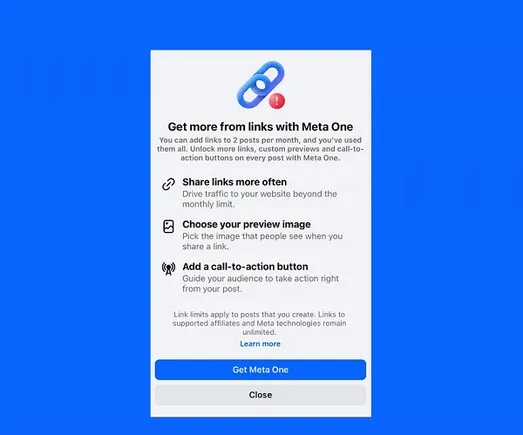
Facebook has significantly expanded its test program, which limits the number of link posts non-paying professional accounts can publish each month, following the recent launch of its Meta One for Business paid subscription packages. This development has prompted concerns among business managers who report encountering pop-up alerts indicating their accounts are now restricted to just two link posts per month unless they subscribe to one of Meta’s new premium tiers. This move marks a notable escalation in Meta’s strategy to monetize features previously available organically to businesses, aligning with a broader industry trend of social media platforms seeking direct revenue streams from their professional users.
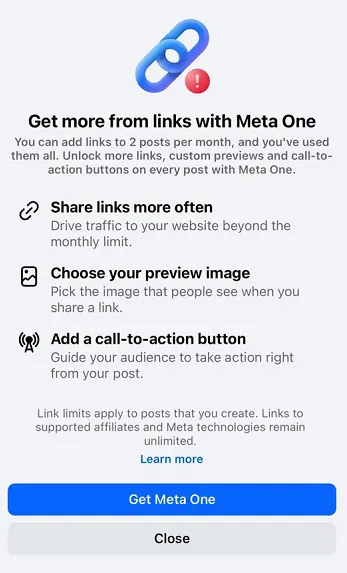
The recent expansion comes hot on the heels of the introduction of Meta One for Business, a suite of subscription packages designed to offer enhanced tools and support to businesses operating across Meta’s platforms. While Meta One for Business initially highlighted benefits such as the ability to include a limited number of links in Instagram posts and Reels—with the exact allowance varying by paid tier—Facebook post links were not explicitly listed as a primary benefit at the outset. However, the emerging restrictions suggest that this feature is now being integrated into the paid offering strategy. Managers across various sectors have reported receiving an alert stating, "You’ve reached your monthly limit of 2 link posts. Subscribe to Meta One for Business to unlock unlimited link posts." This explicit prompt underscores Meta’s intention to transition link posting from an organic capability to a premium feature.
The Genesis of Meta One for Business and Its Strategic Context
Meta One for Business represents Meta’s latest and most comprehensive effort to create a tiered subscription model for its vast ecosystem of professional users. Launched with the promise of delivering "enhanced value" to businesses, the packages are structured to offer a range of benefits, from advanced analytics and customer support to potentially higher visibility or specific content capabilities. The introduction of such a subscription service is not an isolated event but rather a reflection of a maturing digital advertising market and a strategic pivot by major social media platforms. As advertising revenues face increasing scrutiny and competition, platforms are exploring alternative monetization channels, with direct subscriptions for business tools becoming an increasingly attractive option.
The Meta One for Business packages are designed to cater to a spectrum of business needs, from small entrepreneurs to larger enterprises. While specific features and pricing tiers have been rolled out progressively, the overarching goal is to provide businesses with a more predictable and potentially more effective way to engage with their audiences, albeit at a cost. The inclusion of link posting capabilities, which are fundamental to driving external traffic for many businesses, within these paid tiers positions Meta One for Business as a critical, rather than merely supplementary, tool for certain types of online commerce and content distribution. This development forces businesses to re-evaluate their operational costs and digital marketing strategies on the platform.
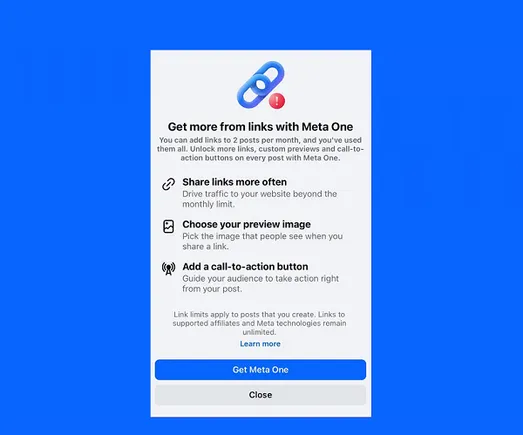
A Phased Rollout: The Timeline of Link Restrictions
The concept of restricting link posts on Facebook Pages is not entirely new. Meta initiated a limited test of this nature in December 2025 (as reported), targeting specific pages and limiting them to two links per month. At the time, Meta clarified that this initial test was an exploratory measure, aimed at understanding "whether the ability to publish an increased volume of posts with links adds additional value" for paying users. This early phase allowed Meta to gather data and gauge the potential impact and user acceptance of such a policy shift. Publisher Pages, often critical for news dissemination and information flow within the app, were explicitly exempt from this initial test, a policy that appears to remain in place for the expanded rollout, ensuring a continued supply of journalistic content.
The current expansion, however, signifies a more definitive move. By directly linking the lifting of these restrictions to the Meta One for Business subscription, Meta is moving beyond a mere "test" and towards a formalized policy for a broader segment of its business users. The timing, immediately following the Meta One launch, suggests a deliberate strategy to integrate this new monetization model with a feature that many businesses consider essential for their online operations. This phased approach allows Meta to gradually introduce significant changes, giving businesses time to adapt while simultaneously developing a compelling subscription offering.
Meta’s Strategic Imperative: Monetization and Value Proposition
Meta’s decision to restrict link posts for non-paying business pages is deeply rooted in its long-term monetization strategy, famously outlined by CEO Mark Zuckerberg in 2016. Zuckerberg articulated a three-stage approach for app development and monetization: first, build a product that users love; second, help businesses succeed on that product; and third, monetize that success. The current actions clearly fall within the third stage of this strategy, where the immense value created by businesses operating on Meta’s platforms is now being directly tapped into for revenue generation beyond traditional advertising.
Historically, Facebook provided extensive organic reach for businesses, fostering an environment where companies could build large audiences and drive traffic without significant direct costs beyond content creation. However, as the platform matured and became saturated with content, organic reach for businesses steadily declined, pushing companies towards paid advertising to maintain visibility. This latest move can be seen as a further evolution of this strategy, offering a different pathway to access essential features – a subscription model – in parallel with its dominant advertising business. Meta argues that by offering paid tiers, it can provide more dedicated resources, better tools, and perhaps a more stable environment for businesses, thus justifying the shift from free to paid access for certain functionalities. The company’s rationale, as previously stated, centers on determining if "an increased volume of posts with links adds additional value," implying that the paid service will unlock this perceived value.

The Diminishing Returns of Organic Link Posts
Paradoxically, while the restriction on link posts might feel punitive to businesses, Meta’s own data suggests that organic link posts have been steadily losing visibility on the platform for years. According to Meta’s "Widely Viewed Content report from Q1 2026" (as reported), a staggering 98.7% of post views in the U.S. during that period did not include a link to a source outside of Facebook. This figure highlights a dramatic shift in content consumption patterns and Meta’s algorithmic priorities.
Tracing this decline, the report indicates that in 2022, 9.8% of viewed content included an external link when Meta first began sharing these insights. This percentage dropped significantly to a new low of 1.3% by the time of the Q1 2026 report. This persistent decline suggests that Meta’s algorithms have been increasingly deprioritizing content that directs users away from its ecosystem, favoring native content formats like videos, images, and text-only posts that encourage on-platform engagement. This algorithmic shift serves Meta’s interest in maximizing user time within its apps, which in turn enhances its ability to serve ads and collect data.
For businesses, this data presents a critical insight: even without explicit restrictions, the organic reach for link posts was already minimal. This means that for many, the impact on overall performance might not be as catastrophic as the initial shock of the restriction might suggest. Businesses relying heavily on organic link clicks were likely already struggling to generate meaningful traffic from Facebook. The new policy, therefore, formalizes a reality that has been unfolding algorithmically for some time, pushing businesses towards either paying for Meta One or investing more heavily in Facebook Ads to drive external traffic, or fundamentally rethinking their content strategy to align with Meta’s preferred native formats.
Implications for Businesses and Marketers
The expansion of link post restrictions carries significant implications for businesses and digital marketers, forcing a strategic re-evaluation of their presence on Facebook.
- Content Strategy Shift: Businesses will need to pivot towards creating more native content that thrives within Facebook’s ecosystem. This means prioritizing engaging videos, high-quality images, polls, quizzes, and text-based discussions. Instead of directly linking out, strategies might include driving engagement to Messenger conversations, encouraging users to visit a profile link (if not restricted), or teasing content that compels users to search for the brand’s external site independently.
- Budgetary Considerations: Small and medium-sized businesses (SMBs), often operating on tight marketing budgets, will face a difficult choice. They must decide whether to absorb the cost of a Meta One for Business subscription to maintain their link posting capabilities or to reallocate their marketing spend towards Facebook Ads, other platforms, or different organic strategies. This could potentially increase the barrier to entry for smaller businesses looking to leverage Facebook for traffic generation.
- The "Bait-and-Switch" Perception: While Meta’s actions align with its long-term monetization strategy, the perception among some business users is one of a "bait-and-switch" tactic. Platforms often offer free access and tools to attract a large user base, only to later introduce charges or reduce organic reach once businesses become reliant on the platform. This dynamic can erode trust and foster resentment, even if the business decision is strategically sound for Meta.
- Diversified Digital Strategy: This development underscores the critical importance for businesses to diversify their digital marketing strategies. Over-reliance on any single platform for organic reach is inherently risky, as algorithms and policies can change without warning. Businesses will increasingly need to cultivate audiences across multiple channels – including their own websites, email lists, and other social media platforms – to mitigate the impact of such platform-specific restrictions.
- Publisher Exemptions: The continued exemption for publisher Pages highlights Meta’s strategic interest in maintaining a flow of news and information within its app, likely to keep users engaged and informed, thereby supporting its broader advertising model. This creates a dichotomy where news organizations retain a critical capability that other businesses are losing.
Industry Reactions and Future Outlook
While specific official statements from affected businesses or industry bodies are not provided, the "some managers" mentioned in the original report suggest a mixture of frustration and pragmatic adaptation. Digital marketing agencies will likely advise clients to analyze their current traffic sources from Facebook, evaluate the cost-effectiveness of a Meta One subscription versus increased ad spend, and explore new creative ways to engage audiences without relying on direct links. The emphasis will shift from "link in bio" or "click here" to more indirect calls to action or a greater investment in content designed for native consumption.
Looking ahead, this move signals a more aggressive stance by Meta in monetizing its professional services. It aligns with a broader industry trend where platforms like X (formerly Twitter) and Snapchat have also introduced subscription tiers for enhanced features and visibility. This evolution is likely to continue, with more features that were once free becoming part of premium packages. The long-term success of this strategy for Meta will depend on whether businesses perceive sufficient value in the paid subscriptions to justify the cost, and whether the platform can maintain its dominance amidst growing competition and evolving user behaviors. The era of robust organic reach for businesses on Facebook, particularly for external links, appears to be definitively drawing to a close, ushering in a new phase of platform-business engagement defined by explicit costs and strategic adaptation.