The divide between sales and marketing departments within small and mid-sized businesses (SMBs) has reached a critical juncture, characterized by a significant disconnect between executive perception and frontline reality. According to a comprehensive new study released by Unbounce, which surveyed over 500 go-to-market (GTM) professionals, while 87% of organizations expect improved alignment to drive substantial performance gains, only 56% of teams currently describe themselves as "highly aligned." This gap suggests that despite a decade of technological advancement, the fundamental operational synergy required for efficient revenue growth remains elusive for nearly half of the market.
The research highlights that sales and marketing misalignment is rarely a single, catastrophic failure of strategy. Instead, it manifests as a series of compounding inefficiencies: "qualified" leads that sales representatives instinctively distrust, marketing campaigns launched without sales input, and pipeline data that masks a slowing rate of closed revenue. As businesses navigate a 2026 economic landscape defined by a shift from "growth at all costs" to "efficient revenue generation," these internal frictions are emerging as the primary barrier to scalability.
The Perception Paradox: Executive Optimism vs. Frontline Friction
One of the most striking findings of the 2026 report is the "perception gap" existing across organizational hierarchies. The data indicates that 69% of executives report strong alignment between their sales and marketing functions. However, this optimism is not shared by those executing the work; only 47% of non-executive professionals agree that their teams are truly aligned.
Industry analysts suggest this discrepancy is the result of a structural information lag. Executives often view alignment through the lens of high-level strategy decks and the existence of recurring cross-departmental meetings. In contrast, frontline employees experience misalignment through daily operational hurdles, such as data inconsistencies and broken lead-handoff processes. This "view from the top" often overlooks the granular friction that erodes productivity.

The functional divide also persists between departments. While 62% of sales professionals feel highly aligned with their marketing counterparts, only 53% of marketers share that sentiment. This suggests that marketing teams often feel the burden of proof more acutely, struggling to demonstrate the value of their leads in a system where sales may not provide consistent feedback.
The Chronology of Misalignment: From Strategy to Stalled Revenue
To understand how these gaps form, it is necessary to examine the typical chronology of a misaligned go-to-market motion. The process often begins with a lack of shared definitions at the top of the funnel.
- Phase One: The Definition Gap. Marketing and sales fail to agree on what constitutes a "qualified" lead. Marketing focuses on volume and engagement metrics, while sales prioritizes firmographic fit and immediate intent.
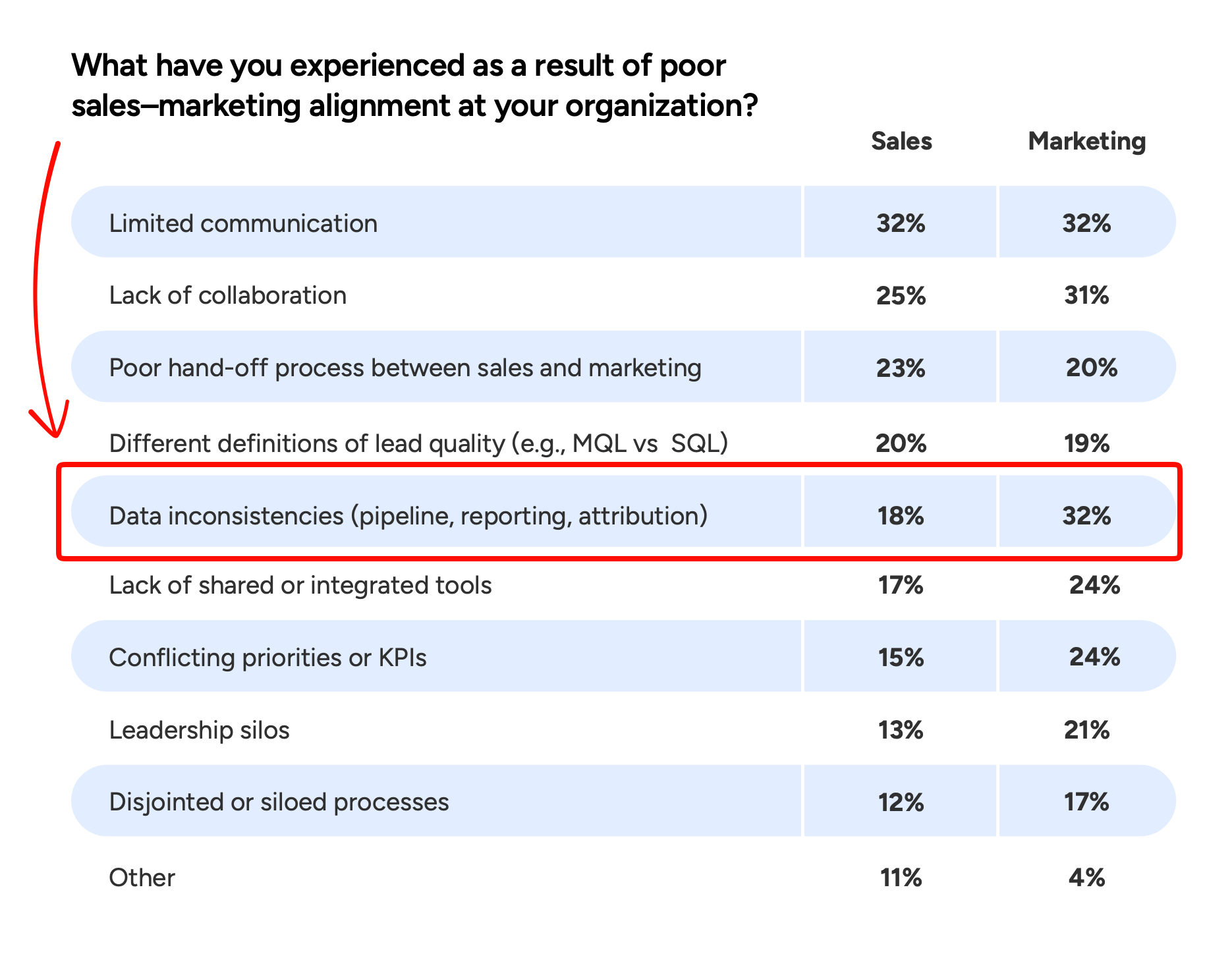
- Phase Two: The Handoff Friction. Leads are passed from marketing automation platforms to the CRM without a clear Service Level Agreement (SLA). This leads to delayed follow-ups, with 32% of marketers reporting that sales reps do not engage with leads in a timely manner.
- Phase Three: The Data Divergence. As the sales cycle progresses, marketing loses visibility into the lead’s journey. Data inconsistencies—cited as a barrier by 32% of marketing teams—prevent accurate attribution, making it impossible to refine future campaigns based on closed-won data.
- Phase Four: The Revenue Plateau. Finally, the lack of coordination results in a disjointed customer experience. Messaging inconsistencies across the buyer’s journey lead to lower conversion rates and a bloated cost per acquisition (CAC).
The Hidden Costs of Operational Friction
The financial implications of misalignment are severe. While employee frustration is the most commonly cited consequence (29%), the direct impact on the bottom line is undeniable. The report identifies three primary cost centers associated with poor GTM alignment:
- Missed Opportunities (28%): Leads that are never contacted or are followed up with too late often churn to competitors.
- Wasted Marketing Budget (23%): When sales does not trust or use the leads generated by marketing, the capital spent on demand generation is effectively nullified.
- Stalled Deal Cycles (20%): Inconsistent messaging between marketing materials and sales discovery calls creates confusion for the prospect, extending the time required to close a deal.
Furthermore, the "MQL vs. SQL" debate continues to be a major point of contention. Approximately 20% of sales and 19% of marketing professionals cite differing definitions of lead quality as a primary blocker. This suggests that many organizations are still operating in silos, where success for one department does not necessarily translate to success for the company.
The Technology Trap: Tool Bloat and the Myth of the "Silver Bullet"
In an attempt to solve alignment issues, many SMBs have turned to technology, often with counterproductive results. The 2026 report reveals a widespread issue of "tool bloat," where organizations purchase software to fix process problems.

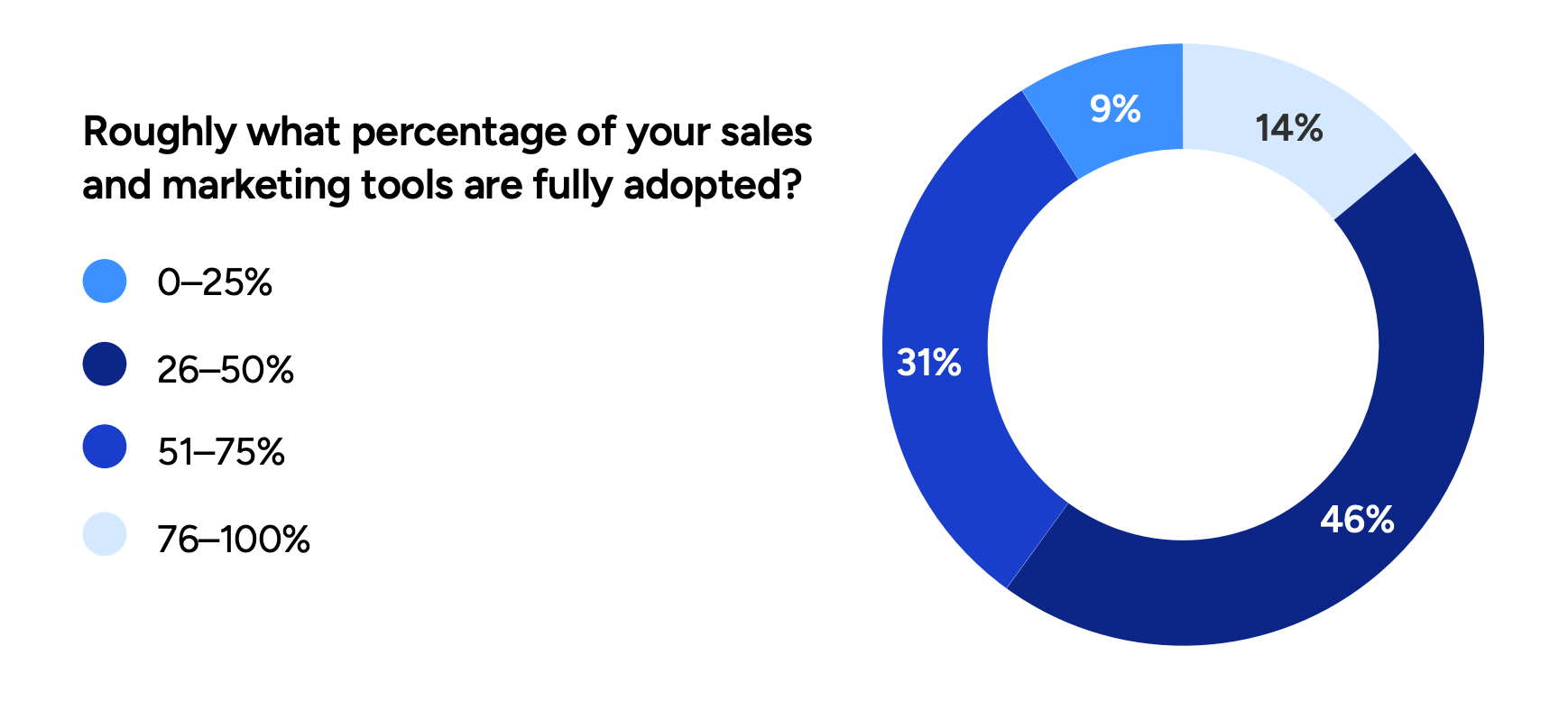
The data shows that 56% of GTM professionals believe tool bloat is a significant issue within their organization. Perhaps more concerning is the lack of adoption: 60% of respondents admit to using less than half of the tools available in their tech stack. Specifically, 14% of teams utilize only 0-25% of their software, while 46% utilize between 26% and 50%.
The report findings suggest that "leaner is better." Teams that have significantly consolidated their tech stacks are twice as likely to rate their lead quality as "excellent" (55% vs. 20%). High-performing, aligned teams are 30% more likely to describe their tech stack as "lean and focused." This indicates that the most successful organizations prioritize deep integration and high adoption over a broad collection of disconnected platforms.
Identifying the Characteristics of High-Performing Teams
The 56% of teams that identify as "highly aligned" share several distinct operational characteristics that set them apart from their peers. These organizations have moved beyond simply increasing the frequency of meetings—which 54% of teams mistakenly believe is the primary lever for alignment—and have instead focused on the underlying operating model.
1. Unified Data Systems
Aligned teams are 3.5 times more likely to have strong cross-functional data sharing (59% vs. 16%). In these organizations, marketing data feeds both functions from a single source of truth. When both teams look at the same dashboard, the "blame game" regarding lead quality and attribution is largely eliminated.
2. Integrated Workflows and Shared KPIs
High performers move past siloed metrics. Instead of marketing being measured solely on lead volume and sales on closed deals, they adopt shared Key Performance Indicators (KPIs) such as Customer Acquisition Cost (CAC) and lead-to-revenue conversion rates. This creates a shared incentive structure where both teams win or lose together.
3. Messaging Consistency
Messaging drift is a significant risk in the B2B sales cycle. Aligned teams report significantly fewer messaging inconsistencies (17% vs. 28%). They achieve this by involving sales in the content creation process and ensuring that marketing has access to sales call recordings to understand the real-world objections and language of the customer.
Strategic Recommendations for SMB GTM Leaders
Based on the 2026 dataset, several actionable steps emerge for leaders looking to bridge the alignment gap.
Establish a Formal Lead-Handoff SLA: This agreement must define exactly what data points a lead must have before being passed to sales, the timeframe for the initial follow-up, and the process for sales to provide feedback on lead quality.
Conduct Shared Persona Exercises: Buyer personas should not be a static document created by marketing in isolation. They should be a joint artifact that incorporates the frontline insights of the sales team and the behavioral data captured by marketing.
Prioritize Data Integration Over New Tool Acquisition: Before buying a new platform, organizations should focus on integrating their existing CRM and marketing automation tools. The report suggests that the most effective alignment tools are the CRM (70%), marketing automation platforms (58%), and shared analytics dashboards (52%).
Invest in Landing Page Optimization: Interestingly, 24% of GTM teams are prioritizing landing page optimization as a key tech investment for the coming year. This suggests a renewed focus on the "handoff surface"—the digital environment where a prospect first converts and sets the tone for the entire sales relationship.
Implications for the Future of Go-To-Market Strategy
As we look toward the remainder of 2026 and into 2027, the role of Artificial Intelligence (AI) is expected to play a larger part in GTM alignment. Currently, 44% of teams are prioritizing data integration and AI-driven insights to make alignment more measurable. AI has the potential to automate the lead scoring process and provide real-time feedback loops that humans often overlook.
However, technology remains secondary to culture and process. The "2026 Anatomy of Aligned Go-to-Market Teams" report serves as a reminder that alignment is not a destination but a continuous operational discipline. Organizations that fail to address the perception gap between leadership and the frontline, or that continue to mask process failures with software, will likely find themselves struggling to compete in an increasingly efficient marketplace.
The path forward for SMBs requires a fundamental shift in how they view the relationship between sales and marketing. By treating these two functions as a single, unified revenue engine—powered by shared data, common definitions, and a lean tech stack—businesses can finally unlock the performance gains that 87% of them know are possible.