The landscape of enterprise e-commerce has undergone a seismic shift over the last decade, transitioning from simple digital storefronts to complex, multi-layered architectures designed for global scale. At the heart of this evolution is Magento, the open-source platform that, following its $1.68 billion acquisition by Adobe in 2018, was rebranded as Adobe Commerce. While the platform provides unparalleled flexibility and power for enterprise brands, it introduces a unique set of technical hurdles for conversion rate optimization (CRO) professionals. Standard A/B testing methodologies, which often assume a linear relationship between a server request and a browser render, frequently fail when applied to Magento’s sophisticated infrastructure. This failure manifests as inconsistent user experiences, corrupted data sets, and the "flicker" effect, where original content flashes before a variant appears, ultimately undermining the integrity of the experimentation program.
The Evolution and Infrastructure of Magento Enterprise
To understand why A/B testing on Magento requires a specialized approach, one must first look at the platform’s architectural history. Originally developed by Varien Inc., Magento became the gold standard for mid-to-large-scale e-commerce due to its modularity. The transition to Adobe Commerce integrated the platform into the Adobe Experience Cloud, adding enterprise-grade features such as cloud hosting and AI-driven insights through Adobe Sensei. However, the core codebase remains a PHP-based monolith that relies heavily on a complex caching ecosystem to maintain performance at scale.
The primary differentiator in the enterprise edition is the implementation of a multi-layered caching strategy, specifically the Full-Page Cache (FPC) and the integration of Varnish. Varnish is a high-performance HTTP accelerator, acting as a reverse proxy that sits in front of the web server. When a visitor requests a page, Varnish serves a pre-rendered HTML version from its memory, bypassing the PHP application and database entirely. While this is essential for handling high traffic volumes—such as those seen during Black Friday or major product launches—it creates a "blind spot" for A/B testing tools. Because the server is delivering identical cached HTML to every visitor, the traditional server-side logic used to assign visitors to different "buckets" or test variants is bypassed.
Chronology of Implementation Challenges
The implementation of a reliable testing program on Magento typically follows a specific chronology of technical discovery. Initially, teams attempt to deploy standard client-side JavaScript snippets. While these scripts execute in the visitor’s browser, they often struggle against the cached nature of the site.
The first complication usually arises with session handling. Magento’s session management is designed to be robust, yet it can conflict with the way testing tools set and read cookies. If the Varnish layer is not explicitly configured to "vary" its cache based on the testing tool’s bucketing cookie, a visitor might see Variant A on the homepage but be served a cached version of the original page (Control) upon navigating back, leading to "bucket leakage."
The second stage of the chronology involves addressing the "flicker" or Flash of Original Content (FOOC). Because Magento’s pages are often heavy with assets, a testing script that loads asynchronously may not execute until after the browser has already begun rendering the cached HTML. This creates a jarring user experience that can skew results, as users react to the visual glitch rather than the actual UI change being tested.
Technical Data and the Impact of Optimization
The necessity for rigorous A/B testing is underscored by global e-commerce data. According to industry benchmarks and Statista reports, the global shopping cart abandonment rate currently hovers around 70.22%. For enterprise brands generating hundreds of millions in annual revenue, even a 1% reduction in abandonment through optimized checkout flows can result in seven-figure revenue gains.

In the context of Magento, "Configurable Products"—a native feature allowing for complex SKU variations like size, color, and material—represent a significant area for data-backed improvement. Testing the layout of these configurations, such as using swatches versus dropdown menus, has been shown to directly impact "Add to Cart" rates. Furthermore, Magento’s template-driven architecture means that a single change to a category filter or a navigation element can affect thousands of pages simultaneously, magnifying both the potential reward and the risk of any given experiment.
Strategic Testing Areas for Enterprise Growth
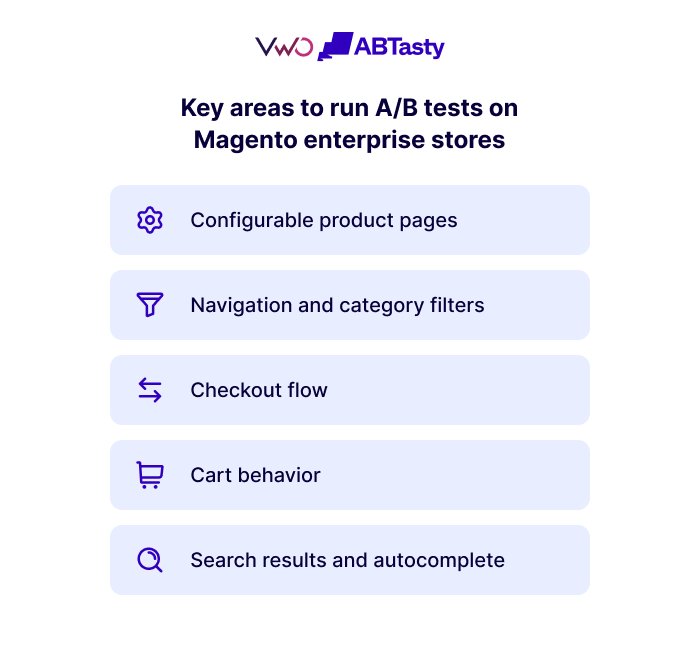
For organizations operating on Adobe Commerce, certain high-traffic templates offer the most fertile ground for experimentation:
- The Checkout Flow: Unlike many "software-as-a-service" (SaaS) platforms where the checkout is a "black box," Magento allows for deep customization. Teams can test the sequencing of address entry, shipping selection, and payment. Data suggests that reducing the perceived friction in these steps is the most direct path to increasing conversion rates.
- Navigation and Layered Filters: For stores with massive catalogs, the way visitors filter products is critical. Testing whether filters are expanded by default or how "price sliders" are utilized can significantly decrease "time to product," a key metric in user satisfaction.
- Search and Autocomplete: Internal search users often have the highest intent to buy. Optimizing the default sort order of search results or the logic of autocomplete suggestions can drive higher average order values (AOV).
- B2B Buying Flows: Magento’s B2B module includes specific features like "Request a Quote" and "Requisition Lists." Experimenting with the friction in these B2B-specific journeys is essential for brands moving away from traditional manual sales cycles toward digital self-service.
Expert Insights and Industry Responses
Industry leaders emphasize that technology is only one half of the experimentation equation; the other half is organizational culture and resource allocation. Garret Cunningham, Director of Global Optimization at Columbus Global, noted in a recent VWO Podcast that velocity is the key to success. Cunningham argues that organizations dedicating specific design and development capacity to experimentation consistently outperform those who rely on shared teams. This is particularly true in the Magento ecosystem, where a developer must understand both the frontend UI and the backend caching logic to execute a clean test.
Similarly, Ilan Hurwitz, a veteran in the enterprise e-commerce space, highlights the importance of stakeholder alignment. In the enterprise environment, the challenge is often securing the "buy-in" required to run tests on high-risk areas like the checkout page. Building trust through transparent QA processes—such as testing on staging environments that mirror production’s Varnish configuration—is vital for a program’s longevity.
Best Practices for Reliable Magento Testing
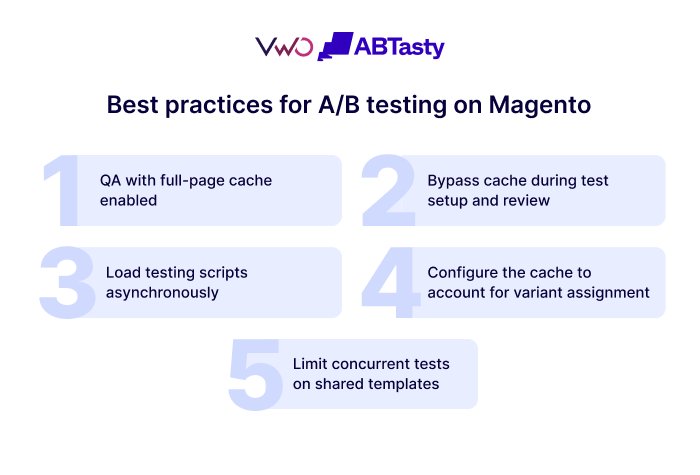
To mitigate the technical risks associated with Magento’s architecture, several best practices have emerged as industry standards:
- QA with FPC Enabled: It is a common mistake to perform quality assurance on a developer instance where caching is disabled. For a test to be valid, it must be verified in an environment that replicates the production Varnish and Full-Page Cache settings.
- Asynchronous Loading with Pre-hiding: To eliminate flicker, enterprise teams utilize pre-hiding snippets. These are small, synchronous scripts placed high in the
<head>tag that hide the page content momentarily until the testing variant is ready to be displayed. - Persistent First-Party Cookies: Ensuring that variant assignments are stored in persistent, first-party cookies—and that the server-side cache is configured to respect these cookies—is the only way to prevent data corruption across multiple sessions.
- Scoping to Store Views: In a multi-storefront architecture, tests must be scoped to specific "Store Views." This prevents a promotional test intended for a UK audience from inadvertently appearing on the US or German storefronts.
Analysis of Tools and Market Implications
The market for A/B testing tools compatible with Magento Enterprise is dominated by three major players: VWO (incorporating AB Tasty’s capabilities), Kameleoon, and Optimizely.

VWO has gained significant traction through its specialized Magento 2 integration. Its "SmartCode" implementation is designed to minimize render-blocking, and its ability to gather qualitative data—such as heatmaps and session recordings—provides a holistic view of the user journey. Kameleoon is often cited for its strength in handling variant assignments earlier in the request cycle, making it a favorite for high-traffic sites where cache-respecting bucketing is a priority. Optimizely remains a staple for large enterprises that require a unified platform for content management, personalization, and experimentation across multiple internal teams.
The broader implication of these technical requirements is a shift toward "hybrid" experimentation. As enterprise brands move toward headless commerce—where the Magento backend is decoupled from a React or Vue.js frontend—the lines between client-side and server-side testing continue to blur. Organizations that master the complexities of testing on traditional Magento architectures today will be better positioned to navigate the even more complex world of composable commerce tomorrow.

Conclusion and Future Outlook
A/B testing on Magento Enterprise is not merely an exercise in UI adjustment; it is a sophisticated technical discipline that sits at the intersection of web performance, data science, and consumer psychology. By acknowledging the platform’s unique caching layers and multi-storefront complexities, enterprise brands can move beyond "guesswork" and build a culture of data-backed decision-making.
As Adobe continues to integrate more AI-driven optimization features into the Commerce Cloud, the role of the CRO specialist will evolve from manual test setup to strategic oversight. However, the fundamental requirement remains the same: a testing program is only as reliable as the technical foundation upon which it is built. For the modern enterprise, the ability to experiment rapidly and accurately on Magento is no longer an optional advantage—it is a prerequisite for survival in an increasingly competitive global marketplace.