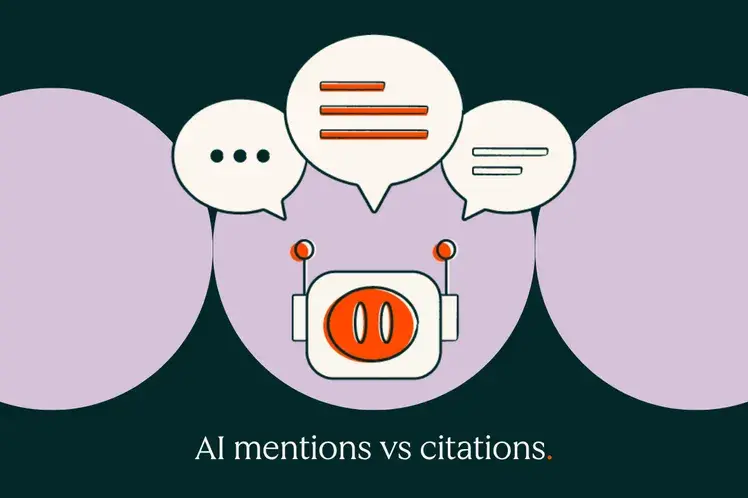
The landscape of digital visibility has undergone a profound transformation with the rise of artificial intelligence in search. Brands accustomed to tracking organic rankings and website traffic are now confronting a perplexing challenge: their names frequently appear in AI-generated answers, yet this apparent visibility often fails to translate into measurable web traffic or conversions. This disconnect stems from a critical distinction between an AI Answer Engine Optimization (AEO) "mention" and an AEO "citation," a nuance that dictates whether a brand gains mere recognition or tangible, attributable engagement.
The Evolving Landscape of Search: From Links to Answers
For decades, search engine optimization (SEO) focused on securing high rankings in a list of "10 blue links." Users would type a query, and search engines like Google would return a ranked list of web pages. The goal was to optimize content to appear prominently in this list, driving direct clicks to a brand’s website. This paradigm began to shift with the introduction of "featured snippets" and "knowledge panels," where search engines started synthesizing answers directly on the results page, often pulling information from various sources.
The true inflection point arrived with the proliferation of generative AI. The launch of ChatGPT in late 2022 catalyzed a rapid acceleration in the development and integration of AI into search. Google responded with its AI Overviews, Microsoft integrated Copilot into Bing, and dedicated AI-first engines like Perplexity emerged. These new "answer engines" fundamentally altered the user experience, moving from providing links to synthesizing comprehensive answers. Users now frequently receive direct answers, often eliminating the need to click through to a source page. This evolution has birthed Answer Engine Optimization (AEO), the strategic practice of making content discoverable and citeable within these AI-generated responses.
Decoding the Distinction: Mentions vs. Citations
At the heart of effective AEO strategy lies a clear understanding of mentions versus citations. These two forms of visibility, while seemingly similar, yield vastly different outcomes for a brand.
An AEO mention occurs when an AI engine references a brand, product, or content within its generated answer without providing a direct, clickable link back to the brand’s website. The brand’s name appears, acknowledging its relevance to the query or topic. This contributes to brand recognition and entity association within the AI model’s understanding. For instance, an AI might answer a query about "best CRM software" and list "HubSpot" as a leading option, but without a direct link to HubSpot’s website. While valuable for brand awareness, such mentions do not generate direct referral traffic.
Conversely, an AEO citation is established when an AI engine attributes a portion of its answer to a specific page or content from a brand’s domain, providing a direct, clickable link to that source. This attribution can manifest in various forms: a numbered footnote, a source card, a linked URL beneath the summary, or a "Learn more" reference. When a user clicks on a citation, they are directed to the brand’s website, generating measurable referral traffic. This is the holy grail of AEO for marketers seeking direct engagement and measurable ROI.
The practical implications of this distinction are profound. Consider a hypothetical scenario: a brand, "InnovateTech," might appear in 70% of AI answers related to "project management tools" (a high mention rate). However, if only 10% of those appearances include a direct link to InnovateTech’s site (a low citation rate), the brand is missing out on 60% of potential referral traffic and direct engagement.
The manner in which mentions and citations are displayed varies across AI engines, adding another layer of complexity for brands.
- Google AI Overviews: Typically feature linked sources as small cards below or alongside the summary text. A brand name in the summary without a corresponding card is a mention; a card with a link is a citation. Research from The Digital Bloom in early 2026 indicated a significant shift, with citation overlap between AI Overviews and the organic top 10 falling from approximately 76% in mid-2025 to between 17% and 54%. This suggests AI citation presence is increasingly an independent visibility layer.
- ChatGPT and ChatGPT Search: In its web search mode, ChatGPT often uses numbered footnotes linked to specific claims. Brand mentions appear as part of the narrative, while citations are the numbered references. Industry data suggests ChatGPT currently drives a significant portion of AI referral traffic.
- Perplexity: Designed to be citation-forward, Perplexity explicitly lists numbered sources alongside nearly every claim, making the distinction between a mention in the text and a cited source very clear.
- Microsoft Copilot: Integrates Bing search results and surfaces citations as linked references within its answers. Monitoring Copilot separately from Google AI Overviews is crucial due to differing source pools and ranking signals.
The Impact on Measurement and Attribution
The gap between mentions and citations directly impacts a brand’s ability to measure its AI search presence and attribute value. An AEO mention, by its nature, does not generate a trackable session in analytics platforms. This means that if a brand is only tracking what lands in Google Analytics 4 (GA4) or HubSpot, it is significantly underestimating its true AI search presence and overestimating the "unexplained" portion of its brand awareness.
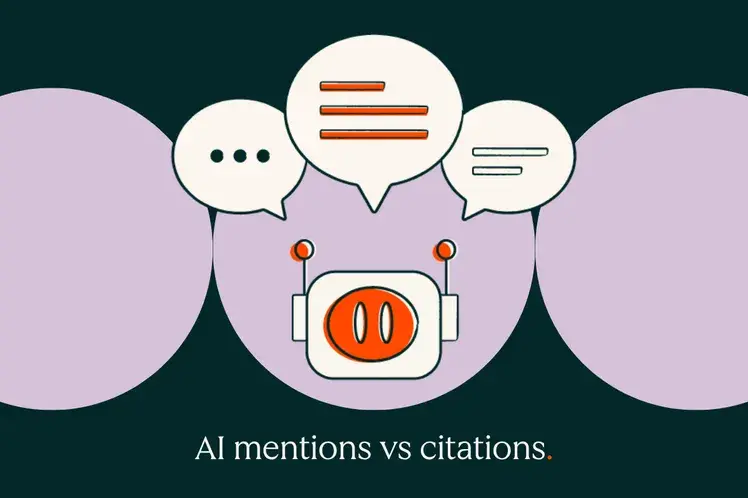
Measuring AEO Mentions and Citations:
Accurate measurement requires a systematic approach that goes beyond standard analytics:
- Fixed Query Set: Develop a consistent set of 20-50 queries representing core brand topics, including branded, unbranded category, and comparison queries. This set must remain static to enable trend analysis.
- Regular Query Execution: Run the full query set across all targeted AI engines (Google AI Overviews, ChatGPT, Perplexity, Copilot, Claude, Gemini) on a recurring schedule, typically weekly.
- Separate Logging: For each query, manually record: (a) brand mention (yes/no), (b) linked citation from the domain (yes/no), and (c) the specific engine. A simple spreadsheet is effective for this scale.
- Rate Calculation: Calculate the "mention rate" (percentage of queries with a brand mention) and "citation rate" (percentage with a linked source). Tracking divergence is key: a rising mention rate without a corresponding citation rate suggests AI engines recognize the brand but lack a strong enough content signal for direct attribution.
- Segmentation: Analyze data by engine and topic cluster, as different AI engines have varying citation behaviors and content preferences.
Tracking AI Referrals in GA4 and HubSpot:
While mentions are harder to track directly, citations generate referral traffic that can and should be meticulously captured. Research from MeasureU indicated that approximately 22% of ChatGPT sessions were misclassified as "(not set)" in default GA4 configurations, disappearing into direct or unassigned traffic. To combat this:
- GA4 Configuration: Create a custom channel group in GA4 for "AI Search" or "AI Referral." Include key referral domains such as
chatgpt.com,chat.openai.com,perplexity.ai,bing.com(for Copilot),claude.ai, andgemini.google.com. Implement a consolidated regex filter within your default channel group to catch any sessions from these domains that might otherwise be miscategorized. This ensures AI-sourced sessions are isolated for accurate analysis in Explorations and Conversions reports. - HubSpot Integration: To connect AI referral traffic to sales pipeline and revenue, establish a contact property for "AI Source" (recording the specific engine of the first visit). Create an AI referral smart list based on UTM parameters or referral domains, and set up a workflow to tag contacts entering via an AI referral. This allows HubSpot’s Smart CRM to track AI-sourced contacts through the funnel, associating them with deals and providing attribution reporting on AI search’s contribution to revenue.
Strategic Imperatives: Driving Citations for Growth
The journey from a mere mention to a valuable citation requires a multi-faceted and sustained content strategy.
- Clarify Entity Across Footprint: AI engines build a brand’s "entity" understanding from consistent signals across the web. Ensure brand names, product descriptions, and category associations are uniform across your website, social profiles, third-party listings, and press. Use semantic triples—explicit statements like "[Brand] is a [category] platform that helps [audience] [achieve outcome]"—to solidify these relationships.
- Structure Answer-First Content: AI engines prioritize content that directly answers a query. Structure web pages and blog posts so that the most direct answer to an implied question appears at the beginning of each section, followed by supporting details. Employ short paragraphs, clear subheadings, and declarative sentences that are easily extractable by AI for synthesis.
- Implement Validated Schema: Structured data (Schema.org markup) provides explicit signals to both traditional and AI search systems about content context and relationships. High-priority schema types include
Article,FAQPage,HowTo, andOrganization. Accurate and validated implementation is crucial; broken or mismatched schema can be detrimental. - Add E-E-A-T Signals: Google’s E-E-A-T framework (Experience, Expertise, Authoritativeness, Trustworthiness) is a critical signal for AI engines when evaluating source credibility. Integrate clear author bylines with linked credentials, original research, named contributors with verifiable expertise, citations from authoritative external sources, and up-to-date publication/update dates. A regularly updated piece by an expert with original examples significantly boosts citation probability.
- Refresh and Monitor Frequently: AI engine retrieval pools and training data are dynamic. A page earning citations today might lose them tomorrow to newer, more authoritative content. Establish a content refresh cadence (e.g., every 3-6 months) for high-value pages. Update statistics, examples, and recommendations, and adjust the publish date accordingly. Monitor citation rates for key query clusters and investigate any sudden drops.
Competitive Intelligence in the AI Era
Understanding your own AEO performance is crucial, but true strategic advantage comes from benchmarking against competitors.
- Define Competitive Set and Query Universe: Use the same fixed query set for yourself and 3-5 key competitors. Run queries simultaneously to capture comparable data.
- Build a Share-of-Model Table: For each query cluster, calculate mention and citation rates for all brands. This offers a direct comparison of who is winning awareness and who is winning attributable traffic.
- Look for Asymmetries: Identify competitors with high mention rates but low citation rates—these are prime targets for outflanking with citation-earning content. Conversely, a competitor with high citations where your brand has none signals a clear content gap.
- Investigate Cited Content: When a competitor’s page is cited for a relevant query, analyze its structure, schema, update frequency, and entity framing. This provides actionable insights into what the AI engine is rewarding.
- Revisit Benchmarks Quarterly: The AI search landscape is fluid. Quarterly competitive reviews are essential to adapt strategies to shifts in competitor performance.
Limitations and Future Outlook
It is important to acknowledge the inherent limitations of AEO measurement. AI engines do not serve identical answers to every user; personalization, location, and real-time retrieval variations mean that query results can differ. A spot-check provides a snapshot, not a universal truth. AI answers also change more rapidly than traditional organic rankings, making trends over time far more valuable than single data points.
Attribution gaps, despite best efforts, will persist. While GA4 channel grouping and HubSpot workflows improve accuracy, some AI-sourced sessions may still be misclassified. Treat AI referral data as a baseline, understanding that actual impact might be higher. Finally, avoid over-indexing on small week-over-week fluctuations. Focus on sustained directional movement over several weeks before drawing firm conclusions or making precise revenue claims based solely on AEO metrics.
Expert Insights and Recommendations
Industry analysts emphasize that brands must integrate AEO as a core component of their overall digital strategy, moving beyond traditional SEO. "The future of search is conversational and answer-driven," states a hypothetical digital marketing strategist. "Brands that understand how to earn citations, not just mentions, will be the ones capturing direct traffic and pipeline in this new era. It requires a shift from keyword-centric content to entity-centric, answer-first content that builds trust signals for AI models."
The recommendation is to prioritize citations as the primary KPI, leveraging mentions as a leading indicator of growing brand association. Investment in structured data, robust E-E-A-T signals, and a consistent content refresh cadence are no longer optional but foundational for AI visibility. Furthermore, establishing clear internal processes for tracking and reporting on AI referrals is paramount to demonstrating business impact and securing continued investment in AEO initiatives.
In conclusion, as AI continues to reshape how users find information, the distinction between an AEO mention and a citation has become a critical differentiator for brands. While mentions contribute to brand recognition, it is citations that drive measurable traffic and directly contribute to business growth. By understanding this nuance and implementing a strategic approach to earn attributed sources, brands can effectively navigate the complexities of AI search and secure their place in the future of digital discovery.