The stark silence that often follows a seemingly straightforward question—"What did paid media contribute to pipeline last quarter?"—underscores a critical disconnect in B2B marketing. While metrics like cost per click and return on ad spend (ROAS) may appear healthy, their true impact on the bottom line frequently remains elusive. This disconnect arises from a fundamental misunderstanding of the B2B sales cycle, where conversions are rarely the result of a single interaction. Instead, complex buying committees, often comprising five to ten individuals, engage in a protracted decision-making process that can span months. Consequently, a measurement framework that halts at platform-level data—impressions, clicks, and immediate conversions—ultimately measures the efficacy of the advertising platform, not the tangible business outcomes it is intended to drive. The imperative, therefore, is to reorient B2B marketing measurement, shifting the focus from vanity metrics to defensible pipeline generation, a transformation that begins not with dashboard customization, but with a foundational integration of media efforts with customer relationship management (CRM) systems before campaigns are even launched.
The Foundational Imperative: Integrating Media with the CRM from Inception
The pervasive measurement challenges within B2B paid media often stem from a failure to implement robust tracking mechanisms at the outset. This "tracking problem," as it is often termed, allows the trail of attribution to go cold long before a significant business event, such as a first meeting, can be meaningfully linked back to its origin. Inconsistent or delayed application of campaign IDs to CRM systems like Salesforce, haphazard or absent UTM tagging, and lead forms that fail to synchronize with campaign objects create a fragmented data landscape. By the time stakeholders inquire about the drivers of initial engagement, the ability to establish a clear lineage from marketing touchpoint to sales qualified lead is severely compromised.
The solution lies in an unglamorous yet crucial discipline: meticulous upfront setup. This involves ensuring that every campaign is properly tagged at its inception, that lead forms are seamlessly integrated with CRM campaign objects, and that conversion tracking within platforms like Google Ads and LinkedIn is configured to reflect actual pipeline outcomes. This includes tracking key performance indicators such as Marketing Qualified Leads (MQLs), first meetings, and CRM-defined lead quality scores. Establishing this baseline data integrity before any campaign modifications are made is paramount. It provides the essential foundation for discerning whether subsequent campaign adjustments are genuinely influencing business metrics or merely manipulating platform-specific numbers. When executed with precision, this integrated approach allows for a comprehensive tracking of the entire customer journey, from the initial touchpoint through to MQL, SQL (Sales Qualified Lead), and, where data permits, to closed-won deals. This holistic view aligns perfectly with how sales teams operate, providing finance departments with data they can trust rather than abstract analytical narratives.
The Illusion of a Single Source of Truth: The Necessity of Multi-Layered Attribution
A candid assessment within the B2B marketing and agency landscape often reveals a critical truth: no single attribution model can accurately capture the entirety of pipeline generation. The pursuit of a solitary "source of truth" frequently leads to oversimplification and, consequently, flawed insights. In the complex ecosystem of B2B sales, where multiple touchpoints and influences converge over extended periods, relying on a single attribution methodology is inherently deceptive.
The effective solution lies in a tri-layered attribution framework, where each layer acts as a cross-check for the others, mitigating the inherent biases and blind spots of individual models.
-
Multi-Touch Attribution (MTA): This foundational layer links various ad interactions and self-reported customer data to CRM outcomes. While invaluable for understanding the sequence of engagement, MTA can be biased towards channels that are easily trackable, often over-crediting the last discernible click in a user’s journey. This can lead to an inflated perception of the value of immediate conversion drivers.
-
Causal Modeling: Employing econometric methods, causal modeling seeks to quantify each channel’s independent contribution to pipeline generation. Crucially, it controls for external factors that can influence demand, such as seasonality, market trends, and broader brand awareness campaigns. This layer provides a more nuanced understanding of a channel’s true incremental impact, moving beyond simple correlation.
-
Geo-Based Incrementality Testing: This rigorous methodology aims to definitively prove whether paid media efforts have generated net-new pipeline or have merely captured demand that would have materialized organically. By comparing outcomes in test markets exposed to campaigns against control markets that are not, incrementality testing provides a robust validation of marketing’s direct influence.
By running these three layers concurrently, B2B marketers can construct a defensible narrative of their impact, rather than relying on a flattering, yet potentially inaccurate, representation. This integrated approach acknowledges that multi-touch attribution may overemphasize the final click, causal modeling might miss individual user journeys, and incrementality testing, while precise, can be time-consuming. The synergistic application of these models offers a more holistic and reliable perspective, particularly crucial for making confident budget allocation decisions in complex B2B environments where isolating the true drivers of demand is paramount.
Speaking the Language of Finance: Aligning Marketing Metrics with Business Objectives
For any measurement framework to hold sway, it must resonate with the financial stakeholders who ultimately control the budget. This necessitates a fundamental shift in reporting, moving away from marketing-centric jargon towards the financial language that governs business operations. A revenue-based planning approach, which begins with an audit of marketing spend against realized revenue, is instrumental in this transition. This process involves sizing the opportunity and then iteratively refining strategies based on performance.

The metrics that transcend the marketing department and gain traction with finance are those that directly mirror how the company is managed. These include critical financial indicators such as:
- Contribution Margin: The revenue remaining after deducting variable costs, indicating profitability per unit sold.
- Lifetime Value (LTV) to Customer Acquisition Cost (CAC) Ratio: A key indicator of the long-term profitability of acquiring new customers.
- Payback Period: The time it takes for an investment to generate sufficient returns to cover its initial cost.
For paid media to be integrated into this financial discourse, metrics like cost per first meeting and cost per pipeline dollar must be presented alongside these established financial benchmarks. Traditional platform metrics like impressions and clicks, while serving as directional indicators, lack the gravitas to inform strategic financial decisions and should be relegated to a secondary role in pipeline reviews.
Advanced modeling tools play a pivotal role in bridging this gap. Marketing Mix Modeling (MMM), for instance, can effectively tie marketing spend to tangible outcomes like first meetings, MQLs, and pipeline generation, leveraging CRM data for validation. Similarly, geo-holdout testing provides empirical evidence of which markets are genuinely responding to paid media investments, distinguishing true impact from mere correlation. The ultimate objective is not to introduce undue complexity but to arrive at a quantifiable outcome that marketing leaders can confidently present and defend to the board of directors, demonstrating a clear return on investment.
The Transformative Power of Measurement-Led Strategies: Case Studies in Success
The tangible benefits of prioritizing measurement and aligning it with business objectives are evident in numerous accounts where data-driven insights have actively shaped marketing strategy, rather than merely reporting on its aftermath.
One notable example involves an integrated search program for a Business-to-Business (B2B) Software-as-a-Service (SaaS) company. By reorienting their budget allocation towards pipeline signals rather than solely focusing on click volume, the program achieved a significant 27% reduction in cost per MQL. Concurrently, they witnessed an 18% increase in conversion rates and a 22% uplift in qualified traffic. This outcome was not the result of a more sophisticated bidding algorithm but a fundamental shift in what was being measured and optimized for.
In another instance, a global technology company implemented a strategic integration of Salesforce lead scoring directly into their Google Ads campaigns. By assigning real dollar values to each lead tier identified through this scoring system, the company experienced a remarkable 138% growth in ROAS. This demonstrates how directly connecting platform performance with sales-qualified lead value can unlock substantial efficiency gains and revenue growth.
These success stories underscore a critical principle: the most impactful results are achieved not through incremental tactical adjustments but by first identifying and prioritizing the correct metrics—those that directly correlate with business objectives—and then rigorously optimizing towards them. This measurement-first approach fosters a strategic alignment that drives meaningful growth.
The Core Principle: Measurement as Foundation, Not Afterthought
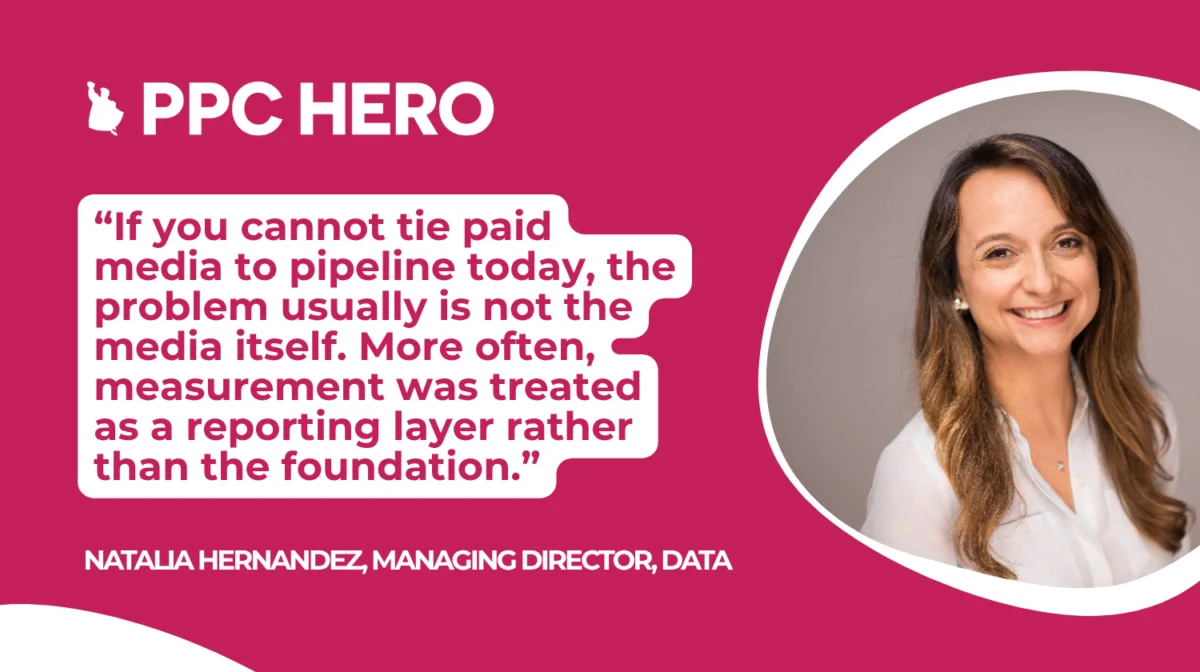
The persistent inability of many B2B organizations to directly attribute paid media efforts to pipeline generation typically signifies a foundational issue with their measurement strategy, rather than an inherent flaw in the media execution itself. Far too often, measurement is treated as a superficial reporting layer, tacked on after campaigns are live, rather than being embedded as the bedrock upon which all strategic decisions are built.
The path forward involves a commitment to several key principles. Firstly, integration with the CRM system must precede any campaign optimization efforts. This ensures that data is flowing accurately and that the marketing touchpoints are correctly linked to sales progression. Secondly, reliance on a single attribution model is insufficient; a multi-layered approach is essential because no single methodology provides a complete and unbiased picture of performance. By triangulating data from multiple attribution sources, marketers can achieve a more robust and defensible understanding of their impact. Finally, reporting must be framed in the financial vernacular that CFOs and other business leaders understand and trust.
By adhering to these principles—connecting to the CRM before optimizing, employing a diverse suite of attribution models, and reporting in metrics that resonate with financial leadership—B2B organizations can move beyond the ambiguity of platform-specific data. The outcome will be a clear, quantifiable contribution of paid media to pipeline, a figure that can be confidently defended and that serves as a powerful driver for future investment and strategic refinement. This shift transforms paid media from a cost center with ambiguous results into a predictable and accountable engine for business growth.