The affiliate marketing industry, often referred to as the "partnership economy," has been shaken by the sudden and high-profile removal of PayPal Honey from two of the world’s leading affiliate networks. Within a single week in January 2026, Rakuten Advertising and impact.com—gatekeepers for thousands of global retail brands—took decisive action against the browser extension giant. These moves follow a series of technical investigations alleging that Honey engaged in "attribution manipulation," a practice that undermines the fundamental mechanics of how digital marketing commissions are earned and distributed.
The significance of this development cannot be overstated. Honey, which was acquired by PayPal in 2020 for approximately $4 billion, has long been a dominant force in the coupon and rewards space. Its removal from major networks signals a potential paradigm shift in how platforms enforce compliance among "mega-publishers" and highlights a growing intolerance for technical noncompliance that disadvantages other partners in the ecosystem.
Chronology of the Disciplinary Actions
The enforcement actions against PayPal Honey unfolded rapidly during the week of January 12, coinciding with Affiliate Summit West, the largest industry conference in North America. The timing ensured maximum visibility within the marketing community.
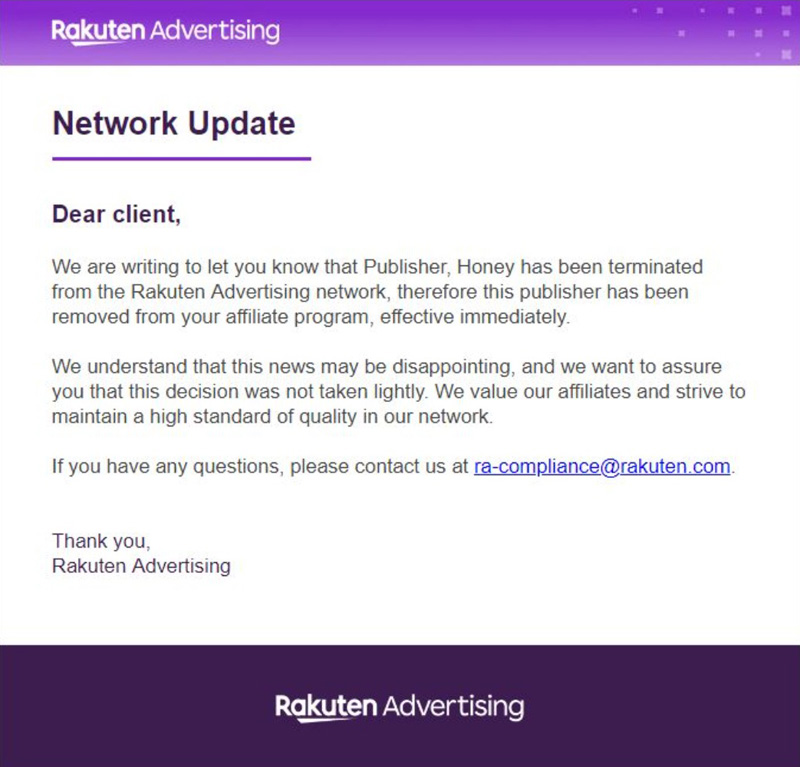
On Monday, January 12, Rakuten Advertising issued a formal announcement stating that Honey had been "terminated from the network." The network characterized the move as a necessary measure to "maintain a high standard of quality" and integrity for its advertisers and other publishing partners. Unlike a temporary suspension, a termination suggests a severe breach of the network’s participation agreement.
On Friday, January 16, impact.com followed suit, though with a slightly different administrative approach. The platform confirmed that Honey was found to be "out of compliance" with its platform policies. Consequently, Honey was removed from the "Discovery Marketplace," the centralized hub where brands find and recruit new partners. While impact.com’s leadership described the current status as a suspension rather than a permanent termination, the reasoning remained consistent: the protection of the partnership economy from behavior that erodes trust.
The Technical Catalyst: Investigations into Attribution Manipulation
The catalysts for these network-level actions were two distinct but overlapping investigations that gained viral traction in the weeks leading up to the removals. The first was a technical exposé by the creator MegaLag, whose video investigation detailed specific instances where the Honey browser extension appeared to override other affiliate cookies improperly.
The second, and perhaps more damaging from a policy perspective, was an investigation by Ben Edelman, a well-known expert in web transparency and online fraud. Edelman’s research alleged that Honey had implemented "tester detection" mechanisms. This software logic allegedly allowed the extension to behave according to the rules when it detected it was being monitored or audited by compliance tools, while reverting to noncompliant behavior for standard users.

The core of the allegation centers on the violation of "stand-down" rules. In the affiliate world, most programs operate on a "last-click" or "last-touch" attribution model. If a consumer clicks a link from a content creator or a review site and then proceeds to checkout, that original affiliate is entitled to a commission. However, many browser extensions are programmed to "fire" a new affiliate link at the moment of checkout, effectively "hijacking" the attribution and claiming the commission for themselves.
To prevent this, industry-standard "stand-down" rules require extensions to remain dormant if another affiliate’s cookie is already present in the user’s browser. The investigations suggested that Honey was intentionally bypassing these rules, overwriting the cookies of smaller content creators and influencers to capture revenue it did not legitimately earn through the initial referral.
Understanding the "Last-Touch" Impact
To understand why these violations are viewed so severely, one must look at the economics of the affiliate program. When a browser extension like Honey manipulates attribution, it creates a "one bad apple" scenario for the entire program.
Most affiliate programs have a finite budget for commissions. When a large software publisher uses technical workarounds to claim "last-touch" status, they are not just taking money from the merchant; they are effectively stealing it from the "top-of-funnel" affiliates—the bloggers, YouTubers, and niche reviewers who actually introduced the consumer to the product.
When these high-quality content creators realize that their commissions are being consistently overwritten by a browser extension at the final second of the transaction, they often lose the incentive to promote the brand. This leads to a degradation of the affiliate base, leaving the merchant with an "unhealthy" program dominated by bottom-of-funnel discount tools rather than genuine brand advocates.
Official Responses and Industry Sentiment
While PayPal has not released an extensive public rebuttal to the specific technical allegations at the time of this report, the actions taken by network CEOs have been uncharacteristically blunt. David A. Yovanno, CEO of impact.com, explicitly cited "attribution manipulation" as the cause for the suspension, noting that such behavior undermines the transparency required for the partnership economy to function.
The reaction at Affiliate Summit West reflected a mix of shock and vindication. For years, smaller publishers have complained about the aggressive behavior of "Downloadable Software Publishers" (DSPs). The move by Rakuten and Impact is being viewed by many as a long-overdue enforcement of the rules, proving that even a $4 billion entity owned by a global payments giant is not above the terms of service that govern the industry.
Broader Implications for Affiliate Management
The "Honey Incident" serves as a landmark case study for affiliate managers and digital marketing directors. It highlights five critical lessons for the future of the industry:
1. The Necessity of Independent Policing
Brands can no longer afford to outsource their ethics and compliance entirely to the networks. While Rakuten and Impact eventually took action, the investigations that triggered these moves came from independent third parties. Brands must utilize their own auditing tools and monitor clickstream data to ensure their "stand-down" rules are being honored in real-time.
2. Technical Literacy in Marketing
The distinction between a "soft click" and a "stand-down violation" is technical, yet it has massive financial implications. Modern affiliate managers must understand the mechanics of browser extensions, cookie durations, and attribution logic. As the UK’s Affiliate & Partner Marketing Association (APMA) recently noted in its independent audit, the complexity of these issues requires a standardized industry approach to attribution rules.
3. Avoiding Generalization
While the Honey case highlights the risks of browser extensions, industry experts warn against banning all software-based publishers. Many extensions provide genuine value, such as price comparison or carbon-offsetting tools, and operate with full transparency. The lesson is not to ban a category, but to evaluate every partner based on their specific technical behavior and incremental value.
4. Protecting the Ecosystem
A healthy affiliate program is one where all participants feel they have a fair chance to earn a commission based on their contribution to the customer journey. If a program allows one partner to engage in "attribution theft," it will eventually lose its most valuable "discovery" partners. Integrity is a prerequisite for long-term growth.
5. The Urgency of Diversification
The most significant risk exposed by the Honey removal is the over-reliance on a single type of affiliate. Many brands discovered that a massive percentage of their "affiliate revenue" was actually coming from Honey. When Honey was removed, their reported affiliate sales plummeted. This reveals that those sales were likely not "incremental"—the customers were already at the checkout and simply used the extension to find a coupon they would have used anyway.
Strategic Diversification: 28 Affiliate Types to Explore
To build a resilient and ethical affiliate program in 2026, experts suggest moving away from a "coupon-heavy" model and diversifying across a wider range of partner types. A robust program should include a mix of the following:
- Content and Influence: Content producers, social media influencers, podcasters, and video marketers who drive brand awareness.
- Niche Authority: Ranking and review sites, educators, and consultants who provide deep-dive product analysis.
- Audience Access: Affinity groups, charities/fundraisers, and closed user group (CUG) loyalty solutions.
- Technological Innovation: Card-linked offers, Connected TV (CTV) partners, and post-checkout solutions.
- Traditional Digital: Email marketers, paid search affiliates (operating under strict guidelines), and datafeed-driven price comparison sites.
- Advocacy: Existing customers and brand advocates who share referral links with their personal networks.
Conclusion: A Turning Point for Transparency
The removal of PayPal Honey from Rakuten Advertising and impact.com marks a pivotal moment for the affiliate marketing industry. It serves as a stark reminder that in an ecosystem built on partnerships, trust is the primary currency. When technical sophistication is used to circumvent the spirit of an agreement, it threatens the viability of the entire channel.
As the industry moves forward into 2026, the focus will likely shift toward more rigorous, automated compliance monitoring and a renewed appreciation for top-of-funnel affiliates who drive genuine brand discovery. For PayPal Honey, the path back to these major networks will almost certainly require a complete overhaul of its extension’s attribution logic and a transparent commitment to industry-standard "stand-down" protocols. For the rest of the industry, it is a call to prioritize quality over volume and integrity over easy "last-click" wins.