The fiercely competitive landscape of e-commerce necessitates robust marketing automation platforms, with Klaviyo and Drip emerging as two prominent contenders. While both platforms empower businesses to engage customers through email and other channels, a detailed comparison reveals distinct strengths and trade-offs, particularly concerning cost-effectiveness at scale versus advanced feature depth. Drip typically offers better value at higher contact volumes, coming in $21 per month less for 2,500 contacts, with cost efficiencies extending across many subsequent tiers. Conversely, Klaviyo distinguishes itself with more sophisticated segmentation, automation workflows, and reporting capabilities, better suited for intricate customer journeys and data-driven strategies. The central question for businesses is whether Klaviyo’s extensive feature set justifies its higher price point, or if Drip provides sufficient functionality for their operational needs.
This analysis, drawing from several days of in-depth comparison, delves into their respective strengths and potential caveats, spanning critical areas such as pricing, segmentation, automation, SMS marketing, reporting, integrations, customer support, email builders, and templates.
Overall Strategic Positioning
![Klaviyo vs. Drip: Which Is Better in 2026? [Comparison]](https://www.omnisend.com/blog/wp-content/uploads/2026/08/Comparison-_-VS-2.webp)
For e-commerce businesses seeking a platform that offers outright depth and facilitates data-led multichannel marketing, Klaviyo stands out. Its capacity to leverage predictive analytics and comprehensive attribution data enables proactive engagement. In contrast, Drip presents a compelling choice for email-centric stores prioritizing lower operational costs at contact volumes exceeding 2,500, coupled with a preference for a more streamlined setup and less ongoing maintenance.
Detailed Feature Analysis
1. Pricing Structures and Value at Scale
The pricing models for Klaviyo and Drip represent a critical differentiator for businesses of varying sizes. Klaviyo employs a scaling model based on active profiles, starting at a lower entry point of $20 per month for up to 500 contacts. This makes it initially more accessible for smaller businesses or those just beginning their marketing automation journey. However, its costs escalate with list growth, capping email sends at 10 times the number of active profiles. Klaviyo also offers a free plan, accommodating up to 250 active profiles, which is a significant advantage for nascent operations.
Drip, while lacking a free plan, provides a 14-day free trial. Its pricing structure is simpler, with a flat rate of $39 per month for up to 2,500 contacts, and crucially, offering unlimited email sends within this tier. Beyond the 2,500-contact mark, Drip consistently proves more cost-effective. For instance, at 5,000 contacts, Klaviyo costs $100/month compared to Drip’s $89/month. This saving becomes more pronounced at 15,000 contacts ($350/month for Klaviyo vs. $209/month for Drip) and 20,000 contacts ($375/month for Klaviyo vs. $289/month for Drip).
![Klaviyo vs. Drip: Which Is Better in 2026? [Comparison]](https://www.omnisend.com/blog/wp-content/uploads/2026/08/1.-Drips-People-dashboard.webp)
The distinction in how contacts are counted also bears financial implications. Klaviyo counts "active profiles," which include subscribers and other engaged contacts (e.g., those who provided an email at checkout), automatically excluding unsubscribed or suppressed profiles. While convenient, this means non-subscribed contacts can still contribute to the bill if a store experiences high order volumes. Drip, conversely, bills for every "Active person," and unsubscribed contacts remain "Active" unless manually deactivated or deleted, potentially leading to payment for unmarketable contacts if not actively managed.
SMS Costs: Klaviyo integrates SMS capabilities across 22 countries, including the U.S., Canada, Australia, New Zealand, and 18 European nations. All plans include $5 worth of mobile messages, with additional credit bundles available from $15 per month for 1,000 credits, priced at $0.011 per send plus provider fees. Drip’s SMS offering, as of July 2026, is rebuilding after a previous iteration, currently limited to the U.S., in beta, and available only by request as a paid add-on starting at $39 per month on top of the email plan. This limited availability and higher entry cost for SMS position Klaviyo as the clear leader in multichannel messaging.
2. Advanced Segmentation and Data-Driven Insights
Segmentation is paramount for personalized marketing, and here, Klaviyo demonstrates a distinct advantage with its predictive analytics layer. Both platforms effectively capture dynamic, real-time segments based on behavioral data such as viewed products and placed orders, with segments automatically updating. However, Klaviyo elevates this by allowing businesses to segment customers based on forecasted behaviors: churn risk, expected next order date, and predicted customer lifetime value (CLV), all derived from individual purchase histories. This predictive capability enables proactive strategies, such as sending replenishment reminders before a customer runs out of a product or identifying potential VIPs based on forecasted CLV.
Drip offers robust dynamic segments, tags, and behavioral triggers, including a valuable lifetime-value threshold that can initiate workflows once a customer crosses a specific spending milestone. Pre-built segments become accessible upon connecting an e-commerce store, streamlining initial setup. However, Drip’s segmentation primarily reacts to past customer behavior rather than forecasting future actions. For example, while Klaviyo can target customers whose predicted next order date is within the coming week, Drip relies on historical data, such as "customers who placed three or more orders," which is a reactive approach.
![Klaviyo vs. Drip: Which Is Better in 2026? [Comparison]](https://www.omnisend.com/blog/wp-content/uploads/2026/08/2.-Klaviyos-pre-built-segments.webp)
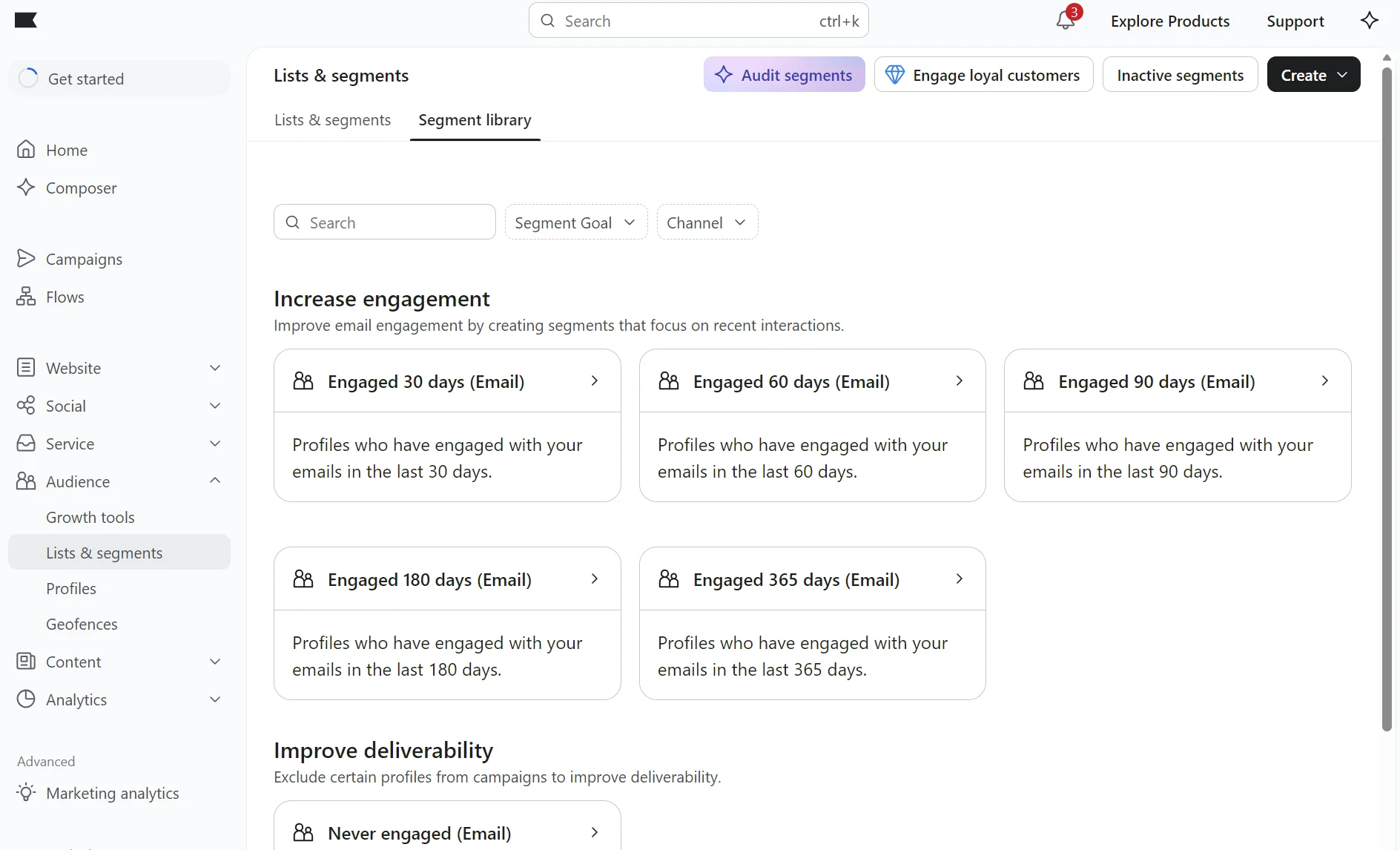
Klaviyo’s segments library further includes numerous pre-built options based on engagement, deliverability, and targeting past purchasers, many of which leverage its predictive data. It’s important to note that Klaviyo’s predictive features require specific data thresholds to populate (500 customers with an order, 180 days of order history, recent orders, and repeat buyers). Until these are met, Klaviyo’s segmentation operates similarly to Drip’s, focusing on behavioral data.
3. Automation Logic and Workflow Sophistication
Klaviyo excels in automation logic, particularly with its advanced conditional branching. Each Klaviyo flow initiates from a single trigger (e.g., a list subscription, a placed order, a date), but a single flow can then split into up to 20 distinct paths. Critically, Klaviyo re-checks who qualifies at every step, ensuring highly dynamic and personalized journeys. This depth allows for exceptionally complex customer journeys tailored to minute behavioral nuances.
Drip, while offering less conditional depth, provides a practical advantage by allowing multiple triggers within a single workflow. This feature can simplify the management of automations, as cart abandoners and customers crossing a spend milestone can enter the same workflow. Drip’s "Workflow Goals" are also a powerful feature, automatically pulling customers out of a workflow once they convert, preventing unnecessary communication. Drip’s LTV trigger, which initiates a workflow when a customer crosses a set lifetime-spend threshold, is another unique capability not directly matched by Klaviyo’s segmentation alone.
Both platforms provide pre-built template libraries for common e-commerce scenarios, including welcome series, abandoned cart reminders, post-purchase sequences, and win-back campaigns, ensuring businesses don’t start from scratch. Both also support A/B or split testing within automations. Klaviyo tests messages within a flow, while Drip splits entire workflow paths, requiring manual declaration of a winner.
![Klaviyo vs. Drip: Which Is Better in 2026? [Comparison]](https://www.omnisend.com/blog/wp-content/uploads/2026/08/3.-Klaviyos-flow-builder.webp)
4. Multichannel Engagement: The SMS Divide
Klaviyo maintains a significant lead in SMS marketing. Its SMS functionality is universally available to all customers in 22 countries, offering robust features for both standalone campaigns and integrated multichannel flows combining email and SMS. Klaviyo supports sending both SMS and MMS, triggering texts based on customer actions, and building two-way conversational automations, such as quizzes and surveys that store replies as profile data. It also includes built-in compliance tools like quiet hours and automatic opt-out handling.
Drip, as of July 2026, is in the process of rebuilding its SMS offering, which is currently in a limited beta phase, U.S.-only, and available by request rather than self-serve. While it supports SMS and MMS sending and triggered texts for actions like welcome series, it lacks the two-way, keyword-reply conversational capabilities that Klaviyo offers for more interactive engagements. This disparity positions Klaviyo as the superior choice for businesses prioritizing comprehensive, international, and interactive SMS marketing.
5. Reporting, Analytics, and Performance Measurement
Klaviyo offers a more profound level of reporting and analytics, crucial for data-driven decision-making. Its custom dashboards allow users to build up to 10 personalized boards, pulling cards for flow performance, deliverability, or channel-specific metrics. Klaviyo attributes revenue per campaign and per flow, providing granular insights down to individual sends and automations behind each order. While last-touch attribution is the default, lookback windows are configurable per channel (email, SMS, push).
Beyond standard metrics, Klaviyo’s predictive analytics forecast churn risk, predicted CLV, and expected next order dates. Its "Deliverability hub" provides a holistic view of bounces, spam, and unsubscribe rates across email and SMS, along with a sender-reputation score for accounts sending over 1,000 emails in 30 days. Furthermore, a "Benchmarks report" allows businesses to compare their open, click, and conversion rates against peer groups across multiple date ranges, offering valuable competitive context.
![Klaviyo vs. Drip: Which Is Better in 2026? [Comparison]](https://www.omnisend.com/blog/wp-content/uploads/2026/08/4.-Drips-flow-builder.webp)
Drip’s reporting, while foundational for most e-commerce stores, is less extensive. Its revenue dashboard provides real-time total and Drip-attributed revenue based on last-touch attribution, broken down by strategy, with the ability to compare up to three workflows, email series, or campaigns side-by-side. The "Email Metrics report" details opens, clicks, orders, and revenue per send, with CSV export options including conversion rate, average order value, and revenue per person. Drip also reports on list health, showing new subscribers and total list size over time, and event recording frequency. However, Drip lacks predictive tools, peer benchmarks, or a comprehensive sender-reputation score, limiting its capacity for proactive optimization and broader market comparison.
6. Ecosystem Connectivity: Integrations
Klaviyo boasts a significantly broader integration ecosystem, offering over 350 native integrations compared to Drip’s approximately 90. Both platforms natively connect to leading e-commerce platforms like Shopify, BigCommerce, and WooCommerce. However, Klaviyo extends its native support to platforms like Wix, and provides a more extensive array of apps for CDP (Customer Data Platform), CRM (Customer Relationship Management), POS (Point of Sale), and helpdesk solutions. For instance, Klaviyo offers native integrations with Salesforce and HubSpot, which are absent in Drip. For connections not natively supported, both platforms integrate with Zapier, a middleware service, though Zapier’s capabilities may not always match native counterparts. This extensive native integration network makes Klaviyo a more seamless fit for businesses operating with a diverse tech stack.
7. Customer Support and Accessibility
Customer support access varies significantly between the two platforms. Klaviyo’s free plan includes email support for the initial 60 days. All plans gain access to "Composer," an AI chatbot (currently in beta) designed to answer questions, locate information, and assist in building flows and segments. Paid Klaviyo plans include both email and live chat support, with live chat available 24/5 (excluding weekends) and email support 24/7. Response times are quoted at four hours for urgent issues and 12 hours for high-priority issues. Professional and Enterprise plans offer reduced response times and, for Enterprise, 24/7 live chat.
Drip provides email support across all tiers. Live chat support, however, is restricted to customers spending $99 per month or more. Drip also features an AI chatbot within its dashboard, which can answer questions and escalate to a human agent if needed. Support is provided during standard business hours. The tiered access to live chat in Drip means smaller, yet paying, customers may experience slower resolution times compared to Klaviyo’s broader live chat availability for paid plans.
![Klaviyo vs. Drip: Which Is Better in 2026? [Comparison]](https://www.omnisend.com/blog/wp-content/uploads/2026/08/5.-Klaviyo-vs.-Drip-flow-libraries.webp)
8. Email Design and Customization
Klaviyo offers a more versatile and extensive email builder and template library. With over 160 pre-built templates, it significantly outnumbers Drip’s collection of 50+. Klaviyo’s drag-and-drop editor includes a wider range of content blocks, such as text, images, buttons, dynamic product blocks (pulling live catalog items and recommendations), coupons, and review blocks. Most blocks offer display options to show or hide content based on device or audience, and an HTML block accommodates custom code. The "Universal content" feature allows users to save and reuse blocks across multiple templates, enhancing efficiency.
Drip’s "Visual Builder" is a point-and-click interface, providing blocks for text, images, buttons, navigation, product, and social links. It includes a "top-selling-products" block that dynamically pulls bestsellers from the connected store. Conditional display rules enable showing or hiding blocks based on device, tag, or custom field using AND/OR logic. Saved email templates can also be accessed across multiple accounts, benefiting users managing several stores. While functional for everyday e-commerce emails, Drip’s builder has fewer content blocks and customization options, and notably lacks coupon and review blocks, as well as support for external fonts, limiting design flexibility compared to Klaviyo.
User Experience and Market Perception
As of August 2026, user ratings across major review platforms reflect Klaviyo’s generally higher standing, accompanied by a larger volume of reviews. On G2, Klaviyo scores 4.6/5 from 1,360 reviews, compared to Drip’s 4.4/5 from 480 reviews. The Shopify App Store shows Klaviyo at 4.7/5 (2,965 reviews) against Drip’s 4.6/5 (51 reviews). Capterra ratings are 4.6/5 (534 reviews) for Klaviyo and 4.4/5 (188 reviews) for Drip.
![Klaviyo vs. Drip: Which Is Better in 2026? [Comparison]](https://www.omnisend.com/blog/wp-content/uploads/2026/08/6.-Klaviyos-SMS-campaign-builder.webp)
User sentiment on G2 highlights Klaviyo’s ease of use (160 mentions) despite 63 users noting a steep learning curve. The most frequent complaint for Klaviyo revolves around its cost and perceived limited support (73 mentions). A verified user in consumer goods, giving Klaviyo a 4/5 star review, stated, "Klaviyo’s pricing gets expensive as contact lists grow, especially for small businesses or high-volume email senders."
For Drip, the efficiency of its automation features is the top positive, followed by ease of use. However, four users found it expensive, and another four expressed frustration over its limited integrations. Some customers also note Drip’s lack of advanced marketing features, citing its limited multichannel capabilities, particularly the beta status and U.S.-only restriction for SMS as of July 2026. A G2 user, Belcourt L., remarked on integration challenges: "A major downside is the absence of native connections to our primary accounting platform, which means we have to input marketing expense data manually."
In summary, Klaviyo’s user complaints primarily center on cost and support accessibility for lower tiers, while Drip’s focus on missing capabilities and integration gaps.
Strategic Considerations and Business Implications
![Klaviyo vs. Drip: Which Is Better in 2026? [Comparison]](https://www.omnisend.com/blog/wp-content/uploads/2026/08/7.-Klaviyos-custom-reports-1.webp)
The choice between Klaviyo and Drip ultimately hinges on a business’s specific needs, budget, and strategic marketing ambitions.
When to pick Klaviyo: Klaviyo is the preferred choice for businesses that prioritize sophisticated, data-driven, and multichannel marketing. Its predictive analytics allow for highly proactive customer engagement, enabling strategies like predicting churn or optimizing replenishment cycles. Its extensive integration ecosystem supports complex tech stacks, and its mature SMS offering facilitates international and interactive mobile marketing. Businesses that require granular reporting, custom dashboards, and competitive benchmarking will find Klaviyo’s analytics capabilities invaluable for optimizing performance and understanding customer lifecycles deeply. It’s ideal for those willing to invest more for advanced depth and a holistic view of their customer journey.
When to pick Drip: Drip is a strong contender for e-commerce stores that are primarily email-led, operating on leaner budgets, and require solid, behavior-based automation without the need for Klaviyo’s predictive depth. Its cost-effectiveness at scale (above 2,500 contacts) makes it attractive for growing businesses mindful of operational expenses. Drip’s ability to use multiple triggers in a single workflow can simplify automation management, and its LTV threshold is a powerful tool for segmenting based on past spending. It’s well-suited for businesses looking for standard flows, reliable reporting basics, and efficient core e-commerce marketing features with less upkeep.
It is crucial for businesses to conduct hands-on testing with both platforms through their respective free plans or trials. User interface preferences, specific workflow requirements, and the comfort level with each platform’s design philosophy can be significant deciding factors that only direct experience can reveal.
![Klaviyo vs. Drip: Which Is Better in 2026? [Comparison]](https://www.omnisend.com/blog/wp-content/uploads/2026/08/8.-Drips-revenue-reports-1.webp)
The Evolving Landscape: Alternatives and Competitive Dynamics
The e-commerce marketing automation market is dynamic, with several strong alternatives offering competitive features. Omnisend frequently emerges as a compelling alternative to both Klaviyo and Drip. It aims to strike a balance, closely matching Klaviyo’s flow and segmentation capabilities while being generally easier to master, akin to Drip. Omnisend’s core offering is multichannel, encompassing email, SMS, and web push notifications. A key differentiator is its "Customer Breakdown" feature, which includes AI RFM (Recency, Frequency, Monetary) analysis across all plans, providing deep insights into customer lifecycle stages.
Omnisend’s SMS pricing starts competitively at $0.007 per SMS in its Pro plan (from $59/month for 2,500 contacts). Furthermore, all Omnisend plans, including its Free Forever plan, offer 24/7 customer support, and unrestricted access to generative AI and an AI segment builder. While Drip may be cheaper at comparable contact tiers, Omnisend’s inclusion of SMS, RFM analysis, and a robust free plan often presents a more comprehensive value proposition. Klaviyo, generally, is positioned as more expensive than Omnisend. Businesses can utilize Omnisend’s comparison tools to conduct detailed cost analyses. For existing Klaviyo customers, Omnisend also provides migration assistance for lists of 250+ contacts. A testament to its efficacy, Latvian wellness brand MUSS reported a 41% increase in open rates and a 13% rise in revenue per recipient after switching from Klaviyo to Omnisend for unified email and SMS, alongside improved deliverability.
Other competitors in the e-commerce marketing automation space include ActiveCampaign, which also offers strong SMS and multichannel capabilities, and tools like Brevo and Campaign Monitor, which cater to businesses with fewer enterprise-level feature requirements.
![Klaviyo vs. Drip: Which Is Better in 2026? [Comparison]](https://www.omnisend.com/blog/wp-content/uploads/2026/08/9.-Klaviyos-Composer.webp)
Conclusion
The decision between Klaviyo and Drip is a strategic one, reflecting a business’s priorities for investment in marketing technology. Klaviyo offers unparalleled depth in predictive analytics, complex automation, and multichannel reach, making it ideal for data-intensive, growth-focused e-commerce operations. Drip, conversely, provides a highly capable, cost-effective solution for email-centric businesses that prioritize streamlined operations and value a more accessible price point at scale. The market continues to evolve, with strong alternatives like Omnisend offering compelling blends of features and value. Ultimately, the most effective platform will be the one that best aligns with an individual business’s current operational needs, future growth ambitions, and budget constraints, underscoring the importance of thorough evaluation and practical testing before commitment.
Drip vs. Klaviyo: FAQs
Is Drip cheaper than Klaviyo?
Yes, Drip is generally cheaper than Klaviyo at comparable contact tiers above 2,500 contacts. Drip costs $39/month for 2,500 contacts, whereas Klaviyo costs $60/month for the same number. Klaviyo does offer a lower entry point at $20/month for 500 contacts and provides a free plan, which Drip does not.
![Klaviyo vs. Drip: Which Is Better in 2026? [Comparison]](https://www.omnisend.com/blog/wp-content/uploads/2026/08/10.-Drips-AI-virtual-assistant.webp)
What’s cheaper than Klaviyo?
Several platforms offer more competitive pricing than Klaviyo at various contact tiers. Omnisend, Drip, and Mailchimp are often cited as more affordable alternatives. Mailchimp is well-suited for small businesses, Drip for stores prioritizing behavior-based automation, and Omnisend for e-commerce businesses seeking a comprehensive email and SMS platform with advanced analytics.
Which tools compete with Klaviyo?
Key competitors to Klaviyo in the e-commerce marketing automation space include Drip, ActiveCampaign, and Omnisend. Omnisend and ActiveCampaign are notable for their strong multichannel capabilities, including SMS. Other competitors offering fewer enterprise-level features but still viable for many businesses include Brevo and Campaign Monitor.
Can you migrate from Klaviyo to Drip?
Yes, migration from Klaviyo to Drip is possible. Businesses can undertake self-serve data imports, or for larger contact lists (typically over 17,500 contacts), Drip offers a managed migration service. This service, included in the plan price, covers data imports, rebuilding core workflows, and replicating email templates.