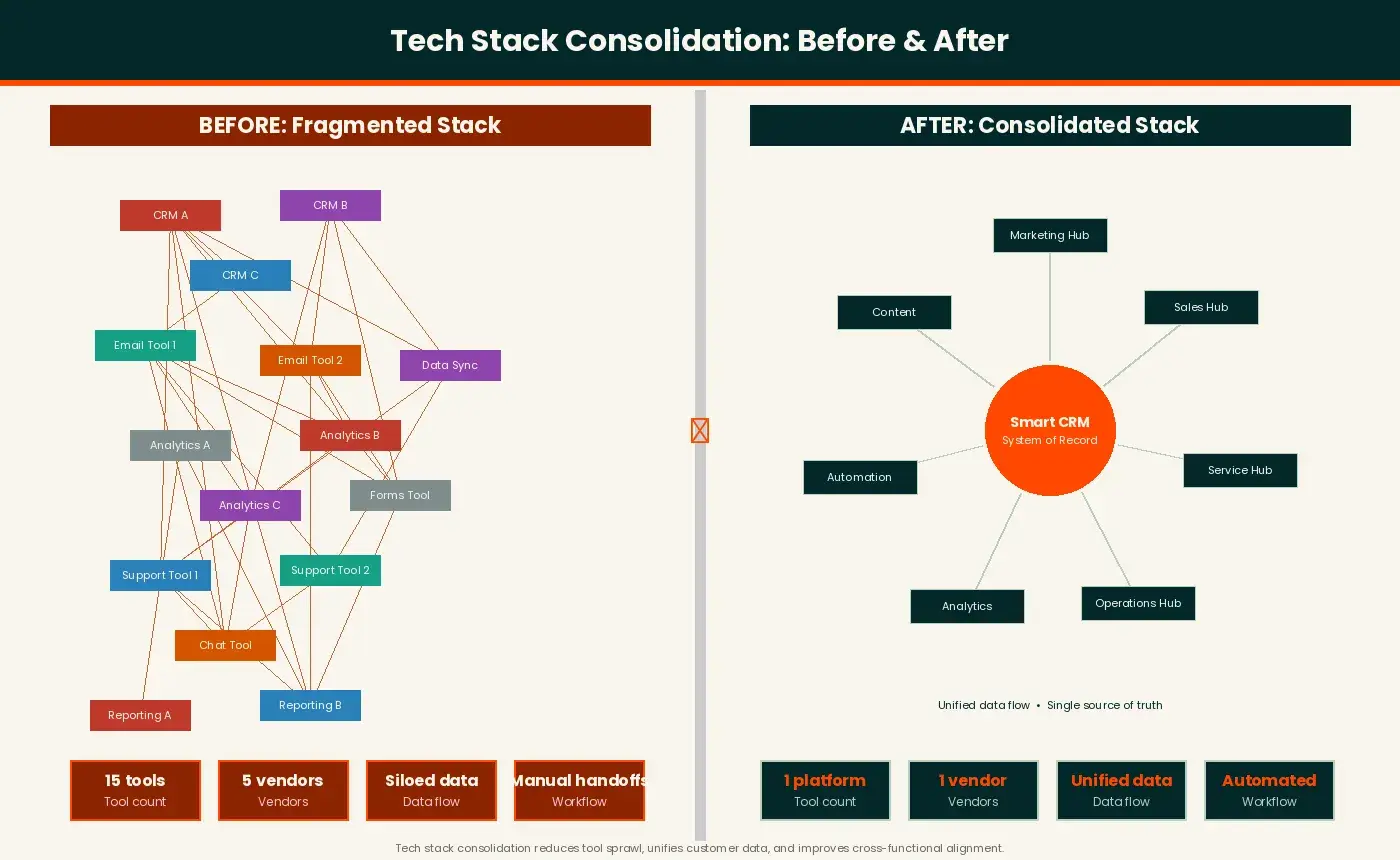
Tech stack consolidation represents a strategic imperative for modern enterprises, focusing on the systematic reduction of redundant software tools and the standardization of workflows on a smaller, more integrated suite of systems. This process extends far beyond mere cost-cutting, aiming instead to foster a unified operational environment where data flows seamlessly, customer-facing teams operate with a singular view of customer interactions, and automation spans the entire customer journey, eliminating the need for constant context rebuilding as customers transition between marketing, sales, and service touchpoints. At its core, successful consolidation establishes a robust Customer Relationship Management (CRM) system as the definitive system of record, serving as the central repository for all customer data, powering essential workflows, and acting as the undisputed source of truth for every department interacting with the customer.
The current landscape of digital enterprise is often characterized by what industry experts term "tool sprawl" or "SaaS sprawl." The rapid proliferation of Software-as-a-Service (SaaS) solutions over the past decade has made it easier than ever for departments, and even individual teams, to acquire and implement specialized software to address specific needs. While initially beneficial for agility and targeted problem-solving, this decentralized procurement often leads to a convoluted ecosystem of disparate applications. A 2023 report by Statista indicated that the average enterprise uses over 130 SaaS applications, a number that has steadily climbed year-over-year. This unchecked growth results in significant operational challenges, including fragmented data, redundant functionalities, increased security vulnerabilities, and complex, often fragile, integration requirements. Data silos become prevalent, hindering a holistic understanding of the customer and obstructing cross-functional collaboration. For instance, a customer’s interaction with a marketing campaign might be recorded in one tool, their sales conversation in another, and their support tickets in a third, making it nearly impossible for any single team member to access a complete historical overview without laborious manual reconciliation. This fragmentation not only degrades customer experience but also inflates operational costs through overlapping subscriptions and the extensive resources required for maintenance and custom integrations.
The strategic imperative for tech stack consolidation, therefore, moves beyond immediate financial savings, though these are often substantial. Industry analysts, including Gartner and Forrester, consistently highlight improved data integrity as a primary driver. When customer data resides in a single, authoritative CRM platform, inconsistencies are minimized, and all teams can report from the same accurate numbers. This unified data foundation empowers faster and more precise reporting, enhances the effectiveness of automation across the full customer lifecycle, and significantly elevates the customer experience by providing representatives with immediate access to comprehensive context. For example, a sales representative can instantly view a prospect’s engagement with marketing content, previous support inquiries, and past purchases, enabling more personalized and effective interactions. Furthermore, the simplification of the IT environment reduces the attack surface for cyber threats, enhancing overall data security and simplifying compliance efforts, a growing concern for Chief Information Security Officers (CISOs) globally. The operational gains – better data, streamlined workflows, fewer integration failures – can then be reinvested into core business execution, fostering innovation and competitive advantage.
Determining the opportune moment to initiate tech stack consolidation is crucial. While there isn’t a magic number of tools that triggers the need, several indicators signal that a fragmented tech stack is generating more friction than it resolves. Organizations frequently encounter challenges such as customer-facing teams lacking a unified view of interactions, requiring them to constantly switch between applications to gather context. Discrepancies in data across different systems lead to conflicting reports and undermine strategic decision-making. Essential automations fail to function across the entire customer journey, necessitating manual interventions. Furthermore, if IT and operations teams spend an inordinate amount of time on maintaining custom integrations or resolving data synchronization issues, or if the organization is struggling with escalating software costs for underutilized or redundant tools, consolidation becomes an operational necessity rather than a mere "nice-to-have." These symptoms collectively point to an inefficient digital infrastructure that impedes growth and agility.

The journey of tech stack consolidation is a methodical process that typically unfolds in several distinct phases, ensuring minimal disruption while maximizing long-term benefits. This transformation often mirrors a comprehensive digital overhaul, requiring meticulous planning and execution.
Phase 1: Comprehensive Audit and Strategic Alignment
The initial phase is foundational: a thorough audit of the existing technology landscape. This involves compiling a complete inventory of every software tool currently in use, encompassing both centrally procured systems and "shadow IT" or departmental subscriptions. For each tool, critical information must be documented, including its ownership, cost, renewal date, actual utilization rates, and its role in data flows and integrations. The key output of this phase is a master tool inventory that provides a clear, annotated snapshot of the organization’s digital ecosystem. Simultaneously, leadership alignment is critical. Presenting the audit findings to executive stakeholders, clearly outlining the challenges posed by the current sprawl, and establishing consensus on the overarching goals of consolidation – whether it’s enhancing customer experience, reducing operational overhead, or improving data governance – sets the strategic direction for the entire initiative. This alignment ensures that the project receives the necessary executive sponsorship and resources.
Phase 2: Defining the Core and Prioritizing Rationalization
With a clear inventory in hand, the next step is to categorize tools and strategically define the organization’s "system of record." This usually involves selecting a robust CRM platform capable of unifying contact, company, deal, and ticket data across all customer-facing functions. This chosen system of record will be the central hub for all customer data, powering workflows and acting as the single source of truth. Alongside this, rigorous data standards must be established, encompassing field naming conventions, lifecycle stage definitions, and deduplication rules, to ensure data quality and consistency across the new, integrated environment. Concurrently, tools within each category are evaluated against a consistent set of criteria, such as their strategic value, integration capabilities, vendor support, and cost-effectiveness. This evaluation helps identify quick wins – tools that are easy to retire or replace with minimal disruption – building momentum and freeing up immediate budget for more complex migrations.
Phase 3: Meticulous Migration and Seamless Integration
Once the core system of record is defined and tools for retirement or retention are identified, the focus shifts to planning and executing migrations. This phase demands meticulous attention to detail to prevent disruption to ongoing business operations. Before any tool is retired, a comprehensive data migration plan must be developed, including strategies for data cleansing, validation, and transfer. Crucially, a clear communication plan must be established to inform affected teams about upcoming changes, timelines, and expected impacts. Rollouts should be phased, often starting with pilot programs in specific departments or for particular use cases. This allows for early detection and resolution of issues before a broader deployment, minimizing risks and ensuring a smoother transition. The goal is to move data and workflows to the new, consolidated platform without losing critical information or causing significant downtime.
Phase 4: Empowerment, Adoption, and Continuous Governance
The success of consolidation ultimately hinges on user adoption. Even the most perfectly consolidated stack will fail if teams revert to old tools due to lack of training or understanding. Therefore, comprehensive training programs are essential for all affected teams, focusing not just on the technical aspects of the new tools but also on the updated workflows and the benefits they bring. Regular monitoring of adoption rates, feature utilization, and key business outcomes – such as improved conversion rates, faster deal velocity, and enhanced customer satisfaction – provides critical feedback on the effectiveness of the consolidation efforts. Beyond the initial rollout, a robust governance framework is indispensable to prevent the recurrence of tool sprawl. This includes establishing a formal intake process for all new software requests, assigning category ownership for managing renewals and utilization, implementing a regular review cadence for existing tools, and documenting clear data and integration standards. A living tool inventory, continuously updated, serves as the backbone for ongoing governance and future optimization cycles.

Navigating the hurdles inherent in tech stack consolidation requires proactive strategies. Stakeholder resistance is a common challenge, as teams may be deeply accustomed to existing tools and workflows. Overcoming this requires transparent communication about the benefits, involving key users in the decision-making process, and providing extensive training and support during the transition. Legacy systems and niche "edge cases" can also pose significant challenges, as some older tools may perform unique functions that are difficult to replicate in newer, consolidated platforms. In such instances, a careful cost-benefit analysis is needed to determine whether to retain the legacy tool as a deliberate exception with a clear integration strategy or invest in developing a workaround within the core platform. Integration gaps, where anticipated connections between systems prove more complex than expected, often necessitate custom development or the use of integration platform as a service (iPaaS) solutions. Contract timing can also complicate matters, as organizations may be locked into long-term agreements for tools they wish to retire. Strategic planning around renewal dates and negotiating early termination clauses can mitigate this. Finally, dirty data – inconsistencies, duplicates, or incomplete records – is a pervasive issue. Migrating bad data into a new, clean system simply perpetuates the problem; therefore, a comprehensive data cleansing initiative must precede any migration efforts. Ignoring the critical input of procurement, security, and finance stakeholders can also lead to downstream problems, underscoring the need for cross-functional collaboration from the outset.
To prevent SaaS sprawl from re-emerging post-consolidation, robust governance mechanisms must be embedded into organizational culture. An intake process for all new software requests, including free trials, is paramount. This brief but mandatory review should cover the business case, cost, integration requirements, and whether similar functionality already exists within the approved stack. Assigning clear category ownership ensures accountability, with designated individuals responsible for renewals, utilization reviews, and new requests within their specific tool categories. Implementing a renewal-based review cadence, typically quarterly, allows for proactive assessment of tool utilization against licensed seats, flagging underperforming assets before contract renewal. Documented standards for data, integrations, and an approved vendor list must be readily accessible and integrated into onboarding processes for new hires in operations, IT, and marketing. Finally, maintaining a living, updated tool inventory serves as the organization’s governance record and a baseline for future optimization efforts, ensuring the tech stack remains agile, efficient, and aligned with strategic objectives.
In conclusion, tech stack consolidation is no longer merely an IT project but a strategic business initiative essential for cultivating agility, enhancing customer experience, and securing a competitive edge in an increasingly digital marketplace. By systematically streamlining digital operations, organizations can unlock significant efficiencies, improve data integrity, and empower their teams with a unified, context-rich view of their customers. While the journey presents challenges, a phased, well-governed approach—from initial audit and strategic alignment to meticulous migration and continuous oversight—ensures that businesses can build a scalable, secure, and future-ready technology foundation, paving the way for sustained growth and innovation. The investment in a consolidated tech stack is an investment in the foundational strength and responsiveness of the entire enterprise.