Williams-Sonoma Inc. has announced a strong performance in its fiscal second quarter ended August 2, 2023, with net revenue climbing 6.7% year-over-year to $1.96 billion. This growth was achieved despite a persistently stagnant housing market, underscoring the company’s resilience and strategic diversification. A key driver of this success has been the significant expansion of its artificial intelligence (AI)-powered shopping tools, including the recent launch of "Otto," an AI assistant now active on the Pottery Barn website, and the continued evolution of "Olive" on the Williams Sonoma platform.
The company’s financial report revealed that e-commerce comparable revenue saw a healthy increase of 6.5%, slightly outpacing the 5.5% growth observed across its brick-and-mortar stores. This trend highlights a growing consumer preference for online shopping within the home furnishings sector, a shift Williams-Sonoma Inc. has been proactively addressing. The conglomerate, which operates under several well-established brands including Williams Sonoma, West Elm, Pottery Barn, and Pottery Barn Kids and Teen, reported a total comparable brand revenue increase of 6.2% for the quarter. This growth was broadly distributed across its portfolio, with every brand contributing positively to the overall performance. Notably, the company’s business-to-business (B2B) operations and its emerging brands emerged as significant growth engines, both achieving double-digit expansion.
This impressive revenue growth occurred within a challenging economic landscape for the broader home furnishings industry, which has largely remained flat. Furthermore, the company navigated the impact of tariffs, which have historically weighed on profit margins. In a significant financial development during the second quarter, Williams-Sonoma Inc. successfully recovered approximately $200 million in refunds and interest related to previously paid tariffs, providing a substantial boost to its earnings.
Williams-Sonoma Inc. holds a significant position in the North American e-commerce landscape, ranking 22nd in Digital Commerce 360’s Top 1000 Database, which tracks the largest online retailers by annual e-commerce sales. Moreover, the company’s commitment to technological innovation is recognized by its 306th position in Digital Commerce 360’s inaugural AI Rankings, reflecting its strategic integration of artificial intelligence into its business operations.
AI Assistants Drive Enhanced Customer Experience and Sales
The company’s strategic investment in AI-powered shopping tools is yielding tangible results, particularly in elevating the online customer journey. CEO Laura Alber emphasized that the company is leveraging AI to "drive sales, improve service, and make our teams more effective." This approach aligns with the broader industry trend of utilizing AI to personalize customer interactions and optimize operational efficiency.
Building upon the successful introduction of "Olive," an AI assistant launched on the Williams Sonoma website last year, the company rolled out "Otto" across its Pottery Barn brands earlier this month. Both AI assistants are designed to offer personalized product recommendations and facilitate seamless connections with the company’s complimentary design services.
The impact of "Olive" has been particularly striking. Chief Technology and Digital Officer Sameer Hassan reported that since the beginning of the year, customer engagement with "Olive" has surged by an impressive 700%. The revenue directly attributed to the assistant has also seen a remarkable 620% increase. Critically, customers who interact with "Olive" demonstrate a conversion rate three times higher than that of other online shoppers, indicating the AI’s effectiveness in guiding purchasing decisions.
"Otto" is exhibiting similar promising trends, despite its recent launch. Hassan noted that over 70% of customer interactions with "Otto" have been successfully resolved without the need for human intervention, showcasing its efficiency in handling customer inquiries. Hassan elaborated on "Otto’s" capabilities, stating, "Otto will help you narrow down the right piece for your space. It will coordinate items that go together, sofa to rug. It works room by room. It knows rug sizing, outdoor materials, the way that our associates do." The AI assistant is also equipped to schedule design consultations and seamlessly transfer customers to human designers when necessary.
Beyond these customer-facing tools, Williams-Sonoma is implementing AI across its entire operational spectrum, including supply chain management, inventory control, merchandising, and corporate functions. Alber acknowledged that while AI cannot replicate the "tactile and taste-driven" aspects of their business, it significantly enhances operational capabilities. The company’s commitment to personalization is further underscored by the fact that a personalized online visit now generates approximately nine times the revenue of an average visit, a substantial increase from twice the revenue recorded last year. This demonstrates a clear correlation between personalized digital experiences and increased customer spending.
Market Share Gains Amidst Housing Market Stagnation
Williams-Sonoma Inc. has demonstrated its ability to capture market share and increase the proportion of products sold at full price, even without a recovery in the housing market. In the second quarter, the Williams Sonoma brand led the company’s major brands with a growth rate of 7.6%. West Elm followed with 6.4% growth, while Pottery Barn saw a 5.1% increase, and Pottery Barn Kids and Teen achieved 3.5% growth.
This expansion was observed across both direct-to-consumer (DTC) channels and traditional retail. At Pottery Barn, DTC sales showed particular strength, driven by Williams-Sonoma’s renewed focus on product discovery, compelling storytelling, and high-quality photography, which now includes AI-generated imagery.
The impact of tariff refunds on the company’s financial performance was substantial. During the second quarter, these refunds boosted pretax earnings by approximately $117 million. This positive financial impact was achieved after accounting for $47.5 million allocated to reimburse vendors for tariff-related discounts and a $10 million contribution to employee 401(k) accounts, a gesture acknowledging their efforts during a challenging period.
In light of its strong performance and strategic initiatives, Williams-Sonoma Inc. has raised its fiscal year 2026 outlook. The company now anticipates net revenue growth between 4.7% and 7.2%, an upward revision from its previous forecast of 2.7% to 6.7%. The comparable brand revenue outlook has also been increased to a range of 4% to 6.5%, up from 2% to 6%. These projections are based on the assumption that current tariff structures will remain in place, with no significant improvements in interest rates or housing market turnover.
Alber expressed confidence in the company’s ability to thrive irrespective of market conditions, stating, "A strong national real estate market with more turnover would certainly be a tailwind for us. But I believe that we have now proven that our business can succeed regardless of the housing market." This statement reflects a strategic pivot towards building a more robust and adaptable business model.
Emerging Brands and B2B Operations Fuel Future Growth
Williams-Sonoma’s strategic diversification into emerging brands and its robust B2B segment continue to be significant contributors to its growth trajectory. The company’s three emerging brands – Rejuvenation, Mark & Graham, and GreenRow – each reported double-digit comparable growth in the second quarter, although specific percentages were not disclosed.
Rejuvenation experienced record sales across its cabinet hardware, bath, and lighting categories, fueled by accelerated customer acquisition. Mark & Graham saw strong performance driven by its personalized gift offerings, wedding products, corporate gifting initiatives, and the successful launch of its new dorm collection. GreenRow debuted its first collaboration with the New York Botanical Garden, featuring a collection of textiles, decor, and furniture inspired by the garden’s archives.
The company’s B2B division, which serves commercial clients and design professionals, achieved a notable 14.5% growth in its largest quarter by volume to date. Key projects during Q2 included supplying furnishings for Virgin Hotels in New York City, Signature Aviation at Miami Executive Airport, and various multi-family and restaurant developments across the United States. Williams-Sonoma is actively expanding its B2B reach into what Alber described as "underserved but high-growth markets," including cruise ships, senior living facilities, and student housing developments.
Looking ahead, Williams-Sonoma foresees significant potential for its B2B revenue to reach $2 billion in the coming years, though a specific timeline has not yet been established. The company also believes that Rejuvenation has the potential to become a $1 billion brand in its own right.
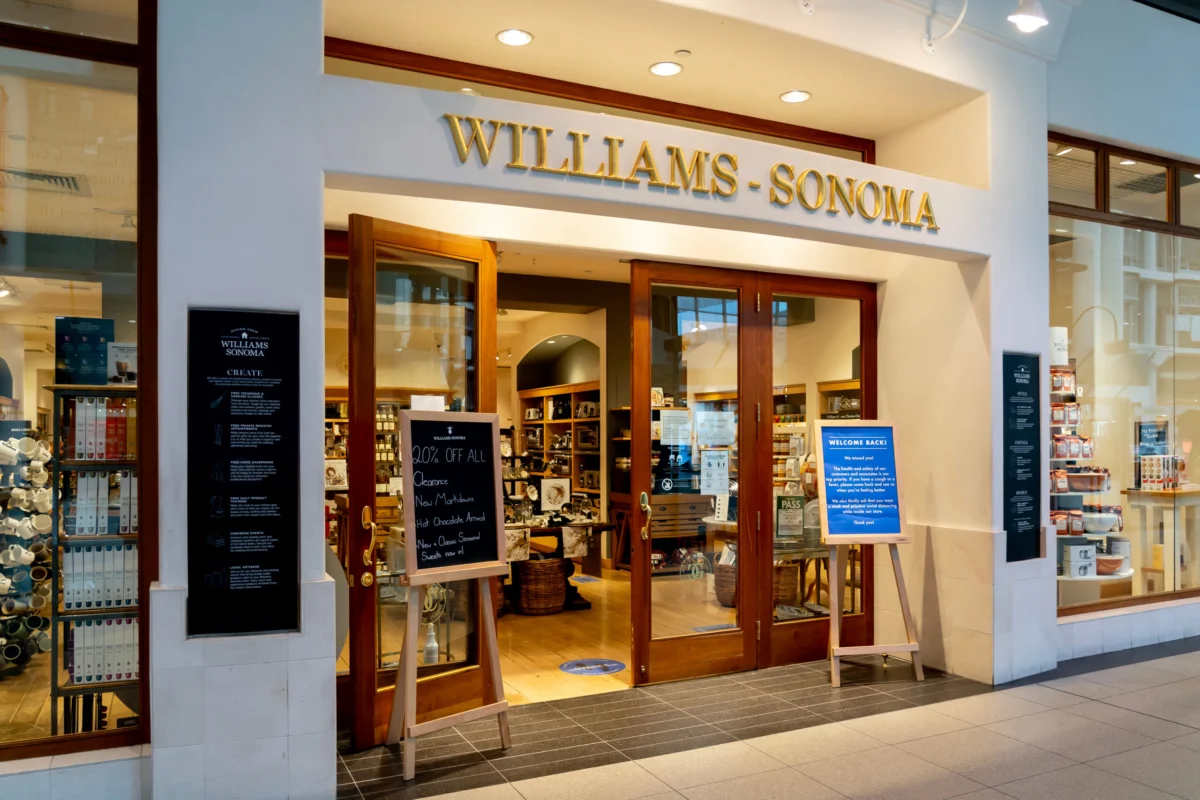
As of the end of the second quarter, Williams-Sonoma operated 508 company-operated stores globally. The company anticipates this store count to remain relatively stable through fiscal year 2026, with a projected annual growth rate of 1% to 3% commencing in fiscal year 2027. This measured approach to physical retail expansion, coupled with aggressive digital innovation, positions Williams-Sonoma for sustained success in the evolving retail landscape.