

The landscape of digital marketing is undergoing a significant transformation, with artificial intelligence (AI) emerging as a pivotal force in streamlining and personalizing consumer interactions. A recent development from AWeber, a long-standing player in email marketing, exemplifies this shift with the introduction of its AI Signup Form Builder. This innovation is poised to redefine how businesses, particularly small to medium-sized enterprises (SMEs), approach lead generation and customer acquisition, moving away from the often cumbersome and generic nature of traditional template-based form creation towards a more intuitive, efficient, and deeply customized experience.
For years, the creation of signup forms—essential tools for building email lists and capturing leads—has largely relied on templates. Marketers would browse galleries, select a pre-designed option, and then embark on a time-consuming process of customization. This typically involved adjusting fields, rewriting headlines, swapping colors, and rearranging layouts to align with their brand identity and specific offer. The inherent flaw in this approach, as many marketers have discovered, lies in its backward methodology: starting with a generalized solution and attempting to mold it into something unique. This often leads to compromise, inefficiency, and a final product that may still fall short of true brand integration and optimal conversion potential.
The Inherent Limitations of Traditional Form Templates
Templates, by their very design, aim for broad applicability. They are crafted to be versatile, appealing to a wide array of users across diverse industries. While this universality might seem advantageous, it paradoxically becomes their primary weakness when applied to specific business needs. Each template comes equipped with a generic headline, a default set of fields, and a layout optimized for no particular audience. This means a fitness coach offering a five-day email course on dog training might be presented with a form generically titled "Subscribe to our newsletter." Similarly, a business might receive a form with three fields when only one is necessary, or a multi-column layout when a minimalist, single-column design better suits their brand aesthetic.
The chasm between a generic template and a truly effective, brand-aligned signup form necessitates substantial manual effort. This "gap" requires significant investment in copywriting to tailor messaging, design decisions to ensure visual consistency, and field logic adjustments to capture relevant information without overwhelming the user. Often, by the time the form genuinely reflects the business’s identity and offer, marketers have spent more time customizing it than they might have by building from scratch with a clear, specific vision. Furthermore, templates can inadvertently anchor creative thinking. By providing a pre-existing structure, they can inadvertently limit innovation, encouraging adaptation around someone else’s framework rather than fostering a ground-up design process tailored precisely to the target audience and marketing objectives. This can stifle originality and potentially lead to missed opportunities for truly impactful engagement.
The Dawn of AI-Powered Form Generation
The advent of AI form builders, such as AWeber’s new offering, fundamentally alters this paradigm. Instead of starting with a template gallery, these intelligent systems initiate the form creation process with the user’s specific requirements. This represents a significant leap forward, promising to reduce development time, enhance brand consistency, and optimize conversion rates through hyper-personalization. The core principle is simple yet revolutionary: describe what you need, provide inspiration, or answer a few guided prompts, and the AI generates a form built precisely for your business from the outset. This eliminates the tedious template hunt and the need to overwrite generic copy, allowing businesses to deploy highly relevant and effective forms in a fraction of the time previously required.

A Deeper Look at AWeber’s AI Signup Form Builder
AWeber’s implementation of this technology offers three primary methods for creating forms, each leveraging AI to deliver tailored results:
-
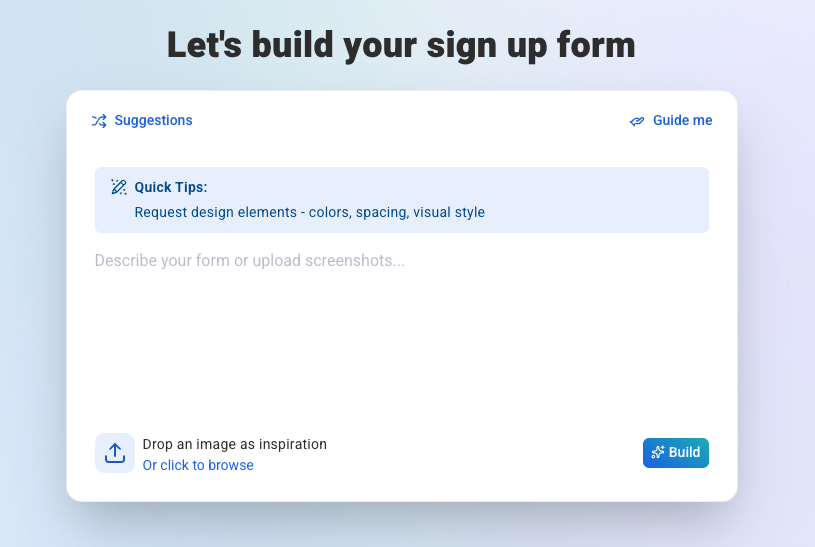
Descriptive Prompting: Users can articulate their needs in natural language, much like interacting with a human designer. For example, a user might type, "A simple one-field form for a free guide on meal planning for busy parents." The AI builder then processes this input, generating a form with a relevant headline (e.g., "Unlock Your Free Meal Planning Guide!"), appropriate fields (e.g., "Email Address"), and copy that resonates with the stated offer and target audience. This method harnesses advanced natural language processing (NLP) to interpret user intent and translate it into a functional design, ensuring contextual relevance from the first iteration.
-
Screenshot-Based Inspiration: Recognizing that visual inspiration often sparks creativity, the builder allows users to upload a screenshot of any form they admire online. The AI then analyzes the uploaded image, identifying key design elements such as layout structure, color schemes, font styles, and field arrangements. It uses these cues as creative inspiration, producing a version customized to the user’s specific brand guidelines and content requirements. This means businesses can capture the essence of a compelling design without engaging in manual replication, significantly accelerating the design process while maintaining originality. The AI interprets the structural cues and applies them intelligently, rather than simply copying.
-
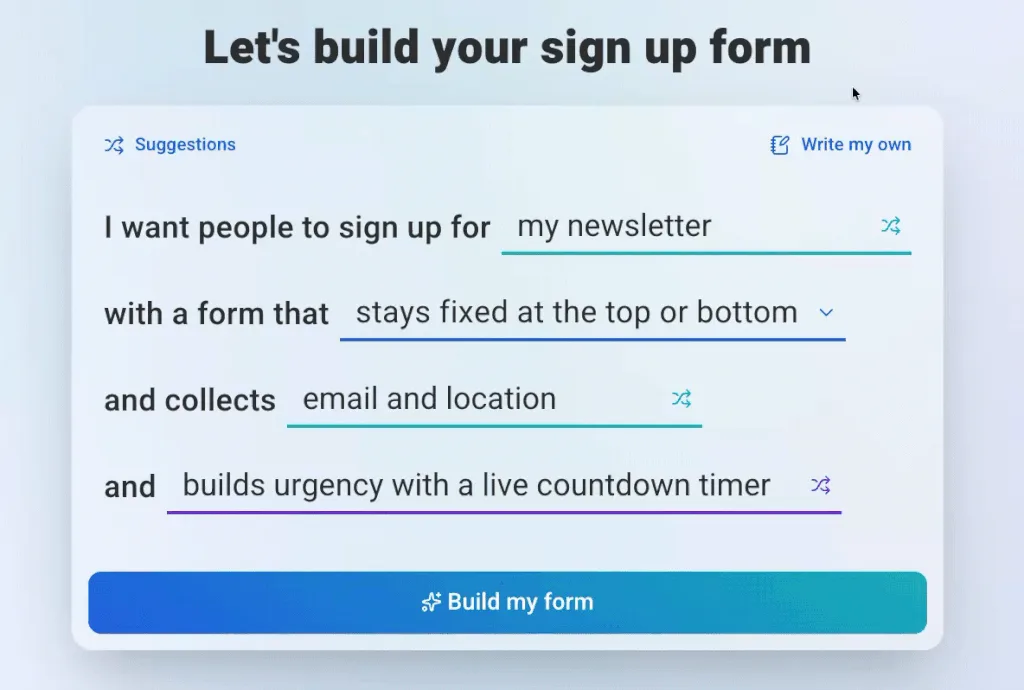
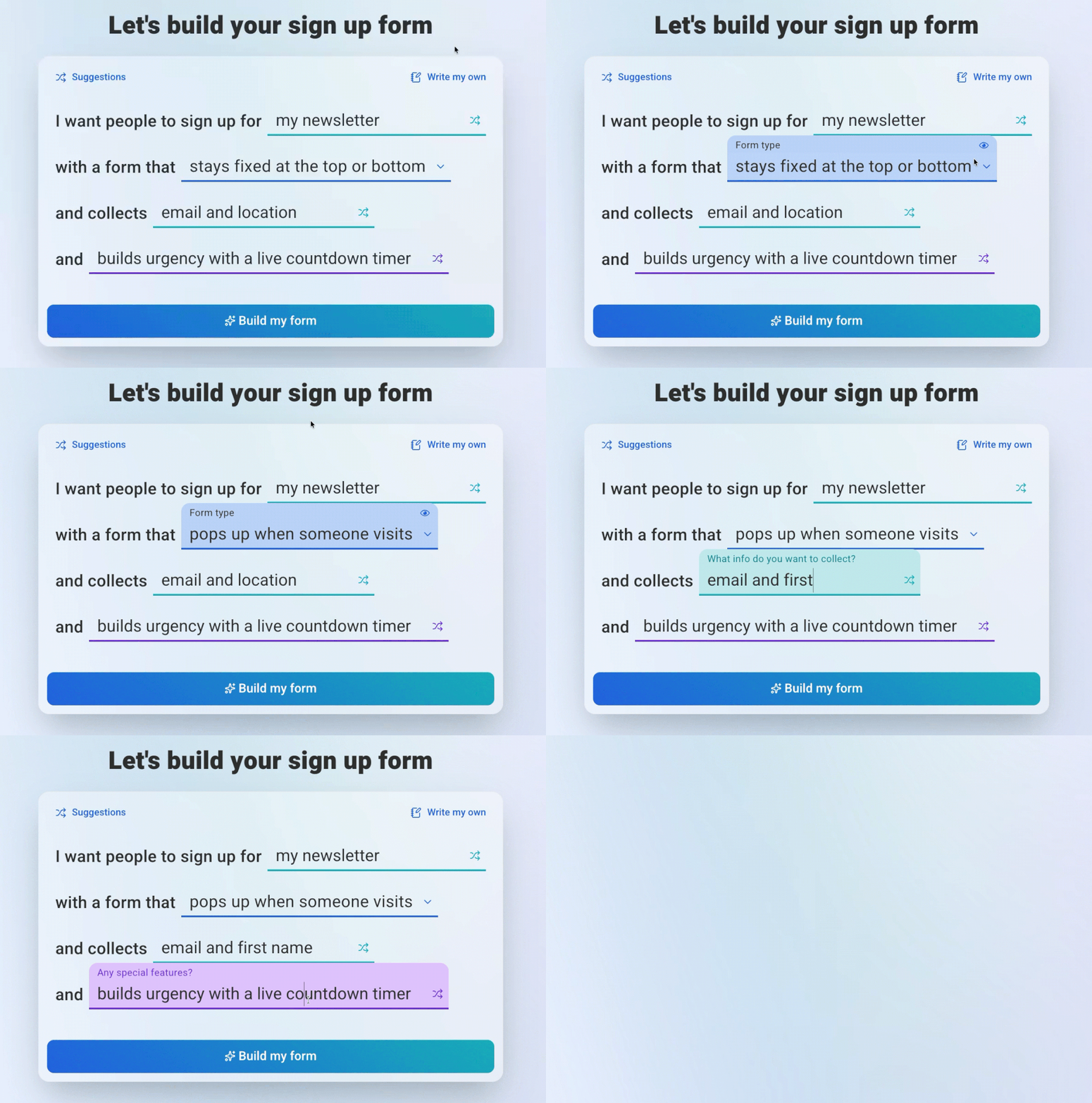
Guided Prompts: For users who prefer a more structured approach, the builder offers a series of guided prompts. By answering a few targeted questions about their audience, the specific offer, and their overarching goals, the AI system assembles a form from these precise inputs. This method ensures that every element of the form, from the call-to-action to the required data fields, is purpose-built to achieve the user’s objectives. Specific inputs invariably lead to specific, optimized outputs, reducing guesswork and enhancing the strategic alignment of the form.
Crucially, the interaction with the AI builder doesn’t end with the initial generation. Users can refine the form through conversational commands, telling the AI to "shorten the headline," "add a checkbox for newsletter opt-in," or "change the button text to ‘Get My Free Guide Now!’" The form updates dynamically in real-time, eliminating the need to navigate complex settings panels or drag-and-drop interfaces. This plain-language editing capability democratizes form design, making sophisticated customization accessible to users regardless of their technical proficiency. The speed and quality of a form created using this AI Form Builder are reported to be significantly superior to traditional drag-and-drop methods, offering an unmatched level of efficiency and precision.
The Strategic Advantage: Customization vs. Compromise
The fundamental difference between an AI builder and a template gallery boils down to a choice between customization and compromise. With a template gallery, businesses are confined to a fixed set of options. If the perfect form for their brand and offer doesn’t explicitly exist within that gallery, they are forced to compromise, settling for something "close enough" and then spending valuable time trying to bridge the gap.
In contrast, an AI builder operates without a fixed set of options. The form is generated dynamically from the user’s unique inputs. This means the headline is precisely matched to the offer, the field count is optimized for the specific ask, and the copy authentically reflects the brand’s voice rather than sounding like a generic product demonstration. Consider the distinct needs of a fitness coach versus a B2B SaaS tool. A template gallery might offer both the same starting point, forcing extensive modifications. An AI builder, however, begins with the specific description provided by each user, ensuring that the generated form inherently resonates with their target audience and business objectives from the very first draft. This level of intrinsic customization fosters stronger brand identity and improves the user experience, which are critical factors in conversion success.
Supporting Data and Industry Context
The shift towards AI in marketing is not an isolated phenomenon but part of a broader industry trend. According to various market research reports, the global artificial intelligence in marketing market is projected to grow significantly, driven by the increasing demand for personalized customer experiences and operational efficiency. Studies by companies like Gartner and Salesforce indicate that personalization can increase conversion rates by up to 10-15%, and companies leveraging AI for marketing automation report significant reductions in manual labor, sometimes upwards of 30-40%. Form abandonment rates, a perennial challenge for marketers, often hover around 60-80%. A well-designed, concise, and highly relevant form generated by AI, which respects user time and intent, has the potential to dramatically reduce these figures.
Historically, email marketing signup forms evolved from basic HTML inputs in the early days of the internet to sophisticated visual builders with extensive template libraries in the 2000s and 2010s. While these builders offered greater flexibility than coding from scratch, they still placed the burden of design and copywriting heavily on the user. The current wave of AI-powered tools represents the next evolutionary step, leveraging advancements in machine learning and natural language processing to automate and optimize these tasks. This progression reflects a wider movement in technology to make complex processes more accessible and efficient for end-users, especially critical for small businesses with limited marketing resources.
Implications for Small Businesses and the Broader Marketing Landscape
The implications of AI signup form builders extend far beyond mere convenience. For small businesses and solo entrepreneurs, these tools democratize access to sophisticated marketing capabilities that were once the exclusive domain of larger enterprises with dedicated design and development teams. They enable these businesses to:
- Compete More Effectively: By creating professional, high-converting forms quickly, small businesses can level the playing field, presenting a polished and credible online presence.
- Optimize Resource Allocation: Time previously spent on tedious form customization can now be redirected to core business activities, content creation, or customer engagement.
- Enhance Brand Consistency: AI ensures that forms align perfectly with existing brand guidelines, fostering a cohesive and trustworthy brand image across all digital touchpoints.
- Improve Conversion Rates: Personalized forms that speak directly to the user’s needs and offer relevant value are inherently more likely to convert visitors into subscribers or leads.
- Accelerate Campaign Launches: The ability to generate and deploy forms in minutes means marketing campaigns can be launched faster, allowing businesses to capitalize on timely opportunities.
For the broader marketing landscape, AI form builders signal a continued shift towards intelligent automation and hyper-personalization. Marketing experts anticipate that such tools will become standard, pushing the industry to focus more on strategic thinking and less on manual execution. Industry analysts, if queried, might express enthusiasm for the efficiency gains and the potential for improved data quality that comes from well-designed, specific forms. They would likely emphasize how this technology empowers marketers to be more creative and strategic, by freeing them from repetitive design tasks.
When Templates Still Hold Value: Inspiration, Not Imitation
Despite the undeniable advantages of AI-powered generation, traditional templates are not rendered entirely obsolete. They retain significant value in one specific area: inspiration. If a marketer encounters a form online that captures their attention, perhaps due to its innovative layout, compelling call-to-action (CTA), or efficient field structure, that observation is worth preserving. The goal is not to copy it verbatim, but to understand what elements made it effective and why it resonated.
This is where the screenshot feature of AI Signup Form Builders truly shines. Users can capture a screenshot of any inspiring form, upload it to the AI builder, and then describe their own business and offer. The AI system then intelligently extracts the structural and aesthetic cues from the admired design and applies them to generate a brand-new form that is entirely unique but imbued with the desired inspirational elements. This approach provides the creative shortcut without the pitfalls of direct imitation or brand mismatch. It allows businesses to leverage external design brilliance as a springboard for their own customized solutions, fostering innovation without compromising brand integrity.
Building the Future of Digital Engagement
The introduction of AWeber’s AI Signup Form Builder represents a significant milestone in the evolution of digital marketing tools. It heralds an era where the creation of essential marketing assets like signup forms is no longer a laborious, compromise-laden process, but an intuitive, efficient, and deeply personalized experience. By enabling businesses to build their first form in minutes simply by describing their offer, the technology removes barriers to entry and empowers marketers to focus on strategy and engagement rather than technical execution.
As these AI capabilities become more sophisticated, the future of digital engagement promises even greater levels of personalization and automation. We can anticipate forms that dynamically adapt based on user behavior, deeper integration with CRM systems for richer lead profiling, and predictive analytics that optimize form elements for maximum conversion. The form is ready when the business is, and the subscribers it collects will seamlessly integrate into welcome email campaigns, initiating personalized journeys from the moment they sign up. This ongoing innovation underscores a fundamental truth in digital marketing: the relentless pursuit of efficiency, relevance, and a superior customer experience remains paramount. AWeber’s commitment to offering a free trial for 14 days, allowing users to experience this AI-generated form building firsthand, reflects confidence in a technology poised to reshape how businesses connect with their audiences.








