Despite its robust feature set and widespread adoption, a significant portion of Klaviyo’s customer base is reportedly leaving the platform, primarily driven by dissatisfaction with its billing practices and customer support. A comprehensive analysis of 300 customer reviews from G2, Trustpilot, and Capterra, collected between late 2024 and mid-2026, reveals that pricing structure, particularly the active-profile billing and additional charges, constitutes the most prevalent complaint, appearing in nearly 40% of all reviewed feedback. This deep dive into user experiences uncovers a complex interplay of cost concerns, technical frustrations, and trust issues that are compelling businesses to seek alternative solutions.
The study, which meticulously tagged and categorized user feedback, paints a clear picture of the friction points experienced by Klaviyo users. While the platform is generally acknowledged for its capabilities in email marketing and automation, particularly within the e-commerce sector, the findings suggest that operational aspects like billing transparency and responsive support significantly impact customer retention. Klaviyo, a prominent player in the marketing automation landscape known for its deep integration with e-commerce platforms like Shopify, faces a critical challenge in reconciling its billing model with customer expectations and ensuring robust, accessible support channels.
Methodology and Scope of the Comprehensive Review Analysis
To understand the underlying reasons for customer attrition, a total of 300 reviews were manually read and tagged, with an equal distribution of 100 reviews sourced from each of the three major review platforms: G2, Trustpilot, and Capterra. The timeframe for these reviews spanned from late 2024 to mid-2026, providing a recent and relevant snapshot of user sentiment. This period is significant as it covers a time when digital marketing tools, especially those for e-commerce, were undergoing rapid evolution and increased scrutiny.
Each review platform attracts a distinct demographic of users and, consequently, a different tenor of feedback. G2 reviews, often incentivized or seller-invited, tended to skew positive, framing complaints as trade-offs rather than outright flaws. Here, pricing and the platform’s learning curve were the most common points of discussion. Capterra, with a mix of incentivized and organic submissions, mirrored G2 but offered slightly more candid remarks on cost. Trustpilot, largely unprompted and a destination for users experiencing significant issues, presented a decidedly negative skew, with sharp criticisms predominantly focused on customer support and a pervasive lack of billing trust.
Reviews were systematically tagged for every complaint raised, meaning a single review could contribute to multiple complaint categories if it addressed more than one issue. This approach allowed for a comprehensive mapping of user grievances, which were subsequently grouped into seven overarching themes that emerged organically from the review content. This granular analysis provides a detailed breakdown of the specific areas where Klaviyo users encountered friction.
Top-Line Findings: The Seven Ranked Customer Complaints
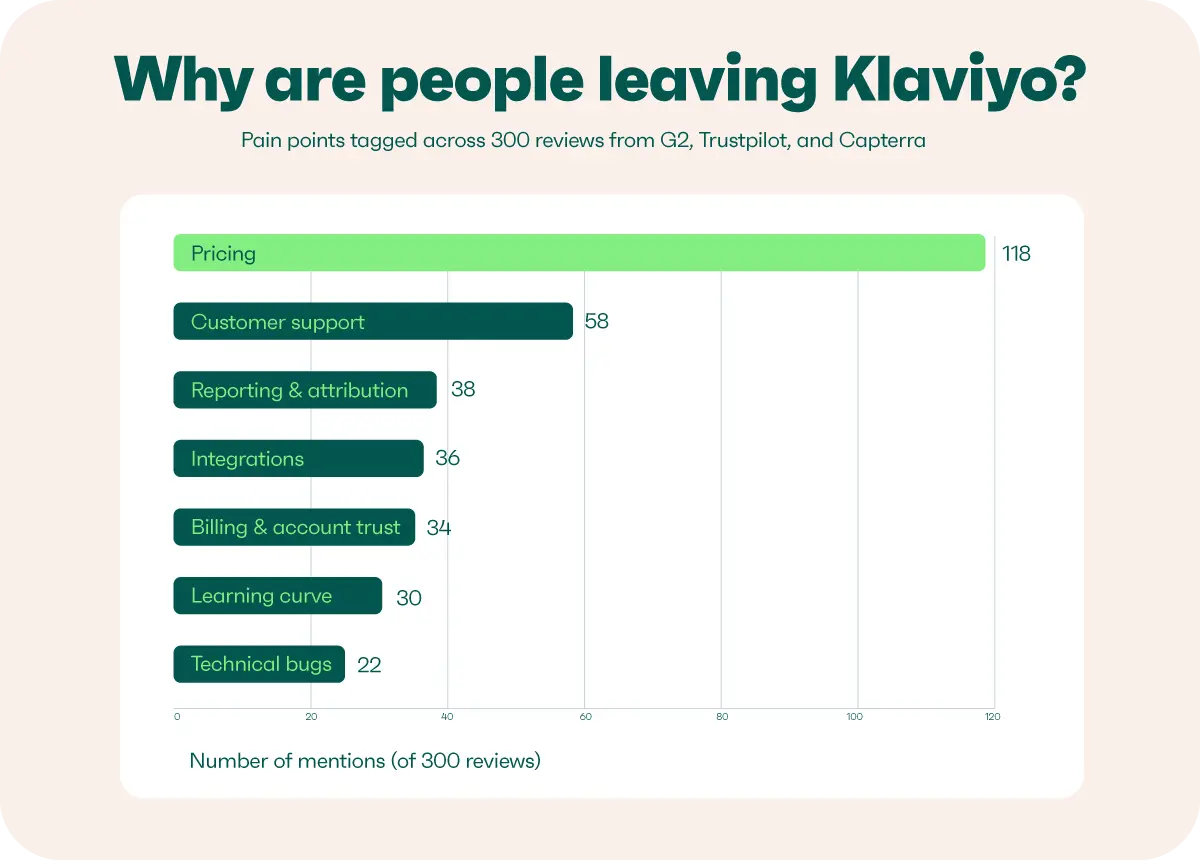
The analysis revealed a consistent pattern of complaints, with pricing leading the charge, followed by customer support quality. The breakdown of mentions across the 300 reviews highlights the disproportionate impact of certain issues:
- Pricing: 118 mentions (~39% of reviews)
- Support: 58 mentions (~19% of reviews)
- Attribution: 38 mentions (~13% of reviews)
- Integrations: 36 mentions (~12% of reviews)
- Billing Trust: 34 mentions (~11% of reviews)
- Learning Curve: 30 mentions (~10% of reviews)
- Technical Bugs: 22 mentions (~7% of reviews)
The stark contrast in complaint frequency, with pricing mentioned nearly twice as often as the next highest category (support), underscores its critical role in customer dissatisfaction. This data, visually represented in a bar chart in the original study, strongly suggests that while Klaviyo’s core functionality may be appreciated, its commercial model and operational support mechanisms are significant pain points.
Detailed Findings by Category: Unpacking User Grievances
1. Pricing Mechanics and Active-Profile Inflation (39% of Reviews)
The most significant driver of customer churn, pricing, stemmed less from the headline cost and more from Klaviyo’s specific billing mechanism: charging based on "active profiles." Active profiles include all emailable contacts, excluding only those who have explicitly unsubscribed or been suppressed. This model presents several challenges for businesses, leading to unexpected cost escalations.
Reviewers frequently cited issues such as:
- Bot Influx: Automated bots often bypass sign-up forms, creating numerous "active profiles" that are then billed to the customer, despite being illegitimate contacts.
- Tier Jumps from Usage Spikes: Even a temporary surge in marketing activity or list growth during a busy sales period could push an account into a higher billing tier, sometimes resulting in substantial, unforeseen cost increases (e.g., one reviewer noted a jump from $150 to $250 monthly).
- Re-suppression Lock-in: Once a profile is unsuppressed, Klaviyo’s policy prevents re-suppression for 90 days. This means businesses are charged for these profiles for three months, regardless of their immediate marketing utility.
- Snapshot Billing Discrepancies: Some Trustpilot reviewers reported being charged based on a previous, higher profile count, even after actively pruning their contact lists, leading to a sense of unfairness and distrust.
These concerns are exemplified by user comments such as a G2 reviewer, a graphic designer from a small business, who stated, "Klaviyo charges by the number of active profiles, not just the emails you send. As your list grows, the bill jumps significantly." Another Trustpilot user from Germany recounted, "We have barely used Klaviyo for email sending over the past few months, yet our monthly bill suddenly jumped from $150 to $250, thousands of fake profiles were automatically created via the Shopify integration." These firsthand accounts highlight the tangible financial impact and frustration caused by the billing model.
2. Customer Support and AI Chatbot Friction (19% of Reviews)
Customer support emerged as the second most frequent complaint, consistently drawing negative feedback. The primary issues revolved around the efficacy of support channels and the timeliness of responses:
- Ineffective AI Chatbots: Many users reported that the 24/7 chat support, often powered by an AI bot, was unable to resolve complex, account-specific issues, leading to dead ends and increased frustration.
- Delayed Email Responses: When escalating issues beyond the chatbot, users experienced significant delays, with email responses taking hours or even days, impacting critical business operations.
- Inconsistent Advice: Several reviewers noted receiving contradictory information from support staff compared to published documentation, or simply receiving unhelpful advice that prolonged problem resolution.
A Capterra reviewer, a Digital Producer, articulated this frustration: "When you contact Klaviyo support, staff give information that contradicts their published documentation and often don’t give the correct advice at all, resulting in going around in circles trying to get issues resolved." Another Trustpilot reviewer from the UK bluntly stated, "Chat support available 24/7… chat support is an AI bot which is poorly trained." These comments underline a significant gap in the platform’s customer service infrastructure, where efficiency and accuracy are paramount for businesses reliant on their marketing tools.
3. Revenue Attribution and Integration Limitations (13% / 12% of Reviews)
Issues related to revenue attribution and platform integrations were closely linked, reflecting concerns about the accuracy of performance metrics and the flexibility of the platform.
- Inflated Revenue Reporting: A recurring complaint was that Klaviyo’s reported revenue figures often significantly exceeded those credited by independent analytics platforms like Google Analytics 4 (GA4) or by e-commerce platforms such as Shopify. This discrepancy led many users to distrust Klaviyo’s internal reporting and rely on external validation.
- Shopify-Centric Design: While Klaviyo is renowned for its strong integration with Shopify, users operating on other platforms or requiring broader data synchronization faced limitations. Several reviewers noted the need for third-party integration tools to connect essential data sources, such as Google Sheets, indicating a lack of native flexibility.
- Lag in Industry Developments: Some customers felt that Klaviyo was lagging behind industry innovations, particularly in the rapidly evolving field of AI, limiting their ability to implement advanced marketing strategies.
A G2 reviewer from a small business captured the attribution issue: "I have issues with the reporting/attribution, where the revenue is often massively inflated compared to GA4/Shopify attribution." Regarding integrations, a Capterra developer explained, "For example, we needed to integrate Google Sheets, which is where we store many of our customer emails (fed in through Facebook forms). We had to download a separate integration tool…" These observations point to a platform that, while powerful within its core ecosystem, struggles to meet the diverse integration and analytical needs of a broader user base.
4. Billing Trust and Secondary Complaints
A lack of trust in billing practices, coupled with other technical and usability issues, rounded out the list of complaints.
- Billing Trust Issues (11%): This category encompassed serious allegations, including unnotified account suspensions and subsequent data deletion, difficulties in downgrading service tiers, and even claims of suppressed profiles being reactivated without user consent to inflate billing. A Trustpilot reviewer from the Netherlands reported, "They suspended my account without any notice. Not even an email… they delete all your data and profiles." Another Capterra reviewer from France alleged, "Réactivent des profils sans mon consentement afin d’augmenter la facturation (reactivates profiles without my consent to increase billing)." These claims, though disputed by Klaviyo, highlight a profound breakdown of trust.
- Learning Curve (10%): While less critical, the platform’s steep learning curve was mentioned 30 times. Users often conceded that the platform was powerful once mastered, but the initial onboarding and complexity presented a barrier.
- Technical Bugs (7%): Technical glitches, specifically the latency in the template editor due to its auto-save feature, were cited 22 times. A Trustpilot reviewer from Denmark described the issue: "The template editor text box is extremely slow – almost dysfunctional due to the auto-saving function. It can take hours to edit a template." Such issues significantly impede productivity and user experience.
Cross-Platform Comparison: G2 vs. Trustpilot vs. Capterra
The study also shed light on the varying sentiments across different review platforms, a phenomenon attributed to the nature of their user acquisition. G2 and Capterra, which often involve vendor-invited or incentivized reviews, tend to attract more positive feedback or complaints framed as minor inconveniences. In contrast, Trustpilot predominantly serves as an outlet for unprompted reviews, frequently from users who have encountered significant problems and wish to voice their dissatisfaction publicly.
The quantitative breakdown of complaints by platform confirmed these patterns:
- Pricing: Capterra led with approximately 48 mentions, followed by Trustpilot (~38) and G2 (~32). This indicates that while pricing is a universal concern, Capterra users were particularly vocal.
- Support: Trustpilot overwhelmingly dominated this category with roughly 45 mentions, far surpassing G2 (~6) and Capterra (~7). This stark difference underscores Trustpilot’s role as a platform for escalating customer service grievances.
- Attribution & Integrations: G2 showed the highest number of complaints for attribution (~19) and integrations (~17), suggesting that more technically savvy users or those evaluating the platform’s core performance metrics are more likely to use G2 for detailed feedback.
- Billing Trust & Technical Bugs: Trustpilot again led significantly in billing trust (~28) and technical bugs (~12), reinforcing its status as a forum for serious operational issues.
- Learning Curve: Capterra (~15) and G2 (~13) had more mentions regarding the learning curve, indicating that these platforms might attract a broader range of users, including those new to such sophisticated marketing tools.
These figures, while directional estimates from manual tagging, clearly illustrate the differing user journeys and expectations associated with each review platform.
Klaviyo’s Official Stance and Broader Industry Implications
It is crucial to note that Klaviyo representatives have publicly disputed several of the most serious allegations raised in customer reviews, including data deletion, unnotified account suspensions, and arbitrary bill increases. The company maintains that all account actions adhere strictly to its established system rules and settings, implying that any perceived issues are either misunderstandings of their policies or isolated incidents that do not reflect systemic problems. This official disclaimer, integrated into the study, underscores the complexity of interpreting user feedback, especially when it touches upon sensitive operational practices.
The findings of this study carry significant implications for Klaviyo and the broader marketing automation industry. For Klaviyo, a company that has recently entered the public market, managing customer satisfaction and addressing these critical pain points is paramount for maintaining its market position and fostering sustainable growth. High rates of churn due to billing complexities and support inadequacies can erode trust, damage brand reputation, and ultimately impact financial performance.
For businesses utilizing or considering marketing automation platforms, this analysis serves as a vital reminder of the necessity for thorough due diligence. Beyond evaluating feature sets and integration capabilities, prospective users must deeply scrutinize:
- Billing Models: Understand the nuances of how platforms charge, especially for contact lists, and anticipate potential cost escalations.
- Customer Support Structure: Investigate the availability, responsiveness, and efficacy of support channels, including the role of AI and human agents.
- Attribution Transparency: Verify how revenue and performance metrics are calculated and cross-reference them with independent analytics.
- Contractual Terms: Pay close attention to terms related to account management, data retention, and downgrading policies.
The prevalence of complaints regarding pricing and support in a sophisticated platform like Klaviyo highlights a universal challenge for SaaS providers: balancing advanced functionality with user-friendly commercial models and reliable customer service. As marketing technology continues to evolve, the demand for transparency, fairness, and responsive assistance will only intensify. Companies that can successfully navigate these challenges will be better positioned to retain customers and thrive in an increasingly competitive landscape. The insights from this study offer a valuable roadmap for both providers aiming to improve and businesses seeking to make informed decisions in their digital marketing investments.