The contemporary business environment mandates a shift from reactive social media engagement to proactive strategic listening. With an estimated 5.75 billion social media users projected by 2026, the digital sphere represents an immense, dynamic focus group operating 24/7. Without a predefined strategy, businesses risk being overwhelmed by data, failing to discern critical signals from noise, and missing opportunities to innovate, mitigate crises, or enhance customer experiences. A well-articulated social listening strategy provides the necessary focus, ensuring that efforts are aligned with overarching business goals and translate directly into measurable impact.
The Evolution of Digital Engagement: From Monitoring to Strategic Listening
The journey of brands on social media has evolved significantly since its nascent stages. Initially, the emphasis was predominantly on social media monitoring, a largely reactive process focused on tracking individual mentions, comments, and direct messages to facilitate immediate responses. This approach was crucial for customer service, community management, and addressing immediate concerns. However, as social platforms matured and the volume of user-generated content exploded, the limitations of monitoring became apparent. While effective for individual interactions, it often failed to reveal the broader patterns, underlying sentiments, or emerging trends that could inform strategic decision-making.
This realization paved the way for social listening – a more sophisticated, analytical discipline. Social listening transcends individual interactions by aggregating and analyzing vast datasets to identify overarching themes, sentiment shifts, and long-term trends. It seeks to answer "why" behind the "what," providing a panoramic view of public perception, industry discourse, and competitive positioning. This strategic shift allows businesses to move from merely tracking conversations to understanding their implications and leveraging them for growth.
The distinction is critical for any organization seeking to harness the full power of social media intelligence:

| Dimension | Social Monitoring | Social Listening |
|---|---|---|
| Focus | Individual mentions, comments, DMs | Patterns, themes, sentiment across many conversations |
| Scope | Primarily own brand, tagged mentions | Brand, competitors, industry, untagged conversations |
| Timeframe | Real-time, daily responses | Trends over weeks, months, quarters |
| Output | Reply, resolved ticket, escalation | Insight, recommendation, strategic shift |
| Typical Owner | Community, customer care teams | Social, insights, product, leadership teams |
While distinct, monitoring and listening are not mutually exclusive; they are complementary. Monitoring serves as a vital input into the broader listening program, providing the raw data of individual interactions that, when aggregated and analyzed, reveal strategic insights. A comprehensive strategy integrates both, ensuring prompt customer engagement while simultaneously extracting high-level intelligence for long-term planning.
Core Methodologies of Social Listening
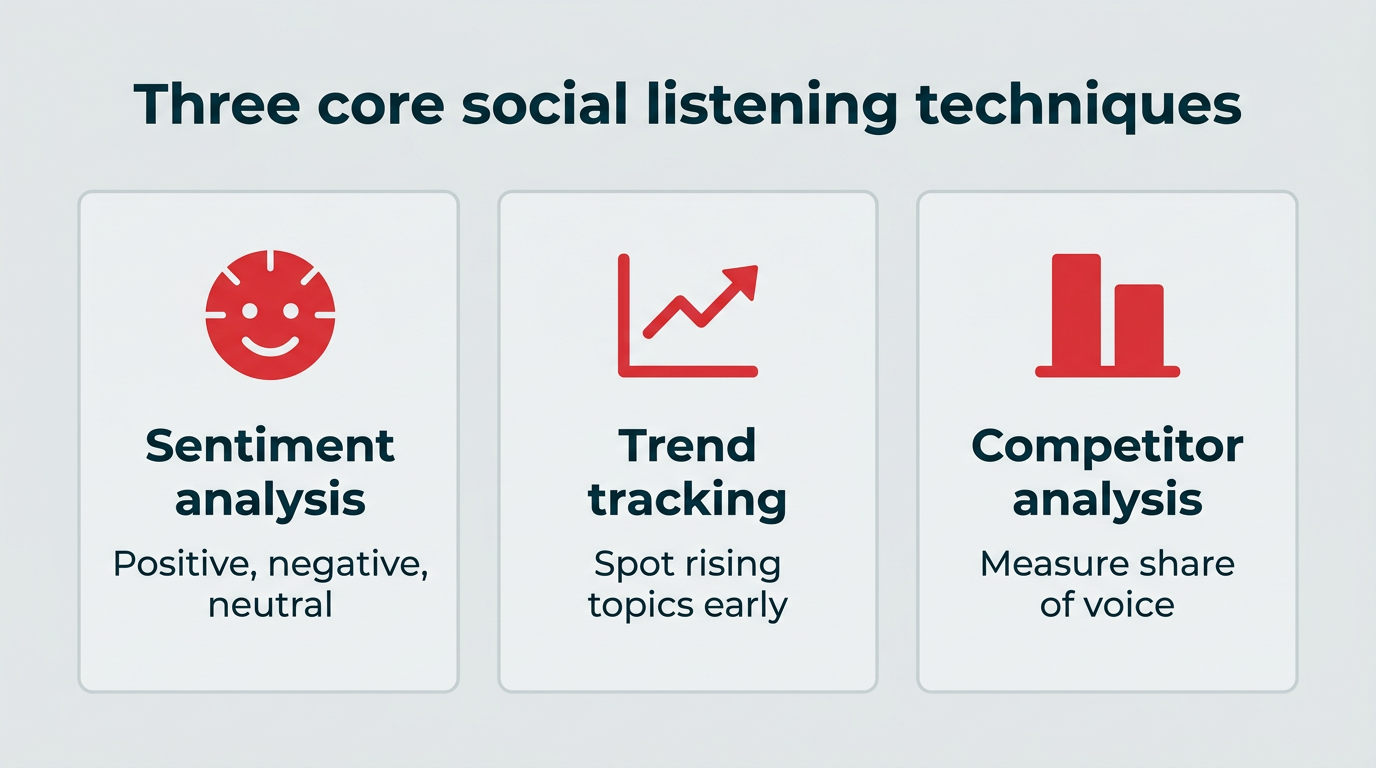
Effective social listening relies on a suite of analytical techniques designed to extract meaningful insights from unstructured social data. The three fundamental methodologies are sentiment analysis, trend tracking, and competitor analysis.
Sentiment Analysis: Unpacking Public Emotion
Sentiment analysis is the process of classifying the emotional tone behind social media conversations—typically as positive, negative, or neutral. Modern social listening tools leverage advanced natural language processing (NLP) and machine learning algorithms to interpret the nuances of human language, including sarcasm, irony, and context, across massive volumes of posts. This goes beyond simple keyword frequency to understand how people feel about a brand, product, or topic.
For strategic purposes, the true value of sentiment analysis lies in identifying trends rather than focusing on isolated posts. A stable sentiment score suggests consistent brand health, while a sudden dip or spike signals a significant event or shift in public perception. Pairing sentiment data with mention volume further amplifies its utility: a surge in mentions accompanied by falling sentiment often indicates a problem or crisis, whereas a volume spike with rising sentiment suggests a successful campaign or positive news. Insights derived from sentiment analysis are invaluable for reputation management, crisis communication, and refining marketing messages.
Trend Tracking: Anticipating the Next Wave
Trend tracking involves identifying topics, hashtags, and phrases that are gaining momentum within a specific industry or demographic before they reach peak popularity. This proactive capability is a cornerstone of strategic social listening, enabling businesses to anticipate market shifts rather than merely reacting to them. By spotting early signals, organizations can gain a significant competitive advantage.

Content teams, for instance, utilize trend data to inform content calendars, identifying nascent interests that resonate with their target audience. Product development teams can leverage these insights to detect demand for new features, product variations, or even entirely new offerings that consumers are discussing. The challenge lies in differentiating fleeting fads from sustained, impactful shifts. A consistent review cadence and sophisticated analytical tools are essential to ensure that identified trends represent genuine opportunities for strategic planning.
Competitor Analysis: Benchmarking and Opportunity Mapping
Competitor analysis, when integrated into a social listening strategy, involves applying the same analytical methodologies to rival brands. This entails tracking their social mentions, analyzing sentiment around their products and campaigns, and assessing their share of voice within the industry. This comparative perspective offers crucial intelligence for strategic positioning.
By monitoring competitor complaints, businesses can identify unmet customer needs or product gaps in the market that they can potentially address. Conversely, analyzing positive feedback directed at competitors reveals attributes or service elements that customers highly value within the category, providing benchmarks for improvement. Share of voice—the proportion of conversations about a specific brand relative to its competitors—offers a clear, quantifiable metric that resonates with leadership and provides a direct measure of market presence and brand salience. Strategic competitor analysis informs product innovation, marketing differentiation, and overall market strategy.
Crafting a Robust Social Listening Strategy: A Six-Step Framework
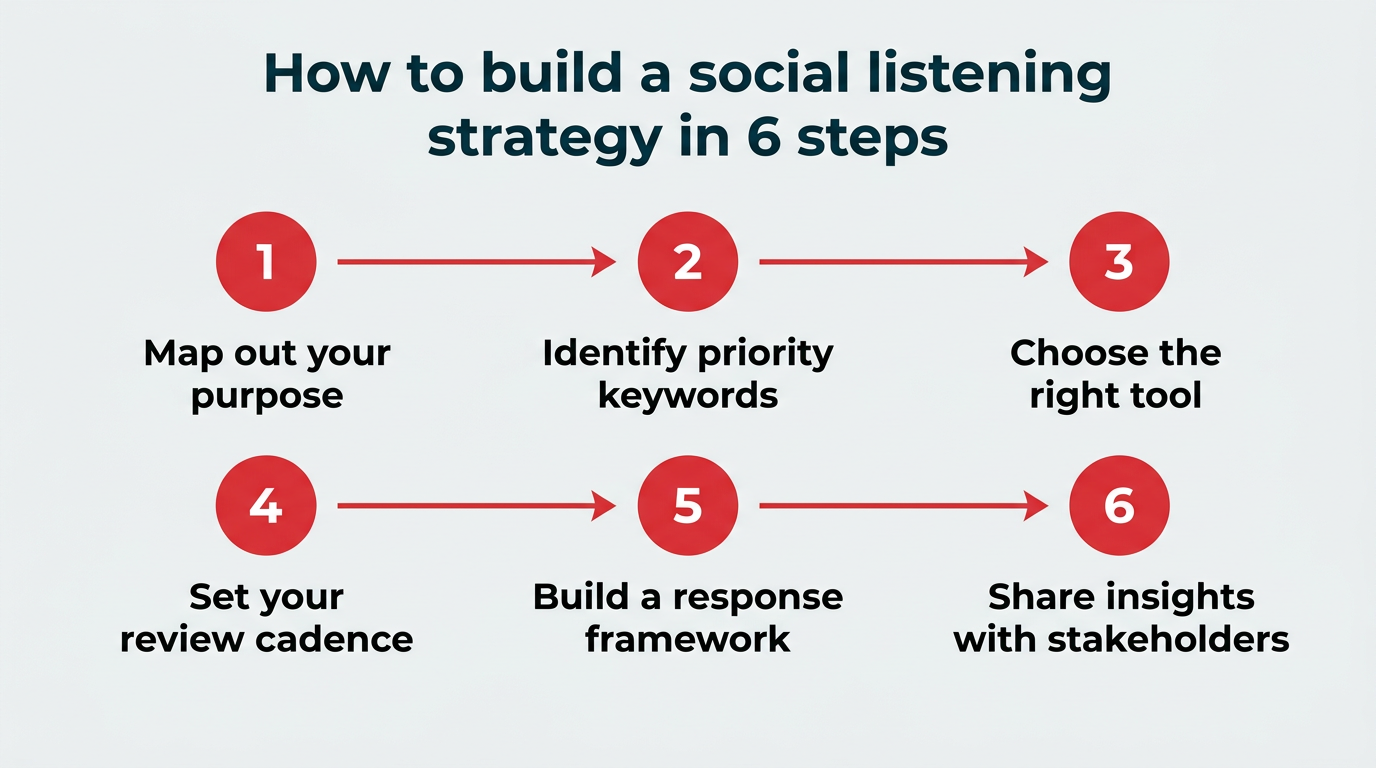
Building an effective social listening strategy requires a structured approach that moves from defining objectives to disseminating actionable insights. The following six steps outline a comprehensive framework:
1. Defining Strategic Purpose and Goals
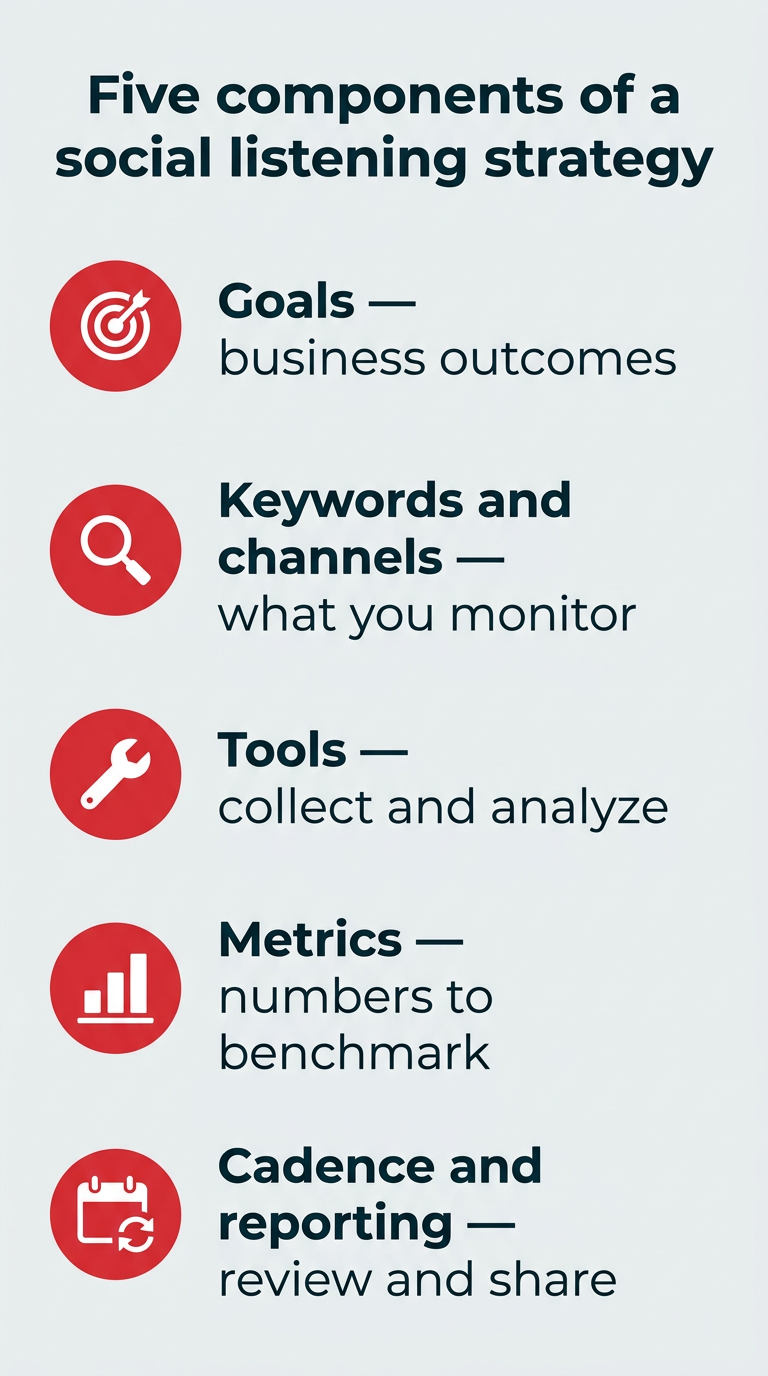
The foundational step involves clearly articulating the overarching goals for social listening, ensuring they are directly aligned with broader organizational objectives and key performance indicators (KPIs). This moves social listening beyond a mere marketing function to a cross-departmental intelligence source. Instead of simply "listening," the question becomes "what are we listening for, and why does it matter to our business?"
Potential strategic purposes include:
- Reputation Management: Tracking brand sentiment, executive mentions, and public perception to protect brand equity.
- Customer Experience (CX) Enhancement: Identifying pain points, unmet needs, and areas for improvement in the customer journey.
- Product Development & Innovation: Uncovering feature requests, market demand for new products, or feedback on existing offerings.
- Competitive Intelligence: Monitoring competitor activities, campaigns, and customer reactions to identify opportunities and threats.
- Crisis Prevention & Management: Detecting early warning signs of potential issues and managing reputational crises in real-time.
- Content Strategy & Ideation: Identifying trending topics, popular formats, and consumer interests to inform content creation.
- Influencer Identification: Discovering key opinion leaders and advocates within a specific niche.
- Campaign Performance Measurement: Assessing the immediate and long-term impact and sentiment around marketing campaigns.
By mapping social listening efforts directly to organizational KPIs—whether it’s reducing customer churn, increasing market share, or accelerating product development cycles—the strategy gains executive buy-in and demonstrates tangible business value.
2. Identifying Key Data Points: Keywords, Topics, and Channels
Once goals are established, the next step is to define precisely what needs to be tracked. This involves a comprehensive selection of keywords, phrases, hashtags, and topics relevant to the defined objectives, along with identifying the most pertinent social media channels.
For reputation monitoring, this would include brand names (including common misspellings), product names, executive names, and relevant hashtags. For competitive intelligence, the same categories would apply to top competitors. Industry-specific terms, broader niche conversations, and trending topics provide context and reveal wider market shifts. It’s crucial to consider variations in language, slang, and regional colloquialisms, especially for global brands.
Equally important is the selection of channels. While comprehensive listening tools can monitor across numerous platforms, prioritizing channels where the target audience is most active or where critical conversations occur (e.g., X for news, Reddit for niche discussions, TikTok for emerging trends) ensures efficient resource allocation and maximum impact.
3. Selecting the Optimal Social Listening Platform
Social listening generates vast quantities of data, making a robust, intelligent platform indispensable for collection, filtering, and analysis. The right tool transforms raw data into digestible, actionable insights.
Key considerations when evaluating platforms include:
- Data Coverage: The breadth of social networks, forums, blogs, and news sites the tool can monitor.
- AI-Powered Analytics: Capabilities like advanced sentiment analysis, topic clustering, and anomaly detection.
- Reporting & Visualization: Ability to generate clear, customizable reports and dashboards.
- Integration: Compatibility with existing CRM, marketing automation, or business intelligence systems.
- Scalability: Capacity to handle increasing data volumes and expand listening queries as needed.
- Multilingual Support: Essential for global brands tracking conversations in diverse markets.
- Historical Data Access: Ability to analyze past trends for comparative analysis.
Platforms like Hootsuite (with its Lumen integration), Sprinklr, Brandwatch, and Meltwater offer enterprise-grade solutions designed to meet complex social listening needs, providing features such as sentiment over time, influencer identification, and audience demographics.
4. Establishing a Review Cadence and Alert System
A critical element of a strategic listening plan is defining the frequency at which data will be reviewed and acted upon. This cadence varies based on the strategic goals. High-priority objectives, such as crisis management or customer service, demand daily or even real-time check-ins. For longer-term strategic decisions, such as product development or market trend analysis, weekly, monthly, or quarterly reviews may suffice.
Furthermore, implementing automated alerts within the chosen listening tool is crucial. These alerts can notify relevant teams of sudden spikes in mention volume, significant shifts in sentiment, or the emergence of critical keywords, ensuring that potential issues are identified and addressed promptly without relying solely on manual review schedules. This proactive alert system acts as an early warning mechanism, preventing minor issues from escalating into major crises.
5. Developing a Proactive Response Framework
Listening without a plan for action is merely data collection. A robust social listening strategy includes a predefined framework for how insights will be acted upon. Not every insight requires the same level of response, necessitating a tiered approach:
- Tier 1: Direct Action: Immediate responses to customer inquiries, complaints, or positive feedback. This often falls to community management or customer care teams.
- Tier 2: Internal Escalation: Insights requiring cross-functional collaboration, such as a recurring product bug identified by social sentiment, which would be escalated to product development or engineering.
- Tier 3: Strategic Shift: Broad trends or significant shifts in market perception that necessitate a change in marketing strategy, product roadmap, or corporate messaging, requiring input from leadership, PR, or legal departments.
For larger organizations, documenting approval workflows—specifying which responses require legal, PR, or executive sign-off—is essential to maintain compliance and consistency, preventing fast reactions from inadvertently creating further issues.
6. Translating Insights into Actionable Intelligence for Stakeholders
The ultimate value of social listening lies in its ability to inform and influence business decisions across the organization. This requires effectively communicating insights to relevant stakeholders in a clear, concise, and actionable manner. The 56% statistic indicating that many social marketers feel their bosses don’t understand social media underscores the importance of this step.
Tailoring reports to the audience is key:
- Executive Leadership: High-level summaries focusing on strategic implications, competitive standing, and ROI.
- Product Teams: Detailed feedback on features, bugs, and desired functionalities.
- Marketing & Sales: Insights on campaign performance, audience sentiment, and competitive messaging.
- Customer Service: Common pain points, recurring issues, and opportunities for proactive support.
Tools with AI layers, such as Hootsuite’s Wisdom, can significantly aid in this process by analyzing large volumes of data to surface key themes and shifts, allowing reports to lead with actionable findings rather than raw numbers. Measuring ROI involves logging the actions taken based on social insights and the demonstrable business outcomes, such as reduced crisis response times, improved campaign effectiveness, or product enhancements driven by customer feedback.

Real-World Applications: Case Studies in Strategic Social Listening
Examining how real brands implement social listening illuminates its transformative potential. These examples demonstrate how a clear purpose, targeted tracking, and an action plan yield tangible business results.
1. Yves Rocher: Product Development Guided by Consumer Sentiment
Yves Rocher, the French beauty brand, leveraged social listening to navigate the dynamic natural cosmetics industry. Their strategy focused on three core goals: understanding consumer perception of ingredients, identifying emerging trends in eco-friendly packaging, and adapting their brand messaging to evolving beauty ideals.
By continuously monitoring discussions around specific ingredients, Yves Rocher could anticipate shifts in consumer expectations regarding product formulations, allowing them to proactively adjust their offerings or develop new, compliant products. Their listening efforts also revealed consumer demand for sustainable packaging materials. Crucially, their social intelligence highlighted a broader cultural shift: consumers increasingly viewed beauty products as part of a self-care routine rather than merely a means to conceal perceived flaws. This insight prompted a significant revamp of their social media strategy, repositioning the brand to embrace individuality and inclusivity, directly influencing product innovation and marketing campaigns.
2. Zoo Zurich: Engaging Untagged Conversations and User-Generated Content
As a major tourist attraction, Zoo Zurich faced the challenge of vast amounts of untagged social media content generated by its visitors. While visitors frequently shared their experiences, they often did not tag the zoo directly, leaving a significant portion of valuable feedback unseen. Given its status as a non-profit reliant on donor support, brand reputation and visitor engagement were paramount.
Zoo Zurich implemented a social listening strategy specifically designed to capture these untagged mentions. Using a sophisticated listening tool, they established daily reports of all relevant conversations, regardless of whether the brand was tagged. This allowed them to uncover missed opportunities for engagement and gather invaluable visitor feedback. They further capitalized on this by launching a user-generated content (UGC) campaign, #FollowerFotoDerWoche (follower photo of the week), which encouraged visitors to share photos. This initiative not only provided a wealth of authentic content for their own social channels but also deepened their connection with the visitor community, transforming passive mentions into active engagement and positive brand association.

3. Dubai TV Channels Network: Data-Driven Content Production
For content-centric organizations like Dubai TV Channels Network, social listening offers a direct conduit to audience preferences, enabling data-driven production decisions. Their strategy was built on two main pillars: understanding audience reactions to specific shows and identifying popular themes for future content development.
By monitoring social media across multiple platforms and languages, Dubai TV Channels Network garnered rich, real-time data on viewer sentiment regarding plotlines, characters, and overall show quality. They established a system to track positive and negative sentiment changes after each episode aired, delivering weekly automated reports to relevant production stakeholders. Monthly reports provided broader departmental overviews. This direct feedback loop allowed the network to optimize current seasons and, more strategically, inform the greenlighting and development of future programming, ensuring that content resonated deeply with their diverse audience.
The Future of Social Listening
The landscape of social listening is continually evolving, driven by advancements in artificial intelligence, machine learning, and big data analytics. The future will likely see even deeper integration of social listening platforms with broader business intelligence systems, moving towards predictive analytics that can anticipate trends and consumer behaviors with greater accuracy. AI assistants, while not capable of real-time listening independently, will become increasingly sophisticated in summarizing, interpreting, and generating actionable recommendations from the data collected by dedicated listening tools.
Ultimately, social listening will remain an indispensable tool for businesses navigating the complexities of the digital age. It empowers organizations to move beyond guesswork, ground their decisions in authentic consumer voice, and foster a more responsive, customer-centric approach to strategy across all functions.
Save time managing your social media marketing strategy with Hootsuite. Publish and schedule posts, find relevant conversions, measure results, and more — all from one dashboard. Try it free today.