A new European Union regulation designed to ensure the identifiability of AI-generated content, Regulation (EU) 2024/1689, informally known as the EU AI Act, is poised to introduce significant changes for content creators and marketers. While the Act’s stated goal is to foster transparency and consumer protection by mandating that "synthetic" content be machine-detectable, it simultaneously lays the groundwork for potential surveillance-like consequences and the segregation or censorship of content based on its origin rather than its inherent quality. This development has already prompted leading AI companies to implement new identification mechanisms, signaling a new era in how digital content will be managed and perceived.
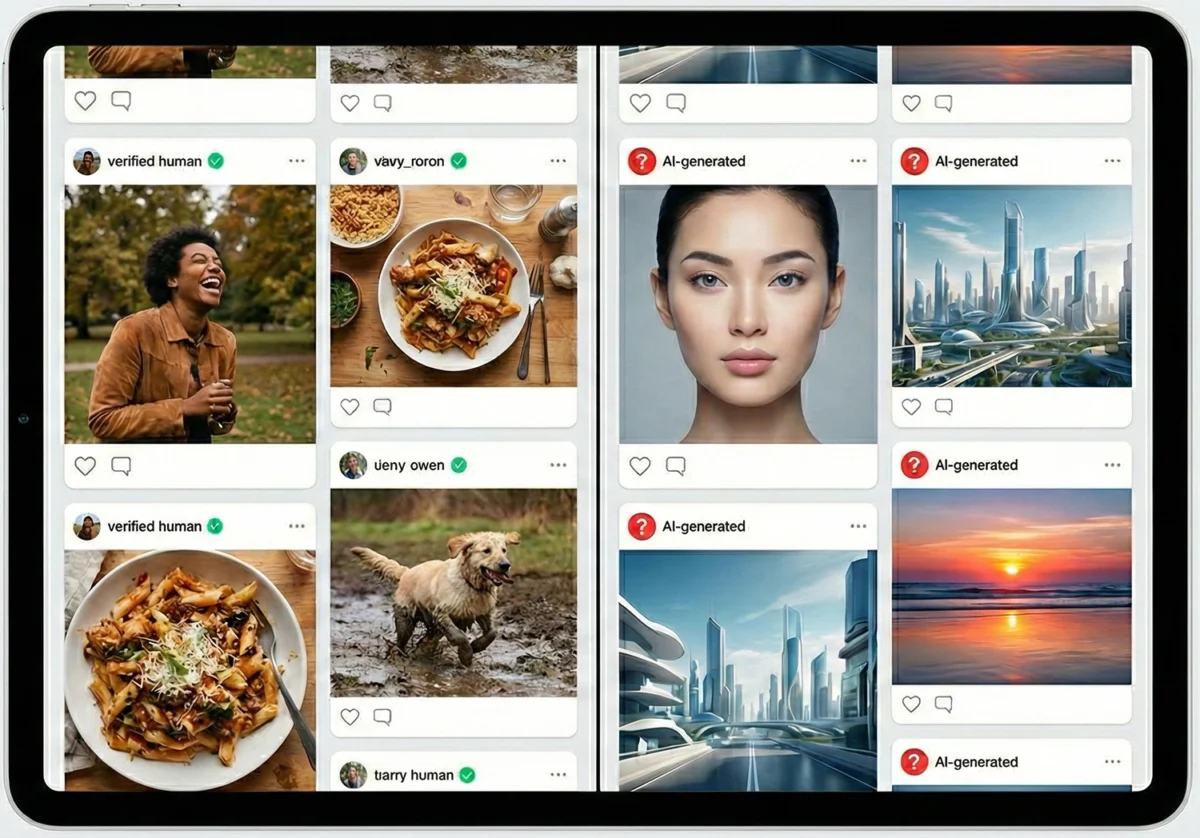
The core of the EU AI Act’s approach lies in its requirement for AI-generated material to possess a detectable signature. This is intended to help distinguish between human-created and machine-generated text, images, and other media, thereby providing users with a clearer understanding of the content they are consuming. However, critics argue that the infrastructure built to achieve this identification could be repurposed by governments or platform operators to classify, filter, or even suppress content, creating a powerful tool for information control. The potential for this technology to evolve from a transparency measure into a censorship mechanism has become a focal point of discussion within the tech and marketing industries.
In anticipation of and response to these new regulatory demands, major players in the AI development space are already moving to comply. Anthropic, a prominent AI safety and research company, has publicly announced that all future iterations of its Claude language models will incorporate identifiable, text-based "watermarks." This proactive step suggests that other AI companies are likely to follow suit, integrating similar detection technologies into their models to ensure their outputs can be identified as AI-generated. This trend indicates a rapid acceleration in the implementation of content identification technologies, driven by both regulatory pressure and the competitive landscape.
The Technical Underpinnings of AI Identification
The European Union’s drive to identify AI-generated content stems from a growing concern about the proliferation of misinformation, disinformation, and the potential for AI to be used in deceptive ways. While some observers might point to stylistic quirks, such as the use of em dashes or colons, as telltale signs of AI authorship, these linguistic features are far from reliable indicators. Punctuation marks and grammatical structures have evolved organically over centuries and are not exclusive to artificial intelligence. As AI models become increasingly sophisticated, their output grows more nuanced and human-like, making purely stylistic analysis an increasingly unreliable method for differentiation.
The challenge, therefore, lies in developing robust, scalable, and future-proof methods for identifying AI-generated text. Relying on a constantly evolving database of AI writing "affinities and proclivities" would quickly become obsolete as AI models are continuously refined. This is precisely why Anthropic and other companies are turning to more embedded technical solutions. Anthropic’s implementation, for instance, is leveraging a Google-developed, text-based watermarking technique known as SynthID-Text. This innovative approach embeds a subtle, hidden watermark directly into the text as it is being generated by the AI model.
How SynthID-Text Works: A Statistical Approach
SynthID-Text operates by embedding a statistical watermark directly into the output of a large language model (LLM) during the text generation process. The concept hinges on the probabilistic nature of how LLMs construct sentences and paragraphs. When an AI model is tasked with generating content, such as a marketing email, a blog post, or a product description, it does so by predicting and selecting the most statistically probable "token" – a unit of data that can represent a word, part of a word, punctuation, or even a number – to follow the preceding sequence.
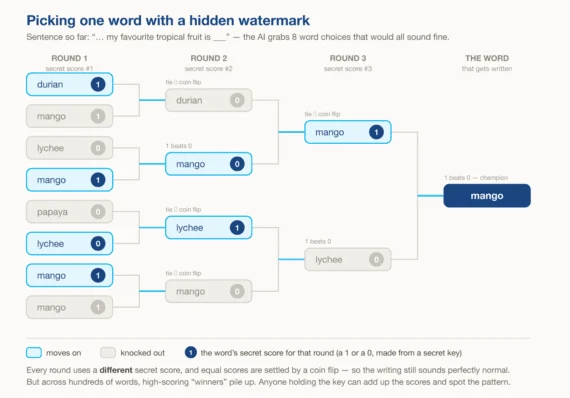
To illustrate, consider a hypothetical sentence starter: "My favorite tropical fruit is…" An LLM like Google Gemini, when prompted with this phrase, would then use its trained parameters to calculate the probability of various fruit names appearing next. While there might be several plausible options – mango, papaya, durian, lychee – the AI model selects one based on its learned statistical patterns. Critically, even with the same prompt, an AI model might not always select the exact same token. This inherent variability, while contributing to more natural-sounding text, also creates opportunities for subtle, statistically detectable patterns to be embedded.
SynthID-Text exploits this variability by introducing a slight bias in the token selection process. It doesn’t force a specific token but rather subtly influences the probabilities, creating a "tournament" for each token generation. This tournament involves evaluating a set of statistically plausible alternative tokens. The selection of the winning token, which then forms part of the generated text, is influenced by a secret seed or key associated with the watermarking algorithm. This process is repeated for every token generated, building up a statistical signature across the entire piece of content.
The "Tournament" Mechanism Explained
The "tournament" analogy, as described by proponents of SynthID-Text, helps to visualize how the watermark is embedded. Imagine a scenario where the AI is deciding on the next word after "My favorite tropical fruit is." Instead of simply picking the single most probable word, the SynthID algorithm might present a bracket of several likely candidates – for instance, mango, papaya, durian, and lychee. These candidates are then evaluated through a series of "matches," akin to a sports tournament.
The algorithm, using its secret key, assigns scores or preferences to these candidates. For example, in a hypothetical first round, "mango" might be pitted against "papaya," and "durian" against "lychee." Based on the underlying statistical bias introduced by the watermark, one token emerges as the "winner" of each pairing. This process continues through subsequent rounds until a single token is selected. This selected token becomes part of the generated text.
Crucially, the "winners" are not fixed. The outcome of a single tournament might appear random or arbitrary. However, when this tournament process is repeated hundreds or thousands of times for every token in a longer passage of text, a discernible statistical pattern emerges. The sequence of winning tokens, influenced by the watermark’s seed, will deviate from what would be expected by pure chance in unwatermarked text. This aggregated statistical deviation is the watermark itself – a subtle, yet detectable, imprint of AI generation. It’s important to note that the watermark isn’t tied to specific words; "mango" might win in one sentence and lose in another, but the underlying statistical influence of the watermark across numerous selections is what provides the evidence of AI generation.
Detecting the Watermark: The Role of the Detector Algorithm
Once text has been generated and potentially watermarked, a "detector" algorithm is employed to ascertain its origin. This detector, armed with the same secret key used during the generation process, can analyze a given passage of text. It works by deconstructing the text back into its constituent tokens and then reconstructing the hypothetical "tournament scores" that would have occurred if the text were generated by the watermarked model.
By comparing the actual token choices in the text with the probabilities and biases introduced by the watermark, the detector can calculate a statistical correlation. If the token choices align strongly with the expected patterns of the watermarked AI model, and if this alignment surpasses a predefined detection threshold, the text is flagged as AI-generated or AI-aided.
The effectiveness of this detection is directly proportional to the length of the text. A short passage might contain only a few watermarked tokens, and the observed statistical deviations could be attributed to random chance. However, a longer document, containing hundreds or thousands of watermarked tokens, provides much more robust evidence. The cumulative statistical signal becomes significantly stronger, making it far less likely that the observed pattern occurred naturally.
Conversely, the detection signal can be weaker in certain scenarios. For instance, if the AI model is generating highly factual content where the choices of tokens are heavily constrained by the subject matter, or if there’s significant human feedback or editing during the composition process, the AI might have fewer acceptable choices for each token. This reduced variability can lead to a less pronounced statistical watermark, potentially making detection more challenging. Nevertheless, any text that consistently scores above the detection threshold is considered to bear the imprint of AI generation.

Marketing Implications: Segregation and Censorship Concerns
The ability to identify AI-generated content with a reasonable degree of accuracy carries significant implications for digital marketers and e-commerce businesses. The primary concern is that this newfound identifiability could lead to the segregation and potential censorship of AI-assisted content by major online platforms. Search engines, social media networks, LLMs used as information sources, and even email clients could implement systems to isolate and then filter or suppress content based on its detected origin.
For many businesses, particularly smaller ones or those with limited resources, generative AI has been a game-changer, enabling the cost-effective creation and repurposing of content. The ability to scale content production rapidly and inexpensively has been a key advantage. If AI-generated content begins to be systematically disadvantaged, this competitive edge could be significantly eroded.
The potential consequences are far-reaching. Search engines, like Google, might choose to de-emphasize or discount pages containing AI-generated content in their search rankings, affecting organic visibility. LLMs could be programmed to avoid citing AI-generated text as sources, limiting its reach in informational contexts. Social media platforms, such as Pinterest, which have already begun to implement measures that reduce the distribution of AI content, could further restrict its visibility. Email clients might route messages identified as AI-generated to spam folders or to a dedicated "likely AI" inbox, diminishing engagement rates.
This situation raises the specter of watermarking becoming a proxy for perceived quality, irrespective of the actual content’s value. If AI-generated content is automatically treated with suspicion or relegated to lower tiers of visibility, it could stifle innovation and limit the accessibility of information for consumers.
The Imperfect Nature of Detection
It is crucial to acknowledge that the detection system, while sophisticated, is not infallible. Statistical detection inherently involves probabilities, and there is always a risk of false positives and false negatives. If the detection threshold is set too low, there is an increased likelihood of flagging human-written content as AI-generated, leading to unwarranted discrimination. Conversely, if the threshold is too high, some AI-generated content might slip through undetected.
The ongoing evolution of AI technology means that the methods of watermarking and detection will also need to adapt. As AI models become even more adept at mimicking human writing styles and potentially learning to circumvent detection mechanisms, continuous research and development will be necessary to maintain the integrity of identification systems. The EU AI Act, by mandating this identification, has initiated a dynamic where regulatory requirements, technological development, and platform policies will be in constant interplay. The ultimate impact on the marketing landscape will depend on how these technologies are implemented, regulated, and perceived by both platforms and consumers in the years to come.