The ecommerce landscape is on the precipice of significant transformation in 2026, driven by rapid advancements in artificial intelligence, evolving geopolitical trade dynamics, and a widening economic chasm. Industry leaders Bill D’Alessandro and his collaborator have outlined eleven key predictions for the coming year, offering a strategic roadmap for businesses navigating this dynamic market. These forecasts encompass the profound impact of AI on advertising and content creation, potential shifts in trade policy concerning China, and the increasingly polarized economic conditions that will shape consumer behavior and market opportunities.
The stakes for these predictions are notably high this year, with the two analysts agreeing to submit their forecasts to advanced AI models, Claude and Grok, for an objective evaluation at the end of 2026. The vanquished party will reportedly be subject to a public display of culinary humiliation, underscoring the competitive spirit driving these forward-looking analyses.
AI’s Telepathic Reach in Advertising
One of the most significant predictions centers on the imminent integration of AI into advertising platforms, particularly with the anticipated launch of advertising capabilities by OpenAI. The current capabilities of platforms like Meta, which already leverage vast datasets to understand user interests, are poised to be eclipsed. As articulated in the analysis, "Meta knows your interests. ChatGPT knows you’re afraid your business partner resents you, you’ve Googled ‘signs of burnout’ four times this month, and you’re one bad quarter away from seriously considering selling."
The implication of OpenAI entering the advertising arena is a leap from precise targeting to what is described as "telepathic" advertising. This suggests an AI’s ability to infer not only explicit interests but also underlying psychological states and future intentions, enabling hyper-personalized ad delivery. The analysis posits that "Early movers win big," indicating a potential first-mover advantage for businesses that can effectively harness this next generation of AI-driven advertising tools. This development signals a fundamental shift in how brands will connect with consumers, moving beyond demographic and interest-based segmentation to a more nuanced, almost predictive, form of audience engagement. The sophistication of such targeting could lead to unprecedented levels of ad effectiveness and, conversely, raise new questions about data privacy and consumer autonomy.
Tariffs on China: A Middle Ground Expected
In terms of international trade policy, a key prediction is that tariffs imposed on goods from China will stabilize within a range of 30% to 50%, rather than escalating further. This forecast is attributed to a complex interplay of economic and political factors. The analysis notes, "Inflation is creeping up and economic growth looks soft. Trump responds to markets, and when the bond market freaked out earlier this year, tariffs got walked back fast. I don’t see him shooting a wounded economy when things are already shaky."

This perspective suggests that pragmatic economic considerations will likely temper further aggressive tariff increases. The historical responsiveness of political decisions to market reactions indicates a potential for policy adjustments aimed at mitigating adverse economic impacts. For the ecommerce sector, this forecast implies a degree of predictability in sourcing costs from China, although the stipulated tariff levels would still represent a significant factor for businesses reliant on Chinese manufacturing. The ongoing geopolitical tensions, however, mean that this prediction remains subject to considerable uncertainty, with any unforeseen global events or domestic economic shifts potentially altering this trajectory.
The Enduring Strength of the AI Bubble
Counter to some prevailing market sentiments, the prediction is that the "AI bubble won’t pop in 2026." This assertion is supported by a comparative analysis of current market valuations and historical tech booms. The NASDAQ’s current forward Price-to-Earnings (PE) ratio is cited at approximately 27x, a figure significantly lower than the over 100x ratio observed during the dot-com bubble of the early 2000s. Furthermore, government investment in AI, when adjusted for inflation, is reported to be roughly five times the level of tech spending during that same historical period.
This data suggests that the current AI-driven market expansion is underpinned by more robust fundamentals than speculative excess. The substantial government backing for AI research and development signals a long-term strategic commitment, indicating that AI is not merely a fleeting trend but a foundational technology with enduring economic potential. The implications for ecommerce are substantial, as AI continues to permeate various operational aspects, from customer service and inventory management to marketing and product development. Businesses that effectively integrate AI are likely to gain a significant competitive edge.
The Rise of Verified Human Content
A growing concern within the digital sphere is the proliferation of AI-generated content, which is increasingly blurring the lines between authentic and synthetic media. This trend has led to an erosion of trust online, with a recent observation highlighting that "Roughly a third of the videos in my feed looked AI-generated" on a newly created social media account. In response to this challenge, a significant development anticipated for 2026 is the testing of "verified human content" badges by major online platforms.
This initiative aims to restore user confidence by providing a clear indication of content authenticity. The implementation of such badges could involve rigorous verification processes to confirm human authorship. For ecommerce businesses, this development could impact content marketing strategies, emphasizing the value of genuine brand storytelling and user-generated content. It also points to a broader societal reckoning with the implications of advanced AI on information dissemination and digital authenticity. The success of such verification systems will depend on their robustness, scalability, and user adoption.
Automation in Media Creation

The capabilities of AI in content creation are rapidly advancing, with a prediction that video and audio editing will become largely automated, achieving a quality level of "7/10." Tools like Descript are already demonstrating the potential for AI-assisted editing, and by the end of 2026, it is anticipated that users will be able to "drop raw footage into an AI, tell it what matters, and get a polished edit back."
This advancement has profound implications for content production within the ecommerce sector. It suggests that smaller businesses and individual entrepreneurs will be able to produce professional-grade video and audio content with significantly reduced resources and technical expertise. This democratization of media creation could lead to an explosion of diverse and engaging content, further personalizing the online shopping experience and enabling brands to connect with their audiences on a more intimate level. The ability to generate high-quality marketing materials efficiently will become a key differentiator.
Bill D’Alessandro’s Predictions
Bill D’Alessandro’s forecasts offer a complementary perspective, focusing on economic polarization and its impact on consumer spending and business strategy.
The K-Shaped Economy Takes Hold
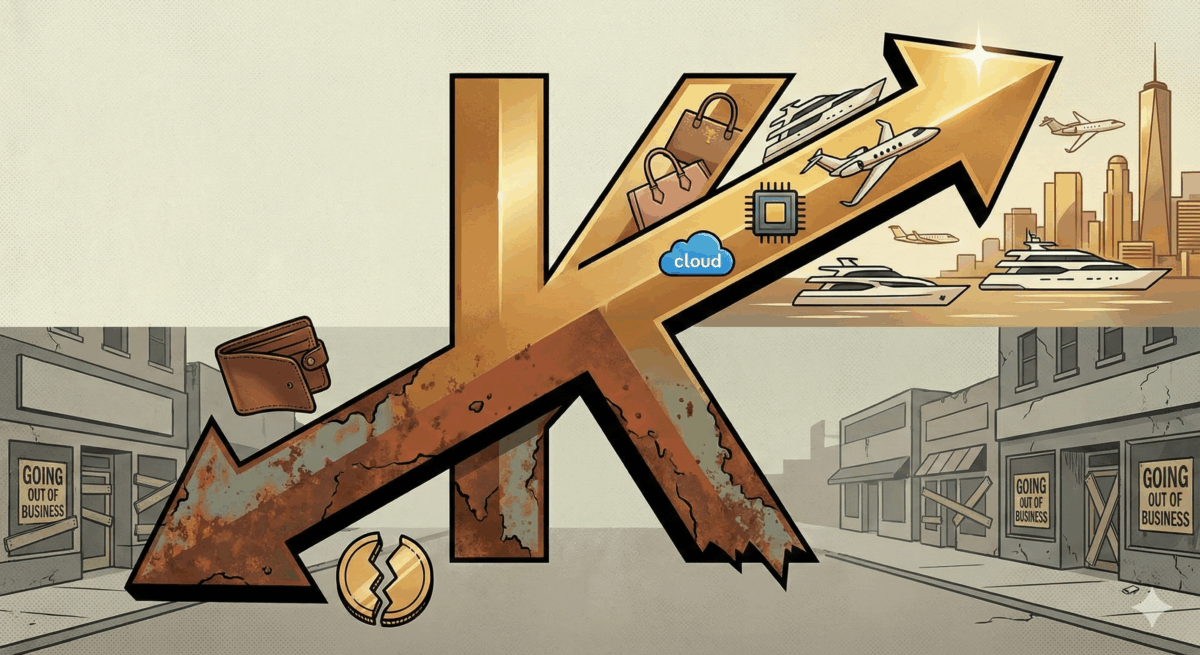
D’Alessandro predicts that "2026 will be the year of the K-shaped economy." This economic model describes a scenario where different segments of the population experience vastly different economic outcomes. Specifically, "Big tech and the Mag 7 continue to run, maybe up another 20%+, while the real economy and average consumer struggles."
For the ecommerce industry, this bifurcation presents a strategic imperative. The analysis suggests that businesses must choose to either "go up-market selling to affluent consumers, or go down-market with sharp pricing on essentials. The middle is dangerous." This means that brands targeting the middle-income consumer may face significant challenges as discretionary spending tightens for this demographic. Conversely, businesses catering to high-net-worth individuals or those offering deeply discounted essential goods may find fertile ground for growth. This prediction underscores the need for granular market segmentation and tailored value propositions.
Persistent Inflationary Environment

Another key prediction from D’Alessandro is that inflation will remain "north of 3% in 2026." This outlook is driven by a perceived lack of political will to curtail government spending, leading to continued deficit spending and, consequently, sustained inflationary pressures. D’Alessandro believes this is a long-term trend, stating, "His advice: position your portfolio and your business for a persistent inflationary environment."
The implications for ecommerce are considerable. Businesses will need to manage rising costs of goods, shipping, and labor. Strategies such as optimizing supply chains, exploring alternative sourcing, and adjusting pricing models will become critical. Furthermore, a persistent inflationary environment can impact consumer purchasing power, necessitating a careful balance between maintaining profitability and offering value to price-sensitive customers. This prediction suggests a fundamental shift in the economic landscape that will require long-term strategic adaptation.
AI’s Complete Dominance in Meta Ads Content
Echoing the broader AI trend, D’Alessandro predicts that "AI will completely take over Meta ads content." He points to the development of "pipelines that spit out 100 novel ads per day" for major brands. This involves AI reading customer reviews, leveraging brand assets, and generating stills and video content, which can then be launched directly through advertising APIs. D’Alessandro anticipates that "2026 is when this goes mainstream."
This prediction signifies a seismic shift in digital advertising, moving beyond AI-assisted ad creation to AI-driven ad generation and deployment at scale. For ecommerce businesses, this means that the creation of compelling and varied ad creatives will become significantly more accessible and efficient. It also raises questions about the unique value proposition of human creativity in advertising, as AI becomes capable of producing highly effective campaigns. Brands that can integrate these AI-powered advertising tools effectively are likely to see substantial improvements in campaign performance and return on ad spend.
The Demise of the Lifestyle Brand
In a stark assessment, D’Alessandro declares, "The lifestyle brand is dead." He argues that unless ecommerce businesses possess strong intellectual property protection or rank within the top 5-10% of brand recognition, "single-digit million eCommerce businesses are going to get crushed." The rationale is that larger, AI-powered competitors will possess a significant advantage in terms of spending power, testing capabilities, and the ability to absorb higher customer acquisition costs (CACs).
This prediction suggests a consolidation of market power within the ecommerce sector, favoring larger, well-capitalized entities that can leverage advanced technologies. For smaller and medium-sized businesses, the challenge will be to find niche markets, differentiate through exceptional customer service, or develop unique brand narratives that resonate deeply with a specific audience. The era of easily establishing a lifestyle brand through sheer appeal may be drawing to a close, replaced by a more data-driven and technologically sophisticated competitive landscape.
Mergers and Acquisitions: A Tale of Two Tiers
The mergers and acquisitions (M&A) landscape in ecommerce is also predicted to become increasingly bifurcated. D’Alessandro forecasts that "M&A will be gang busters at the high end and anemic at the low end." Evidence cited includes a 19% year-over-year increase in deals exceeding $1 billion, while deals in the small and mid-size range have seen an 18% drop. This trend is expected to continue, with "top-tier businesses will command eye-popping multiples, while typical eCommerce brands struggle to transact at all."
This prediction indicates a challenging environment for smaller ecommerce businesses seeking to exit or scale through acquisition. The focus of investment capital appears to be shifting towards larger, more established players, potentially due to their perceived resilience, scalability, and integration of advanced technologies. For smaller businesses, this means that achieving a successful M&A outcome may require significant growth, demonstrated profitability, and a clear strategic advantage to attract buyer interest.
Bitcoin’s Volatile Ascent
Finally, in the realm of digital assets, D’Alessandro predicts that Bitcoin will experience a dip below $70,000 in the first half of 2026 but will ultimately finish the year above $100,000. This forecast is based on competing pressures: a struggling consumer economy, which tends to suppress risk assets like Bitcoin, and the persistent inflation narrative, which supports Bitcoin as a potential store of value, or "digital gold."
The prediction of volatility suggests a dynamic market influenced by broader economic sentiment and the ongoing debate about Bitcoin’s role in a diversified investment portfolio. The anticipated recovery in the latter half of the year is linked to the increasing acceptance of inflation as a persistent economic reality, which could drive investors towards assets perceived as hedges against currency devaluation.
The collective insights from these predictions paint a complex picture of the ecommerce landscape in 2026. The pervasive influence of AI, coupled with economic shifts and evolving trade policies, will necessitate strategic agility and a forward-thinking approach from businesses seeking to thrive in this increasingly competitive and technologically driven market. The emphasis on AI-powered tools, understanding economic polarization, and adapting to a changing media environment will be paramount for success.