The Evolution of the Duo Mascot: From App Icon to Cultural Menace
Duolingo’s rise to the top of the shared media landscape was not accidental but the result of a disciplined, years-long effort to transform its mascot into a genuine internet celebrity. Unlike traditional corporate mascots that serve as passive symbols of brand values, Duo the Owl was developed into a complex character with specific motivations, flaws, and a distinct "unhinged" personality. This character work was designed to mirror the app’s core mechanic: the persistent, sometimes guilt-inducing notification system that encourages users to maintain their daily "streaks."
By early 2025, the mascot had evolved into a "growth strategy wearing a bird costume." The brand’s social media team was granted significant creative autonomy, allowing them to engage in storylines, feuds, and parasocial relationships with celebrities and fans alike. This strategy reached its zenith in February 2025 with the "Duo is Dead" campaign. In a move that shocked the marketing world, Duolingo announced the death of its mascot, inviting the internet to participate in a two-week mourning period before orchestrating his resurrection.
The metrics associated with this campaign were unprecedented for an organic social media effort. On the day of the announcement, mentions of the mascot spiked by approximately 25,560%. The hashtag #ripduo was utilized more than 45,000 times, and the brand accumulated over 580,000 total mentions within the two-week window. Most notably, the campaign generated a larger and more sustained spike in social conversation than the multi-million dollar Super Bowl commercials airing during the same period. While other brands paid roughly $8 million for 30 seconds of airtime, Duolingo commanded the global conversation through a fictional funeral.
The PESO Model Diagnostic: Analyzing the Four Pillars
The PESO Model® (Paid, Earned, Shared, Owned) serves as the industry standard for evaluating the health and integration of a brand’s communication strategy. When applied to Duolingo, the diagnostic highlights a stark imbalance between its world-class shared media and its underdeveloped owned media assets.
Shared Media: The High-Performing Rented Land
Duolingo currently occupies "Stage 5" on the PESO Model Maturity Ladder for shared media. Its content is not merely reactive; it is compounding. Every stunt builds upon the established lore of the character, creating a feedback loop of engagement. However, the diagnostic identifies this as "rented land." The brand’s massive audience resides entirely within the algorithms of TikTok, Instagram, and X (formerly Twitter). Consequently, Duolingo does not set the rules of engagement, cannot easily export these relationships to other platforms, and must essentially "rent" its reach from tech giants.
Earned Media: Personality Over Authority
The brand’s earned media record is prolific but largely derivative of its shared media activities. While Duolingo receives an avalanche of coverage from major news outlets, the focus is almost exclusively on its viral stunts and mascot antics. This is classified as "personality coverage" rather than "authority coverage." Despite sitting on what is likely the largest dataset of human language acquisition in history, Duolingo is rarely cited as the primary authoritative source on educational technology or skill acquisition in a professional or academic context.
Owned Media: The Strategic Gap
Owned media represents the most significant vulnerability in Duolingo’s current operating system. Compared to other industry leaders like HubSpot—which built a decades-long "moat" of educational content and research—Duolingo’s owned record remains thin. While it maintains a blog and an annual language trends report, it has yet to publish the deep, machine-readable body of expertise that its data could support. In the PESO framework, owned media is the "library" that provides stability; without it, the brand’s influence is as flighty as the bird that represents it.
Paid Media: The Accelerator
Duolingo’s paid media strategy is characterized by efficiency and opportunism. Rather than using paid channels to build awareness from scratch, the brand uses them to amplify organic winners. This approach allows the company to maintain a billion-dollar revenue run rate without the massive advertising overhead typical of consumer apps.
Chronology of a Reputation Crisis: The 2025 AI Backlash
The fragility of Duolingo’s "shared-first" strategy was laid bare in April 2025. Following a period of record growth, CEO Luis von Ahn published a memo declaring Duolingo an "AI-first" company. The memo included plans to phase out human contractors in favor of AI-driven workflows. The reaction from the brand’s core audience—the same audience that had celebrated the owl’s "death" weeks earlier—was swift and overwhelmingly negative.
Timeline of the 2025 Stress Test:
- February 2025: The "Duo is Dead" campaign achieves record-breaking social engagement and earned media mentions.
- April 2025: The "AI-first" memo is released. User sentiment shifts from playful engagement to corporate criticism.
- May 2025: Negative sentiment begins to impact user growth projections. The brand is forced to scale back its "edgy" social media presence to focus on sentiment recovery.
- August 2025: TechCrunch and other outlets report that while the backlash was severe, the product’s habit loops and streak mechanics helped maintain daily active user (DAU) growth.
- Q2 2026: Duolingo reports 23% DAU growth, signaling a financial recovery, though the brand’s reputation remains sensitive to AI-related discourse.
The diagnostic reveals that during this crisis, Duolingo’s only lever was volume. Because the brand had not built a foundation of owned authority, it lacked a credible, machine-readable record to counter the backlash. There was no deep repository of learning science or ethical AI frameworks for journalists or AI models to reference. Consequently, the loudest voices in the room—the critics—defined the narrative.
The AI Visibility Problem and Engineering Reputation
In the modern media landscape, reputation management is increasingly mediated by AI answer engines and Large Language Models (LLMs). This presents a unique challenge for brands like Duolingo. When an AI assistant is asked about language learning, it does not typically cite TikTok comments or viral stunts. Instead, it relies on structured, authoritative content: news coverage, white papers, and research data.
Because Duolingo’s primary "moat" is a social media character, its most valuable brand assets are largely invisible to AI engines. The "AI-first" backlash of 2025 highlighted this gap; the most prominent recent content regarding Duolingo and AI was the controversy itself. Without a robust owned media strategy to provide a "citable record," the brand remains at the mercy of whatever information is most available to the machines—which, in a crisis, is usually the criticism.
Strategic Implications and Future Optimizations
The Duolingo case study offers several critical lessons for brands attempting to replicate its success. The diagnostic suggests three primary optimizations for the company to balance its PESO operating system and secure its long-term reputation.
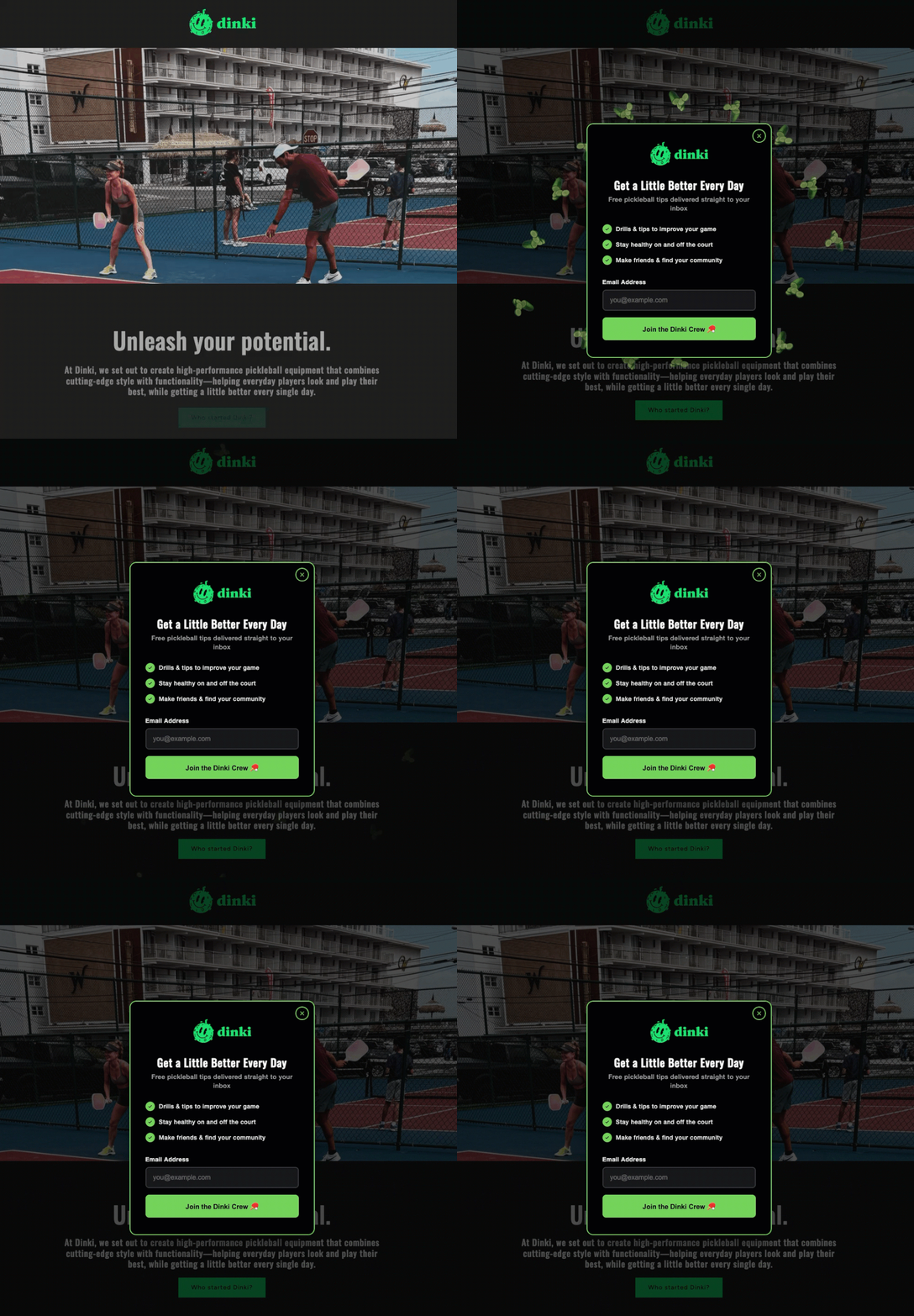
First, the brand must convert its "borrowed" audience into an "owned" one. Every viral moment should serve as a pipeline to a durable, addressable asset, such as an email community or a content subscription. This ensures that the brand can maintain a direct line of communication with its fans even if social media algorithms change or a crisis necessitates a temporary withdrawal from public platforms.
Second, Duolingo must begin publishing the authority that its data already supports. The annual language trends report should be expanded into a comprehensive research publishing program. By becoming the definitive source for language learning science, the brand can earn the type of authority coverage that shields a company during periods of corporate transition.
Finally, the brand needs to de-concentrate its personality. Relying on a single mascot for the entirety of the brand’s emotional resonance is a high-risk strategy. Developing executive voices, expert personalities, and owned editorial identities would allow the brand to maintain a multi-dimensional presence. This ensures that if the "unhinged" mascot persona becomes a liability—as it did during the 2025 backlash—the brand still has other credible ways to speak to its audience.
Conclusion: The Lesson for the Modern Marketer
The story of Duolingo in 2025 and 2026 is a testament to the power of character-driven marketing, but it is also a warning about the limits of shared media. The brand’s ability to out-earn Super Bowl ads with a fake funeral proves that "unhinged" social media can be a powerful growth engine when backed by a disciplined system. However, the subsequent AI backlash proves that even the most beloved brand can be vulnerable if it lacks a foundation of owned authority.
For mainstream organizations, the takeaway is clear: copy the discipline of the character system, not the chaos of the stunts. While virality provides the spark, it is the owned media library that provides the fuel for long-term sustainability. As the digital landscape moves toward an AI-mediated future, the brands that survive will be those that own their audience, their data, and their authority, rather than merely renting them from the platforms of the day. Duolingo’s product and habit loops ultimately saved its growth during its most turbulent year, but "the product saved us from the brand" is a precarious long-term business strategy. Building the library while the bird is still flying is the only way to ensure lasting resilience.