

The modern e-commerce landscape demands sophisticated marketing automation, making the choice between platforms like Klaviyo and Drip a critical strategic decision for online businesses. While Drip often presents a more cost-effective solution at scale, particularly for stores managing over 2,500 contacts, its savings come with a trade-off in the depth and complexity of features. Klaviyo, conversely, excels in delivering robust segments, intricate automation flows, and comprehensive reporting capabilities, better suited for highly complex customer journeys and data-driven multichannel strategies. This detailed comparison delves into their core offerings, pricing structures, and strategic implications, providing a journalistic perspective on their strengths and potential limitations.
Core Findings: A Strategic Overview
At a glance, the distinction between Klaviyo and Drip becomes clear: Drip is often the preferred choice for e-commerce businesses seeking lower operational costs at higher contact volumes and a quicker setup for essential e-commerce marketing functions. Its appeal lies in streamlining core email-led strategies with less ongoing maintenance. Klaviyo, on the other hand, stands out for its profound analytical depth and advanced capabilities in data-led multichannel marketing. Businesses that prioritize acting on predictive insights, detailed attribution data, and integrated email alongside robust SMS campaigns will find Klaviyo’s comprehensive toolkit more aligned with their strategic objectives.
The evaluation criteria for this comparison span crucial aspects of e-commerce marketing platforms, including their pricing models, segmentation prowess, automation flexibility, SMS marketing capabilities, reporting and analytics depth, integration ecosystems, customer support structures, and the user experience of their email builders and template libraries. Each area presents distinct advantages and considerations that influence a business’s long-term marketing effectiveness and operational efficiency.
![Klaviyo vs. Drip: Which Is Better in 2026? [Comparison]](https://www.omnisend.com/blog/wp-content/uploads/2026/08/Comparison-_-VS-2.webp)
User Sentiment and Market Reputation
In the competitive realm of marketing automation, user feedback offers invaluable insights into a platform’s real-world performance and perceived value. Across leading review platforms like G2, the Shopify App Store, and Capterra, Klaviyo consistently garners higher ratings and significantly more reviews than Drip. As of August 2026, Klaviyo boasts an average rating of 4.6/5 on G2 (from 1,360 reviews), 4.7/5 on Shopify (from 2,965 reviews), and 4.6/5 on Capterra (from 534 reviews). Drip, while still well-regarded, lags slightly with 4.4/5 on G2 (480 reviews), 4.6/5 on Shopify (51 reviews), and 4.4/5 on Capterra (188 reviews). The higher volume of reviews for Klaviyo also suggests a broader user base and perhaps greater market penetration within the e-commerce sector.
Analyzing user sentiment on G2 reveals a nuanced picture. A significant number of Klaviyo users (160 reviewers) commend its ease of use, indicating that despite its advanced features, the platform is generally accessible. However, 63 reviewers noted a steep learning curve, suggesting that unlocking its full potential may require a dedicated investment in time and training. The most frequently cited grievances for Klaviyo users revolve around its pricing, which can become prohibitive as contact lists expand, and perceived limitations in customer support, with 73 mentions. One verified user in the consumer goods sector highlighted this, stating, "Klaviyo’s pricing gets expensive as contact lists grow, especially for small businesses or high-volume email senders." This indicates a common tension between powerful features and their associated costs.
For Drip, the efficiency of its automation features is the top positive, closely followed by its ease of use. This feedback underscores Drip’s strength in delivering straightforward and effective automated workflows. However, Drip is not without its criticisms. Four users found it expensive, and four expressed frustration over a perceived lack of integrations. Furthermore, some customers reported that Drip lacks the advanced marketing features present in competitors, particularly its multichannel capabilities, noting that its SMS offering was limited to a beta phase for U.S.-only users as of July 2026. A G2 user, Belcourt L., pointed to integration issues as a major downside: "A major downside is the absence of native connections to our primary accounting platform, which means we have to input marketing expense data manually." This highlights Drip’s challenge in providing a comprehensive, interconnected ecosystem for all business operations.
In summary, while Klaviyo users often appreciate its powerful capabilities, their complaints tend to focus on financial outlay and support accessibility. Drip users, conversely, laud its efficiency but express concerns about missing advanced functionalities and integration breadth. This divergence in feedback points to different market niches and user expectations for each platform.
![Klaviyo vs. Drip: Which Is Better in 2026? [Comparison]](https://www.omnisend.com/blog/wp-content/uploads/2026/08/1.-Drips-People-dashboard.webp)
Pricing Models: A Deep Dive into Cost-Effectiveness
The pricing structure of marketing automation platforms is a primary concern for e-commerce businesses, and here, Drip presents a compelling value proposition at scale, while Klaviyo offers a more accessible entry point for smaller operations.
Klaviyo stands out with a free plan that accommodates up to 250 active profiles, providing a no-cost avenue for nascent businesses to explore its capabilities. Its paid plans commence at a contact threshold of 500 profiles for $20/month, making it a more affordable option for businesses with smaller lists. Drip, conversely, does not offer a free plan but provides a 14-day free trial. Its paid plans begin at a higher contact threshold of 2,500, priced at $39/month. This means that for businesses with fewer than 2,500 contacts, Klaviyo is generally the more economical choice. However, once a business surpasses the 2,500-contact mark, Drip’s pricing model becomes more advantageous, offering increasingly significant savings at higher tiers. For instance, at 20,000 contacts, Drip costs $289/month compared to Klaviyo’s $375/month, illustrating Drip’s strong value proposition for growing and scaled operations.
Both platforms employ contact-based pricing, but their methodologies differ critically. Klaviyo’s "active profiles" model counts subscribers and other engaged contacts (e.g., those who provided an email at checkout), automatically excluding unsubscribed or suppressed profiles. This approach simplifies list management, as users only pay for marketable contacts. However, rapid list growth, particularly from high order volumes, can quickly escalate costs if not actively managed. Drip’s "Active person" model, conversely, counts every person in the account, including unsubscribes, until they are manually deactivated or deleted. This necessitates proactive list hygiene to avoid paying for unmarketable contacts, adding a layer of administrative upkeep.
Regarding email send limits, Drip offers unlimited email sends for plans up to 30,000 contacts, after which a multiplier based on list size applies. Klaviyo provides a consistent 10x contact send limit across all paid plans, ensuring ample capacity for most e-commerce strategies.
![Klaviyo vs. Drip: Which Is Better in 2026? [Comparison]](https://www.omnisend.com/blog/wp-content/uploads/2026/08/2.-Klaviyos-pre-built-segments.webp)
SMS costs also vary significantly. Klaviyo includes a nominal $5 worth of mobile messages in all plans and offers credit bundles starting at $15/month for 1,000 credits (at $0.011 per send plus provider fees), making its SMS capabilities readily available across 22 countries. Drip’s SMS offering, as of July 2026, was in a limited beta phase for U.S.-only users, available as a paid add-on from $39/month on top of the email plan. This positions Klaviyo as the clear winner for businesses prioritizing integrated, international SMS marketing.
Advanced Segmentation: Unlocking Customer Insights
In the pursuit of personalized marketing, advanced segmentation is paramount, and Klaviyo demonstrably leads in this domain with its sophisticated predictive analytics layer. Both platforms are adept at capturing dynamic, real-time segments and behavioral data, with segments automatically updating as customers meet or cease to meet specified conditions, such as viewed products or placed orders.
Klaviyo elevates segmentation by incorporating predictive analytics, enabling businesses to segment customers based on their forecasted behavior. This includes metrics like churn risk, expected next order date, and predicted customer lifetime value (CLV), all derived from a customer’s historical purchase data. This proactive approach allows marketers to anticipate customer needs and behaviors, enabling highly targeted and timely interventions. For instance, a replenishment flow could target customers whose predicted next order date falls within the coming week, ensuring they receive a reminder before they run out of a product. Similarly, a VIP segment could leverage predicted CLV to differentiate high-value, repeat purchasers from one-time buyers, tailoring exclusive offers accordingly.
Drip, while robust in its own right, focuses on reactive segmentation based on past behavior. It effectively handles dynamic segments, tags, and behavioral triggers, including a lifetime-value threshold that can initiate a workflow once a customer crosses a specific spending milestone. Drip’s pre-built segments become accessible upon connecting an e-commerce store, simplifying initial setup. However, Drip’s capabilities do not extend to forecasting future customer actions. Marketers using Drip construct segments based on what a customer has done (e.g., "customers who placed three or more orders"), rather than what they will do, limiting the proactive scope of their strategies.
![Klaviyo vs. Drip: Which Is Better in 2026? [Comparison]](https://www.omnisend.com/blog/wp-content/uploads/2026/08/3.-Klaviyos-flow-builder.webp)
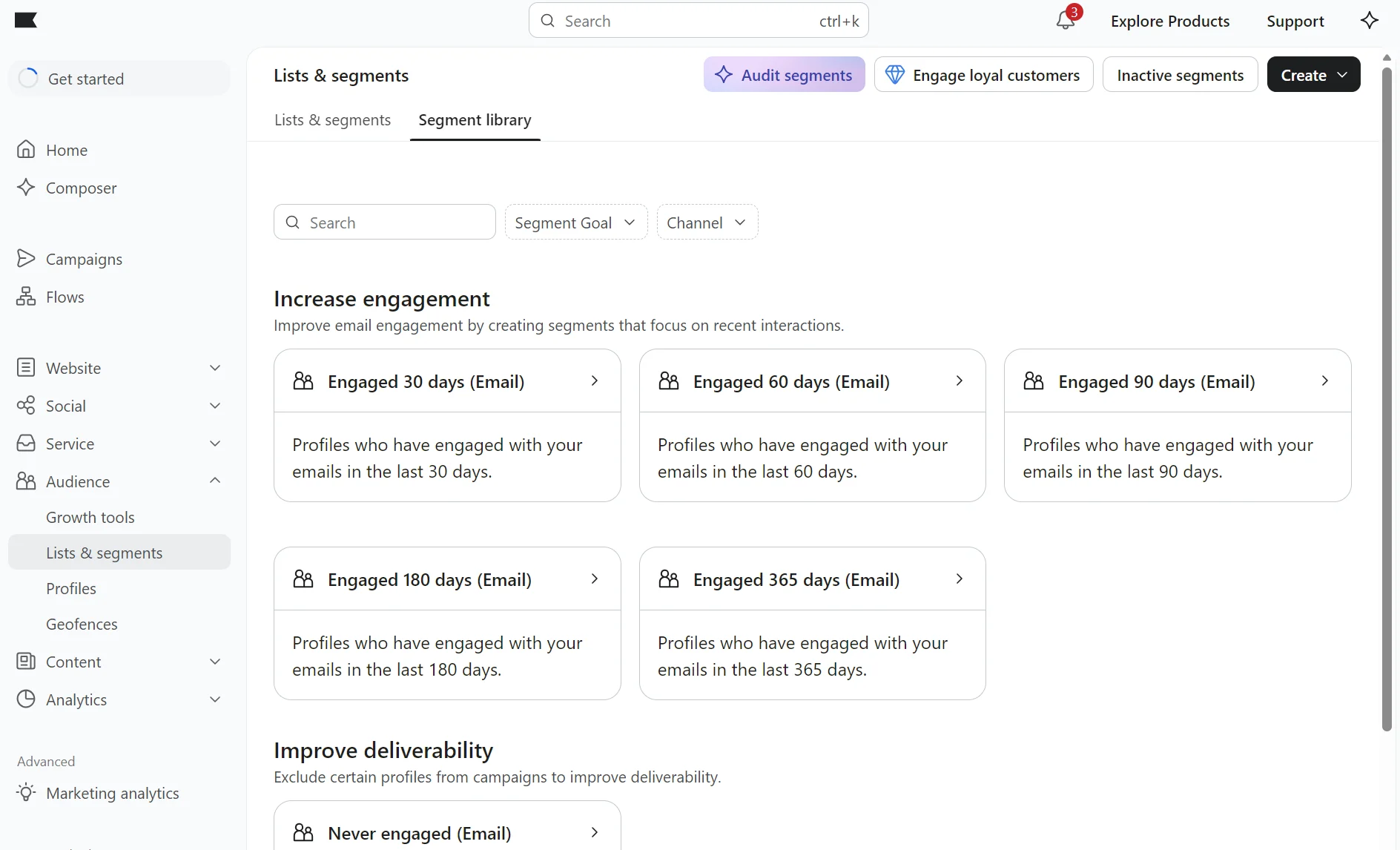
Klaviyo’s segments library offers a wealth of pre-built options based on engagement, deliverability, and targeting past purchasers, many of which leverage its predictive data. However, it’s crucial to note a condition: Klaviyo’s predictive features remain dormant until a store meets specific data thresholds, typically requiring 500 customers who have placed an order, 180 days of order history, recent orders within the last 30 days, and a sufficient number of repeat buyers. Until these metrics are met, Klaviyo’s predictive segments will not populate, offering a similar behavioral segmentation experience to Drip without the added forecasting power. This nuance is vital for businesses in their early growth stages.
Automation Capabilities: Crafting Customer Journeys
When it comes to the intricate architecture of marketing automation, Klaviyo’s advanced conditional logic provides a deeper, more flexible framework for orchestrating complex customer journeys, while Drip offers a streamlined approach with multi-trigger workflows.
Klaviyo’s automation flows are designed around a single trigger per flow, whether it’s a list subscription, a segment entry, a placed order, a specific date, or a price drop. This focused trigger approach ensures clarity and precision in defining the starting point of a customer journey. The platform compensates for this single-trigger design with sophisticated branching logic, allowing a single flow to split into up to 20 different paths. Crucially, Klaviyo re-checks who qualifies at every step of the journey, ensuring that customers always receive the most relevant communications based on their real-time behavior and updated segment membership. This depth of conditional logic is particularly beneficial for highly personalized and adaptive marketing campaigns.
Drip, by contrast, offers the flexibility of using several triggers within a single workflow. This feature can be advantageous for marketers who prefer to consolidate multiple entry points into one automation, reducing the overall number of workflows to manage. For example, cart abandoners and customers who cross a spend milestone could enter the same automation, with "Workflow Goals" designed to pull a customer out of the flow once they convert. Drip also uniquely features an LTV trigger that initiates a workflow when a customer surpasses a user-defined lifetime spend threshold, a capability not directly mirrored by Klaviyo’s segment-alone approach. While Drip’s conditional depth is less extensive than Klaviyo’s multi-branching, its multi-trigger functionality simplifies workflow organization for certain use cases.
![Klaviyo vs. Drip: Which Is Better in 2026? [Comparison]](https://www.omnisend.com/blog/wp-content/uploads/2026/08/4.-Drips-flow-builder.webp)
Both platforms provide comprehensive libraries of pre-built templates for common e-commerce scenarios, including welcome series, abandoned cart reminders, post-purchase sequences, and win-back campaigns. This ensures that businesses can quickly deploy essential marketing automations without building them from scratch. Both also support A/B or split testing within automations, though with slightly different methodologies. Klaviyo enables testing of individual messages within a flow, allowing for granular optimization. Drip, conversely, splits entire workflow paths, requiring manual declaration of a winner, which can be more suited for evaluating broader strategy variations. The choice between these two approaches depends on the desired level of testing granularity and workflow management preference.
Multichannel Engagement: The SMS Dimension
In the contemporary e-commerce landscape, multichannel engagement, particularly through SMS marketing, is no longer a luxury but a strategic imperative. In this critical area, Klaviyo significantly outperforms Drip, offering a mature, internationally-reaching, and interactive SMS solution.
Klaviyo’s SMS functionality is a fully integrated component available to all customers across 22 countries, including major markets like the U.S., Canada, Australia, New Zealand, and 18 European nations. Its features support both standalone SMS campaigns and sophisticated multichannel flows that seamlessly combine email and text messages. Marketers can send both SMS (short message service) and MMS (multimedia message service), triggering texts based on various customer actions. A standout feature of Klaviyo SMS is its robust two-way conversational automation, enabling businesses to deploy interactive quizzes, surveys, and personalized dialogues that capture customer replies as valuable profile data. This capability fosters deeper engagement and richer customer insights. Furthermore, Klaviyo incorporates built-in compliance tools, such as quiet hours and automatic opt-out handling, ensuring adherence to regional messaging regulations.
Drip, in stark contrast, is currently rebuilding its SMS offering, having retired an older version. As of July 2026, its new SMS functionality is limited to a beta group in the U.S. only, and is available by request rather than through a self-serve activation. While it supports SMS and MMS sending and triggered texts for actions like welcome series, Drip’s current iteration lacks the two-way, keyword-reply conversational capabilities that Klaviyo provides for quizzes and surveys. This limitation means that e-commerce businesses operating internationally or those aiming for highly interactive SMS campaigns will find Drip’s current offering insufficient. For U.S.-based businesses, Drip’s SMS is a paid add-on, further emphasizing its less integrated and less mature standing compared to Klaviyo. This disparity highlights a significant strategic advantage for Klaviyo in enabling comprehensive, global multichannel marketing.
![Klaviyo vs. Drip: Which Is Better in 2026? [Comparison]](https://www.omnisend.com/blog/wp-content/uploads/2026/08/5.-Klaviyo-vs.-Drip-flow-libraries.webp)
Reporting and Analytics: Driving Data-Led Decisions
The ability to derive actionable insights from marketing data is crucial for optimizing campaigns and fostering business growth. Klaviyo establishes itself as the superior platform in reporting depth, offering advanced custom dashboards, predictive analytics, and competitive peer benchmarks. Drip, while providing essential metrics, presents a more basic reporting suite that focuses on real-time attributed revenue but lacks the forecasting and comparative data points.
Klaviyo’s reporting framework is designed for granular analysis. It attributes revenue per campaign and per flow, dissecting performance down to individual sends and automations contributing to each order, rather than just offering a running total. While last-touch attribution is the default, Klaviyo allows for configurable lookback windows per channel (email, SMS, push notifications), offering flexibility in understanding conversion paths. Its custom dashboards are a powerful feature, enabling users to build up to 10 personalized boards by pulling in cards for flow performance, deliverability metrics, or channel-specific performance. This level of customization empowers marketers to monitor KPIs most relevant to their specific strategies.
Furthermore, Klaviyo’s predictive analytics extend to its reporting, forecasting churn risk, predicted CLV, and expected next order dates based on individual customer purchase histories. The platform’s Deliverability hub provides critical insights into bounces, spam complaints, and unsubscribe rates across email and SMS, complemented by a sender-reputation score for accounts sending over 1,000 emails in 30 days. A unique Benchmarks report allows businesses to compare their open, click, and conversion rates against anonymous peer groups across various date ranges, offering valuable context for performance evaluation.
Drip’s reporting, while functional for most e-commerce stores, is more streamlined. Its revenue dashboard displays total and Drip-attributed revenue in real-time, based on last-touch attribution, with the ability to compare up to three workflows, email series, or campaigns side-by-side. The Email Metrics report provides standard performance indicators such as opens, clicks, orders, and revenue per send, with export options to CSV including conversion rate, average order value, and revenue per person. Drip also offers list health reports, tracking new subscribers and total list size over time, alongside event recording frequencies. However, Drip lacks predictive tools, peer benchmarks, or a comprehensive sender-reputation score within its deliverability view, which limits the depth of strategic insight available to marketers compared to Klaviyo.
![Klaviyo vs. Drip: Which Is Better in 2026? [Comparison]](https://www.omnisend.com/blog/wp-content/uploads/2026/08/6.-Klaviyos-SMS-campaign-builder.webp)
Integrations and Support: Ecosystem and Service
The breadth of integrations and the quality of customer support are pivotal factors in the long-term viability and operational efficiency of any marketing automation platform. In both these areas, Klaviyo maintains a lead, offering a more extensive integration ecosystem and a more accessible, tiered support structure across its paid plans.
Klaviyo boasts over 350 native integrations, significantly outnumbering Drip’s 90+. Both platforms offer native connections to major e-commerce platforms like Shopify, BigCommerce, and WooCommerce. However, Klaviyo extends its native support to platforms like Wix, expanding its appeal to a broader range of online retailers. Klaviyo’s integration strength is also evident in its wider array of connections for Customer Data Platforms (CDP), Customer Relationship Management (CRM) systems, Point of Sale (POS) solutions, and helpdesk applications. For instance, Klaviyo provides native integrations for Salesforce and HubSpot, which are notably absent from Drip’s native offerings. For integrations not natively supported, both platforms leverage Zapier, a middleware service, though the depth and functionality often differ from direct native connections.
Regarding customer support, Klaviyo’s free plan includes email support for the initial 60 days. All Klaviyo plans benefit from "Composer," an AI chatbot (currently in beta) designed to answer questions, locate information, and assist in building flows and segments, offering an immediate resource for users. Paid Klaviyo plans come with email and live chat support. Live chat is available 24/5 (Monday to Friday), with email support extending to 24/7. Standard quoted email response times are four hours for urgent issues and 12 hours for high-priority issues. For businesses requiring faster assistance, Klaviyo offers add-ons: its Professional plan reduces response times to two hours for urgent issues and eight hours for high-priority issues, while the Enterprise plan halves these times further and provides 24/7 live chat coverage, catering to the most demanding operational needs.
Drip’s support model includes email support across all tiers, regardless of monthly spend. Live chat support becomes available for customers spending $99/month or more. Similar to Klaviyo, Drip incorporates an AI chatbot within its dashboard that can answer queries and escalate to a human agent when necessary. Drip’s support operates during standard business hours, which may pose limitations for businesses operating across different time zones or requiring immediate assistance outside conventional work hours. The absence of paid add-ons for expedited support means Drip’s base offering dictates the level of service, potentially impacting businesses with critical, time-sensitive support needs.
![Klaviyo vs. Drip: Which Is Better in 2026? [Comparison]](https://www.omnisend.com/blog/wp-content/uploads/2026/08/7.-Klaviyos-custom-reports-1.webp)
Email Builder and Templates: Design and Personalization
The effectiveness of an email marketing platform is often reflected in the usability of its email builder and the richness of its template library. In this segment, Klaviyo emerges as the stronger contender, offering a more extensive collection of pre-built templates and greater customization capabilities within its email editor.
Klaviyo’s email builder operates on a drag-and-drop interface, providing marketers with a versatile toolkit for crafting engaging emails. Its content blocks include essentials like text, images, and buttons, alongside specialized e-commerce blocks for products, coupons, and customer reviews. The product blocks are particularly powerful, capable of dynamically pulling live catalog items and personalized recommendations for each recipient, significantly enhancing personalization. Most blocks offer advanced display options, allowing content to be shown or hidden based on the recipient’s device or audience segment. For maximum design flexibility, an HTML block is available for custom coding, and a "universal content" feature enables users to save and reuse blocks across multiple templates, promoting consistency and efficiency. With over 160 pre-built templates, Klaviyo provides a vast starting point for various campaign types.
Drip’s "Visual Builder" employs a point-and-click interface, offering a straightforward approach to email creation. Its content blocks cover fundamental elements such as text, images, buttons, navigation, product listings, and social links. A notable feature is the "top-selling-products" block, which dynamically integrates bestsellers directly from the connected e-commerce store. Drip also provides pre-built templates, though its library is more modest, with just over 50 options. Conditional display rules allow marketers to show or hide blocks based on device, tags, or custom fields using AND/OR logic, enabling a degree of personalization. Additionally, saved email templates in Drip are accessible across all accounts, a useful feature for users managing multiple stores. However, Drip’s builder generally offers fewer content blocks and customization options compared to Klaviyo, lacking dedicated blocks for coupons or reviews, and not supporting external fonts, which may limit brand-specific design aspirations.
Strategic Verdict and Market Alternatives
![Klaviyo vs. Drip: Which Is Better in 2026? [Comparison]](https://www.omnisend.com/blog/wp-content/uploads/2026/08/8.-Drips-revenue-reports-1.webp)
The choice between Klaviyo and Drip ultimately hinges on a business’s specific strategic priorities, scale, and budget. Klaviyo is the superior platform for businesses committed to deeply data-driven marketing, leveraging predictive analytics, comprehensive attribution, and robust multichannel capabilities that integrate email with advanced SMS. Its extensive feature set is ideal for complex customer journeys and brands seeking granular insights into customer lifecycle management. D Drip, conversely, is a more suitable fit for email-led e-commerce stores prioritizing cost efficiency at scale (above 2,500 contacts) and a more straightforward approach to marketing automation with less administrative upkeep. It excels at delivering core e-commerce functionalities efficiently. It is crucial for businesses to conduct hands-on testing with both platforms through their respective trials to evaluate user interfaces and specific feature alignments before committing.
What is the Best Klaviyo and Drip Alternative?
For businesses seeking a compelling alternative that balances advanced features with user-friendliness and competitive pricing, Omnisend stands out. Omnisend closely matches Klaviyo’s sophisticated flows and segmentation capabilities, notably including a "Customer Breakdown" feature with lifecycle stages based on AI RFM (Recency, Frequency, Monetary) analysis, available across all plans. Omnisend is often cited as easier to master than Klaviyo, yet it offers comparable depth to Drip, making it an attractive middle-ground option.
Omnisend’s core offering is truly multichannel, seamlessly integrating email, SMS, and web push notifications. Its SMS service is robust and available in the Pro plan starting from $59/month for 2,500 contacts, with competitive SMS pricing beginning at $0.007/SMS. A key differentiator for Omnisend is its commitment to customer support: all plans, including the Free Forever plan, benefit from 24/7 customer support. Furthermore, Omnisend provides unrestricted access to generative AI tools and an AI segment builder, empowering marketers with cutting-edge capabilities without additional cost.
When comparing pricing, Drip may appear cheaper than Omnisend at some comparable contact tiers, but this comes at the expense of comprehensive SMS, advanced RFM analysis, and a free plan. Klaviyo, while powerful, is generally more expensive than Omnisend across most tiers. Omnisend offers a detailed pricing comparison tool to help businesses evaluate the cost-effectiveness. For existing Klaviyo customers, Omnisend also facilitates the migration process for lists exceeding 250 contacts, exemplified by success stories like Latvian wellness brand MUSS, which saw a 41% increase in open rates and 13% rise in revenue per recipient after switching from Klaviyo to Omnisend for unified email, SMS, and improved deliverability.
![Klaviyo vs. Drip: Which Is Better in 2026? [Comparison]](https://www.omnisend.com/blog/wp-content/uploads/2026/08/9.-Klaviyos-Composer.webp)
Drip vs. Klaviyo: FAQs
Is Drip cheaper than Klaviyo?
Yes, Drip typically becomes cheaper than Klaviyo once an e-commerce store exceeds 2,500 contacts. Drip’s entry point for this contact tier is $39/month, whereas Klaviyo’s comparable plan is $60/month. Klaviyo does offer a free plan for up to 250 contacts and paid plans starting at $20/month for 500 contacts, providing a lower initial cost of entry for smaller businesses.
What’s cheaper than Klaviyo?
Several platforms offer more budget-friendly alternatives to Klaviyo at various contact tiers. Omnisend, Drip, and Mailchimp are prominent examples. Mailchimp is often suitable for very small businesses or those primarily focused on basic email campaigns. Drip is a strong contender for e-commerce stores prioritizing behavior-based automation with a focus on email, offering cost savings at scale. Omnisend provides a comprehensive multichannel solution (email, SMS, web push) with advanced features like RFM analysis and 24/7 support, often at a more competitive price point than Klaviyo.
Which tools compete with Klaviyo?
In the e-commerce marketing automation space, Klaviyo faces competition from several robust platforms. Key competitors include Drip, ActiveCampaign, and Omnisend. Omnisend and ActiveCampaign are notable for their strong multichannel capabilities, including SMS marketing, similar to Klaviyo. Other competitors, often with fewer enterprise-level features but still viable for many businesses, include Brevo (formerly Sendinblue) and Campaign Monitor. The choice among these often depends on the specific needs for segmentation depth, automation complexity, multichannel integration, and budget.
Can you migrate from Klaviyo to Drip?
Yes, migration from Klaviyo to Drip is possible. Businesses can undertake a self-serve data import process, transferring their contact lists and historical data. Drip also offers a managed migration service, which is typically included in the plan price for accounts with more than 17,500 contacts. This service often encompasses data imports, and the rebuilding of core workflows and email templates, simplifying the transition for larger operations.








