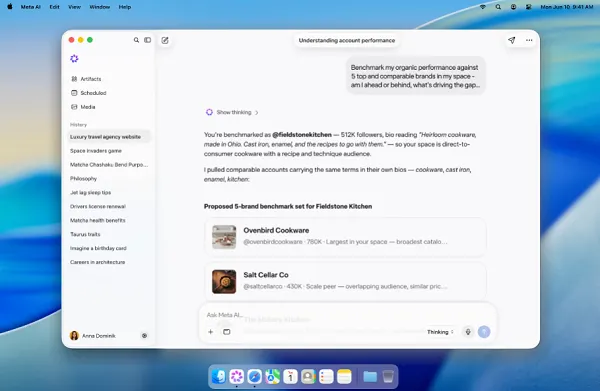
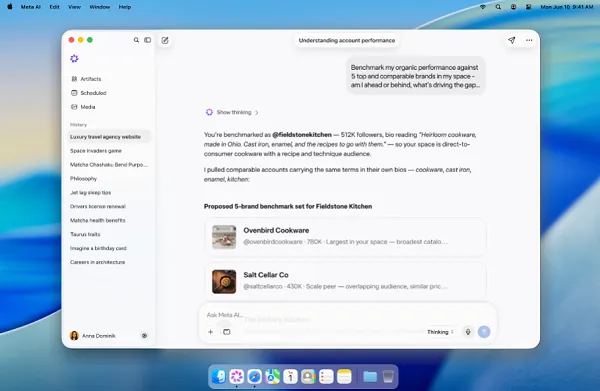
Meta Platforms Inc. has officially rolled out a dedicated Mac version of its Meta AI application, marking a significant expansion of its artificial intelligence assistant tools and providing a new, deeply integrated access point for desktop users, particularly small and medium-sized businesses (SMBs). This strategic move integrates all functionalities previously available on the mobile version while introducing enhanced workflow capabilities tailored for the macOS environment, signaling Meta’s intensifying commitment to embedding AI into the fabric of daily productivity and solidifying its long-term monetization ambitions within the burgeoning AI landscape.
The new Mac-specific iteration of Meta AI is designed to offer a seamless and intuitive experience, mirroring the comprehensive feature set of its mobile counterpart but optimized for desktop interaction. This includes core AI assistant functionalities such as answering queries, generating creative content, summarizing information, and facilitating communication. However, its true differentiator lies in its deep integration with the macOS operating system, enabling a more organic and contextually aware AI experience that feeds Meta’s AI-powered responses directly into the user’s system flow. For instance, users can share a specific window during an AI session, allowing Meta AI to analyze the displayed content and provide tailored advice directly relevant to the task at hand. This level of contextual understanding and real-time assistance represents a leap beyond typical web-based AI interactions, promising to significantly streamline various professional workflows. Furthermore, the application boasts built-in dictation capabilities that function across all applications on a Mac, offering a hands-free input method for generating text, drafting emails, or composing documents with the assistance of Meta AI.
Strategic Utility for Small and Medium-sized Businesses (SMBs)
A primary focus of this Mac app release is to empower business owners, particularly within the SMB segment, with advanced AI capabilities. Meta has explicitly stated that the application is engineered to assist businesses by leveraging unique, proprietary data insights. Owners can pose direct questions about their operations to Meta AI and receive answers drawn from Meta’s vast internal context, including granular data on account engagement and advertising performance. This proprietary data access is a critical advantage, distinguishing Meta AI from general-purpose AI assistants that lack direct integration with a business’s social media and advertising metrics. For an SMB manager, this means the ability to quickly ascertain the effectiveness of a recent ad campaign, understand audience demographics interacting with their content, or identify peak engagement times without having to navigate multiple analytics dashboards.
Beyond internal data, the system is also designed to integrate publicly available insights concerning comparable brands. This feature provides invaluable benchmarking data, allowing businesses to see how similar entities are building their presence on Meta’s platforms. Such competitive analysis can inform strategic decisions, highlight best practices, and identify opportunities for differentiation in a crowded digital marketplace. An SMB, for example, could ask Meta AI to analyze the social media strategy of a competitor in their niche, receiving actionable insights on content types, posting frequency, or engagement tactics that have proven successful.
The Mac app further extends its utility by enabling businesses to prompt Meta AI to utilize information from their business profiles and the broader web to generate essential business documents. This includes creating professional decks for presentations, drafting detailed documents, and constructing complex spreadsheets for financial tracking or inventory management. This automation capability aims to alleviate the manual burden of administrative tasks, freeing up valuable time for business owners to focus on core operations and growth strategies. Moreover, the app allows for the setup of recurring tasks and reminders, ensuring that business owners stay consistently updated on their business performance and never miss critical deadlines or analytical reviews. This proactive assistance fosters greater efficiency and organization, which are often challenging aspects for resource-constrained SMBs.
Meta’s Evolving AI Landscape and Strategic Investments
The launch of Meta AI for Mac is not an isolated event but a pivotal step within Meta’s overarching and aggressive AI strategy, which has seen substantial investment and strategic reorientation over recent years. For much of its history, Meta (formerly Facebook) was primarily known as a social media and advertising giant. However, under the leadership of CEO Mark Zuckerberg, the company has increasingly pivoted towards becoming a leader in artificial intelligence and the metaverse. This shift began in earnest with significant investments in AI research initiatives, notably through Facebook AI Research (FAIR), which has contributed foundational work in areas like computer vision, natural language processing, and large language models (LLMs).
A key milestone in Meta’s AI journey was the development and open-sourcing of its Llama series of large language models. The release of Llama 2 in 2023, followed by Llama 3 in 2024, signaled Meta’s commitment to fostering an open and collaborative AI ecosystem, challenging the closed-source approaches of competitors like OpenAI and Google. These powerful foundational models underpin Meta AI, providing the intelligence behind its conversational capabilities and content generation features.
Meta AI itself was initially introduced as an AI assistant integrated across Meta’s family of applications—WhatsApp, Messenger, and Instagram—in late 2023. This initial rollout aimed to make AI readily accessible where billions of users already spend their time, offering conversational AI, image generation (via Imagine with Meta AI), and search capabilities within chat interfaces. The subsequent release of a standalone mobile app further solidified its presence, allowing users to interact with the AI outside of specific messaging contexts. The Mac app now extends this reach to the desktop, catering to professional users who require more integrated and robust tools for their daily work. This chronological progression underscores Meta’s methodical approach to AI deployment: start with broad integration, follow with dedicated mobile access, and then expand to desktop platforms for deeper workflow integration.
The Competitive Landscape and Meta’s Unique Positioning
The market for AI assistants is fiercely competitive, with major tech giants vying for dominance. OpenAI’s ChatGPT, Google’s Gemini, Microsoft’s Copilot (integrated into Windows and Microsoft 365), and Apple’s anticipated AI offerings all represent formidable contenders. Meta’s strategy to differentiate Meta AI involves several key elements. Firstly, its deep integration into Meta’s vast ecosystem of social platforms provides a unique advantage in understanding user behavior and content trends, which can be leveraged for more relevant AI interactions. Secondly, the open-source nature of its foundational Llama models fosters a community of developers and researchers, potentially accelerating innovation and adoption. Thirdly, the Mac app’s ability to tap into a business’s proprietary Meta data (ad performance, engagement) offers a specialized utility that current general-purpose AI assistants cannot replicate without direct API integrations. This positions Meta AI as a uniquely powerful tool for businesses already leveraging Meta’s advertising and social media infrastructure.
Industry analysts suggest that by bringing Meta AI directly to the desktop environment, Meta is addressing a critical user need for seamless integration into existing workflows. While web-based AI tools are convenient, dedicated applications often offer superior performance, deeper system-level access, and a more cohesive user experience. This move signals Meta’s intent to capture a larger share of the professional productivity market, moving beyond consumer-focused AI applications.
The Monetization Pathway: From Free Utility to Meta One
Underlying Meta’s strategy with its AI offerings is a familiar business approach: build indispensable tools, cultivate user reliance, and then introduce monetization. The Meta AI mobile and desktop applications are currently free to use, serving as powerful attractants designed to onboard a broad user base and demonstrate the tangible value of AI assistance. This "land and expand" model is a classic Silicon Valley tactic, observed across numerous software and service offerings.

As users, particularly businesses, come to rely on the efficiency and insights provided by Meta AI, the company plans to transition them towards paid subscription offerings. Meta has explicitly stated that businesses seeking extended or more advanced usage will be able to subscribe to "Meta One." While specific pricing tiers and a comprehensive list of premium features for Meta One have yet to be fully detailed, it can be logically inferred that the subscription will unlock enhanced capabilities such as higher usage limits, access to more sophisticated analytics, priority customer support, deeper integrations with other Meta Business Suite tools, and potentially exclusive features developed for specific industry verticals.
This monetization strategy aligns with a broader trend in the AI industry, where free tiers serve as powerful lead generation tools for premium, enterprise-grade services. Competitors like OpenAI and Google also offer free access to basic AI models, with advanced capabilities and higher usage quotas reserved for paid subscribers. By establishing a clear upgrade path with Meta One, Meta aims to transform its AI investments into a sustainable and significant new revenue stream, diversifying its financial reliance beyond its core advertising business. This move is crucial for Meta’s long-term financial health, especially as the company continues to invest heavily in future technologies like the metaverse. The utility of Meta AI for businesses, particularly its unique access to proprietary performance data, is expected to be a compelling driver for subscription adoption, as the return on investment for enhanced efficiency and data-driven insights will likely outweigh the subscription cost for many SMBs.
Broader Impact and Future Implications
The introduction of Meta AI for Mac carries significant implications across several domains. For small and medium-sized businesses, it represents a powerful new tool to enhance productivity, improve decision-making through data-driven insights, and potentially level the playing field against larger competitors with more extensive resources. The ability to automate tasks, generate content, and gain competitive intelligence from a single, deeply integrated application could be transformative for countless entrepreneurs and small business teams.
For the broader AI assistant market, Meta’s move intensifies competition and sets a higher bar for desktop integration. Other AI developers and platform providers may feel pressure to offer similar deep system-level integrations and specialized business functionalities to remain competitive. This could lead to a rapid acceleration of innovation in desktop AI applications, benefiting users across various platforms.
However, the expansion of Meta AI also raises important considerations regarding data privacy and security. As Meta AI accesses a business’s proprietary engagement and ad performance data, users will need assurances regarding how this sensitive information is processed, stored, and protected. Meta, with its past controversies concerning data handling, will face scrutiny to ensure transparency and robust security protocols are in place to build user trust. While the company has made efforts to improve its data governance, continuous communication and adherence to privacy standards will be paramount.
Looking ahead, the Mac app is likely just another step in Meta’s ambitious AI roadmap. Future developments could include a dedicated Windows application, further deep integrations with other Meta platforms like Shops or Reality Labs, and continued advancements in multimodal AI capabilities, allowing for more natural and comprehensive interactions. As Meta continues to refine its Llama models and explore new applications for AI, the ecosystem surrounding Meta AI is poised for continuous evolution, promising increasingly sophisticated tools for both individual users and businesses alike. This strategic expansion to the Mac desktop underscores Meta’s unwavering commitment to being a dominant force in the AI revolution, transforming how people work, communicate, and grow their businesses in the digital age.