The rapidly evolving landscape of e-commerce necessitates robust marketing automation tools for businesses to connect with customers, drive sales, and foster loyalty. In an increasingly competitive digital marketplace, the choice of an email and SMS marketing platform can significantly impact a store’s operational efficiency and bottom line. This report details a rigorous three-day evaluation comparing three leading platforms—Omnisend, Klaviyo, and Mailchimp—across critical dimensions including pricing, e-commerce specific features, artificial intelligence capabilities, channel coverage, customer support, and overall ease of use. The objective was to provide a clear, factual analysis to assist e-commerce businesses in making informed decisions about their marketing technology stack.
Methodology: A Rigorous Three-Day Evaluation
To ensure a comprehensive and objective assessment, a dedicated three-day testing period was implemented for each platform. This involved hands-on exploration of their interfaces, feature sets, and support channels. The evaluation criteria were meticulously chosen to reflect the core needs of modern e-commerce businesses:
- Pricing Structure: Analysis of subscription costs at various contact tiers, including how each platform counts contacts, which significantly impacts scaling costs.
- E-commerce Features: Examination of purpose-built functionalities for online stores, such as product recommendations, abandoned cart flows, and customer lifecycle management.
- Artificial Intelligence (AI): Assessment of AI-powered tools for content generation, predictive analytics, segmentation, and reporting.
- Channel Coverage: Evaluation of the breadth of communication channels supported, including email, SMS, and web push notifications.
- Customer Support: Investigation into the availability, responsiveness, and quality of support across different pricing plans.
- Ease of Use: User interface intuitiveness, setup complexity, and the learning curve required for effective operation.
This systematic approach aimed to move beyond superficial comparisons, delving into the practical implications of each platform’s offerings for diverse e-commerce scenarios.
Comparative Overview: Key Strengths at a Glance
Initial findings from the comprehensive evaluation revealed distinct strengths for each platform. Omnisend emerged as a leader in terms of overall value and its dedicated e-commerce focus, offering a competitive price point of $132 per month for 10,000 contacts. This stands against Klaviyo’s $150 and Mailchimp Standard’s $135 for the same contact volume, positioning Omnisend as a cost-effective solution without compromising core e-commerce functionalities.
Klaviyo distinguished itself with superior data analytics and predictive capabilities, making it an ideal choice for businesses that prioritize deep customer insights and data-driven optimization. Its advanced algorithms provide unparalleled foresight into customer behavior. Mailchimp, while trailing in specialized e-commerce features compared to its competitors, proved to be a robust toolkit for general marketing needs, particularly suited for businesses requiring a broader, all-encompassing marketing suite.
Further analysis indicated that Mailchimp maintained a strong presence in the Shopify App Store, matching Omnisend’s top rating. However, Omnisend surpassed both in Capterra ratings and offered the most extensive support coverage, including 24/7 live chat and email support across all plans, including its Free Forever tier. Klaviyo, on the other hand, provided the most comprehensive array of communication channels and third-party app integrations, catering to businesses with complex tech stacks and diverse communication strategies.
Deep Dive: Omnisend – The Multichannel E-commerce Powerhouse
Omnisend positions itself as the optimal solution for e-commerce businesses seeking streamlined, revenue-focused marketing automation across multiple channels. Its design philosophy is centered around maximizing customer engagement and retention with minimal setup burden. The platform is purpose-built for e-commerce, integrating seamlessly with online stores to capture and leverage customer data effectively.
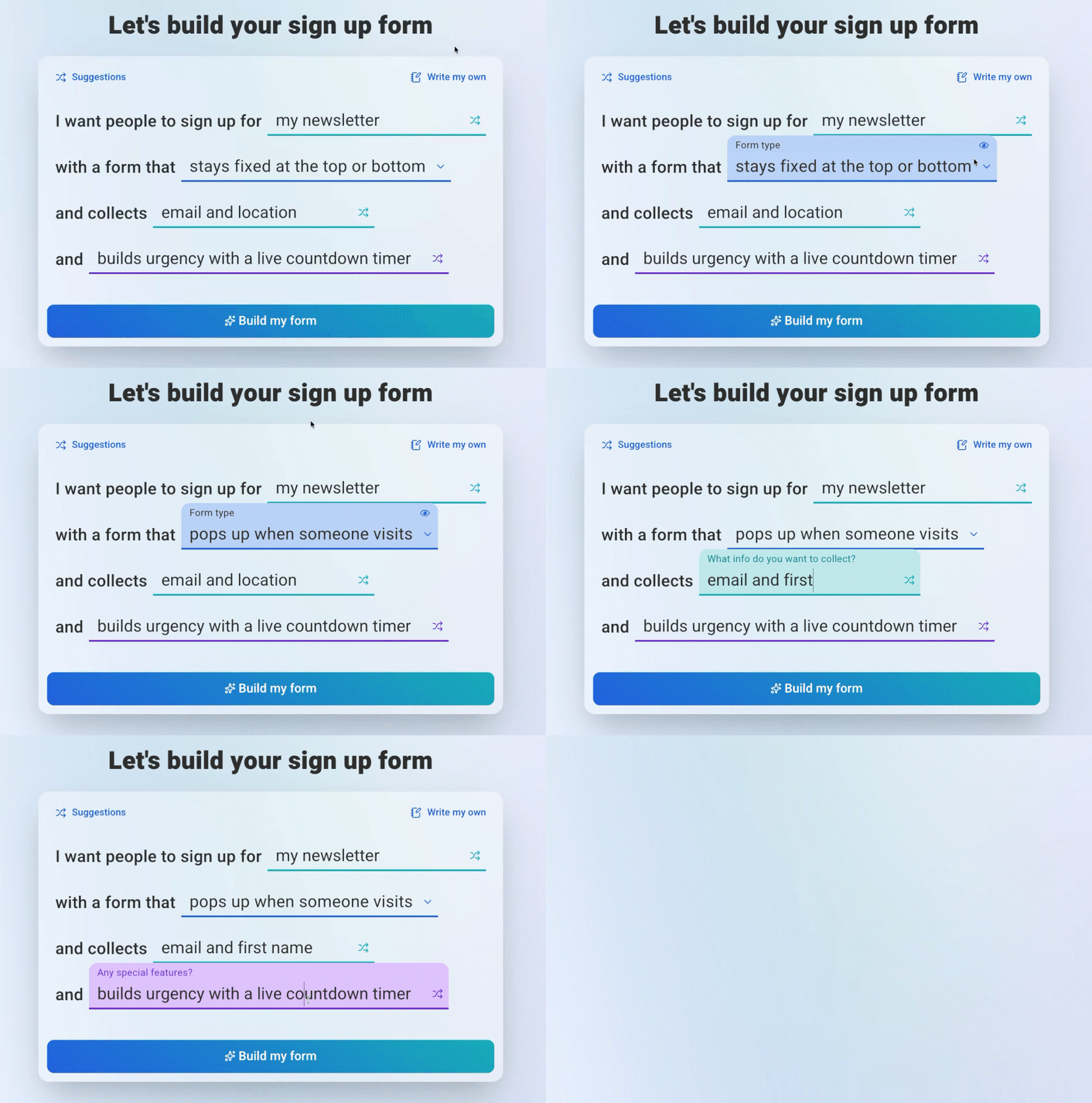
A significant strength lies in its multichannel approach, enabling businesses to manage email, SMS, and web push notifications from a single, unified dashboard. This integration is crucial for creating cohesive customer journeys and ensuring consistent brand messaging across various touchpoints. The flow builder within Omnisend offers remarkable granularity, supporting up to 20 trigger filters, 20 conditional splits, and four exit conditions per workflow. This level of control allows marketers to craft highly specific and personalized automation sequences, such as sophisticated abandoned cart recovery series or targeted post-purchase follow-ups.
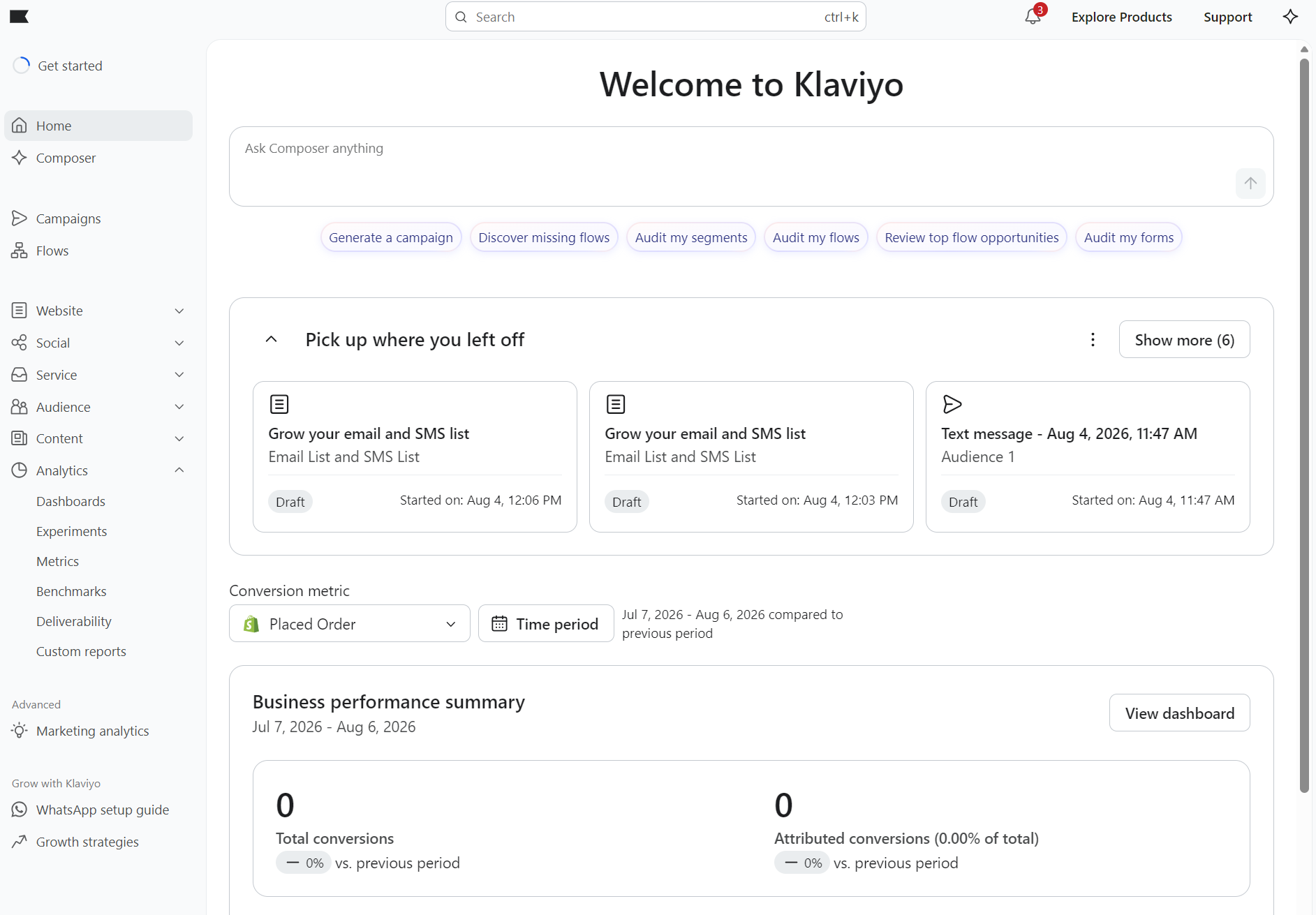
Omnisend’s commitment to user efficiency is further evidenced by its suite of AI features. The AI segment builder automatically identifies customer segments based on behavior and demographics, while generative AI assists in crafting compelling copy and subject lines. For paid plans, Forms AI streamlines the creation of lead capture forms, and Reports AI provides concise summaries of performance data, eliminating the need for manual data aggregation and analysis. This emphasis on AI-driven efficiency makes enterprise-level capabilities accessible even to businesses with limited marketing resources.
Customer support is another area where Omnisend sets a high standard, offering 24/7 live chat and email support across all plans, including its Free Forever option. This commitment ensures that users, regardless of their subscription level, have immediate access to assistance, fostering a more reliable and less disruptive user experience. Furthermore, Omnisend boasts expansive global SMS coverage, supporting over 190 countries, a critical advantage for international e-commerce businesses. Its native web push notifications and Customer Breakdown feature, which categorizes customers into lifecycle stages based on RFM (Recency, Frequency, Monetary) analysis, further empower marketers to optimize reach and improve overall marketing effectiveness.

Despite its robust offerings, Omnisend does present some limitations. Its CRM capabilities are less extensive compared to broader marketing suites, and it offers fewer third-party integrations than Klaviyo or Mailchimp. Additionally, while its Standard plan provides significant cost savings, the pricing for its Pro plan becomes comparable to Klaviyo, potentially narrowing its competitive edge at higher contact volumes.
Deep Dive: Klaviyo – Precision Through Predictive Analytics and Data Mastery
Klaviyo distinguishes itself through a profoundly data-first approach, making it the preferred platform for e-commerce businesses that thrive on deep customer insights and predictive analytics. Its core strength lies in its ability to transform raw customer data into actionable intelligence, driving highly optimized marketing campaigns.
Out-of-the-box, Klaviyo provides crucial metrics such as Customer Lifetime Value (CLV), churn risk, and predicted purchase dates. When combined with the Marketing Analytics add-on, it further enhances predictive capabilities with cross-sell timing and next-best-product recommendations. This suite of predictive tools is invaluable for businesses already generating substantial revenue from email marketing and seeking to optimize their strategies for maximum impact. Such granular insights enable proactive engagement, reducing churn and increasing customer value over time.
Klaviyo’s K:AI, its integrated artificial intelligence, is a significant differentiator. It encompasses over 40 predictive and generative features, including CLV scoring, churn risk assessment, and RFM analysis. For content creation, K:AI offers tools like Composer (beta), Brand Voice AI, and Flows AI, which assist in generating relevant and on-brand marketing messages. These advanced AI functionalities allow for unparalleled personalization and automation, ensuring that every customer interaction is tailored and timely.
The platform is also well-suited for larger organizations and teams, offering the ability to assign up to seven different user roles, including owners, managers, and content creators. This robust permission management system facilitates collaborative marketing efforts and ensures data security and operational control within complex team structures.
However, Klaviyo’s advanced feature set comes with a steeper learning curve. New users may require significant time and resources to fully master its capabilities and extract maximum value. Furthermore, its pricing model scales quickly, and businesses might find themselves paying a premium even if they are not utilizing all of its sophisticated features. This cost consideration makes it more suitable for established e-commerce operations with dedicated marketing teams capable of harnessing its full potential.
Deep Dive: Mailchimp – The Versatile Marketing Toolkit for Broad Appeal
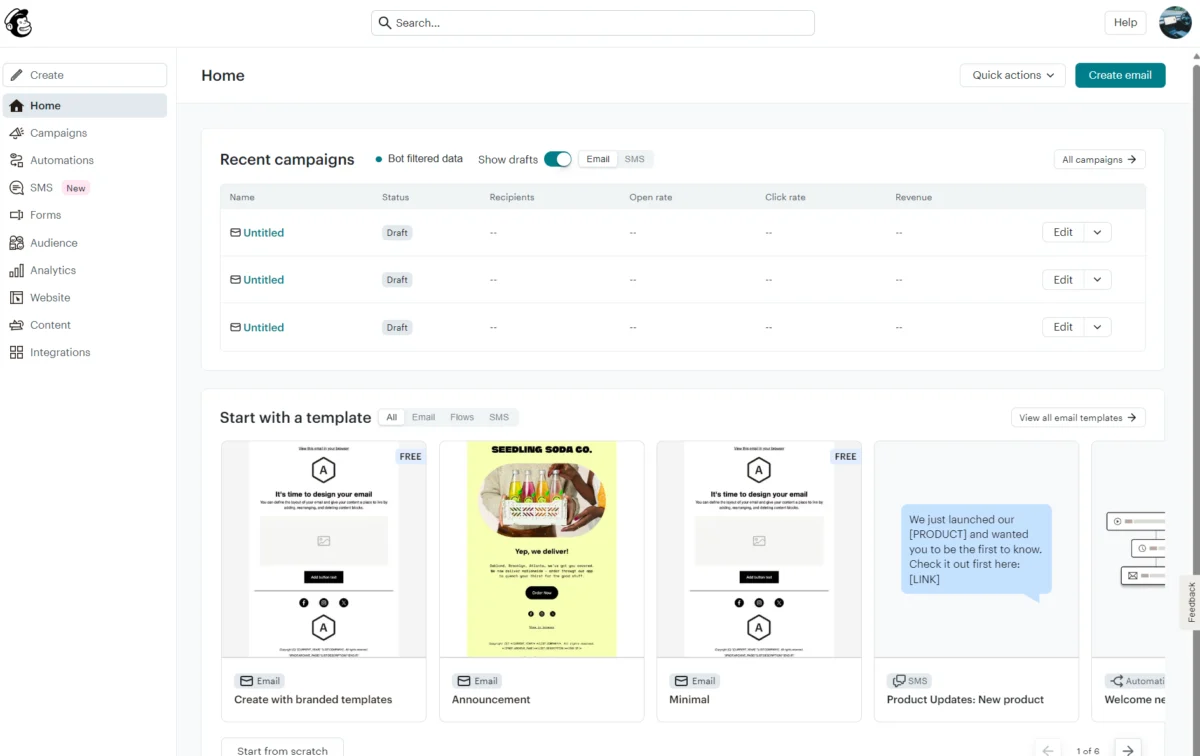
Mailchimp stands out as the broadest, all-purpose marketing toolkit among the three platforms, making it an excellent choice for businesses with diverse marketing needs beyond just e-commerce. Its comprehensive suite includes not only email and SMS capabilities but also a website builder, social media posting tools, and landing page creation, offering a centralized hub for various marketing activities.
The platform’s extensive library of over 130 ready-made email templates covers a wide array of e-commerce scenarios, facilitating quick campaign setup for users of all experience levels. This breadth of functionality, coupled with a low entry price, makes Mailchimp particularly appealing to absolute beginners, small businesses, and those whose primary focus isn’t exclusively e-commerce. It provides an accessible entry point into digital marketing without requiring specialized knowledge or a large budget.
Mailchimp does offer a suite of e-commerce features, including the ability to sync orders and products, automate welcome series, and manage abandoned cart flows. It also incorporates predictive analytics for CLV, purchase likelihood, and churn risk, providing valuable insights for online sellers. However, during the evaluation, these e-commerce functionalities often felt secondary to its broader campaign and general marketing features. This suggests that while Mailchimp can support basic e-commerce operations, it may lack the depth and specialization required by high-growth or complex online stores.
The primary drawback of Mailchimp lies in its feature gating. Many of its advanced capabilities, including predictive analytics, predictive segmentation, and generative AI (powered by Intuit Assist, currently in beta), are exclusively available on its Standard plan or higher. At these tiers, Mailchimp often loses its initial price advantage, with costs becoming comparable to, or even exceeding, Omnisend for similar contact volumes. This necessitates a careful consideration of required features versus pricing for businesses evaluating Mailchimp for scaling e-commerce operations.
Pricing Dynamics: Navigating Cost and Value Across Platforms
The financial implications of choosing a marketing automation platform are paramount for any business. While Mailchimp Essentials presents the lowest starting price at $13 per month, compared to Omnisend’s $16 and Klaviyo’s $20, this initial affordability comes with significant feature restrictions. Mailchimp’s entry-level plans often gate critical functionalities such as predictive segmentation, Customer Lifetime Value (CLV) insights, and advanced automation, which are essential for effective e-commerce marketing.
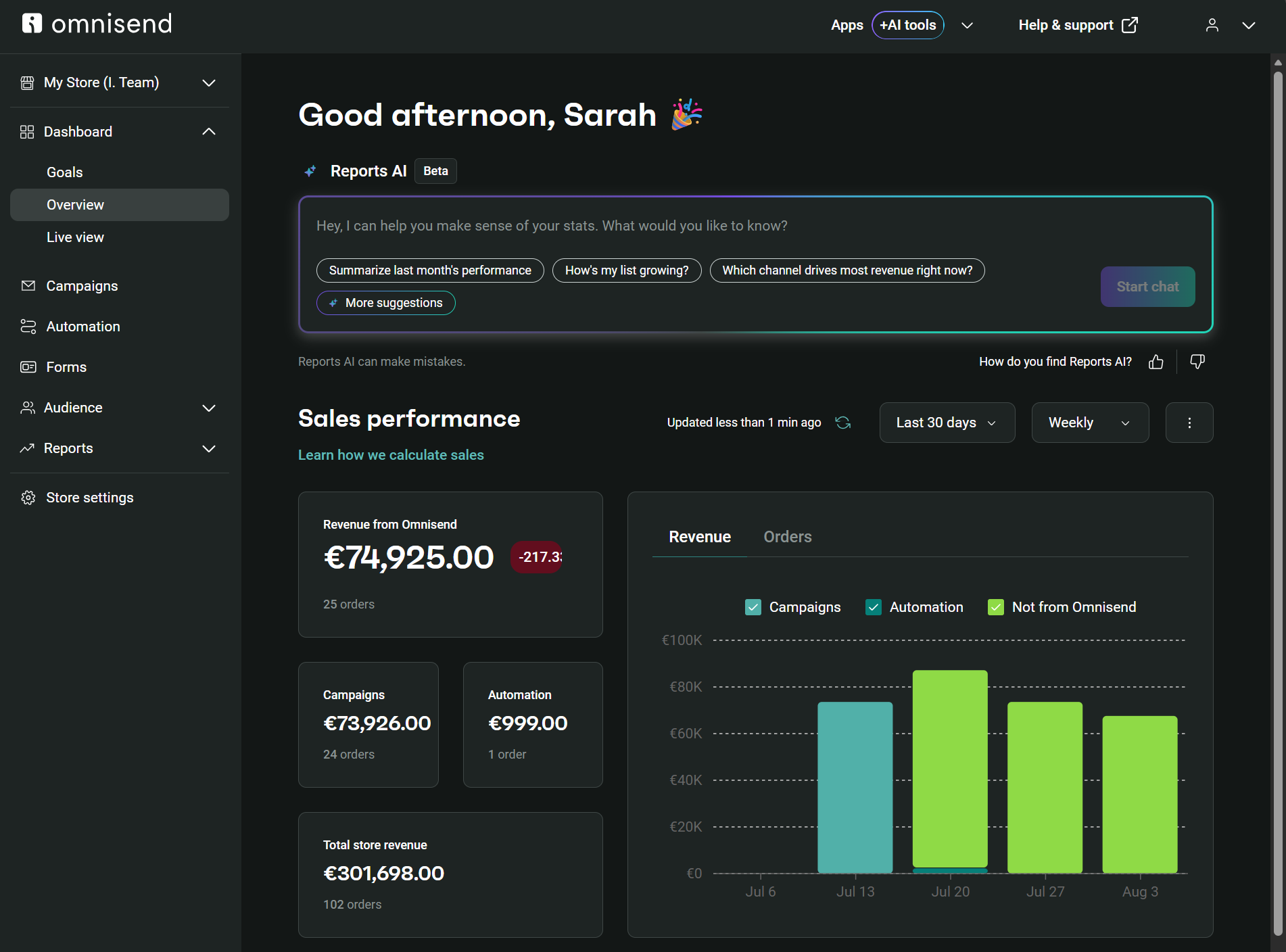
When comparing plans with similar feature sets, specifically the Standard plans, Omnisend frequently undercuts Mailchimp across various contact tiers. For instance, at 10,000 contacts, Omnisend is priced at $132/month, while Mailchimp Standard is $135/month. This demonstrates Omnisend’s strong value proposition for businesses requiring a comprehensive suite of e-commerce marketing tools without the premium price tag. Klaviyo generally maintains the highest starting prices, and its cost scales more rapidly with increasing contact volumes, although its Pro plan pricing is comparable to Omnisend’s higher-tier offerings.
A crucial aspect of pricing often overlooked is how each platform counts contacts, as this directly influences billing tiers. Klaviyo bases its billing on "active profiles," counting anyone who is emailable unless explicitly suppressed. Omnisend counts both subscribers and non-subscribers but excludes unsubscribed contacts from the billable total. Mailchimp, conversely, has the broadest definition, counting nearly all contact types towards the billable total, including non-subscribers and unsubscribed contacts, until they are manually archived or permanently deleted. This distinction can lead to significant cost discrepancies, particularly for businesses with large, dynamic contact lists or those with a high rate of unsubscribes.
Free Plan Comparison:
The availability and capabilities of free plans are vital for startups and small businesses testing the waters:
- Omnisend’s Free Forever plan stands out by offering 24/7 live chat and email support, a unique advantage. It provides access to all core email marketing features, full workflows, and the AI segment builder, along with email and web push notifications for up to 250 contacts and 500 emails/month.
- Klaviyo’s free plan also includes access to all core email marketing features, full workflows, and segmentation. It covers email, mobile push, and provides $5 in mobile message credits monthly. Support is limited to email for the first 60 days. Like Omnisend, it allows for 250 contacts and 500 emails/month.
- Mailchimp’s free plan is the most restrictive. While offering 250 contacts and 500 emails/month, it provides email-only channels, basic segmentation, and notably, no automation whatsoever. Support is limited to email for the first 30 days.
This comparative analysis of free plans highlights that Omnisend and Klaviyo offer more robust starting points for businesses looking to implement basic marketing automation without immediate financial commitment, while Mailchimp’s free tier is best suited for very basic email campaigns.
User Experience and Support: The Foundation of Operational Efficiency
The usability of a marketing platform and the reliability of its support channels are critical determinants of long-term satisfaction and operational efficiency. The evaluation focused on these aspects to understand the real-world impact on businesses.
Omnisend prioritizes accessibility and consistent support. Its provision of 24/7 live chat and email support across all plans, including the Free Forever option, is a significant differentiator. This ensures that users, from startups to established enterprises, can receive timely assistance without being penalized for their subscription tier. This comprehensive support structure contributes to its high Capterra rating (4.7/5) and a strong Shopify App Store rating (4.8/5, based on over 2,900 reviews), reflecting a positive user experience. The platform’s ease of use, rated 4/5 stars, indicates a relatively low learning curve, making it appealing for marketers who need to get campaigns up and running quickly.
Klaviyo, while offering 24/7 email support and 24/5 live chat on paid plans (with free plans receiving 60 days of email support), has a reputation for its advanced features requiring a steeper learning curve. Its ease of use is rated 3/5 stars, suggesting that while powerful, it may demand more time for new users to become proficient. This is often a trade-off for its deep data analytics and predictive capabilities. Its G2 rating of 4.6/5 and Shopify App Store rating of 4.7/5 (over 2,900 reviews) indicate that while it demands more from its users, the investment often yields significant returns for those who master it.
Mailchimp, designed for broad appeal, scores well on ease of use with a 4/5-star rating. Its intuitive interface and vast template library cater effectively to beginners and those with general marketing needs. Support, however, is limited to 24/7 live chat and email only for paid plans, with free plans receiving just 30 days of email support. This tiered support model, coupled with a G2 rating of 4.4/5 and a Shopify App Store rating of 4.8/5 (based on over 1,320 reviews), positions Mailchimp as a user-friendly option for basic needs, but potentially less supportive for complex issues on lower-tier plans.
E-commerce Ecosystem Integration: Seamless Operations
The ability of a marketing platform to integrate seamlessly with various e-commerce platforms and third-party applications is fundamental for creating a cohesive and efficient digital ecosystem.
For Shopify stores, all three platforms offer robust native integrations. As of August 2026, Mailchimp and Omnisend share the highest Shopify App Store rating at 4.8/5. Omnisend’s rating is based on over 2,900 reviews, while Mailchimp’s is from over 1,320 reviews. Klaviyo closely follows with a 4.7/5 rating across more than 2,900 reviews. These high ratings underscore their effectiveness within the Shopify environment, demonstrating their capability to sync customer data, orders, and behavioral events crucial for automation. Omnisend’s purpose-built e-commerce focus, including its AI segment builder and RFM analysis, often makes it a more compelling choice for Shopify stores aiming for rapid growth and advanced automation without a heavy analytical burden.
Beyond Shopify, all three platforms provide native applications for other leading e-commerce platforms such as BigCommerce, WooCommerce, and PrestaShop. These integrations ensure automatic synchronization of contacts, store events (like purchases and abandoned carts), and product catalogs, enabling consistent marketing automation across different storefronts. The choice for these platforms often boils down to the specific feature requirements and budgetary constraints of the business.
In terms of overall integrations, Klaviyo leads with over 350 available integrations, followed by Mailchimp with over 300, and Omnisend with over 250. This metric is crucial for businesses that rely on a diverse tech stack, including CRM systems, loyalty programs, helpdesks, and other specialized tools. Klaviyo’s extensive integration library supports a more complex and interconnected marketing ecosystem, catering to businesses that require a high degree of interoperability. Omnisend’s 250+ integrations are robust for most e-commerce needs, while Mailchimp’s offerings support its broader general marketing appeal.
The AI Frontier: Enhancing Marketing Intelligence and Creativity
Artificial Intelligence has rapidly become an indispensable component of marketing automation platforms, offering capabilities that range from content generation to predictive analytics. Each platform has embraced AI in distinct ways, reflecting their core philosophies.
Klaviyo stands at the forefront of AI-driven predictive analytics. Its K:AI suite encompasses over 40 predictive and generative features. This includes advanced capabilities for Customer Lifetime Value (CLV) scoring, churn risk assessment, and RFM (Recency, Frequency, Monetary) analysis, providing marketers with deep insights into future customer behavior. Generative AI tools like Composer (beta), Brand Voice AI, and Flows AI assist in crafting highly personalized and on-brand messages, automating content creation, and optimizing workflow design. Klaviyo’s AI is geared towards data-heavy stores that seek to leverage granular customer data for hyper-segmentation and proactive engagement strategies, effectively predicting and influencing customer journeys.
Omnisend integrates AI primarily for efficiency and automation in core e-commerce marketing tasks. Its AI features include copywriting assistance, subject line generation, a product recommender, an AI segment builder, Forms AI, and Reports AI. The AI segment builder intelligently creates customer segments based on various criteria, significantly reducing manual effort. Forms AI streamlines lead capture, and Reports AI provides concise summaries of campaign performance, allowing marketers to quickly grasp key insights without delving into extensive data. Omnisend’s AI is designed to lower the setup burden and operational overhead for e-commerce businesses, making advanced automation more accessible and less time-consuming.
Mailchimp’s AI capabilities, primarily branded as Intuit Assist (currently in beta), focus on content generation and send-time optimization. These tools aim to simplify the creation of marketing materials and improve campaign effectiveness by suggesting optimal send times. While offering valuable assistance, Mailchimp’s AI features are generally less extensive in their predictive capabilities compared to Klaviyo, and many are restricted to higher-tier plans. This aligns with Mailchimp’s positioning as a general marketing platform, offering practical AI tools for broader applications rather than specialized, deep e-commerce intelligence.
The evolution of AI in these platforms signifies a broader industry trend towards intelligent automation, where machines assist marketers in understanding customer behavior, personalizing communications, and optimizing campaigns at scale. The choice of platform dictates the depth and type of AI assistance a business can expect, influencing their ability to compete effectively in a data-driven marketing environment.
Strategic Recommendations: Choosing the Right Platform for Your E-commerce Journey
The selection of an e-commerce marketing automation platform is a strategic decision that should align with a business’s current scale, growth aspirations, budget, and internal capabilities. Having thoroughly tested Omnisend, Klaviyo, and Mailchimp, we offer tailored recommendations:
Choose Omnisend if:
You are an e-commerce business seeking a quick setup for segments, flows, and reports, valuing a native integration with Shopify or other major commerce platforms. Your ideal setup involves a single platform for email, SMS, and web push notifications, without the need for complex analytics add-ons that inflate your bill. Prioritizing value, comprehensive support availability (24/7 across all plans), and robust automation and AI features to minimize manual effort in building and analyzing your account, Omnisend offers a powerful, streamlined solution for revenue-focused marketing.
Choose Klaviyo if:
Your e-commerce business is already generating significant revenue and customer data from email marketing, and you require advanced tools to predict customer behavior and recommend strategic next steps. A primary focus on gaining greater control and deep insights into your customer lifecycle, optimizing Customer Lifetime Value (CLV), and reducing churn is paramount. You will benefit from AI that assists in building sophisticated campaigns and value the ability to create unified contact profiles, potentially utilizing Klaviyo’s Advanced KDP add-on for a holistic customer view. Klaviyo is best suited for data-savvy marketers with the resources to fully leverage its powerful analytical and predictive capabilities.
Choose Mailchimp if:
You operate an e-commerce business but also have broader general email marketing needs, such as managing forms, welcome emails, and diverse campaigns across various services or products. You may require flows triggered by customer behavior and store activity, but do not need highly complex filters or the most granular predictive analytics. Your priorities are growing your contact list, engaging customers when they are most receptive, and having access to SMS as a secondary communication channel, rather than a primary focus on maximizing revenue and retention through highly specialized e-commerce features. Mailchimp offers an accessible and versatile toolkit for beginners and businesses with mixed marketing requirements.
Broader Market Implications: Innovation in E-commerce Marketing
The competitive landscape among Omnisend, Klaviyo, and Mailchimp reflects the broader trends and innovations shaping the e-commerce marketing industry. This intense competition has driven significant advancements in several key areas:
- Multichannel Integration: The shift from single-channel email marketing to integrated multichannel communication (email, SMS, web push, mobile push, social) is evident. Platforms are continually expanding their channel offerings to provide a unified customer experience, recognizing that consumers engage across various touchpoints.
- Artificial Intelligence and Machine Learning: The integration of AI, both generative and predictive, is transforming how marketers operate. AI-powered tools are automating content creation, optimizing send times, segmenting audiences with greater precision, and providing predictive insights into customer behavior. This allows businesses to personalize interactions at scale, a capability that was once