The landscape of digital information discovery is undergoing a profound transformation, driven largely by the proliferation of artificial intelligence tools like ChatGPT and Google AI Overviews. In this evolving environment, where users increasingly turn to conversational AI for synthesized answers rather than traditional search result lists, brands are being compelled to fundamentally rethink their strategies for reaching potential customers. Recent groundbreaking research conducted jointly by Meltwater, a global leader in media intelligence, and LinkedIn, the world’s largest professional network, has shed critical light on this paradigm shift, revealing the unexpectedly vital role LinkedIn plays in AI search citations.
The comprehensive study, which involved an extensive analysis of 9.5 million AI citations across various B2B categories and major AI platforms, unequivocally established LinkedIn as one of the preeminent sources referenced in AI-generated responses. What emerged as the most significant and perhaps surprising finding was the origin of these citations: a staggering 75% of LinkedIn-derived citations stemmed from individual member profiles, while only 25% originated from official company pages. This data strongly suggests that while corporate pages retain their importance in establishing foundational brand visibility and identity, the authentic voices of leadership and deep subject-matter expertise articulated by individual professionals are increasingly serving as potent authority signals for AI systems.
The Shifting Sands of AI Search: A New Imperative for Brands
The advent of sophisticated generative AI models has fundamentally altered how information is consumed and validated. Traditional search engine optimization (SEO) often focused on keywords, backlinks, and technical site performance. While these elements remain relevant, AI-driven search prioritades different signals. Users interacting with AI chatbots or overview features seek concise, credible, and context-rich answers, moving beyond simple links to comprehensive summaries. This shift necessitates a re-evaluation of content strategy, pushing brands towards a model where the quality and authority of information, particularly from human experts, takes precedence.
LinkedIn’s unique ecosystem, built upon the premise of professional networking and knowledge sharing, inherently fosters the type of content AI systems are now designed to prioritize. The platform is a repository of real people sharing genuine professional experiences, offering nuanced industry analyses, providing practical advice, and presenting firsthand observations. This "human layer" provides AI algorithms with a richer, more diverse set of data points to process. Unlike a meticulously crafted official brand message, which can sometimes be perceived as promotional, the insights from a credible executive, a seasoned product leader, or a practitioner directly involved in the field offer specific, actionable, and highly useful context. AI-generated answers, designed to synthesize the "best available" information on a given topic, naturally gravitate towards content that demonstrates deep expertise and practical utility.
Why AI Systems Favor Individual Expertise
The research posits that AI systems are actively seeking several key attributes in their source material: expertise, context, credibility, and the provision of genuinely useful answers. LinkedIn’s structure and user behavior align perfectly with these requirements. When individuals share their professional journey, insights, and lessons learned, they implicitly provide:
- Expertise: Directly demonstrating knowledge accumulated through years of experience in a specific domain.
- Context: Offering real-world scenarios, challenges, and solutions that enrich abstract concepts.
- Credibility: Associating information with a verifiable professional identity, often backed by endorsements, recommendations, and a history of professional engagement.
- Utility: Providing actionable advice, practical tips, or problem-solving frameworks that directly address user queries.
This preference for individual voices also resonates with the broader trend in SEO toward E-E-A-T (Experience, Expertise, Authoritativeness, Trustworthiness). Google, for instance, has progressively emphasized these factors in its ranking algorithms, especially for "Your Money Your Life" (YMYL) topics where accuracy and reliability are paramount. Generative AI, in its pursuit of delivering factual and dependable information, naturally extends this emphasis on human-validated expertise.
For marketing professionals, this paradigm shift places "expert activation" squarely at the center of their AI visibility strategy. The imperative is clear: brands must meticulously identify the individuals within their organizations who possess genuine domain expertise—ranging from C-suite executives and product leaders to researchers, strategists, consultants, customer-facing teams, and technical specialists. The subsequent crucial step involves empowering and enabling these experts to transform their invaluable internal knowledge into publicly accessible, structured, and highly useful content.
Defining AI-Citable Content: A Recipe for Success
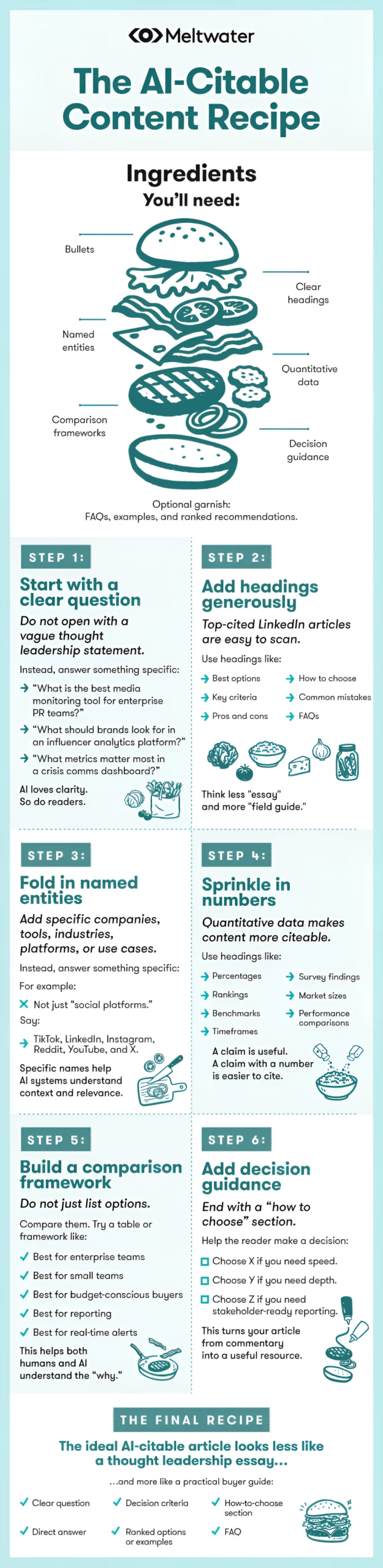
The Meltwater and LinkedIn study didn’t just identify the who but also the what. It meticulously detailed the common characteristics of LinkedIn content that garners the most AI citations, providing a practical blueprint for content creation. These traits underscore a clear preference for clarity, structure, and data-driven insights:
- Structured Formatting is Paramount: Every single top-cited article in the analyzed sample utilized bullets or numbered lists. This seemingly simple formatting choice significantly enhances readability for both human readers and AI algorithms, allowing for easy parsing and extraction of key points.
- Clear Hierarchical Structure: A remarkable 92% of the highly cited content featured a clear organizational structure, typically employing H2 and H3 tags. This hierarchical arrangement signals to AI systems the main topics and sub-points, making it easier for them to understand the content’s logical flow and synthesize information accurately.
- Data and Statistics: A substantial 67% of the cited content included statistics or hard data. Quantifiable evidence lends credibility and specificity, making the information more authoritative and less subjective. AI systems are designed to process and present factual data, and content rich in such information is naturally more appealing.
Furthermore, the research highlighted the formats that proved most effective. Practical, decision-led content consistently outperformed other types. This includes:

- How-to Guides: Step-by-step instructions for accomplishing a task.
- How-to-Choose Frameworks: Guides that help users make informed decisions between options.
- Comparison Pieces: Articles that weigh the pros and cons of different products, services, or approaches.
- Ranked Lists: Curated lists that provide ordered recommendations or insights.
- Buyer-Focused Explainers: Content designed to educate potential customers on complex topics relevant to their purchasing decisions.
Conversely, traditional opinion-led thought leadership, while valuable for establishing personal brand and engaging human audiences, did not perform as well on its own in terms of AI citation. This distinction is crucial: conventional thought leadership often aims to inspire, provoke thought, or persuade, whereas AI-citable content must primarily aim to answer a question clearly and concisely. It needs to be easy for an AI to parse, summarize, and specific enough to confidently support a direct citation.
An ideal AI-citable LinkedIn article, therefore, would be characterized by a combination of expert insight and rigorous structure, ensuring that even the most brilliant idea is presented in a manner that AI algorithms can readily understand and leverage. Without such clear organization, valuable expertise risks being overlooked by AI systems.
The Evolution of Employee Advocacy: From Sharing to Creating
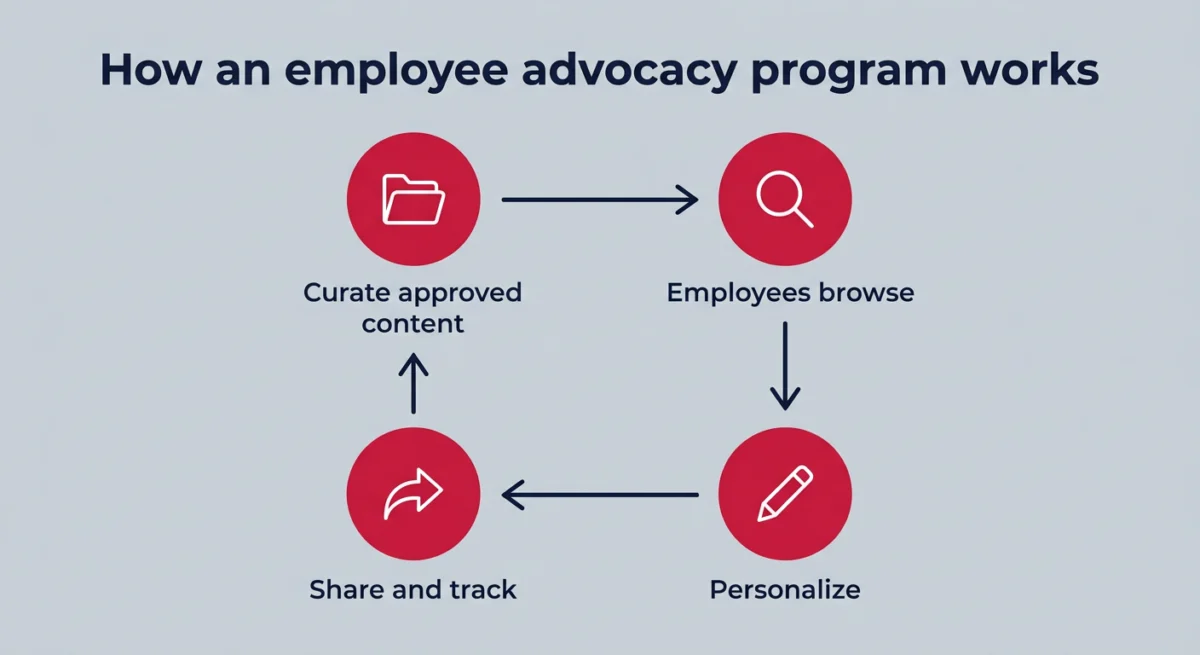
In this emerging landscape, the traditional approach to employee advocacy—simply encouraging employees to share pre-approved social content en masse—is becoming outdated. The new paradigm demands a more sophisticated and strategic approach. Instead of merely amplifying brand messages, employees, particularly those identified as subject-matter experts and leaders, must be empowered and supported to create original content in their own authentic voices.
This shift requires a proactive role from social media, content, and communications teams, moving from content distribution to content enablement and editorial support. Their new mandate includes:
- Providing Guidelines and Frameworks: Offering clear instructions on what constitutes effective AI-citable content, including structural recommendations, tone guidelines, and best practices for incorporating data.
- Supplying Useful Data and Insights: Arming experts with relevant internal data, market research, and industry trends to enrich their content.
- Offering Editorial Support: Providing assistance with drafting, editing, and refining content to ensure clarity, conciseness, and adherence to quality standards.
- Establishing a Realistic Publishing Cadence: Helping experts integrate content creation into their busy schedules without overwhelming them.
The content created by these experts should focus on solving real problems for their target audience, mirroring the practical, decision-led formats identified in the research. Examples include detailed case studies, practical how-to guides based on their direct experience, insightful industry analyses, and clear explanations of complex topics. These types of pieces resonate deeply with human readers because they offer tangible value, and they are equally effective for AI systems due to their structured, specific, and experience-grounded nature.
Recognizing that not all employees are natural content creators, brands also need to cultivate an internal culture that encourages and supports this new form of advocacy. This can involve:
- Reassurance and Permission: Explicitly communicating that employees are not only allowed but encouraged to share their professional expertise on LinkedIn, within appropriate boundaries.
- Training and Workshops: Running regular sessions to educate teams on content creation best practices, demonstrate the value of sharing expertise, and provide practical tools and tips.
- Recognition and Incentives: Acknowledging and rewarding employees who actively contribute valuable content, further fostering a culture of knowledge sharing.
The Emerging AI Visibility Strategy: A Blueprint for B2B
The Meltwater and LinkedIn research provides a clear, actionable blueprint for B2B organizations seeking to optimize their AI visibility. The strategy is dual-pronged: it requires pairing strong, informative content on official company pages with a robust and strategic program for elevating the credible voices of individual experts within the organization.
The key steps involve:
- Identify Your Internal Experts: Conduct an internal audit to pinpoint individuals with deep domain knowledge across various functions and product lines.
- Empower Content Creation: Provide these experts with the resources, support, and encouragement needed to publish useful, structured content on LinkedIn.
- Prioritize AI-Citable Traits: Emphasize clarity, factual data, real-world examples, and genuine experience in all expert-led content. Focus on formats that answer questions and solve problems.
- Track and Optimize: Implement robust analytics to monitor how the brand, its key people, and its core topics appear in AI-generated answers over time, allowing for continuous refinement of the strategy.
This strategic pivot acknowledges that in the age of generative AI, the authority of an organization is increasingly intertwined with the collective expertise and public presence of its individual members. By investing in and nurturing their employees’ voices on platforms like LinkedIn, brands are not just enhancing their traditional social media presence; they are actively building a critical new pathway to visibility and credibility in the rapidly evolving world of AI-powered information discovery. The future of B2B marketing demands not just a brand voice, but a chorus of expert voices.
For a more detailed understanding of these findings and comprehensive recommendations, organizations are encouraged to download the full Meltwater and LinkedIn report, "How LinkedIn Content Wins in AI Search," which offers a complete analysis of the research and actionable insights for navigating this new era of digital visibility.