The landscape of Google search has undergone a profound transformation, evolving far beyond its rudimentary origins as a keyword-matching engine. For content creators and publishers, understanding this shift is not merely advantageous; it is imperative for achieving visibility and relevance in today’s sophisticated digital ecosystem. While many content strategies remain anchored in the outdated premise of keyword research and optimization, Google’s algorithms now prioritize a much deeper understanding of user intent, contextual relevance, and, critically, content quality as defined by its Experience, Expertise, Authoritativeness, and Trustworthiness (E-E-A-T) framework.
The Paradigm Shift: From Keywords to Semantic Understanding
In its nascent stages, Google’s primary function was straightforward: to index web pages and return results based on the literal keywords present in a user’s search query. This mechanistic approach gave rise to early SEO tactics, including keyword stuffing, where pages were artificially inflated with target terms to game the system. However, Google quickly recognized the limitations and vulnerabilities of such a model. The internet’s explosive growth and the increasing complexity of human language demanded a more intelligent search engine capable of discerning meaning, not just matching words.
Over two decades, Google has invested heavily in artificial intelligence and machine learning to develop algorithms that interpret search queries with remarkable nuance. Technologies like Latent Semantic Indexing (LSI), which identifies synonyms and related concepts, and later RankBrain, an AI system that helps Google process ambiguous queries, marked significant milestones. These advancements allowed Google to move from simply matching "blue car" to understanding that a user might be looking for "automobiles," "vehicles," or even "transportation," alongside the specific color. This evolution culminated in an algorithm that strives to understand the intent behind a search – whether the user wants to buy, learn, navigate, or watch – and to evaluate the context in which information is presented.
The inherent challenge for Google was to quantify "quality." Unlike keyword density, quality is subjective and multifaceted, varying significantly based on the searcher’s needs and the nature of the information. How could a machine learn to distinguish between credible, helpful content and misleading, superficial, or even harmful information? The answer emerged in the form of human intervention: the Google Quality Raters’ Guidelines.
E-E-A-T: Google’s Benchmark for Quality Content
The E-E-A-T framework stands as Google’s comprehensive definition of high-quality content. It is an acronym for Experience, Expertise, Authoritativeness, and Trustworthiness, and it applies to both the website itself and the individual content creator. This concept is meticulously detailed in Google’s extensive "Quality Raters’ Guidelines," a document used by over 10,000 human evaluators globally to assess the quality of search results and, in doing so, provide critical feedback that helps train Google’s machine learning algorithms.
The E-A-T components (Expertise, Authoritativeness, Trustworthiness) have been foundational for many years, with discussions of their importance dating back almost a decade in the SEO community. A pivotal update occurred in December 2022, when Google formally added the first "E" for "Experience" to the guidelines. This addition underscored Google’s increasing emphasis on firsthand knowledge and practical engagement with a topic.
- Experience: This refers to the extent to which the content creator has direct, personal experience with the topic. For instance, someone reviewing a product would demonstrate experience by having actually used it and sharing their insights. A travel blogger would showcase experience by detailing their actual journey to a destination.
- Expertise: This denotes specialized knowledge or skill in a particular field. While formal qualifications are often a strong indicator (e.g., a doctor writing about medical advice), expertise can also be demonstrated through a deep understanding, practical skills, and a track record in a niche, even without traditional credentials (e.g., a hobbyist with years of experience building model airplanes).
- Authoritativeness: This relates to the reputation of the content creator and the website as a recognized source of information on a given topic. It is built through citations, mentions, links from other reputable sources, and industry recognition.
- Trustworthiness: This is perhaps the most crucial element, encompassing the accuracy, honesty, safety, and reliability of the content and the website. It involves clear privacy policies, secure connections (HTTPS), transparent contact information, and content that is factually correct and unbiased.
Human quality raters scrutinize pages against these criteria, looking for signals that confirm the presence or absence of E-E-A-T. Their evaluations, though not directly influencing rankings, provide invaluable data that helps Google refine its algorithms to automatically identify and prioritize high-quality content.
The Criticality of E-E-A-T for Your Money Your Life (YMYL) Topics
The importance of high E-E-A-T is not uniform across all content. Google places a significantly higher demand on E-E-A-T for what it terms "Your Money Your Life" (YMYL) topics. These are subjects where inaccurate or misleading information could directly impact a person’s health, financial stability, safety, or well-being. The stakes are considerably higher, and Google’s algorithms are designed to be extremely cautious in these areas to protect users from harm.
Examples of YMYL topics include:
- Medical and Health Information: Advice on treatments, diagnoses, symptoms, nutrition, or mental health. Content must come from qualified medical professionals or reputable health organizations.
- Financial Advice: Guidance on investments, loans, insurance, taxes, or budgeting. Authors should be certified financial advisors or recognized institutions.
- Legal Information: Articles offering legal counsel, rights, or obligations. Expertise from lawyers or official legal bodies is essential.
- Public Safety and Security: Information related to emergencies, disaster preparedness, cybersecurity, or personal safety. Official government or emergency service sources are paramount.
- Civic and Governmental Information: Content on voting, legislation, public policy, or government services. Official government sources or recognized political science experts are required.
- News and Current Events: Reporting on major events (e.g., elections, natural disasters, global conflicts). Content must be factually accurate, timely, and from experienced, ethical journalists.
- E-commerce and Transactional Pages: Websites where users conduct financial transactions (e.g., online shopping, banking, bill payment). These demand high trustworthiness regarding security, product accuracy, and customer service.
For these sensitive areas, Google expects to see clear evidence of genuine experience, deep expertise, established authority, and unwavering trustworthiness. A website might have high E-E-A-T for sports news but low E-E-A-T for medical advice if its authors lack relevant qualifications. Conversely, for lighter topics like hobby blogs or entertainment news, the requirements for formal expertise may be less stringent, and personal experience or passion can be sufficient to demonstrate E-E-A-T.
Strategies for Enhancing Your Content’s E-E-A-T
To succeed in the modern search landscape, content creators must abandon outdated SEO practices like keyword stuffing and instead embrace a customer-centric, quality-first approach aligned with E-E-A-T principles. This shift involves fundamentally rethinking content planning and creation.
1. Learn from Quality Content and User Engagement
Understanding what truly resonates with audiences is the first step. Analyzing successful content helps identify patterns in engagement, style, and depth.
- Engagement Metrics: Tools like BuzzSumo’s Content Analyzer can reveal which content pieces garner the most shares and engagement across social platforms. By examining headlines, formats, and topics of highly engaged content related to your niche (e.g., "Social Media Marketing"), you can glean insights into what captivates your target audience.
- Backlink Profiles: Identify top-linked content to understand which articles are frequently referenced by other authoritative sites. High link counts often indicate valuable, authoritative resources.
- Evergreen Visibility: Focus on content that maintains consistent engagement over time, rather than just short-term viral hits. Evergreen content typically provides lasting value and addresses perennial questions.
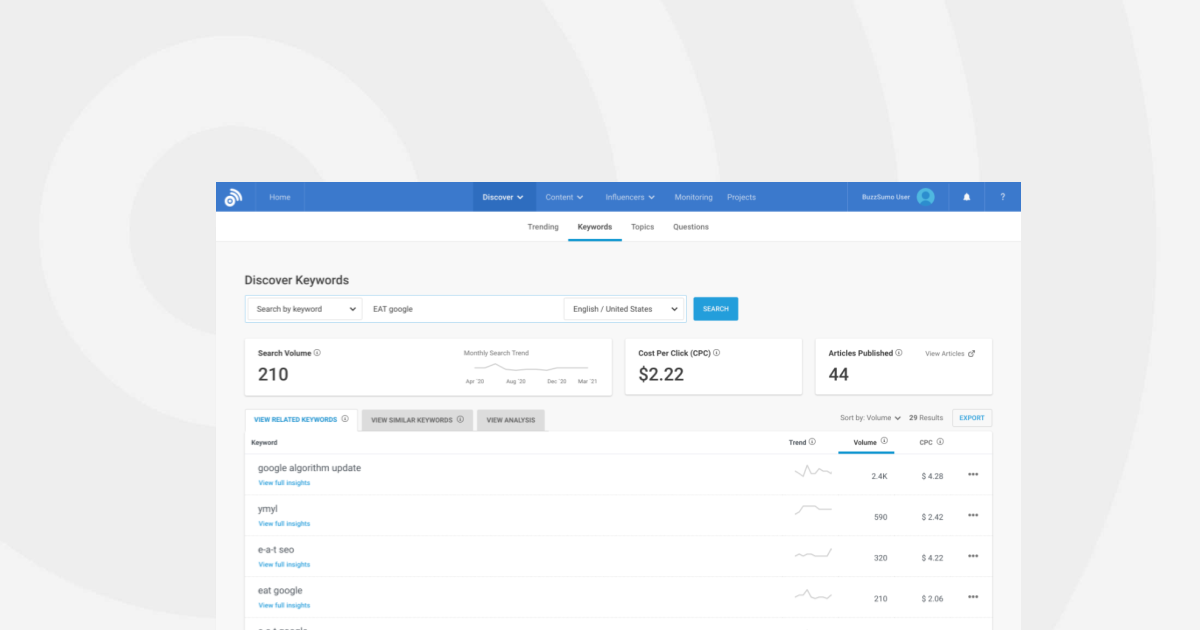
- SERP Analysis: Utilize keyword tools (like BuzzSumo’s Keyword Tool) to analyze the top-ranking content for your target topics. This provides a direct look at what Google currently considers high-E-E-A-T content in your specific domain. Analyzing these top results for their structure, depth, author credentials, and sources offers a blueprint for your own content.
2. Build and Showcase Your Authority
Google actively seeks to identify the credentials and reputation of both the website and its authors. Building and clearly presenting your authority is paramount.
- Author Biographies and Profiles: Ensure every piece of content has a clear author byline. Author bios should include relevant qualifications, experience, awards, and links to professional profiles (e.g., LinkedIn, academic institutions, personal websites). This helps Google connect the author’s identity and credibility to their work.
- Organizational and Author Schema Markup: Implement structured data (Schema.org) for your organization and authors. This provides Google with explicit, machine-readable information about who you are, what you do, and your areas of expertise. Tools like schema generators can simplify this process.
- Consolidate Online Presence: Use platforms like Beacons.ai to create a single, branded hub linking to all your professional channels, publications, and social media profiles. This reinforces your identity as an entity across the web.
- Media Mentions and Interviews: Actively seek opportunities to be featured on reputable podcasts, in interviews, or quoted in industry publications. BuzzSumo’s Content Analyzer, with its "Advanced filters," can help identify publications that feature interviews or podcasts in your niche. Monitoring established authorities in your field can also provide insights into where they are gaining visibility. Each mention contributes to your overall authoritativeness.
3. Embrace a Topic-Centric Content Strategy
Google’s advanced understanding moves beyond isolated keywords to holistic topics and entities. Content strategies should reflect this by organizing information around comprehensive themes.
- Topic Clusters and Pillar Content: Shift from targeting individual keywords to developing "pillar content" – comprehensive guides on broad topics – supported by "cluster content" – detailed articles on specific sub-topics that link back to the pillar page. This hub-and-spoke model signals to Google that your site offers deep, authoritative coverage of a subject.
- Semantic SEO: Focus on covering a topic exhaustively, including related concepts, synonyms, and frequently asked questions, rather than just repeating a single keyword.
- Audience-First Planning: Use tools like BuzzSumo’s Topics Explorer to identify thousands of popular associated topics around a core keyword. This helps uncover the real questions and interests of your audience, ensuring your content directly addresses their needs and intent.
4. Create a "Satisfying" Amount of Content
The ideal content length is not a fixed number but depends entirely on user intent and topic complexity. Google’s goal is to provide a "satisfying amount" of information.
- Intent-Driven Length: For simple queries (e.g., "what is the capital of France?"), a concise answer is satisfying. For complex YMYL topics or comprehensive guides, a much longer, detailed piece is expected.
- Competitive Analysis: Analyze the content length of top-ranking articles for your target topics. BuzzSumo’s Content Analysis report can show "Average engagement by content length," revealing optimal word counts for specific niches. For example, a thorough guide on "Social Media Marketing" might require 3,000-10,000 words to be truly satisfying.
5. Cultivate Strategic Relationships
Beyond mere link building, forming genuine relationships with authoritative voices and publications is a powerful E-E-A-T signal. Google’s algorithms are increasingly adept at understanding "entity relationships" – how brands, authors, and topics are connected across the web, even without direct hyperlinks.
- Identify Influencers: Use tools like BuzzSumo’s Journalist Database to find influential journalists and authors in your niche. Explore their profiles to understand their writing style, preferred topics, and social media activity.
- Build Authentic Connections: Engage with these influencers. Share their content, comment thoughtfully, and establish rapport before pitching your own work. The mantra "Mates First, Links Later" emphasizes building value and trust.
- Collaborate and Co-Create: Seek opportunities for guest posting, expert interviews, or collaborative content projects with other authorities. These collaborations inherently boost E-E-A-T for all involved.
- Earn Mentions: Strive to create content so valuable that it earns mentions and references from authoritative sources, even if they don’t always include a direct link. Google’s semantic understanding can connect these mentions to your brand’s authority.
6. Provide Transparent and Trusted Sources
Citing reputable sources is fundamental to demonstrating trustworthiness and accuracy, especially for YMYL topics.
- Diverse and Authoritative Sources: Include a variety of credible sources: academic research, government reports, official organizations, industry studies, and expert interviews.
- Prioritize Primary Sources: Whenever possible, refer to original research or official data rather than secondary interpretations. For instance, when discussing public health, prioritize links to government health organizations (e.g., using
site:govin Google searches). - Fact-Checking: Ensure all data, statistics, and factual claims are meticulously fact-checked and supported by evidence. This not only builds trust with readers but also signals diligence to Google’s evaluators.
- Transparency: Clearly label sponsored content, disclaimers, and any potential conflicts of interest to maintain integrity.
Broader Impact and Future Outlook
The evolution of Google’s search algorithms towards E-E-A-T represents a significant maturation of the digital information landscape. It’s a proactive measure against misinformation, low-quality content, and manipulative SEO tactics. For content marketers and SEO professionals, this shift means moving away from a purely technical checklist approach to a more holistic, user-centric content strategy.
The implications are profound:
- Sustainable SEO: Focusing on E-E-A-T builds long-term, sustainable ranking power by aligning with Google’s core mission to deliver the best possible results to its users.
- Enhanced Brand Reputation: Consistently producing high-E-E-A-T content establishes a brand as a trusted authority, fostering customer loyalty and credibility.
- Ethical Content Creation: The emphasis on experience, expertise, and trustworthiness encourages ethical content practices, leading to a more informed and reliable internet.
- Adaptation to AI: As Google’s AI and machine learning capabilities continue to advance, its ability to discern quality will increasingly mirror human judgment. Therefore, creating content for humans – with genuine value, depth, and credibility – is the most future-proof strategy.
In conclusion, the era of keyword-centric content is firmly in the past. To thrive in Google’s current and future search environment, content creators must meticulously cultivate and showcase their E-E-A-T. This involves a commitment to rigorous research, authentic experience, demonstrated expertise, building a strong reputation, and fostering trustworthiness in every piece of content published. Embracing this philosophy is not just about ranking higher; it’s about contributing to a more valuable and reliable digital world.