

A comprehensive report released in March 2026, titled "The State of PPC 2026," has illuminated a persistent and critical challenge facing digital marketers: the management of product feeds. Surveying 1,306 professionals, the report revealed that a significant majority, 54%, identified data errors and missing product information as their foremost obstacle. This statistic, largely unchanged over recent years, points to a deeper, systemic issue rooted in the ever-evolving landscape of e-commerce channels.
For over a decade, the infrastructure for product feed management has been meticulously built and refined, supporting more than 17,000 brands. Yet, the core problem remains. The author’s extensive experience suggests a singular recurring culprit: the dynamic nature of the platforms themselves. However, a new, increasingly undeniable factor is emerging. The very discipline of performance marketing is undergoing a profound transformation. What was once primarily a creative endeavor, solvable through enhanced copy, compelling imagery, and astute bidding strategies, is rapidly morphing into a data infrastructure challenge. The paradigm has shifted from Business-to-Consumer (B2C) to what is increasingly being termed Business-to-Robot (B2R).
The signals that dictate product visibility on platforms like Google Shopping, Performance Max campaigns, and nascent AI-driven search engines such as Gemini and Perplexity are no longer predominantly creative. Instead, they are fundamentally technical. Attribute completeness, feed consistency, and data accuracy are paramount. By addressing and rectifying feed quality issues proactively, brands are not merely undertaking a maintenance task; they are laying the essential groundwork for the next generation of agentic commerce discovery.
The plight of the 54% is compounded by the relentless pace of change across various e-commerce channels. Amazon, for instance, routinely updates its product attribute requirements, adding new mandatory fields month after month. Simultaneously, evolving European regulatory frameworks introduce mandatory fields for product safety documentation and compliance links. These changes can render previously compliant feeds non-compliant overnight, demanding immediate adaptation. Google, too, continuously updates its product taxonomy, further complicating the process. Furthermore, the popularity and relevance of specific channels can vary significantly across different geographical markets, requiring a nuanced, localized approach to feed optimization.
The sheer complexity of managing these evolving requirements across multiple channels simultaneously is where most brands falter. This difficulty stems not from a lack of technological solutions, but from the demanding operational discipline required to maintain constant vigilance and adaptation.
Establishing a Solid Foundation: Prioritizing Core Requirements
When brands face the urgent need to improve their product feed quality, a strategic approach is paramount: focus on the "must-dos" before delving into the "nice-to-haves." Attempting to address every potential optimization at once often leads to superficial improvements across the board, rather than impactful solutions.
Each e-commerce channel operates with a defined hierarchy of requirements. Certain fields are critical; their absence or inaccuracy can lead to product rejection or suppression, rendering them invisible to potential customers. Other fields, while not strictly mandatory, are highly recommended and can significantly enhance product performance and visibility. Beyond these, a long tail of optional optimizations exists, which become truly effective only once the foundational elements are robust. Achieving 100% product listing and eligibility is a critical first step, often delivering approximately 80% of the potential performance gains achievable through feed optimization.
Across nearly all channels, the most impactful fields remain consistent: titles, descriptions, and core attributes. A product title must be sufficiently descriptive to convey what the product is and who it is for, while also being strategically crafted to fit the display constraints of each specific channel. A title that performs optimally on Google Shopping might be too lengthy for Amazon’s display or too brief for a comparison shopping engine.

The fundamental mistake many brands make is treating these diverse channels as interchangeable. This oversight is one of the most common and costly errors in product feed management.
The Evolving Definition of Completeness
The concept of "completeness" itself is in flux. Google, for example, has introduced "Conversational Attributes" for Merchant Center, a suite of six new fields including "Question & Answer," "Document Link," and "Popularity Rank." These additions are designed to empower AI to better comprehend and surface products. Brands that adopt these attributes early are cultivating a distinct advantage as Google continues to expand its AI-driven shopping experiences. Consequently, attribute completeness is not a static target but a moving objective, necessitating ongoing adaptation and discipline.
The Hero and Underperformer Framework: A Data-Driven Approach to Optimization
Once a solid foundation is established, the next strategic phase involves performance segmentation. Not all products in a catalog warrant equal attention, and not all optimization efforts yield equivalent returns.
A data-driven approach involves analyzing the product catalog along two key dimensions: clicks and revenue.
- Heroes: These are products that exhibit high click-through rates and strong revenue generation. They are demonstrably performing well and meeting customer expectations.
- Underperformers: This category comprises products with high click rates but low conversion rates. These are prime candidates for content optimization because the demand signal is already present. Customers are finding and clicking on these products, but crucial data deficiencies are hindering conversion at the decision-making stage.
For underperforming products, the root cause typically lies in one of three areas:
- Title Specificity: The product title may not be specific enough to set accurate expectations for the customer.
- Attribute Gaps: Missing key attributes can lead to the product appearing in overly broad search matches, attracting irrelevant clicks.
- Data Inconsistency: Inaccuracies, such as mismatched pricing or availability information, erode customer trust during the comparison phase.
The impact of addressing these underperformers can be substantial. During the carnival season, the German retailer Deiters implemented this framework. They identified products that received advertising budget but generated minimal returns, alongside potentially high-performing products with limited visibility. Instead of a uniform approach, campaigns were restructured around these performance segments. The result was a significant increase in revenue, exceeding €500,000, while maintaining their target Return on Ad Spend (ROAS). Furthermore, the number of products receiving zero impressions plummeted from over 4,000 to approximately 500.
The reason for such outsized impact is straightforward: the strategy focuses on converting existing demand rather than attempting to generate demand from scratch.
After optimizing underperformers, brands should revisit their "heroes." The question then becomes: can these high-performing products be further enhanced? Often, high performers possess untapped potential that brands overlook because their current performance is deemed "good enough." In a competitive e-commerce landscape, "good enough" is frequently insufficient for sustained market leadership.
Navigating the Multi-Channel Landscape: Quality Over Quantity
Brands can achieve visibility across numerous channels, but only if they avoid spreading their data thinly. The key lies in optimizing specifically for each channel with the appropriate attributes, format, and signals.

The operational demands of multi-channel management are significant. Each channel imposes its own attribute requirements, content standards, and pace of change. Attempting to maintain a presence across many channels with limited investment inevitably results in a lack of effective optimization on any single one.
A more strategic approach than simply asking "how many channels should we be on?" is to inquire: "Where is the actual demand for my category concentrated?" Identifying channels where a brand’s category possesses genuine scale, verifying eligibility to sell, and establishing a proper presence before expanding is a more sustainable strategy. A single, well-optimized channel will consistently outperform three under-resourced ones.
Feed Quality: Beyond a Maintenance Task in the Age of B2R
In the emerging era of B2R, brands must master the art of building machine trust in their products to ensure their visibility. The criteria for machine perception differ fundamentally from human engagement. While human consumers respond to emotion, narrative, and brand recognition, AI engines prioritize attribute completeness, feed consistency, and data accuracy. A well-known brand with an incomplete or inconsistent product feed may be outperformed by a smaller competitor whose product data is precise and comprehensive.
Consider the distinction between a product titled "blue running shoe, size 10" and one described as "lightweight trail running shoe, recommended for marathon training, high-arch support, waterproof, 280g." While both describe the same item, the latter effectively answers specific user questions and occupies a more defined search space. AI systems are designed to surface products that provide clear answers.
The Dawn of Agentic Commerce and the Imperative of Data Integrity
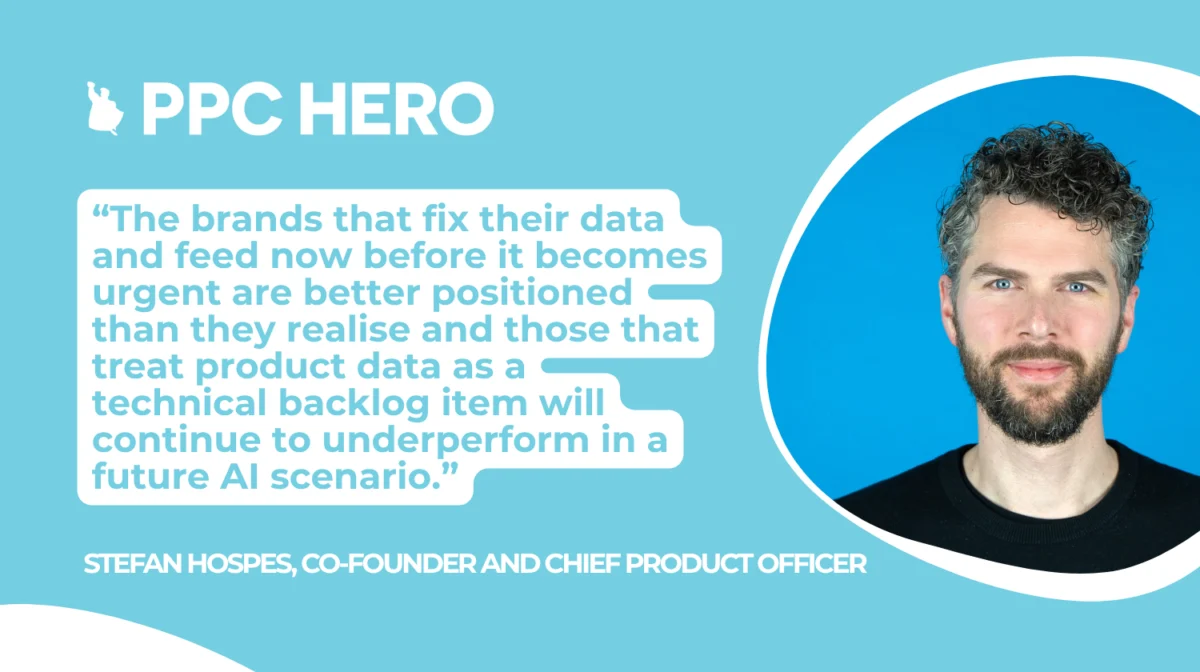
The advent of agentic commerce is still in its nascent stages. The volume of transactions influenced by AI agents is currently modest, and the tools for measuring LLM visibility are far less mature than those available for traditional search. However, brands that proactively address their data and feed quality now, before it becomes an urgent crisis, are positioning themselves for future success in ways they may not yet fully appreciate. Conversely, those who relegate product data to a technical backlog item will likely continue to underperform in an AI-driven future.
The 54% of professionals grappling with fundamental data errors are not only leaving potential efficiency on the table within platforms like Performance Max but are also conceding ground in a competitive race that has, in essence, already begun.
The imperative is clear: fix the product feed, because the machines are already watching and evaluating. The strategic implications are profound, as accurate and complete product data is no longer a mere operational task but a fundamental pillar of future digital commerce success.









