X, the platform formerly known as Twitter, has taken a significant step towards greater algorithmic transparency by releasing more detailed insights into how its code determines the reach and visibility of user posts. This move, announced recently, aims to address persistent concerns regarding content distribution, potential manipulation, and the often-debated phenomenon of "shadowbanning" within its ecosystem. The company’s latest update provides an expanded view of its source code on GitHub and introduces a new tool designed to simplify the process for users to ascertain if their posts or accounts have faced restrictions or specific labels impacting their reach.
The core of X’s new transparency initiative revolves around an expansion of its GitHub listing, which now offers deeper insights into the platform’s post display ranking mechanisms, including the various content labels that can influence a post’s visibility on the coveted "For You" timeline. This initiative is framed as a direct response to a long-standing demand from users, creators, and researchers for clearer understanding of how algorithmic decisions impact content propagation across the massive social network.
Understanding X’s New Transparency Initiatives
According to X’s official statement, this effort marks "another major step in our ongoing efforts to increase transparency." The company explicitly stated its rationale: "We’re open-sourcing the code that affects a post’s visibility in the For You timeline, and releasing a new tool that shows people labels applied to their account or posts that might limit visibility. The goal is straightforward – we want people to be able to answer for themselves whether a platform is limiting their reach, whether the system is fair, and why they see particular content." This declaration underscores X’s intent to empower its user base with actionable data, enabling them to independently assess the fairness and mechanics of the platform’s content delivery system.
The main technical update involves a substantial expansion of X’s existing GitHub repository for its algorithmic code. This augmented display now features more comprehensive details on how posts are ranked and displayed, particularly focusing on the "For You" timeline, which is the primary discovery engine for most users. Crucially, it includes information on content labels that can directly influence a post’s reach. These labels might be applied for various reasons, ranging from content deemed sensitive or misleading to violations of community guidelines, and their application can significantly alter how widely a post is distributed.
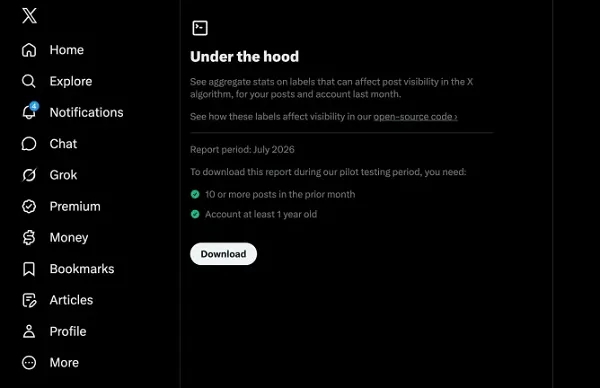
Complementing this code release, X is also piloting a new system that allows users to download information regarding any labels or tags applied to their posts over the preceding month. This feature, currently being tested with a randomized group of eligible accounts that are at least one year old, is designed to provide individual users with tangible evidence of any restrictions. Keith Coleman, X’s VP of Product, further elaborated that users could potentially leverage large language models (LLMs) to analyze the provided source code in conjunction with their own account data, thereby gaining personalized insights into factors affecting their posts’ visibility. This approach suggests a recognition of the complexity of the code and an attempt to democratize its analysis through AI tools.
For X users, particularly those who rely on the platform for content creation and engagement, this level of transparency could be invaluable. Creators participating in X’s revenue share program, for instance, have a direct financial incentive to understand the algorithmic factors influencing their content’s performance. The ability to verify if a post or account has been "shadowbanned" or restricted, even if the process requires some manual effort or technical savvy, offers a new layer of diagnostic capability that was previously unavailable.
The Perennial Debate: Algorithmic Transparency and Shadowbanning
The concept of "shadowbanning" — the alleged practice of subtly reducing a user’s content visibility without explicit notification — has long been a contentious issue across social media platforms. Users often suspect their reach is being artificially suppressed due to political views, controversial opinions, or simply a perceived lack of engagement. While platforms consistently deny employing "shadowbans" in the conspiratorial sense often described by users, they readily admit to implementing various forms of content moderation, demotion, and restriction based on their terms of service and community guidelines. These restrictions, whether due to spam detection, policy violations, or other factors, can indeed lead to a significant reduction in a post’s algorithmic reach, mirroring the user experience of a "shadowban."
X’s latest initiative directly confronts these suspicions by attempting to provide a transparent window into these content moderation decisions. The company hopes that by revealing the code and offering a tool to check for specific labels, it can build trust and demystify the mechanisms that govern content distribution. This move acknowledges the deep-seated user skepticism and aims to shift the narrative from accusations of hidden censorship to a more data-driven understanding of content performance.
However, true algorithmic transparency is a complex endeavor. The sheer scale and intricacy of algorithms used by platforms like X, which process hundreds of millions of posts daily and cater to hundreds of millions of users, make comprehensive and easily digestible transparency a formidable challenge. These algorithms are dynamic, constantly evolving, and incorporate numerous variables, from user engagement signals to content classification models. Providing a raw code dump, while technically "open-sourcing," often presents an insurmountable barrier for the average user, requiring specialized coding knowledge and analytical tools. This is where the suggestion of using LLMs comes into play, attempting to bridge the gap between raw code and user-friendly insights.
A Chronology of Promises and Partial Releases Under Elon Musk
X’s current push for transparency is not its first. Under Elon Musk’s ownership, the platform has made several pronouncements regarding its commitment to open-sourcing its algorithms, though the execution has faced criticism.
- March 2023: Just months after acquiring Twitter, Elon Musk announced his intention to open-source the platform’s feed algorithm. He vowed that this would be a continuous process, with regular updates, allowing anyone to scrutinize how posts were ranked and displayed in-stream. This was presented as a cornerstone of his vision for a transparent and free-speech-centric platform.
- April 2023: Following Musk’s promise, a version of the app’s feed algorithm was indeed published on GitHub. However, the release was met with mixed reactions. Many elements of the code were withheld from public display, leading to accusations that it was only a partial listing. Furthermore, despite Musk’s pledges, the code was not updated regularly, leaving many users and researchers frustrated by the apparent lack of sustained transparency. Critics argued that a static, incomplete code dump offered limited practical insight into a constantly evolving system.
- Ongoing Claims: Despite the criticisms regarding the initial partial release and lack of updates, Musk has consistently referred to this act as a key marker of X’s transparency, frequently insisting that X is the most open platform in terms of content ranking insight compared to its competitors.
- Recent Reiteration (Last Month): Just last month, Musk reiterated his commitment, vowing to "fully open-source X’s codebase" again in an effort to rebuild trust with platform users. This renewed pledge, coming after the previous perceived shortcomings, suggested a recognition that the initial efforts had not fully delivered on the promise of comprehensive transparency. The current announcement can be seen as a direct follow-up to this recent commitment.
This historical context highlights a pattern of ambitious promises followed by challenges in full implementation, leading to skepticism among some users and observers. The current initiative, with its expanded code insights and user-specific tools, appears to be a more substantive attempt to deliver on these long-standing transparency goals.
Implications for Users, Creators, and Researchers
The implications of X’s latest transparency drive are multifaceted:
- For Users: While the complexity of interpreting raw code remains a barrier for many, the new tool to download labels and tags applied to posts offers a tangible, if somewhat technical, way for users to directly investigate potential restrictions. This could empower individuals to understand why their content might not be performing as expected, moving beyond mere speculation. For the average user, however, the practical utility will depend on how easily they can interpret the downloaded data and whether simpler interpretative tools emerge.
- For Content Creators: Creators, particularly those in X’s revenue share program, stand to benefit significantly. Understanding the specific labels or algorithmic factors affecting their content’s visibility can inform their content strategy, helping them avoid unintentional policy violations or adapt their approach to maximize reach. This could lead to more informed content production and a clearer path to monetization on the platform. The economic stakes are high for these creators, making this transparency a crucial resource.
- For Researchers and Developers: The expanded access to X’s algorithmic code, even if still not entirely complete, provides an invaluable resource for academic researchers, data scientists, and independent developers. They can analyze the code to identify potential biases, understand the mechanics of content amplification and demotion, and even propose improvements or alternative models. The ability to feed the code into LLMs for analysis, as suggested by Keith Coleman, could further accelerate research and the development of third-party tools that simplify interpretation for non-technical users. This could foster a new ecosystem of algorithmic auditing and analysis.
- For Trust and Accountability: X hopes this initiative will bolster user trust and provide a clearer path to accountability. By making more of its inner workings visible, the platform aims to counter narratives of opaque moderation and arbitrary decision-making. However, true accountability requires not just transparency in what the algorithm does, but also why it does it, and who is responsible for its design and outcomes. The debate around algorithmic ethics will likely continue, even with increased code visibility.
Challenges and Criticisms of X’s Approach
Despite the positive intent, X’s transparency efforts are not without challenges and potential criticisms:
- Complexity for Average Users: As noted, the raw algorithmic code, even with an LLM intermediary, remains a highly technical domain. Most users lack the expertise to effectively interpret complex programming languages or the nuances of algorithmic ranking. The success of this initiative in truly empowering users will depend heavily on the development of user-friendly interfaces or interpretive tools that translate technical data into understandable insights.
- Scope of Transparency: While expanded, the extent to which the entire codebase and all decision-making parameters are truly open-sourced remains a point of contention. Platforms often have proprietary elements, security protocols, or competitive advantages they are reluctant to fully expose. The "partial listing" criticism from 2023 might resurface if this latest release still omits critical components.
- Dynamic Nature of Algorithms: Algorithms are not static; they are continuously updated, tweaked, and refined. For transparency to be meaningful, the open-sourced code must be consistently updated to reflect the latest versions in use. The past failure to provide regular updates is a significant concern that X will need to overcome to maintain credibility.
- Distinction Between Transparency and Control: Providing insight into how an algorithm works is different from giving users control over it. While transparency allows users to understand the system, it doesn’t necessarily empower them to change it or to appeal decisions effectively. The ultimate goal for many users is not just to know why they were restricted, but to have a fair process to challenge such restrictions.
- Potential for Abuse: While transparency is generally positive, opening up algorithmic code could theoretically provide bad actors with blueprints to exploit vulnerabilities or game the system more effectively. Striking a balance between openness and security is a delicate act for any platform.
Broader Industry Trends and Future Outlook
X’s move aligns with a broader industry trend towards greater algorithmic transparency, driven by regulatory pressure, public demand, and ethical considerations. Governments worldwide, including the European Union with its Digital Services Act (DSA), are increasingly mandating platforms to provide more insights into their content moderation and recommendation systems. This regulatory push, combined with growing public awareness of algorithms’ influence on information consumption and public discourse, is compelling social media companies to be more forthcoming.
Other platforms like Meta (Facebook, Instagram) and TikTok also face similar demands, and some have made strides in offering tools for users to understand their "Why Am I Seeing This?" explanations or providing data access for researchers. X, under Musk, has often positioned itself as a leader in this particular aspect, despite its checkered history with implementation.
Looking ahead, X’s initiative could set a new benchmark for what users and regulators expect from major social media platforms. If successful in truly empowering users and researchers, it could foster a more informed public debate about algorithmic governance. The ultimate success, however, will hinge on X’s commitment to continuous updates, the accessibility of its transparency tools, and its willingness to engage with the insights derived from this open-source effort. This ongoing journey towards complete algorithmic transparency is critical not only for X’s credibility but also for shaping the future of digital public squares in an increasingly algorithm-driven world.