The modern public relations landscape presents a formidable challenge for professionals striving to create impactful campaigns. The pursuit of top-tier media coverage, significant social engagement, and valuable backlinks demands more than mere creativity; it necessitates a rigorous, data-informed approach. In an increasingly crowded media environment, distinguishing a campaign requires both strategic insight and the courage to commit to ideas grounded in evidence. Fortunately, a structured, research-heavy methodology can drastically elevate the probability of a PR campaign’s success. This article outlines a comprehensive two-step process, leveraging sophisticated content analysis and a keen understanding of audience psychology, to consistently generate winning campaigns.
The Evolving Landscape of Public Relations: Beyond Intuition
For decades, public relations often relied heavily on intuition, established relationships, and a deep understanding of traditional media cycles. While these elements remain crucial, the advent of digital media has fundamentally reshaped the industry. Today, PR professionals operate in a highly fragmented ecosystem characterized by an explosion of content, a constant battle for audience attention, and an increasing demand for measurable outcomes. The challenges are multifaceted: cutting through the noise, building genuine trust with diverse audiences, and demonstrating tangible return on investment (ROI).
This evolving environment has necessitated a shift from purely creative brainstorming to a more analytical, data-driven strategy. The stakes are higher, and the cost of an unsuccessful campaign—in terms of resources, time, and reputational capital—is significant. As such, the ability to predict, or at least significantly improve the odds of, a campaign’s success has become paramount. Industry experts consistently emphasize that data analytics are no longer a supplementary tool but a core component of effective PR strategy, enabling practitioners to move beyond gut feelings and make informed decisions. Leading agencies report that campaigns underpinned by thorough research and content analysis consistently outperform those based solely on creative conjecture, often yielding higher media pickup rates and stronger audience engagement.
Phase One: Unearthing Resonant Themes and Emotional Drivers
The foundational step in developing a successful PR campaign involves a deep dive into audience interests, prevailing content themes, and the emotional undercurrents that drive engagement. This phase is not about generating a concrete campaign idea immediately but rather about identifying fertile ground for ideation. The primary objective is to understand which topics consistently resonate with target audiences and media outlets.
Strategic Content Identification: Mapping the Media Terrain
To confidently predict a PR idea’s potential for success, it is imperative to identify themes that are both consistently discussed by media and frequently shared and linked by audiences. Success, in this context, is primarily defined by securing coverage and backlinks from authoritative websites, with social engagement serving as a crucial secondary Key Performance Indicator (KPI).
This initial research begins by exploring core product areas and then strategically branching out to related, broader topics. For instance, a brand specializing in "Honeymoon packages" might initially research "Honeymoons." However, to uncover wider appeal, the research should extend to adjacent themes like "Engagement rings," "Weddings," or even "Destination travel." This process of expansion continues until the topics become too far removed from the core offering, ensuring relevance while maximizing the scope for compelling narratives.
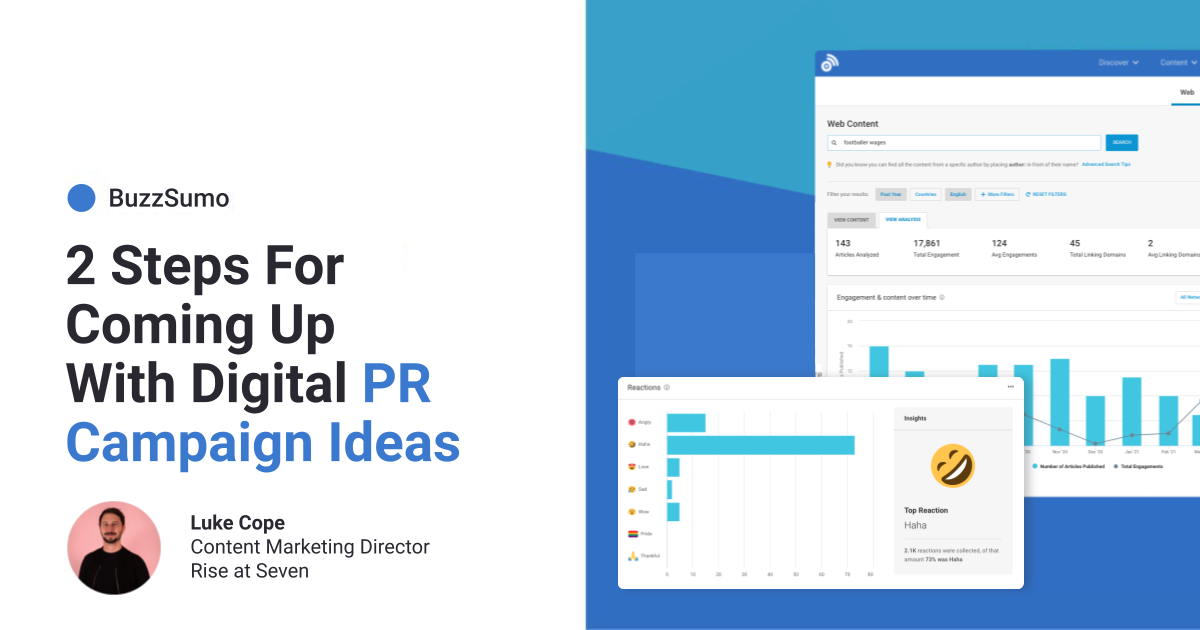
Tools like BuzzSumo’s Content Analysis Report are invaluable in this phase. These platforms allow PR professionals to analyze vast datasets of online content, identifying trends in publication volume over time, average social shares, and the types of content (e.g., articles, infographics, videos) that perform best within specific niches. By examining these metrics, strategists can discern not only what is being discussed but also how successfully it is being engaged with. This empirical approach replaces guesswork with actionable intelligence, revealing opportunities where audience interest is high and media coverage is consistent. This methodical approach ensures that campaign ideas are built upon a solid foundation of proven audience interest and media receptivity.
Understanding the Emotional Resonance: The Psychology of Shareable Content
Beyond mere topics, truly successful PR campaigns tap into fundamental human emotions. Content that evokes strong feelings – whether joy, sadness, anger, awe, or inspiration – tends to be shared more widely and leaves a more lasting impression. Analyzing the emotional tone of top-performing articles within identified themes is therefore a critical component of this research phase.
Platforms offering content analysis capabilities often include sentiment or emotion analysis features, allowing users to see which emotions are most frequently associated with discussions around specific keywords. For example, articles about "light pollution" might predominantly evoke emotions of sadness or concern, while content on "supermoons" might generate awe or wonder. Understanding these emotional triggers early on provides invaluable guidance for crafting compelling narratives and determining the most effective outreach angles.
Real-World Application: The "World Without Light Pollution" Campaign
A compelling illustration of this research-driven approach is the "World Without Light Pollution" campaign. The client, a purveyor of star maps, initially presented a product theme that, while niche, lacked the broad appeal for a major PR push. The initial research, however, systematically explored related themes:
- Product Theme: Star maps (identified as having insufficient traction for a standalone campaign).
- Secondary Theme 1: Supermoons (revealed significant social engagement, offering potential for reactive PR).
- Secondary Theme 2: Night sky (demonstrated high social engagement).
- Secondary Theme 3: Light pollution (emerged as a consistently discussed and rapidly growing topic with substantial social engagement and broad scope for ideas).
The analysis showed that "light pollution" was not only a perennially relevant topic but was experiencing a surge in public discourse. This timing was critical, coinciding with current events such as SpaceX satellite launches, which raised concerns about increased celestial obstruction, and broader discussions about environmental pollution amplified by the COVID-19 pandemic. This confluence of factors signaled an opportune moment for a campaign.
Further analysis of public reactions to existing content on light pollution revealed two dominant emotional responses: sadness/concern and a sense of "wow" or awe at the idea of a pristine night sky. This emotional intelligence was pivotal. It dictated that the campaign needed to be highly visual to achieve the "wow factor" and intellectually stimulating to provoke contemplation about the environmental impact of light pollution. The objective was to create content that not only informed but also emotionally resonated, making the abstract concept of light pollution tangible and impactful.
Case Study: The "Footballer Car Cost Calculator" – Tapping into Aspiration and Frustration
Another insightful example is the "Footballer Car Cost Calculator" campaign, which originated from a seemingly niche product: private number plates. Initial research on the core product theme indicated some humorous content but lacked the depth for a broad campaign. The strategist then branched into aspirational lifestyle themes:
- Product Theme: Private number plates (limited potential).
- Secondary Theme 1: Celebrity cars (numerous articles, high readership).
- Secondary Theme 2: Footballers’ cars (abundant content and, crucially, a high volume of passionate, often critical, reactions in comments sections).
A deeper dive into the comments sections of articles about footballers’ cars unveiled a powerful emotional cocktail: a mixture of intense frustration, envy, and competitiveness. Readers were not merely observing; they were implicitly comparing their own financial realities to the extravagant wealth displayed. This insight was the genesis of the campaign idea: to make that comparison explicit and interactive through a calculator. The tool would allow individuals to input their own salary and determine how long it would take them to afford a footballer’s luxury vehicle.
This campaign brilliantly capitalized on a strong, identifiable emotion – the visceral reaction to wealth disparity and aspirational envy. It transformed passive consumption of content into an active, personalized experience, making the abstract concept of extreme wealth starkly real for the average person. The strategist’s ability to move from generic content popularity to understanding the underlying emotional drivers within audience comments was key to developing a truly engaging and viral concept. This approach, integrating successful themes with potent emotional triggers, forms the bedrock of highly effective PR campaigns.
Phase Two: Crafting Impactful Formats and Adding Strategic Depth
Once compelling themes and their associated emotional triggers have been identified, the second crucial step is to determine the optimal format for the campaign and to infuse it with sufficient depth and multiple angles for broad media appeal. A brilliant idea can fall flat if presented in an unsuitable format or if it lacks the substance to sustain diverse media narratives.
The Art of Format Selection: Tailoring Content to Impact
The format of a campaign is paramount to its success. A powerful idea requires a presentation method that maximizes its impact. For instance, the "light pollution" campaign, with its inherent "wow factor," would have been severely diminished as a simple blog post. The objective was to visually transport the audience, making the "before" and "after" scenarios of light pollution dramatically apparent. This necessitated an interactive format, such as a slider tool, allowing users to dynamically compare polluted cityscapes with their imagined, star-filled counterparts. This interactivity amplified the emotional impact and visual appeal, transforming a static image into an immersive experience.
The choice of format should always be driven by the core emotional and informational goals of the campaign. Interactive tools, data visualizations, calculators, immersive microsites, and even cleverly designed static graphics can each serve distinct purposes. The key is to select a format that not only showcases the content effectively but also enhances user engagement and facilitates media storytelling.
Enhancing Campaign Depth and Angles: Multi-Dimensional Storytelling
Beyond the format, the depth of an idea and the number of angles it presents are critical for securing widespread media coverage. A single, strong angle is a good start, but multiple facets allow for broader outreach to diverse publications and journalists with varying interests.
In the "light pollution" campaign, the striking statistic that 85% of Americans had never seen the Milky Way provided a powerful initial angle. However, the campaign was enriched by integrating data from the Bortle scale, which categorizes sky brightness. This allowed for a visual comparison of major cities (often Bortle 10, indicating extreme light pollution) with how they would appear at a Bortle 1 level (pristine night sky). Furthermore, while the initial focus might have been national (USA), recognizing light pollution as a global issue prompted the campaign’s expansion to include international cities, broadening its potential reach and relevance. This strategic layering of data and geographical scope provided a rich tapestry of angles for journalists, from environmental reporting to travel features and urban planning discussions.
Illustrative Examples of Format and Depth in Action:
- "Touch the Germs" Campaign: This public health campaign could have been a simple graphic or a data list. However, the team went significantly further by developing an interactive microscope function. This experiential format allowed users to "see" germs on everyday objects, making the abstract concept of microbial contamination visceral and memorable. This campaign’s depth, combined with its innovative format, generated high volumes of backlinks and even prompted comments from public officials, including the Mayor of London, underscoring its significant media and societal impact.
- "Who Owns All the Space Junk?" Campaign (Aira): This campaign, visualizing space junk, demonstrates both the potential and missed opportunities in format and depth. While the visualization was effective, a concept of this magnitude could have been expanded significantly. Imagine adding historical timelines of space junk accumulation, projections for future debris, breakdowns by type of junk, or interactive elements exploring the impact on various countries. While a solid piece, it highlights how inherent site limitations or resource constraints can sometimes prevent a truly vast idea from reaching its full potential, offering fewer distinct angles for diverse media pitches.
- "iPods Visualized as Vinyl" (Mark Johnstone, formerly of Distilled): This campaign exemplifies that impactful formats need not be complex. Its simplicity was its genius. By visually representing the digital music libraries of iPods as physical vinyl records, it tapped into nostalgia and offered a clever commentary on the evolution of music consumption. This unexpected, yet aesthetically pleasing, comparison generated significant interest through its creative visual storytelling, proving that a fresh perspective can be as powerful as elaborate interactivity.
The Footballer Car Calculator Revisited: Multi-Dimensional Storytelling
The "Footballer Car Cost Calculator" campaign further showcased the power of depth and multiple angles. Beyond the core interactive tool, the underlying data—comparing weekly wages to car costs—allowed for numerous compelling narratives:
- "How many years would it take the average person to afford [specific footballer’s] car?"
- "The staggering cost of luxury vehicles compared to typical earnings."
- "Regional variations in affordability of celebrity cars."
- "The most extravagant car collections among athletes."
These varied angles, all stemming from a single, well-researched interactive asset, allowed the campaign to be pitched to a wide array of publications, from finance and lifestyle to sports and general news outlets, maximizing its reach and link-building potential.
Optimizing Outreach and Securing Stakeholder Buy-in
The meticulous research conducted in the initial phases provides a dual advantage: not only does it shape the campaign idea, but it also forms the bedrock for highly effective media outreach and stakeholder approval.
Data-Driven Seeding Lists: Precision Targeting
The initial content analysis research, identifying frequently discussed themes and top-performing articles, directly informs the creation of targeted media seeding lists. By exporting details of journalists and publications that have previously covered the campaign’s subject matter, PR professionals can build highly relevant contact lists. This precision targeting significantly increases the likelihood of a pitch resonating, as journalists are approached with topics already aligned with their interests and beat. Platforms like BuzzSumo’s outreach tools facilitate this by allowing users to save journalist profiles and export their contact details, streamlining the outreach process. Studies on journalist pitching consistently show that personalized, relevant pitches are exponentially more successful than generic mass mailings, underscoring the value of this data-driven approach.
De-risking Campaign Approval: The Power of Evidence
Campaign ideas, by their nature, can be subjective. Different stakeholders – clients, internal teams, management – may have differing opinions on what constitutes a "good" idea. The rigorous research outlined in this methodology effectively removes much of this subjectivity. By presenting a comprehensive report on content themes, audience engagement metrics, and emotional drivers, PR professionals can provide objective evidence to support their campaign proposals.
Packaging the research from Phase One into a compelling pitch allows strategists to demonstrate why a particular idea is not merely creative but strategically sound and likely to succeed. This data-backed approach fosters confidence, facilitates quicker approvals, and aligns all parties around a shared, evidence-based vision for the campaign’s potential impact. Tools such as BuzzSumo offer features that allow for such detailed analysis, often providing trial access for users to explore their capabilities and generate compelling reports on engagement and emotion across various themes and publishers.
Conclusion: The Future of Strategic PR
The landscape of public relations is dynamic, but the principles of effective communication remain constant. What has changed is the arsenal available to PR professionals. The integration of robust content analysis, an acute understanding of emotional resonance, strategic format selection, and multi-layered storytelling represents the vanguard of modern PR strategy.
Key takeaways for practitioners include:
- Explore engagement and consistency: Always delve into data to identify consistently talked about themes and content that garners high social engagement.
- Tap into emotion: Ensure campaign ideas resonate on an emotional level, whether evoking awe, concern, inspiration, or a sense of comparison.
- Match format to idea: Select the optimal content format (interactive tools, visuals, long-form content) that best amplifies the campaign’s core message and emotional appeal.
- Leverage comparative insights: Create impactful narratives by drawing comparisons, such as contrasting average incomes with celebrity wealth or urban light pollution with pristine night skies.
- Add depth for multiple angles: Develop ideas with sufficient layers and data points to generate numerous distinct narrative angles for broader media outreach.
By meticulously exploring content performance and audience sentiment, and then crafting ideas into compelling, multi-faceted narratives, PR professionals can move beyond speculative campaigns to consistently deliver measurable success. This blend of analytical rigor and creative execution is not just a best practice; it is becoming the standard for achieving significant media impact and driving tangible value for brands in the digital age. The future of PR is undeniably strategic, analytical, and profoundly impactful when executed with precision.