In today’s hyper-connected digital landscape, customer expectations for support have fundamentally shifted. Consumers no longer tolerate fragmented interactions or the need to repeat their issues across different touchpoints. Instead, they demand swift, personalized assistance delivered seamlessly via their preferred communication channels. This imperative has driven a significant industry pivot towards omnichannel customer service models, which are rapidly becoming the bedrock of superior customer experience (CX) strategies for forward-thinking companies worldwide.
The Evolution of Customer Service: From Multichannel to Omnichannel
For decades, customer service evolved in a somewhat linear fashion, moving from direct phone calls and in-person interactions to the integration of email, then live chat, and eventually social media. This progression initially led to "multichannel" support – a system where businesses offered multiple avenues for customers to seek assistance. While a step forward in accessibility, multichannel approaches often operated in silos. Each channel typically had its own independent inbox, ticketing queue, and often, a separate team. Consequently, a customer initiating contact via live chat and then following up by phone would frequently find themselves starting over, re-explaining their situation and encountering agents without the full context of previous interactions. This disjointed experience often led to frustration, extended resolution times, and a perception of inefficiency.
Omnichannel customer service emerged as the necessary evolution of multichannel. It moves beyond simply offering multiple channels to connecting them into a single, unified experience. In an omnichannel model, all customer history, context, and key data – including purchase history, past support interactions, and preferences – are seamlessly shared across every communication channel. This holistic view empowers support teams with complete context before every interaction, allowing them to deliver faster, more personalized service. For customers, it means the flexibility to start a conversation on one channel, such as social media, and continue it on another, like email or phone, without any loss of information or the need to repeat themselves. This fundamental difference transforms transactional support into a continuous, cohesive dialogue, significantly enhancing the customer journey.
Core Pillars of Omnichannel Excellence: Benefits for Businesses and Consumers
The adoption of an integrated omnichannel solution yields substantial benefits for both customers and the organizations serving them, driving improvements across various key performance indicators.
-
Reduces Customer Friction and Elevates Satisfaction: A primary driver for omnichannel adoption is the elimination of friction points. Research consistently shows that customers are deeply frustrated by having to re-explain their issues. Salesforce reports that 56% of customers frequently encounter this problem when transferred. Omnichannel platforms prevent this by preserving conversation history and customer context across all touchpoints. This continuity allows customers to pick up exactly where they left off, fostering a smoother, less effortful support experience that directly correlates with higher customer satisfaction (CSAT) scores. Industry data indicates that omnichannel service can lift CSAT to 67%, compared to just 28% for disconnected multichannel setups.
-
Enables Faster, More Efficient Support Operations: By centralizing customer context, history, and account information, omnichannel platforms drastically reduce the time agents spend searching for information. Agents gain immediate access to a unified customer record, automatically enriched with data from emails, calls, and web interactions. This unified conversation timeline minimizes context switching and information gathering, allowing agents to quickly grasp the issue and focus on problem-solving. Companies utilizing integrated omnichannel solutions experience up to a 31% reduction in first-resolution times and a 39% decrease in customer wait times. This enhanced efficiency allows teams to handle a larger volume of requests without compromising service quality.
-
Fosters More Personalized Customer Experiences: The ability to access a complete view of the customer – including previous purchases, past support interactions, and account specifics – enables agents to tailor their conversations and make personalized recommendations. Up to 82% of customers prefer companies to know who they are and anticipate their needs. Omnichannel strategies meet this demand by providing the data necessary for agents to offer relevant solutions and proactive assistance, building trust and strengthening customer relationships. When layered with AI tools, this data can further personalize interactions through tailored content suggestions and optimized routing.
-
Provides Comprehensive Visibility into the Customer Journey: An omnichannel strategy offers organizations a holistic, cross-channel view of customer interactions. This eliminates the need to analyze each channel in isolation, allowing customer support leaders to identify trends, pinpoint bottlenecks, and uncover opportunities for improvement across the entire customer journey. Such comprehensive visibility empowers CX teams to optimize workflows, strategically allocate staffing resources, and proactively address customer pain points before they escalate into larger issues.
-
Improves Internal Team Collaboration: Working from a connected service platform with unified customer data streamlines handoffs between agents and departments. Whether a case is transferred or a customer switches channels, the receiving agent has immediate access to all necessary conversation history and context. This automatic transfer of critical information reduces duplicate work, minimizes miscommunication, and ensures that vital context is never lost, fostering a more collaborative and efficient support environment.
Architecting the Omnichannel Solution: Essential Platform Features

Executing a robust omnichannel strategy hinges on selecting and implementing the right technological platform with a comprehensive suite of features.
-
Shared Inbox: A foundational component, the shared inbox consolidates conversations from every communication channel (email, chat, phone, social media, messaging apps) into a single, centralized workspace. This unified view allows agents to manage all customer requests from one interface, eliminating siloed communication and reducing the risk of missed or duplicated responses. It also enhances collaboration and provides leaders with better visibility into queue health and agent capacity.
-
Integrated CRM Data Connection: Critical for personalization, a strong CRM connection links service interactions directly to a single customer record. This enables agents to instantly view crucial data such as purchase history, subscription details, previous support tickets, and account information. This comprehensive customer context is vital for delivering quick, personalized, and informed support. Advanced systems automatically enrich customer records with interaction data, keeping profiles continuously updated.
-
Intelligent Routing: This feature automatically directs incoming conversations to the most appropriate agent or team based on predefined rules or AI-driven insights. Routing criteria can include product expertise, language, geography, customer tier, issue type, or even customer sentiment and urgency. Intelligent routing significantly reduces customer wait times, ensures tickets are assigned to the best-suited agent, and improves first-contact resolution rates, while also balancing agent workloads.
-
AI and Automation Capabilities: Modern omnichannel platforms leverage Artificial Intelligence to enhance efficiency and effectiveness. AI can summarize conversations, draft responses, classify and tag tickets, detect customer sentiment, recommend relevant content, and automate repetitive tasks. AI-powered chatbots and virtual agents can autonomously resolve common issues, providing instant support and freeing human agents to focus on complex cases. This not only accelerates resolution times but also improves overall customer satisfaction.
-
Connected Knowledge Base: Integrating a knowledge base directly into the omnichannel platform empowers both customers and agents. Customers can easily access FAQs, troubleshooting guides, and how-to articles for self-service, reducing the volume of simple inquiries. For agents, integrated access to documentation ensures consistent, accurate responses and reduces time spent searching for information, thereby improving response times and service quality. Advanced platforms can even use AI to transform successful service interactions into new knowledge base content.
-
SLA Management: For service teams, Service Level Agreements (SLAs) are critical metrics. Omnichannel platforms often include SLA management tools that automatically apply SLAs to tickets based on predefined criteria (e.g., customer tier, priority, issue type). These systems track progress, alert teams when an SLA is at risk of being missed, and help automate ticket prioritization. This ensures consistent service delivery, helps meet compliance requirements, and reduces manual oversight.
-
Robust Data Analytics and Reporting: Centralized dashboards and reports are essential for understanding performance across all channels and the entire customer journey. These analytics provide insights into response times, resolution rates, customer satisfaction, and ticket volume. This cross-channel data enables customer service leaders to quickly identify and address bottlenecks, measure team performance, forecast staffing needs, and understand customer behavior and channel preferences to optimize resource allocation.
-
Security and Permissions: Safeguarding customer and company data is paramount. Omnichannel platforms must offer robust security settings, including granular permission structures (role-based, team-based, channel-specific access) to protect sensitive information and ensure compliance with regulatory requirements. For AI-powered platforms, data protection controls and transparent AI recommendations are crucial to build trust and ensure ethical AI use.
Crafting an Omnichannel Strategy: A Step-by-Step Implementation Guide
Implementing an effective omnichannel customer service strategy requires careful planning and a phased approach.
-
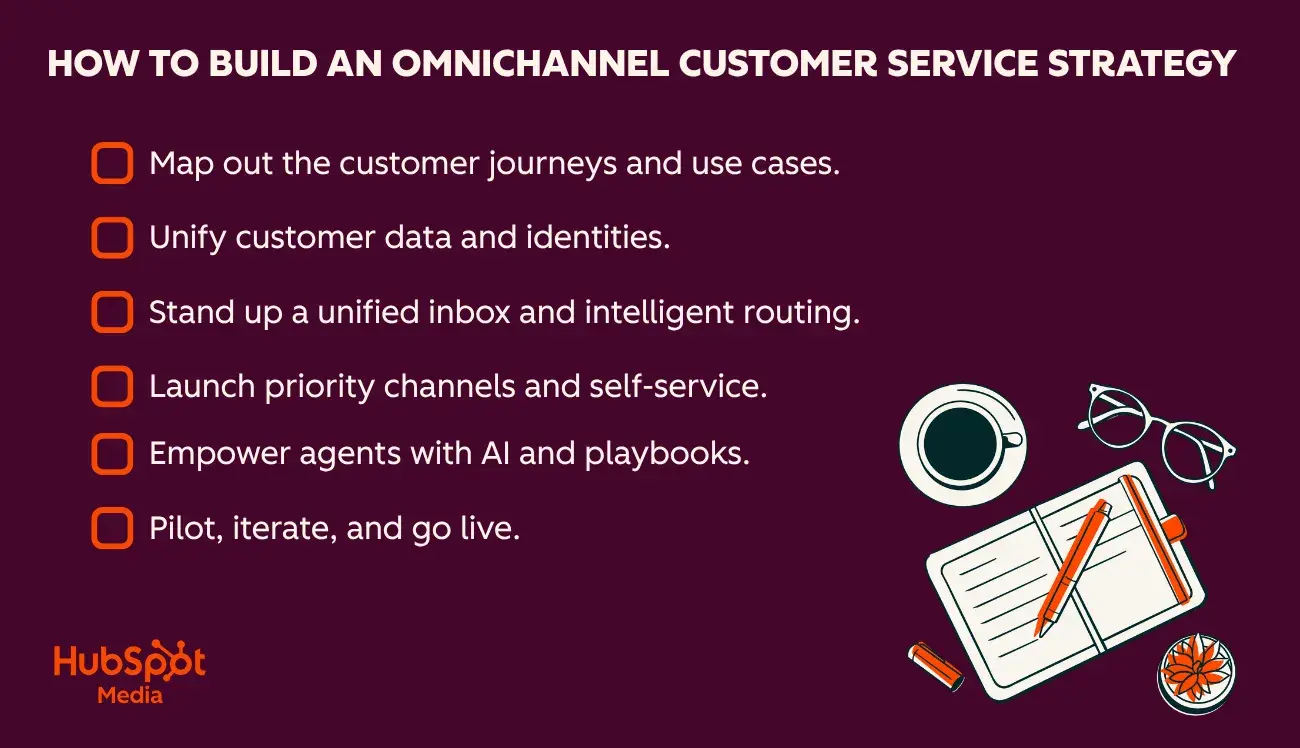
Map Out Customer Journeys and Use Cases: The initial step involves a thorough understanding of your customers. Map out every touchpoint in their journey, identifying preferred channels at each stage and documenting common support use cases. This helps pinpoint areas of friction and opportunities for automation. Incorporate customer feedback actively, as they often highlight critical pain points or channel preferences that might not be immediately obvious.
-
Unify Customer Data and Identities: A successful omnichannel strategy is fundamentally built on complete, unified customer data. Integrate all customer information – conversations, purchase history, account details, previous support interactions – into a centralized platform, ideally an integrated CRM. This creates a single, comprehensive customer profile, empowering agents with context and allowing customers to transition between channels seamlessly. It’s crucial to provide agents with talk tracks or guidelines for picking up conversations that have switched channels, ensuring a smooth handoff.

-
Establish a Unified Inbox and Intelligent Routing: Once customer data is centralized, all support inquiries from various channels must feed into a shared inbox. Concurrently, establish intelligent routing rules to automatically assign conversations based on factors such as issue type, customer tier, product expertise, or urgency. This enhances agent efficiency and provides better visibility into the overall support queue, allowing for strategic prioritization of high-value or at-risk customers.
-
Launch Priority Channels and Self-Service Resources: Begin by deploying omnichannel capabilities on the channels your customers use most frequently or prefer. This often includes email, live chat, and phone, but may also extend to popular messaging apps or social media, depending on your industry and customer demographics. Simultaneously, invest in robust self-service resources such such as comprehensive knowledge bases, FAQs, AI-powered chatbots, and customer portals. These resources empower customers to resolve issues independently, reducing the burden on human agents. Customer communities can also foster self-service and peer-to-peer support.
-
Empower Agents with AI and Playbooks: Integrate AI not as a replacement for human agents, but as a powerful assistant. AI can provide intent detection, summarize conversations, suggest replies, surface relevant knowledge base articles, tag tickets, and automate repetitive tasks. This frees agents to focus on complex, empathetic problem-solving. Develop clear playbooks for common support procedures across all channels, including escalation processes, troubleshooting workflows, and communication guidelines. Crucially, train agents on how AI assists them and encourage feedback to continuously improve AI accuracy.
-
Pilot, Iterate, and Scale: Roll out the omnichannel strategy in phases, starting with a limited pilot (e.g., a few channels, specific customer segments, or a small support team). This controlled environment allows leaders to monitor performance, gather feedback from both customers and agents, and make necessary refinements before a broader rollout. Continuous iteration based on performance data and feedback is key to optimizing workflows and ensuring the strategy effectively meets evolving business and customer needs.
Measuring Success: Key Metrics and Governance Frameworks
Effective omnichannel management relies on consistently tracking key performance indicators (KPIs) and establishing robust governance frameworks. Metrics should be trackable across channels and aligned with broader business outcomes.
- Response Time: Measures how quickly an agent responds to a customer inquiry, often broken down by channel.
- Resolution Time: Tracks the total time taken to resolve a customer issue, from initial contact to closure.
- First Contact Resolution (FCR): The percentage of customer issues resolved during the initial interaction, a key indicator of efficiency.
- Customer Satisfaction (CSAT): Measures customer happiness with specific interactions or the overall service experience.
- Customer Effort Score (CES): Assesses how much effort a customer had to expend to get their issue resolved, aiming for low effort.
- Net Promoter Score (NPS): Measures overall customer loyalty and willingness to recommend the company.
- Self-Service Adoption Rate: Tracks the percentage of customers who successfully resolve issues using self-service options.
- Agent Productivity: Measures the volume of interactions handled per agent, balanced against quality metrics.
- Channel Preference/Usage: Identifies which channels customers prefer and utilize most frequently.
- AI Feedback Score: Measures agent ratings of AI-generated recommendations or responses, crucial for improving AI accuracy and agent trust.
Metric Review Cadences: Structured reviews are essential for proactive performance evaluation.
- Weekly Operational Reviews: Focus on the day-to-day health of the support operation, monitoring metrics like ticket volume, response/resolution times, SLA compliance, queue health, and agent workloads. Attendees typically include customer service managers, team leads, and CX/CS operations members, allowing for quick adjustments to staffing and processes to prevent minor issues from escalating.
- Monthly Customer Journey Reviews: A higher-level review evaluating the end-to-end customer experience across all channels. Analysis includes customer feedback, CSAT/CES trends, self-service adoption, and channel performance. These insights inform improvements to content, AI optimization, and the removal of customer friction points. This involves customer service leadership, CX leadership, and often members from customer education or digital experience teams.
- Quarterly Strategy and Roadmap Reviews: These executive-level reviews focus on the long-term omnichannel strategy’s alignment with broader business goals. Senior directors and VPs from customer service and customer success analyze long-term trends, overall performance, and customer insights to determine future investments, such as expanding to new channels or implementing advanced AI workflows. This helps shape the strategic roadmap for evolving the omnichannel strategy.
Strategic Platform Selection: Investing in the Future of Customer Experience
Choosing the right omnichannel customer service platform is a strategic decision that extends beyond a simple feature checklist. It requires assessing how well the platform can support the evolving customer experience strategy over time.
- Channel Compatibility: Ensure the platform supports all current and future preferred communication channels for your customers, including the ability for customers to seamlessly switch between them.
- Unified Customer View: Evaluate if the platform effectively connects customer conversations with CRM records, purchase history, help desk interactions, and other critical business systems, providing agents with immediate, comprehensive context.
- Scalability and Flexibility: The platform must be capable of scaling with your business, accommodating increasing ticket volumes, additional channels, larger teams, and evolving customer expectations without prohibitive cost implications.
- Robust Reporting and Analytics: A strong platform provides easily accessible and customizable dashboards and data visualization tools to surface key metrics across all channels, enabling data-driven decision-making.
- AI Integration and Ethical Governance: Assess the quality and relevance of the platform’s AI capabilities, ensuring they align with your support strategy goals. Critically, verify strong data privacy protections and transparent AI governance to maintain trust and compliance.
Leading platforms integrate a unified data ecosystem with multi-channel support capabilities, AI-driven automation, and comprehensive analytics, providing everything an organization needs to initiate or scale its omnichannel customer service strategy.
The Broader Implications: Omnichannel as a Business Imperative
Omnichannel customer service transcends mere technical implementation; it represents a fundamental shift in how businesses perceive and manage customer relationships. It’s not just about offering support on multiple channels; it’s about leveraging connected customer context and history to deliver a consistently personalized, highly efficient, and deeply satisfying experience.
For businesses, the implications are profound. A well-executed omnichannel strategy is a powerful differentiator, fostering stronger customer loyalty, enhancing brand reputation, and ultimately driving sustainable growth. By removing friction, empowering agents, and providing unparalleled insights into the customer journey, omnichannel solutions enable companies to move beyond reactive support to proactive, even predictive, customer engagement. As digital interactions continue to proliferate, investing in connected data and a robust omnichannel framework is no longer an option but a critical business imperative for long-term success in a competitive market. The future of customer service is undeniably omnichannel, driven by intelligent automation, unified data, and an unwavering focus on the customer at every turn.