


Manual A/B testing remains a pervasive yet often under-discussed reality within the digital optimization industry, serving as a primary methodology for organizations operating under specific technical or budgetary constraints. While the broader industry conversation frequently centers on sophisticated, third-party experimentation platforms, a significant volume of global testing is conducted through custom-built stacks, feature flags, and manual data analysis. This approach is particularly prevalent among teams with limited budgets, high-security compliance requirements, or highly specialized technical environments that resist "off-the-shelf" integrations.
The fundamental appeal of manual experimentation lies in its perceived simplicity and economic efficiency. By leveraging existing infrastructure—such as feature management systems, custom scripts, and standard analytics tools—businesses can bypass the recurring costs associated with premium experimentation software. Furthermore, it provides engineering teams with total control over randomization logic and data schemas. However, as organizations attempt to scale their testing velocity, the operational overhead associated with manual traffic management, statistical validation, and governance often reaches a breaking point, necessitating a strategic reevaluation of how experiments are conducted.
The Chronology of Digital Experimentation: From Simple Redirects to Server-Side Logic
The history of A/B testing has evolved from basic split-URL redirects to deeply integrated server-side logic. In the early 2010s, the barrier to entry was lowered by visual editors and client-side scripts, most notably through platforms like the now-defunct Google Optimize. When Google announced the sunsetting of Optimize in 2023, it created a vacuum in the market, forcing thousands of organizations to choose between migrating to high-cost enterprise platforms or developing internal manual frameworks.
This transition period marked a significant shift in how engineering and product teams viewed experimentation. The move toward "headless" architectures and server-side rendering (SSR) has further complicated the manual landscape. Today, the chronology of a typical manual experiment involves a complex orchestration: developers must manually bucket users into groups, ensure those assignments persist across sessions via cookies or database entries, and then carefully tag these events within an analytics suite like Google Analytics 4 (GA4) or a data warehouse like Snowflake.
Technical Methodologies for Manual Implementation
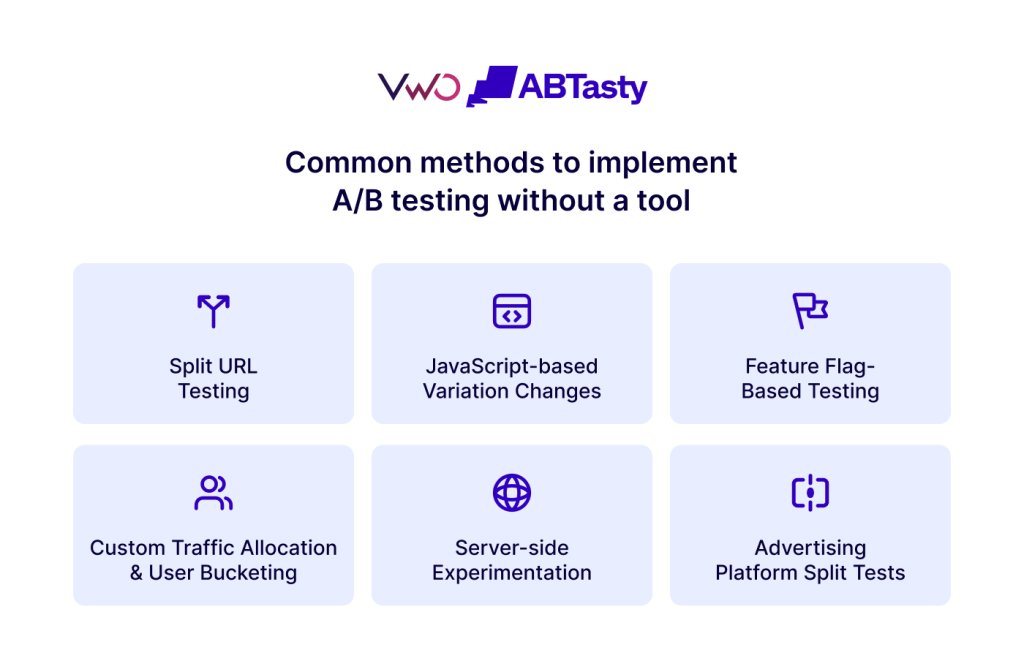
In the absence of a dedicated platform, technical teams generally employ one of five primary methods to facilitate split testing. Each methodology carries distinct trade-offs regarding implementation speed and data integrity.
1. Split URL and Redirect Testing
This is the most rudimentary form of manual testing, where two distinct versions of a page exist on different URLs. Traffic is split at the server or CDN level (Content Delivery Network). While this is effective for radical redesigns or landing page tests, it often results in "flicker" (the original page loading briefly before the redirect) and can dilute SEO authority if canonical tags are not managed with surgical precision.
2. Client-Side JavaScript Modification
Teams use tag managers or internal code deployments to inject JavaScript that modifies the Document Object Model (DOM) after the page has loaded. This allows for rapid changes to headlines, call-to-action (CTA) buttons, and imagery. However, this method is increasingly scrutinized for its impact on Core Web Vitals, specifically Cumulative Layout Shift (CLS), which can negatively influence both user experience and search engine rankings.
3. Feature Flag-Based Experimentation
Modern software development increasingly relies on feature flags—toggles that allow code to be deployed but not necessarily activated. By using these flags to show different features to different user segments, teams can run experiments within their existing CI/CD (Continuous Integration/Continuous Deployment) pipelines. While this reduces the risk of broken code, it lacks built-in statistical analysis, requiring teams to manually join feature-flag data with conversion data in a secondary environment.
4. Server-Side Assignment
For high-security or high-performance applications, server-side experimentation is the gold standard. The server determines the user’s variation before the HTML is even generated. This eliminates layout shifts and ensures that bots or browser extensions do not interfere with the experiment. The limitation here is the heavy reliance on engineering resources for every new test iteration.
5. Advertising Platform Split Tests
Many marketing teams conduct manual A/B testing exclusively within the confines of Google Ads or Meta Ads. While these tools provide robust internal statistics, their insights are often siloed, meaning a "winning" headline in an ad may not translate to a winning experience on the actual website once the user clicks through.
The Analytical Framework: Tracking Results Without Built-in Engines
Tracking the success of a manual A/B test requires a high degree of data discipline. Without a platform to automatically calculate significance, teams must construct their own analytical pipelines.
- Google Analytics 4 (GA4): Most teams send a "custom dimension" representing the experiment ID and the variant. Analysis is then performed using GA4 Explorations. The primary risk here is data latency and the potential for "polluted" data if a user is accidentally exposed to multiple variants.
- Product Analytics (Mixpanel/Amplitude): These tools are better suited for tracking user journeys over time. Teams log an "Assignment Event" and then build funnels to see which variant leads to higher retention or purchase rates.
- The Data Warehouse Approach: Sophisticated organizations route all raw event data to BigQuery or Snowflake. Data scientists then run SQL queries or Python scripts to determine uplift. While this offers the most flexibility, it is also the most labor-intensive, often creating a bottleneck where marketing teams must wait weeks for data analysts to declare a winner.
Statistical Risks and the "Silent Killers" of Accuracy
Manual testing often fails not in its execution, but in its interpretation. Dedicated platforms include "guardrails" that prevent common statistical errors—protections that are absent in manual setups.
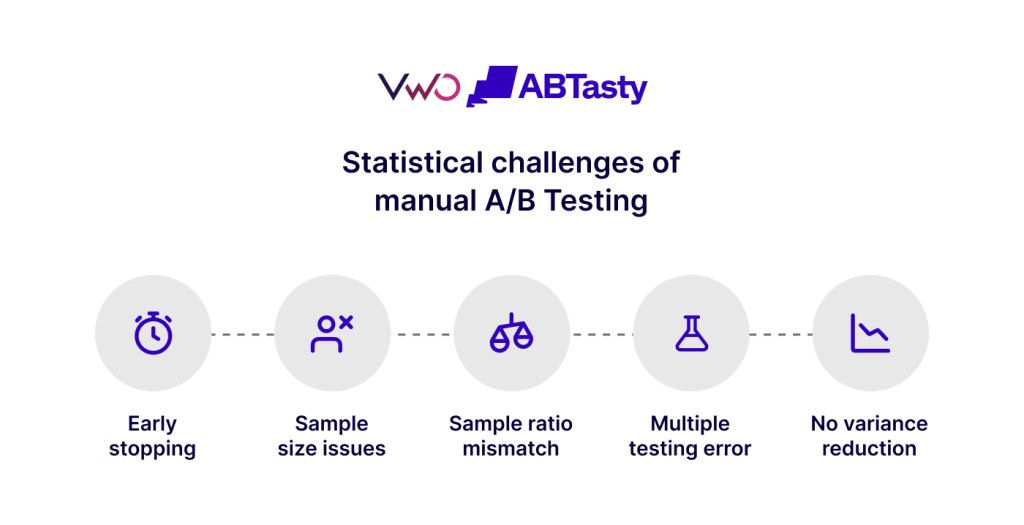
One of the most frequent errors is Peeking and Early Stopping. Without automated controls, teams tend to check results daily and stop the test as soon as one version looks like a winner. Statistically, this dramatically increases the "False Positive Rate." A result that shows 95% confidence on the third day of a test is often a result of random noise rather than a true behavioral shift.
Another critical issue is Sample Ratio Mismatch (SRM). If a test is set to split traffic 50/50, but the final data shows a 48/52 split, the experiment is likely compromised by a technical bug, such as certain browsers failing to trigger the script. Dedicated platforms flag SRM automatically; manual teams often miss it, leading them to make business decisions based on fundamentally flawed data.
SEO and Performance Implications
The impact of manual A/B testing on search engine optimization is a significant concern for enterprise-level organizations. Google’s webmaster guidelines are clear: experiments should not be used for "cloaking"—showing one version of a page to search engines and another to users.
Manual setups that use redirects without rel=canonical tags risk creating duplicate content issues, which can split a page’s "ranking power" across two URLs. Furthermore, if a manual script slows down the page load time (Time to Interactive), search engines may demote the page in organic rankings. Professional platforms mitigate these risks through pre-render technologies and automated SEO-friendly tagging, whereas manual teams must remember to implement these safeguards for every single test.
The Operational Tipping Point: When to Move Beyond Manual
While manual testing is a viable starting point, there is a clear "tipping point" where the cost of human labor outweighs the cost of a dedicated platform. Industry data suggests that once a team attempts to run more than two or three concurrent experiments, the probability of errors increases exponentially.
The ROI of a platform like VWO or AB Tasty is often found in Engineering Efficiency. If a developer spends five hours setting up and cleaning up a manual test, and the company runs 50 tests a year, that represents 250 hours of high-cost engineering time that could have been spent on product development. Dedicated platforms allow non-technical team members to launch and analyze tests, freeing up engineers for more complex tasks.
Moreover, the transition from "testing" to "continuous optimization" requires behavioral insights. Manual A/B testing tells you what happened, but it rarely explains why. Platforms that integrate heatmaps, session recordings, and form analytics allow teams to see that a variant failed because users couldn’t find the submit button, rather than simply seeing a lower conversion rate in a spreadsheet.

Conclusion and Future Outlook
The landscape of A/B testing is moving toward a hybrid model. While manual execution remains a necessary tool for deep backend changes and highly regulated environments, the industry is shifting toward "Experimentation Operating Systems." These platforms act as a centralized brain, connecting to a company’s existing data warehouse and feature-flagging tools while providing the statistical rigor and governance that manual methods lack.
For organizations currently operating manually, the focus must remain on statistical discipline and cross-functional transparency. As the digital marketplace becomes increasingly competitive, the ability to run reliable, high-velocity experiments is no longer just a technical advantage—it is a core business requirement. The transition from manual "guess-and-check" methods to a scalable experimentation program is the defining characteristic of a data-mature organization.







