The landscape of paid search advertising, long dominated by the meticulous craft of keyword management, is undergoing a profound transformation. For years, Pay-Per-Click (PPC) practitioners honed their skills on the precise identification, organization, and optimization of keywords. The core competency revolved around mastering match types, meticulously building negative keyword lists, and relying on the direct correlation between a search term and an advertiser’s offering. However, this methodical approach, once the bedrock of PPC success, is rapidly becoming a relic of a bygone era as Google’s sophisticated machine learning algorithms increasingly dictate ad serving.
The shift is not a subtle evolution; it’s a fundamental redefinition of how search queries are understood and matched with advertising content. Google no longer solely relies on keywords as the primary trigger for displaying ads. Instead, keywords have been relegated to being one signal among many, frequently superseded by artificial intelligence that aims to predict user intent with a granularity that surpasses manual keyword curation. This algorithmic evolution has led to a dramatic alteration in the efficacy and behavior of traditional match types. Broad match, once a tool for expanding reach with caution, now frequently serves ads for queries that advertisers would never have explicitly chosen. Exact match, a cornerstone of control, is no longer truly exact, encompassing a broader range of semantic variations. Phrase match, intended as a middle ground, now often functions with a proximity to broad match that blurs the lines of control. Perhaps the most definitive statement of this new paradigm is Performance Max, a campaign type that eschews keywords entirely, relying solely on audience signals, creative assets, and conversion data.
The critical question for PPC professionals is no longer if this shift is occurring, but rather how their existing account structures are aligned with this new reality. Are they built to leverage the power of intent-based advertising, or are they fighting against the inherent capabilities of the modern search engine?
The Inherent Limitations of Keywords: A Necessary Workaround
To understand the obsolescence of keyword-centric strategies, it’s crucial to revisit the original purpose and limitations of keywords in PPC. Keywords were never the ultimate goal; they were the most effective tool available at the time for advertisers to approximate a searcher’s intent. In the nascent stages of search advertising, a direct correlation between a user’s typed words and their underlying need was often sufficient. For instance, a search for "project management software" strongly indicated an intent to purchase such a solution. This alignment between "word and want" made the keyword-based system functional and profitable for a considerable period.
However, the inherent inconsistency of human language and search behavior always presented a challenge. A singular intent, such as "I want to buy project management software," could manifest through a vast array of search queries. These might include "best tools for team task tracking," "how do I manage multiple projects at once," or "alternatives to spreadsheets for project planning." A static keyword list, by its very nature, could only anticipate and capture the demand it was programmed to recognize. It structurally lacked the ability to discover or account for user needs that were not explicitly included in its predefined terms.
Google’s advancements in natural language processing and machine learning have fundamentally addressed this limitation. The platform’s algorithms can now discern the underlying intent behind a search query, irrespective of the exact phrasing used. This capability to identify semantic equivalence across disparate queries represents a significant leap beyond the predictive limitations of any keyword list, effectively rendering keywords less a direct indicator of intent and more of a historical artifact.
The Algorithmic Reimagining of Match Types
The most palpable evidence of keywords’ diminishing relevance is not found in marketing pronouncements, but in the quiet yet profound redefinition of Google Ads’ match types.
Broad Match: From Looseness to Intent Recognition
Historically, broad match was characterized by its permissive nature, matching variants, synonyms, and conceptually related terms. The original keyword remained the anchor, guiding the matching process. This paradigm has been irrevocably altered. Broad match now operates on the principle of user intent, not literal keyword inclusion. Google’s sophisticated systems analyze the semantic meaning of a keyword and serve ads against any query that shares that perceived intent, even if there is no word overlap. For example, an advertiser bidding on "CRM software" using broad match might find their ads appearing for searches like "how do I keep track of my sales pipeline," as the algorithm has determined these phrases express equivalent user needs.
When coupled with smart bidding strategies, broad match has transitioned from a reach-expansion tool requiring diligent management to Google’s preferred method for algorithmically identifying conversion-ready traffic that might otherwise be missed by a restrictive keyword list. Many accounts continue to employ broad match with a traditional approach, attempting to control its reach through extensive negative keyword lists. However, a more productive utilization involves allowing the algorithm to surface intent and then leveraging conversion data to train the system on what constitutes valuable traffic.
Exact Match: The Erosion of Precision
The evolution of exact match has been more gradual but equally impactful. Many account structures remain built on the assumption that exact match still provides the granular control it once did. In reality, exact match now encompasses "close variants," including misspellings, abbreviations, reordered words, implied words, and paraphrases that Google’s algorithm deems to carry the same meaning.
This subtle expansion means that an exact match keyword list, meticulously crafted for precision, no longer delivers the absolute control it appears to offer. While the keyword list may present as exact, the actual pool of queries it draws from is significantly broader and less predictable than any manual audit can reveal. Campaigns that seem tightly controlled may, in fact, be serving on dozens of query variations that the advertiser never explicitly approved. While this may not always translate into a direct performance deficit, it represents a fundamental conceptual shift. If exact match no longer signifies exactness, the foundational premise of keywords as a precise control mechanism has been dismantled by the platform itself.
Phrase Match: The Dissolution of a Middle Ground
Phrase match, once positioned as a balanced intermediary between broad and exact match, has largely converged with broad match in its functional behavior. Google’s algorithm now prioritizes the shared intent of a query over the mere inclusion of specific words. The word order, a defining constraint of phrase match in previous iterations, carries significantly less weight. Queries that would have been excluded from phrase match parameters a few years ago are now frequently served.
This convergence means that running both phrase and broad match on the same keyword can lead to substantial overlap in query pools, with little meaningful differentiation in reach. Many advertisers continue to utilize phrase match keywords out of habit, believing they are maintaining a distinct line between broad reach and precise control. In the majority of cases, this perceived distinction has dissolved. This is less a performance concern and more a structural one; if phrase match is no longer performing its intended filtering role, accounts structured around it as a control layer are operating on an invalidated assumption.
Performance Max: The Explicit Rejection of Keywords
Performance Max (PMax) represents Google’s most unambiguous declaration of its strategic direction for search advertising. It operates entirely without keyword lists. Instead, PMax leverages audience signals, creative assets, and conversion data to identify and engage users across all Google inventory, including Search, based on predicted intent rather than literal text matching. When a PMax campaign serves a search ad, it is not matching to a keyword; it is matching to a user and their predicted needs, derived from a comprehensive analysis of signals across Google’s vast ecosystem.
For accounts running PMax concurrently with traditional Search campaigns, this creates a scenario where a significant portion of search traffic is influenced and acquired without any keyword involvement. The performance of this traffic, and whether an advertiser’s broader account is capturing or missing these opportunities, cannot be adequately assessed through a keyword-centric reporting lens.

The Hidden Costs of a Keyword-First Mentality
While many practitioners may intellectually acknowledge the shift towards intent-based advertising, those who have not structurally adapted their accounts are incurring costs that often manifest subtly but cumulatively.
Negative Lists: A Futile Rearguard Action
In an environment where match types are driven by AI interpretation of intent rather than literal keyword matching, a negative keyword list becomes a perpetually reactive tool. Advertisers find themselves manually erecting boundaries around a system that continuously finds ways to circumvent them. The negative list grows, irrelevant traffic persists, and the fundamental issue is not the keywords yet to be excluded, but the obsolescence of the control model itself.
Fragmented Campaigns: Starving Smart Bidding Algorithms
Keyword-first account structures often lead to excessive segmentation. Separate campaigns or ad groups are created for each keyword theme, match type, or product variation, creating an illusion of organization. However, this fragmentation disperses conversion data so thinly that smart bidding algorithms, which rely on substantial data volumes for accurate predictions, are starved of the necessary input. These granular structures deny the algorithms the volume they require, leading to underperforming bidding strategies that are often misattributed.
Unseen Demand: The Blind Spot of Keyword Lists
A keyword list is inherently limited to the intent an advertiser anticipated at the time of its creation. Users searching in ways not explicitly included in the list remain invisible to it, not because they don’t exist, but because the keyword structure offers no mechanism for discovery. Intent-based systems, conversely, are not bound by such limitations. They can identify and convert demand that a keyword list would never have encountered, as they respond to the user’s underlying desire rather than the specific words they employed.
Keyword Reporting: An Incomplete Picture
Search term reports, a staple of keyword analysis, only display matched queries. The demand that an advertiser failed to reach never appears in this data. This inherent blind spot makes it structurally impossible to diagnose the gap between current performance and potential performance, as the reporting framework is predicated on what the keyword-matching system perceives, not on what it misses.
Charting the Course: Transitioning to Intent-Based Targeting
The transition from a keyword-first to an intent-first approach is not a mere adjustment of settings; it necessitates a fundamental restructuring of campaign organization, a redefinition of the role of match types, and a recalibration of success metrics.
The Intent Audit: A Paradigm Shift in Audience Understanding
The foundational step involves replacing the keyword-centric view of the audience with an intent-centric one. Instead of asking "what terms are people searching for?", the pivotal question becomes "what problems are people trying to solve, and at what stage of awareness are they?" This involves mapping the distinct intent stages a user progresses through – awareness, consideration, and purchase. For each stage, identifying the natural language users employ to express their needs, grouping similar expressions, and using these consolidated groups as the bedrock of campaign structure is paramount. One well-defined intent group can effectively replace numerous keyword-based campaigns, creating a structure that aligns with Google’s interpretation of queries rather than the limitations of a keyword list.
Campaign Organization: Intent Stages Over Keyword Themes
With intent groups clearly defined, campaigns should be restructured to align with these distinct intent categories, rather than traditional keyword themes or product lines. Ad groups within these campaigns should then reflect intent sub-themes, eschewing keyword variants of the same term. A practical starting point involves building each ad group around a concise set of related keyword seeds – approximately 5 to 15 terms that represent the core intent theme, not every conceivable variation. These seeds serve as signals to Google, indicating the desired intent, while the AI handles the granular query matching. Conversion data then refines the algorithm’s understanding of valuable traffic. This structured approach also simplifies budget allocation, allowing for strategic investment aligned with specific stages of the purchase journey, rather than diffusing budgets across keyword-based campaigns with opaque performance attribution.
Reassigning the Role of Match Types: From Control to Guidance
In an intent-based account, match types assume a different strategic function. Broad match emerges as the primary mechanism for surfacing intent signals, rather than a reach tool to be meticulously managed with negatives. When paired with smart bidding and robust conversion tracking, it provides the algorithm with clear feedback on valuable traffic. Exact and phrase match retain utility, particularly for branded terms, high-value bottom-of-funnel queries requiring precision, and as controlled baselines for performance measurement. However, their role shifts to serving as guardrails for specific high-intent segments, rather than the architectural foundation of the account. Negative keywords transition from a containment strategy to an intent boundary tool, used to safeguard campaign structures – preventing prospecting campaigns from cannibalizing branded search, for instance – rather than attempting to exclude every conceivable irrelevant query.
Creative Alignment: Intent Over Keywords
In keyword-first accounts, ad copy was often crafted to incorporate the specific keyword. In an intent-based model, ad copy serves as a signal to Google’s systems about the target user, necessitating alignment with the intent theme, not a keyword string. For each intent cluster, responsive search ad assets should be developed to reflect the specific concerns, language, and decision-making stage of the audience. Messaging for early-stage research intent must differ from that for bottom-of-funnel purchase consideration, even when both ultimately convert on the same product. The creative must be specific enough to signal clearly to the algorithm and resonate with the user, avoiding the generic nature that might fit every keyword variation. This principle is even more critical for Performance Max, where asset groups built around clear intent themes, reinforced by audience signals, provide the machine with meaningful context, leading to more precise targeting.
Measurement Evolution: Intent Progress Over Keyword Performance
The most critical shift lies in measurement. Keyword-level metrics such as Cost Per Click (CPC), impression share, and Quality Score by keyword no longer adequately reflect the success of an intent-based strategy. They offer an increasingly incomplete picture of performance. Intent-based measurement requires asking different questions: Which stages of the purchase journey are converting efficiently? Where is traffic entering and exiting the funnel? What micro-conversions, such as engaged sessions, tool interactions, or partial form completions, indicate genuine intent progression rather than simple bounces? This necessitates conversion tracking that extends beyond final conversion events, incorporating micro-conversion signals that reflect intent progression. This evolution also amplifies the power of value-based bidding, enabling smart bidding to optimize towards the full value of the customer journey rather than treating every conversion as equivalent.
The Practitioner’s Evolving Role
A common concern arising from this paradigm shift is the perceived obsolescence of the PPC practitioner’s role if machine learning handles intent matching. However, the work does not disappear; it becomes significantly more strategic and less delegable. Deeply understanding audience intent to define meaningful segments, structuring accounts to facilitate machine learning data consolidation, building creative assets that provide unambiguous signals, and constructing measurement infrastructure that captures genuine business value rather than platform-specific metrics – these are all tasks that demand human judgment and cannot be automated.
The shift is from the precision management of keyword lists to precision thinking about audiences and intent. The practitioners who adapt successfully are those who recognize keywords for what they always were: a tool for approximating something more valuable. The machine has now become a superior tool for this task. The fundamental job – understanding what an audience wants and reaching them at the opportune moment – remains unchanged.
The Bottom Line
Keywords were never the ultimate objective; they were the most effective available mechanism for intercepting search intent when the only discernible signal was the text a user typed. While that textual signal remains important, Google now interprets it within a far richer context – semantic, behavioral, and historical – that no keyword list can fully encapsulate. Practitioners and accounts that continue to prioritize keyword management as the primary driver of performance are working against the fundamental direction of the platform. Algorithms reward intent clarity, consolidated structures, and accurate conversion signals, remaining indifferent to the elegance of a meticulously crafted keyword list.
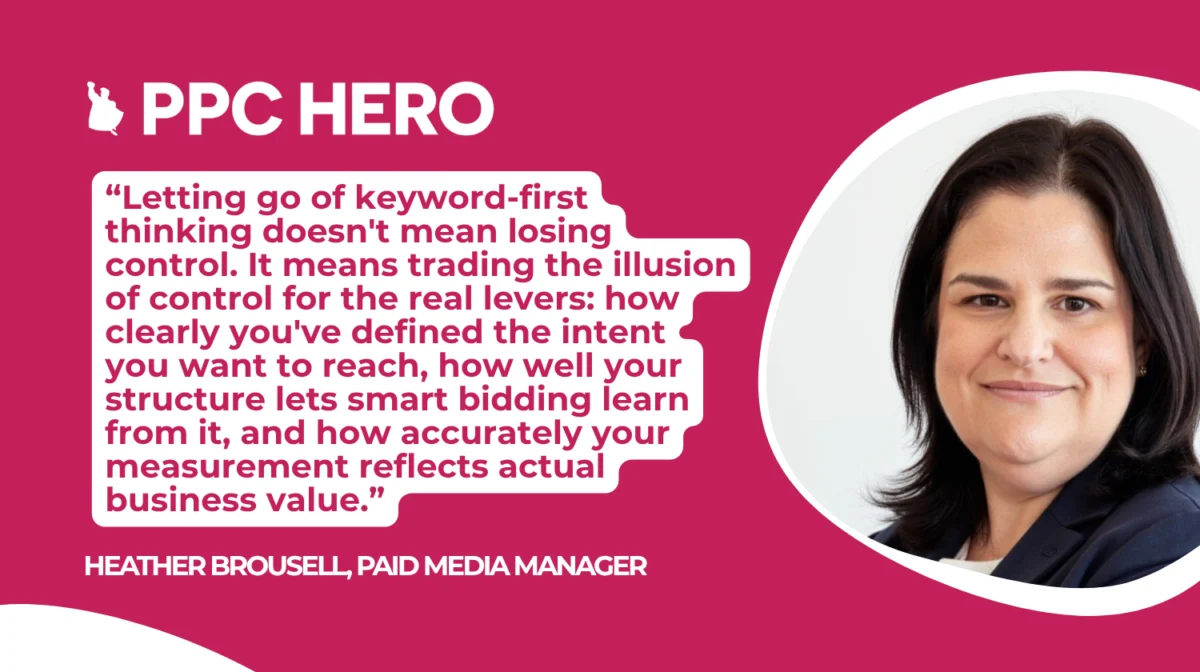
Embracing an intent-first approach does not equate to a loss of control. Instead, it involves trading the illusion of control for the genuine levers of performance: the clarity with which intent is defined, the structural efficiency that enables smart bidding to learn effectively, and the accuracy with which measurement reflects actual business value. The future of PPC lies not in the mastery of keywords, but in the strategic understanding and orchestration of user intent.