


In the high-stakes environment of global retail, the ability to iterate rapidly without compromising user experience has become a primary differentiator for market leaders. As organizations transition from simple A/B testing to complex, multi-layered experimentation programs, the challenges of scale often lead to operational bottlenecks and data silos. Apurva Sandbhor, Manager of Platform & Product Experimentation at The Home Depot, provides a blueprint for navigating this evolution, arguing that the success of an experimentation program is rooted not in the volume of tests conducted, but in the structural frameworks and platform architectures that support them. By shifting focus from "win rates" to "learning value" and "decision integrity," enterprise leaders can transform experimentation from a tactical marketing exercise into a strategic engine for risk mitigation and innovation.
The Architectural Shift: Moving Beyond Manual Scaling
For many years, the standard response to a growing demand for experimentation was to increase headcount. However, Sandbhor posits that scaling a team without concurrently scaling the underlying platform architecture serves only to compound operational friction. In an enterprise setting, a centralized team that manually builds, tests, and analyzes every experiment eventually hits a ceiling. This manual approach leads to "siloed execution," where different departments may use conflicting metrics or redundant methodologies, resulting in "operational noise" that obscures clear business insights.
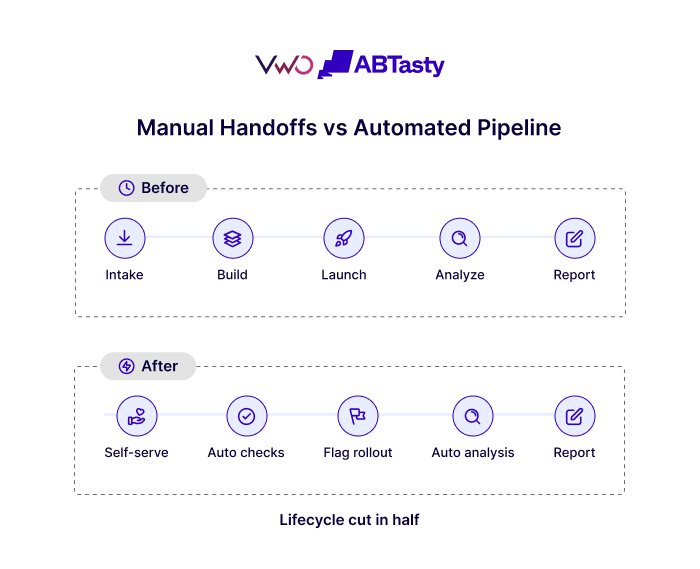
To address this, Sandbhor advocates for a "platform-first" strategy. This involves building a technical ecosystem that acts as a force multiplier, allowing teams to move faster without a linear increase in human capital. The goal is to move away from a reactive support mindset—where the experimentation team acts as a service desk—to a model where the platform enables self-service testing across the organization.

The Dual-Lane Framework for Work Distribution
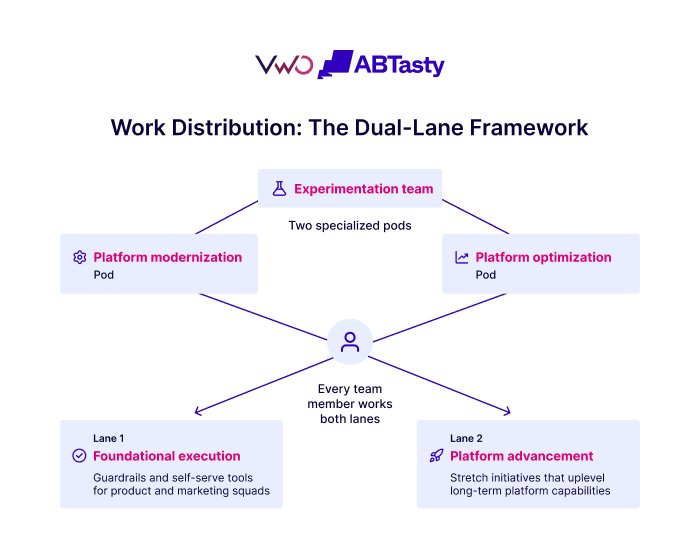
A critical component of this platform-first approach is the "Dual-Lane" framework, which decouples day-to-day enablement from core innovation. This structure allows a large organization to maintain high velocity while ensuring that high-stakes experiments receive the necessary rigor.
- The Enablement Lane: This lane focuses on democratizing experimentation. It provides product squads with standardized templates, automated workflows, and self-service tools. By lowering the barrier to entry, the organization can run a high volume of low-risk tests—such as UI tweaks or copy changes—without burdening the core experimentation experts.
- The Innovation Lane: This lane is reserved for complex, high-impact initiatives that require deep statistical analysis and cross-functional alignment. These might include changes to the recommendation algorithms, checkout flows, or new feature rollouts. By separating these from routine tests, leadership can ensure that the most significant business decisions are backed by the highest integrity data.
Balancing Velocity and Data Integrity through Automation
In the pursuit of speed, many organizations inadvertently sacrifice data quality. Sandbhor emphasizes that true velocity is not achieved by rushing the interpretation of results, but by automating the guardrails that prevent errors. When experimentation is treated as a series of manual analytical projects, it is prone to human error and "false positives" that can lead to costly strategic missteps.
Integrated Statistical Guardrails
The Home Depot’s approach involves integrating a proprietary statistical engine directly into the data ingestion pipeline. This allows for real-time monitoring of experiments and the automatic detection of anomalies. One of the most critical checks is for Sample Ratio Mismatch (SRM), a condition where the actual traffic distribution between test variants does not match the intended assignment. SRM is often a "canary in the coal mine," indicating underlying technical issues that could invalidate the entire test. By automating these checks, the platform can flag or even pause experiments the moment a discrepancy is detected, saving weeks of wasted engineering effort.
Modernizing Infrastructure: Client-Side vs. Server-Side
A significant milestone in the maturity of an experimentation program is the transition from client-side to server-side testing. Client-side testing, while easier to implement, can often lead to "flicker" effects (where the original content is briefly visible before the variant loads) and performance latency. Server-side experimentation, however, occurs at the application level, offering greater control over complex logic and a more seamless user experience.

Sandbhor notes that moving to server-side testing requires a cultural and structural evolution. It demands a robust change management plan, as it involves deeper integration with the engineering stack. Before making this transition, an organization must have a mature data culture and clear stakeholder incentives. The benefits, however, are substantial: server-side testing allows for "decoupling deployment from activation," meaning code can be pushed to production but only "turned on" for specific segments via feature flags, reducing the risk of catastrophic failures.
Case Study: The Behavioral Nuance of Checkout Optimization
The importance of looking beyond surface-level data is best illustrated by a real-world scenario involving a checkout optimization rollout. The Home Depot’s team implemented an algorithmic recommendation engine designed to cross-sell accessories during the final stages of a purchase. Initial data showed an unexpected drop in aggregate cart conversion rates—a result that might lead a less mature program to abandon the initiative entirely.
However, deeper segment analysis revealed a critical behavioral nuance. While the algorithm was highly effective on product discovery pages, presenting users with multiple individual product choices during the high-intent checkout path triggered "decision paralysis." The cognitive load of choosing between several accessories was distracting users from completing their primary purchase.
Based on this insight, the team pivoted. They replaced the multi-choice layout with a single, pre-configured "bundle." This iteration eliminated the friction while retaining the cross-sell value. The follow-up test validated this hypothesis, converting the initial loss into a net revenue lift. This case study underscores Sandbhor’s point: the goal of experimentation is not just to "win," but to uncover business truths that inform future strategy.
Redefining ROI: From "Win Rates" to "Risk Avoidance"
Perhaps the most provocative aspect of Sandbhor’s perspective is the rejection of "win rates" as a primary KPI for experimentation programs. In many organizations, a high percentage of "winning" tests is seen as a sign of success. Sandbhor argues the opposite: an obsession with win rates incentivizes teams to test low-risk, low-reward ideas that they know will succeed, effectively starving the company of true innovation.
The $ Value of Strategic Risk Avoidance
To keep executives engaged, especially when tests "fail," the narrative must shift toward protection and safeguarding. One of the most impactful tools in Sandbhor’s repertoire is the "Strategic Risk Avoidance" report. This report calculates the estimated revenue loss prevented by stopping a heavily backed but flawed feature from going live.
For instance, if a proposed feature change is projected to increase revenue but an experiment reveals it actually causes a 2% drop in conversion, stopping that rollout saves the company millions of dollars in potential losses. By framing a "losing" test as an "insurance policy," experimentation leaders can demonstrate tangible ROI even when the hypothesis is proven wrong.
Metrics That Matter
Sandbhor suggests three key metrics to replace traditional win rates:
- Decision Integrity: The accuracy and reliability of the data used to make business decisions.
- Learning Velocity: The speed at which the organization gains actionable insights from its experiments.
- Risk Mitigation: The total dollar value of potential losses avoided through testing.
The Human Element in an AI-Driven Future
As Artificial Intelligence (AI) begins to commoditize the execution layer of experimentation—automating data pulls, building test variants, and enforcing guardrails—the role of the product leader is evolving. While AI can optimize the path, Sandbhor believes that human judgment remains irreplaceable in three specific areas:
- Ethical and Strategic Boundaries: Determining what should be tested and ensuring that experiments align with the company’s long-term values and brand reputation.
- User Psychology: Translating complex human behaviors into novel hypotheses that AI might not be able to intuit from historical data alone.
- Stakeholder Alignment: Building the cultural consensus and executive buy-in necessary to act on experimental insights.
"AI can optimize the path," Sandbhor notes, "but humans must choose the mountain."
Conclusion: Experimentation as a Long-Term Capability
The perspective shared by Apurva Sandbhor highlights a fundamental truth about modern digital business: experimentation is a continuous engine, not a series of isolated projects. For an enterprise like The Home Depot, success depends on building a system that can scale across products and teams without losing sight of the people making the decisions.
By treating experimentation as a product-driven infrastructure system rather than a manual analytical service, organizations can achieve a level of agility that is both fast and precise. The ultimate goal is to foster a culture where every team member understands that the value of a test lies in the high-integrity business insight it provides. Whether a test wins or loses, the real victory is in the learning that shapes a more effective corporate strategy. As the retail landscape continues to be reshaped by AI and shifting consumer behaviors, the ability to uncover business truths through a robust, scalable experimentation program will remain an "ironclad insurance policy" for long-term growth.







