


In the rapidly evolving landscape of digital optimization, the industry discourse frequently centers on sophisticated, automated experimentation platforms. However, recent market analysis and internal reports from technical teams suggest that manual A/B testing remains a cornerstone of the optimization strategy for a significant portion of the enterprise world. Organizations operating with custom technology stacks, stringent compliance requirements, or targeted budget constraints continue to rely on a patchwork of feature flags, custom scripts, and existing analytics tools to validate product changes. While this "manual" approach offers unparalleled control and avoids the recurring costs of third-party licensing, it introduces a complex web of operational overhead and statistical risks that can undermine the very data-driven decisions it seeks to support.
The Strategic Shift Toward Manual Experimentation
Manual A/B testing is defined by the absence of a dedicated, end-to-end experimentation platform. Instead of utilizing integrated suites that handle everything from traffic splitting to statistical significance reporting, teams manage these components independently. This involves engineers writing custom randomization logic, data analysts building SQL queries for result validation, and product managers manually monitoring experiments across disparate dashboards.
Industry experts note that the decision to go manual is rarely a matter of technical simplicity. Rather, it is a strategic alignment with specific organizational constraints. For many, the primary driver is data residency and compliance. In highly regulated sectors such as finance or healthcare, the transfer of user data to a third-party experimentation cloud can trigger complex legal reviews. By building internal testing frameworks, these organizations ensure that sensitive user interactions never leave their secured infrastructure.
Furthermore, the rise of "headless" architectures and server-side rendered applications has created a demand for deeper engineering control. Modern development teams often prefer to own the randomization logic and rollout processes, integrating experimentation directly into their Continuous Integration and Continuous Deployment (CI/CD) pipelines. This integration allows for more seamless feature management, though it requires a high degree of technical maturity to execute without introducing system instability.
Methodologies of Manual Implementation
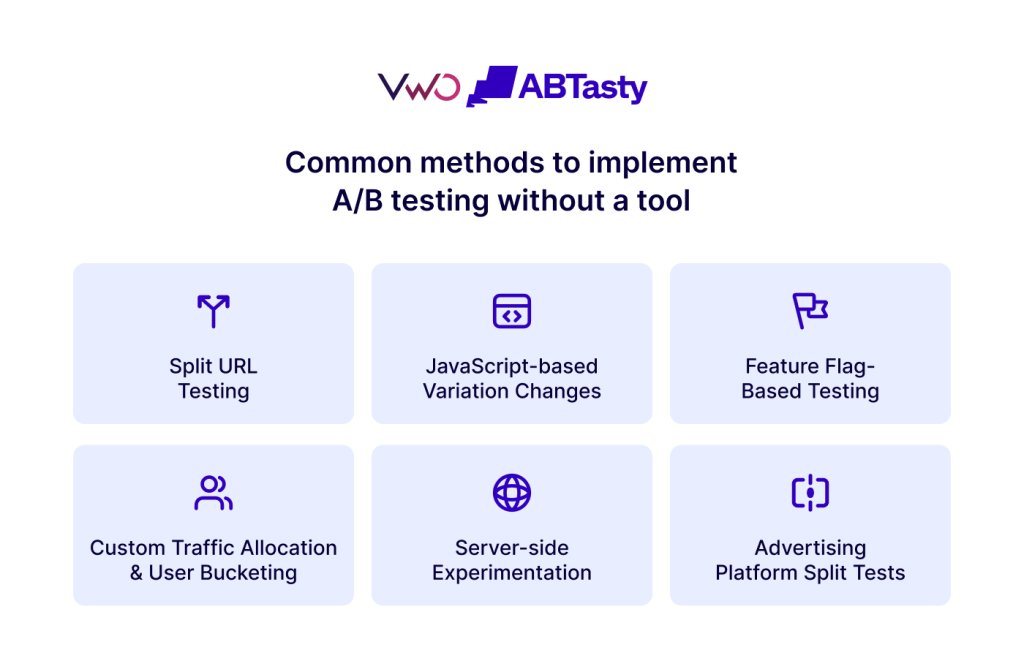
The execution of manual A/B testing varies significantly depending on the technical stack and the specific goals of the experiment. Journalistic observation of the current tech landscape reveals several dominant methodologies:
1. Split URL and Redirect Testing
This method involves creating two distinct versions of a webpage hosted on different URLs. Traffic is then routed between these versions at the server or Content Delivery Network (CDN) level. This approach is frequently employed for major architectural changes or complete page redesigns. However, it is notoriously difficult to maintain without specialized tools, as it often leads to "URL fragmentation," where search engines struggle to identify the primary version of a page, potentially diluting SEO authority.
2. JavaScript-Based Front-End Manipulation
For smaller, tactical changes—such as altering headlines, button colors, or layout elements—teams often use custom JavaScript injected via a Tag Management System (TMS) or a code editor. While this offers rapid deployment, it carries the risk of "flicker" or layout shifts. If the script executes after the initial page render, the user may see the original version for a fraction of a second before it transforms, a phenomenon that negatively impacts Core Web Vitals and user trust.
3. Feature Flag-Driven Experimentation
The convergence of DevOps and Product Management has popularized the use of feature flags for A/B testing. By wrapping new features in conditional logic, teams can toggle experiences on or off for specific user segments. This method is highly effective for backend testing and staged rollouts. The challenge, however, lies in the "cleanup" phase; without a platform to manage the lifecycle of these flags, organizations often accumulate significant technical debt in the form of obsolete code branches.
4. Server-Side Randomization
Regarded as the most robust manual method, server-side testing assigns users to variations before the content is delivered to the browser. This eliminates the performance issues associated with client-side scripts and allows for testing complex business logic, such as pricing algorithms or search results. The tradeoff is the heavy reliance on engineering resources, as every experiment requires backend code changes and deployment cycles.
The Chronology of an Experiment and the Data Gap
To understand the impact of manual testing, one must look at the lifecycle of an experiment. In a manual environment, the chronology is often fragmented.
- Phase I: Hypothesis and Design: Teams identify a friction point. In the absence of integrated behavioral tools, this is often based on "gut feeling" or high-level analytics.
- Phase II: Engineering and Deployment: Developers build the variations and the bucketing logic. This phase can take weeks in a manual setup, compared to hours in a platform-assisted environment.
- Phase III: Data Collection: Events are sent to tools like Google Analytics 4 (GA4) or data warehouses like BigQuery.
- Phase IV: Analysis: This is where the manual approach often falters. Analysts must manually calculate statistical significance, often using Excel or custom Python scripts.
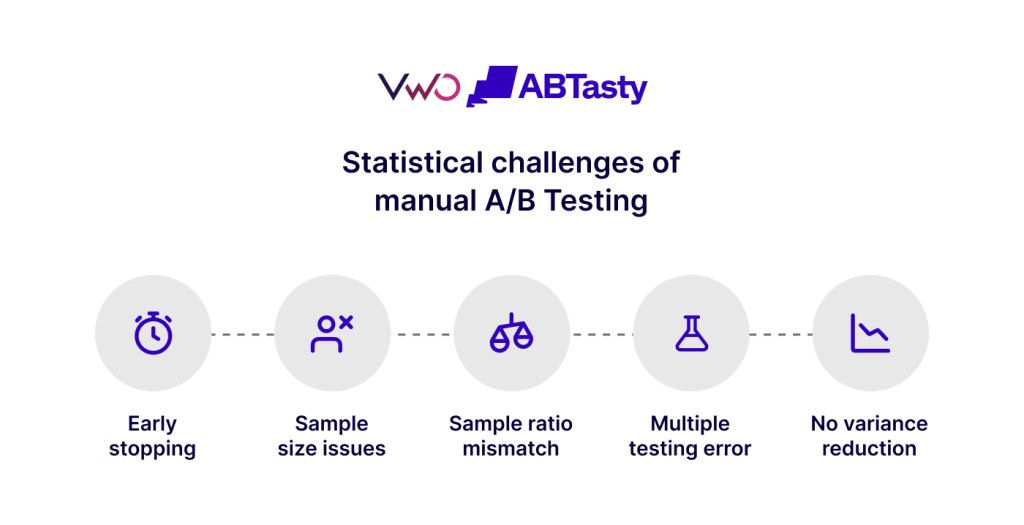
Supporting data from industry benchmarks indicates that manual setups are significantly more prone to "Sample Ratio Mismatch" (SRM). SRM occurs when the actual traffic split (e.g., 48/52) deviates from the intended split (50/50). In a dedicated platform, this is flagged instantly. In a manual setup, it often goes unnoticed, leading to "winning" results that are actually the product of skewed data.
Statistical Integrity and the "Peeking" Problem
The most critical challenge facing manual A/B testing is the preservation of statistical integrity. Without the "guardrails" provided by specialized engines, teams are susceptible to several cognitive and mathematical errors.
A prominent issue is "peeking." In the absence of automated stopping rules, stakeholders often check experiment results daily. If a test shows a 95% confidence level on day three, there is a strong temptation to stop the test and declare a winner. However, statistical theory dictates that p-values fluctuate significantly in the early stages of a test. Stopping early—before a full business cycle has completed—exponentially increases the rate of false positives.
Furthermore, manual setups rarely account for "Multiple Testing Errors." When a team runs ten different tests simultaneously without a unified framework, the probability of finding at least one "significant" result purely by chance increases dramatically. Professional platforms mitigate this through advanced techniques like variance reduction (CUPED) and Bayesian analysis, which are rarely implemented in custom-built manual scripts due to their mathematical complexity.
The SEO and Performance Implications
From a journalistic perspective, the impact of manual testing on a brand’s organic visibility is a growing concern. Search engines like Google have issued specific guidelines for A/B testing to prevent "cloaking"—the practice of showing different content to users than to search engine bots.
Manual setups that rely on flawed routing logic can inadvertently trigger cloaking penalties. Additionally, if a manual split-URL test lacks proper rel=canonical tags, search engines may index both versions, leading to duplicate content issues. The performance hit is equally measurable; layout shifts caused by poorly optimized client-side scripts can lower a site’s ranking in the Cumulative Layout Shift (CLS) metric, a direct factor in Google’s ranking algorithm.
Official Responses and the ROI of Transitioning
As organizations scale, the "hidden costs" of manual testing often begin to outweigh the licensing fees of dedicated platforms. Technical leaders from major firms have noted that the engineering hours spent maintaining custom testing frameworks often cost the company more than a platform subscription.
Case studies from the industry highlight this shift. For instance, the travel giant Meliá Hotels initially utilized various testing methods but found that manual management hindered their ability to scale. By transitioning to a dedicated feature experimentation framework, they were able to implement a booking-funnel change that resulted in a 1.85% uplift in revenue per visitor within a single week. Similarly, the energy company Vandebron used integrated behavioral insights to identify a specific friction point in their sign-up forms that was invisible to their standard analytics, leading to a 16.3% improvement in conversion rates.
The consensus among data scientists is that while manual testing is a valid starting point for "experimentation-light" organizations, it lacks the scalability required for a mature optimization program. The ROI of a platform is found not just in the software itself, but in the "velocity of experimentation"—the ability to run more tests, more accurately, with less engineering intervention.

Broader Impact and the Future of Optimization
The broader implication of the manual-versus-platform debate is the democratization of data. Manual testing, by its nature, remains gatekept by engineering and data science teams. A dedicated platform shifts the power of experimentation to marketing, product, and UX teams, allowing those closest to the customer to validate their ideas in real-time.
As we move toward an era of AI-driven optimization, the limitations of manual testing will likely become even more pronounced. Modern platforms are beginning to integrate machine learning to automatically allocate traffic to winning variations (multi-armed bandits) and to personalize experiences for specific micro-segments. These capabilities are virtually impossible to replicate in a manual setup without a massive investment in proprietary AI research.
In conclusion, manual A/B testing serves as a testament to the ingenuity of technical teams working under constraints. It provides a foundational understanding of data-driven decision-making. However, for organizations looking to turn experimentation into a competitive advantage, the transition to a dedicated platform is increasingly viewed as an inevitability. The shift represents a move from simply "running tests" to building a systematic, reliable, and scalable culture of optimization that can withstand the rigors of the modern digital economy.







