

The global digital landscape is currently navigating a period of profound fragmentation, where the proliferation of specialized software has paradoxically led to a decrease in operational clarity for many enterprises. Wingify, a leader in the experience optimization sector, has announced the launch of its unified suite, a strategic consolidation of two of the industry’s most prominent platforms: VWO and AB Tasty. This move is designed to address the "coordination failures" that plague modern digital businesses, where disconnected tools prevent teams from converting raw data into actionable revenue-driving strategies. By merging the experimentation depth of VWO with the sophisticated personalization and AI-driven capabilities of AB Tasty, Wingify aims to provide a single, cohesive data layer that eliminates the friction inherent in multi-tool environments.
The core challenge facing contemporary digital teams is not a lack of data, but rather a gap in the "translation layer" between insight and execution. Many organizations currently operate with a "patchwork" of point solutions: one tool for heatmaps, another for A/B testing, a third for personalization, and a fourth for feature flagging. While each tool may be effective in isolation, the lack of data interoperability means that teams frequently struggle to connect experimental results to actual revenue. Personalization efforts often miss their targets because the audience definitions in one tool do not match those in another, and AI tools often fail to provide value because they lack the specific context of a company’s live experiments and historical performance.
The Structural Roots of Coordination Failure
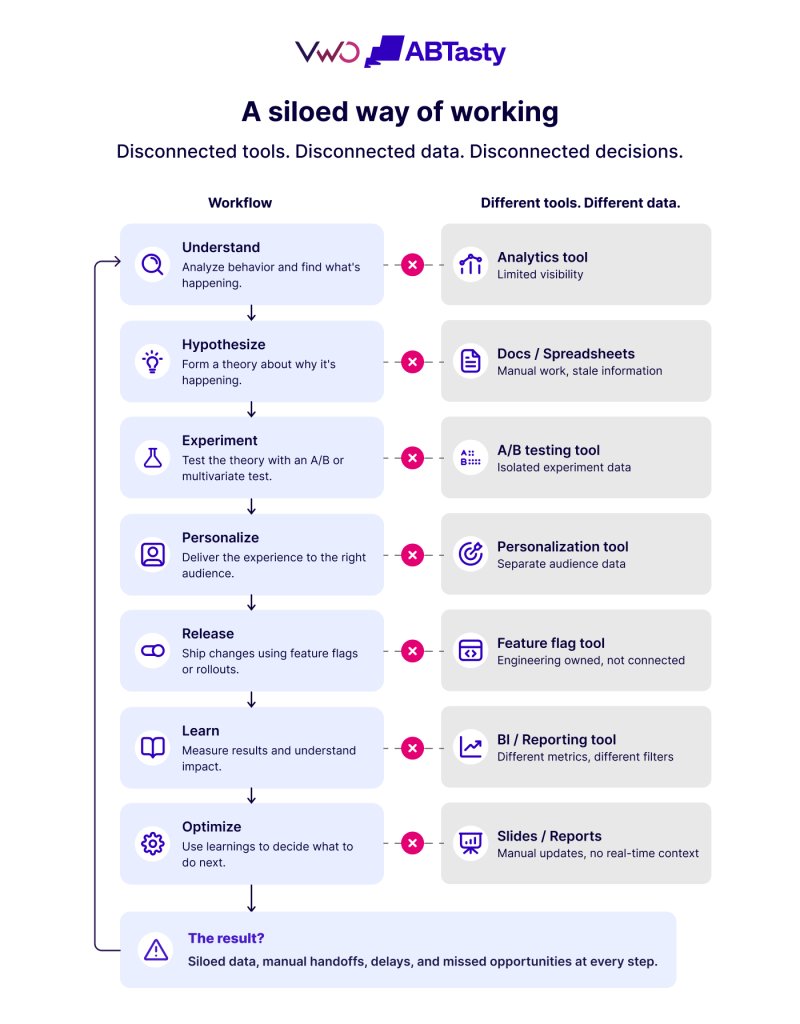
To understand the necessity of Wingify’s unified approach, it is essential to examine the systemic issues that arise when data does not travel freely across an organization. In the current market, the "siloed way of working" has become a significant drain on productivity and ROI. When a digital team identifies a point of friction—such as high cart abandonment on a mobile checkout page—the process of addressing that issue often involves multiple handoffs between data analysts, product managers, and developers.
Each of these handoffs introduces the potential for interpretation errors. By the time a hypothesis is formulated and an experiment is finally launched, the market conditions or consumer behaviors that prompted the initial investigation may have shifted. Furthermore, the problem of "audience drift" creates significant reporting discrepancies. If "returning customers" are defined differently across four different platforms, the metrics will inevitably conflict. Instead of spending time optimizing the user experience, teams find themselves mired in "reconciliation cycles," attempting to explain why analytics reports do not align with experimentation data.
The governance of these fragmented systems also introduces a hidden "security and administrative tax." For large organizations operating across multiple regions or brands, managing separate permission models, audit trails, and compliance standards for five or six different optimization tools is both costly and risky. Wingify’s unified suite addresses this by offering a single permission model and a consolidated audit trail, reducing the administrative overhead that rarely appears in a single tool’s ROI calculation but impacts the bottom line of the entire enterprise.
The Continuous Optimization Loop: A New Operational Standard
At the heart of the Wingify proposition is the "Continuous Optimization Loop," a structural framework that ensures the output of one stage of the optimization process becomes the immediate input for the next. This loop consists of seven distinct stages: Understand, Hypothesize, Experiment, Personalize, Release, Learn, and Optimize.
In a unified environment, a heatmap showing checkout friction (Understand) automatically informs a testing hypothesis (Hypothesize). This hypothesis is then converted into a live test (Experiment). Once a winning variant is identified, it can be immediately deployed as a targeted experience for the specific segment that showed the most improvement (Personalize). This successful change is then integrated into the core product (Release), and the resulting data informs the next round of behavioral analysis (Learn and Optimize).
This seamless transition between stages is intended to create "compounding improvements." In a fragmented system, this chain is broken at every handoff. Wingify’s integration of VWO’s decade-plus expertise in behavioral insights with AB Tasty’s advanced segmentation ensures that the chain remains intact. This connectivity allows for a higher velocity of testing; when the friction of moving from one stage to the next is removed, organizations can run more experiments per year, leading to a statistically higher probability of finding significant revenue-driving wins.
Wandz: The Role of Embedded AI in Optimization
A critical component of this unified suite is "Wandz," Wingify’s embedded AI layer. Unlike general-purpose AI tools that require users to manually input context through "copy-and-paste" workflows, Wandz is built directly into the experimentation and personalization pipelines. It draws upon the combined legacy of VWO’s Copilot and AB Tasty’s Evi, unifying them into a single intelligence layer with access to the suite’s shared data.
The integration of AI directly into the workflow changes the economic equation of optimization. Wandz serves as an "operational accelerator" in several key areas:
- Hypothesis Generation: Instead of growth teams spending days analyzing data to justify a test, Wandz can surface hypotheses grounded in real-time behavioral patterns and historical test results in a matter of minutes.
- Error Mitigation: Before a campaign goes live, the AI reviews configuration metrics, audience targeting, and traffic splits. This prevents expensive "false starts" where a misconfigured test runs for weeks before a human notices the error.
- Natural Language Querying: Teams can bypass complex dashboard navigation by asking Wandz direct questions, such as "How did the latest promotional banner perform for first-time mobile users compared to returning desktop users?"
- Execution Speed: The AI Editor allows for the modification of campaigns using natural-language instructions, significantly reducing the "time-to-live" for new digital experiences.
By removing the "pauses" between stages of work, the AI layer ensures that the optimization loop moves faster and with greater precision. This is particularly relevant as the industry moves toward "agentic" AI, where the system doesn’t just suggest content but helps manage the logic of the experiments themselves.
Market Context and the Evolution of Wingify
The unification of VWO and AB Tasty under the Wingify banner marks a significant milestone in the Digital Experience Optimization (DXO) market. Historically, the market was divided between "easy-to-use" tools favored by small-to-medium businesses and "heavyweight" enterprise platforms that required significant technical resources to maintain.
VWO, founded in 2010, gained global recognition for its intuitive visual editor and robust behavioral analytics, making experimentation accessible to a broad range of companies. AB Tasty, conversely, built its reputation on deep personalization and AI-driven targeting, catering to large enterprises with complex customer journeys. By bringing these two philosophies together, Wingify is positioning itself to serve the entire spectrum of the market, from agile startups to global conglomerates.
Industry analysts suggest that this consolidation is a response to a broader trend in the SaaS industry toward "platformization." As budgets tighten, CIOs and CMOs are looking to consolidate their "martech stacks," moving away from a multitude of niche vendors in favor of comprehensive platforms that offer better data integrity and lower total cost of ownership.
Implications for the Future of Digital Commerce
The move toward a unified optimization suite has broader implications for the future of digital commerce and user experience. As consumer expectations for "hyper-personalization" continue to rise, the ability of a business to react in real-time to user behavior becomes a primary competitive advantage. Companies that can close the gap between "seeing a problem" and "fixing it" will inevitably outperform those slowed down by tool fragmentation.
Furthermore, the unification of data layers is a prerequisite for the next generation of AI applications. AI is only as effective as the data it can access; by providing a clean, unified stream of behavioral and experimental data, Wingify is creating the "fertile soil" necessary for more advanced machine learning models to flourish.
In conclusion, the launch of the Wingify unified suite represents a strategic pivot toward operational efficiency and data clarity. By addressing the "coordination failures" of the past decade, the platform provides a blueprint for how digital businesses can navigate an increasingly complex landscape. The integration of VWO and AB Tasty, underpinned by the Wandz AI layer, offers a comprehensive solution for organizations looking to turn digital experience optimization into a sustainable, high-velocity engine for growth. As the digital economy continues to evolve, the businesses that thrive will be those that can act with the most confidence and the least amount of friction.







