


The landscape of enterprise eCommerce underwent a seismic shift in 2018 when Adobe acquired Magento, rebranding the Enterprise Edition as Adobe Commerce. While the core codebase remains familiar to long-time developers, the platform has evolved into a sophisticated ecosystem designed for high-volume, multi-storefront operations. For digital marketers and conversion rate optimization (CRO) specialists, this complexity presents a unique set of challenges. Most conventional A/B testing guides assume a simplified web environment, but the architectural nuances of Adobe Commerce—specifically its reliance on full-page caching, Varnish layers, and complex session handling—require a specialized approach to ensure data integrity and user experience consistency.
At the heart of the challenge is the inherent conflict between site performance and dynamic experimentation. In an era where a one-second delay in mobile load times can impact conversion rates by up to 20%, Magento utilizes aggressive caching strategies to maintain speed. However, these same strategies often interfere with the delivery of test variants, leading to corrupted data or the dreaded "flicker effect." To build a reliable testing program, enterprise brands must move beyond surface-level modifications and address the underlying technical architecture of their storefronts.
The Technical Foundations of Magento Experimentation
To understand why A/B testing on Magento differs from other platforms, one must examine the role of the Varnish configuration and the Full-Page Cache (FPC). In a typical enterprise deployment, Varnish acts as a reverse proxy cache, sitting in front of the web server to intercept requests. By serving pre-rendered HTML directly, Varnish prevents the server from having to process PHP or query the database for every visitor. This is essential for handling high traffic, yet it creates a "blind spot" for testing tools.
Because Varnish operates at the edge, it lacks visibility into visitor-level data, such as the cookies used to assign a user to a specific test variant. Without proper configuration, the server may deliver the same cached version of a page to all visitors, regardless of whether they were supposed to see "Version A" or "Version B." This results in inconsistent experiences where a user might see a new layout on the homepage but revert to the old layout upon refreshing or navigating back.
Furthermore, Magento’s multi-storefront architecture allows a single installation to power multiple brands, regions, or customer tiers. Each of these storefronts can have its own unique caching and session rules. Scoping a test incorrectly—for instance, applying a global change that was intended only for the North American store—can lead to localized data discrepancies and a fragmented brand image.
Strategic Areas for High-Impact Testing
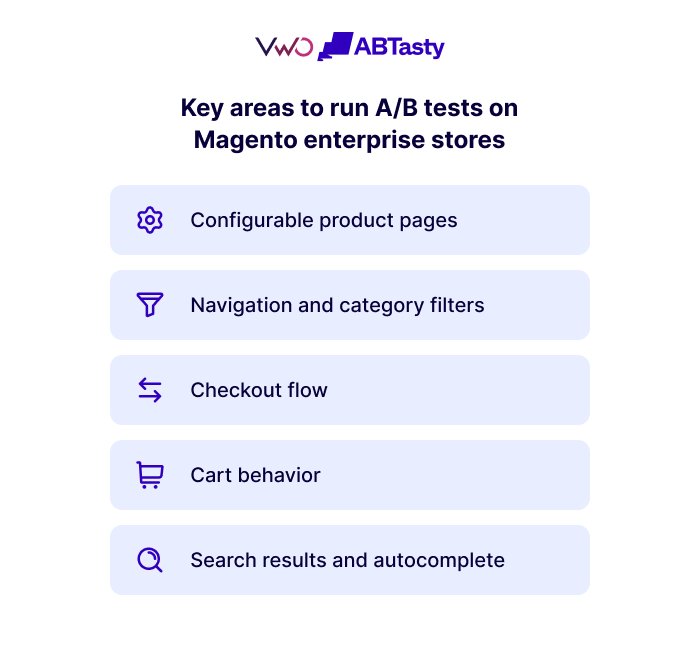
Given Magento’s template-driven architecture, changes made to core templates can influence thousands of pages simultaneously. Data from industry benchmarks suggest that focusing on five specific areas yields the highest return on investment for enterprise retailers.
1. Configurable Product Pages
Configurable products are a cornerstone of the Magento experience, allowing customers to select sizes, colors, and other attributes. Testing the layout of these options—such as using color swatches versus dropdown menus—can significantly impact the "Add to Cart" rate. Additionally, experiments involving the placement of "Save for Later" buttons or the visibility of stock levels can influence the urgency of the purchase.

2. Layered Navigation and Category Filters
For stores with massive catalogs, the way a user filters products is critical. Despite its importance, navigation is often one of the least tested elements in eCommerce. By experimenting with the order of filters (e.g., price vs. brand), the default state of filter groups (expanded vs. collapsed), and the mobile layout of the filter sidebar, brands can reduce the time-to-purchase and improve the overall findability of products.
3. The Multi-Step Checkout Flow
Magento’s checkout process is highly structured, involving distinct steps for address entry, shipping selection, and payment. Unlike "closed" platforms where the checkout is often a black box, Adobe Commerce allows for deep customization. Testing the visual hierarchy of the order summary or the placement of "Trust Badges" during the payment step can help mitigate the global cart abandonment rate, which currently sits at a staggering 70.22%.
4. Cart Behavior and Cross-Sells
The shopping cart is a pivotal moment in the buyer’s journey. Enterprise brands often use this space for cross-selling and up-selling. Testing where these recommendations appear, how coupon fields are surfaced, and the transparency of shipping estimates can prevent last-minute exits. High-performing stores often find that moving the "Calculate Shipping" tool earlier in the process reduces friction.
5. Search Functionality and Autocomplete
For large-scale retailers, search is the primary navigation tool for high-intent shoppers. Testing the default sort order of search results—whether to prioritize "Best Sellers," "Newest," or "High Margin" items—can have a direct impact on revenue. Furthermore, optimizing the autocomplete suggestions to include product images or price points can guide users to relevant products faster.
Best Practices for Maintaining Data Integrity
To ensure that results are statistically significant and not the byproduct of technical glitches, organizations must adhere to a strict set of implementation standards.
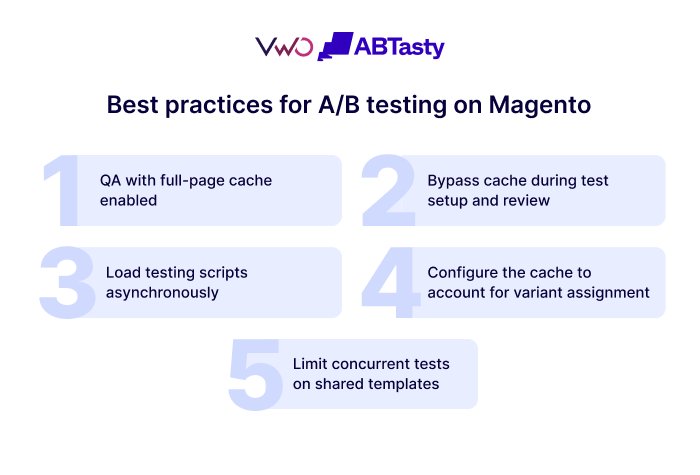
- Asynchronous Script Loading with Pre-hiding: To maintain performance, testing scripts should be loaded asynchronously. However, this can cause the "flicker effect" where the original page is visible for a split second before the variant appears. The industry standard solution is the use of a "pre-hiding snippet" placed high in the
<head>tag. This snippet temporarily hides the page content until the variant is ready to render, ensuring a seamless transition for the user. - QA with Active Caching: A common mistake is performing Quality Assurance (QA) on a staging site where caching is disabled. This does not reflect the production environment. Tests must be verified with FPC and Varnish active across multiple devices to ensure that the "bucketing" (the assignment of users to variants) remains persistent across the entire session.
- Bypassing Cache During Setup: During the initial setup and review phase, developers should use IP-based bypasses or custom cookies to view the site in "developer mode." This allows for real-time adjustments without affecting the cached pages served to the general public.
- Cookie Persistence: Ensure that the testing tool uses first-party cookies that are recognized by the server-side cache. If the cache is not configured to "vary" its response based on these cookies, the test results will be fundamentally flawed.
Organizational Alignment and the Human Factor
The success of a testing program is as much about people as it is about technology. Garret Cunningham, Director of Global Optimization at Columbus Global, emphasizes that testing velocity is tied to dedicated resources. Organizations that rely on "shared teams"—where developers handle both general maintenance and experimentation—often see their testing programs stall.

"Organizations that dedicate design and development capacity to experimentation consistently achieve greater testing velocity and stronger optimization outcomes than those relying on shared teams," Cunningham noted in a recent industry podcast.
Furthermore, Ilan Hurwitz, a veteran in the eCommerce space, highlights that the biggest hurdle for enterprise businesses is often securing alignment across departments. Building stakeholder trust requires transparent reporting and a clear explanation of how A/B testing mitigates the risk of making large-scale site changes.

Broader Implications: The Shift Toward Agentic Optimization
As the eCommerce sector moves toward 2025, the role of Artificial Intelligence in A/B testing is expanding. New "agentic" optimization systems, such as VWO’s Wandz, are beginning to automate the generation of test hypotheses. By analyzing user segments and page performance data, these AI agents can suggest variations that a human team might overlook. For Magento users, this means the bottleneck of "what to test" is being replaced by the technical requirement of "how to implement."
The integration of server-side testing is also becoming more prevalent. By running experiments deeper in the application stack, brands can test fundamental changes—such as different search algorithms or pricing logic—without the performance overhead of client-side JavaScript. This "full-stack" approach is particularly valuable for the B2B sector, where quote requests and shared catalog pricing add layers of complexity to the buying journey.

Conclusion: Building a Data-Driven Culture
For enterprise Magento and Adobe Commerce stores, A/B testing is not a "set-and-forget" activity. It is a rigorous discipline that requires a deep understanding of the platform’s architecture. By addressing the challenges of full-page caching, ensuring cookie persistence, and focusing on high-leverage templates like the checkout and product pages, retailers can turn their storefronts into engines of continuous improvement.
In a competitive global market, the ability to make data-backed decisions is the differentiator between brands that merely survive and those that lead. As the technology continues to evolve, the principles of rigorous QA, technical alignment, and strategic focus remain the foundation of any successful experimentation program. The transition from Magento to Adobe Commerce has provided the tools; it is now up to the enterprise brands to wield them effectively through disciplined testing and optimization.







