

The landscape of digital experimentation is undergoing a fundamental shift as practitioners move away from rigid academic frameworks toward more fluid, business-centric decision models. Andrea Bronzini, the founder of Confident Story, stands at the forefront of this evolution, advocating for a deeper understanding of stochastic noise and the transformative potential of artificial intelligence in the testing workflow. In a recent detailed discussion, Bronzini outlined the structural flaws in traditional Conversion Rate Optimization (CRO) and provided a roadmap for how modern teams can navigate the complexities of data to achieve sustainable growth.
The Paradox of Objectivity in Data-Driven Decisions
For years, the CRO industry has operated under the assumption that data-driven decisions are inherently objective. However, Bronzini argues that the very frameworks used to interpret data are built upon subjective judgment calls. Decisions regarding sample sizes, confidence thresholds, and the timing of an experiment’s conclusion are all human variables that shape the final result before the data is even processed. This realization led Bronzini to focus on "stochastic noise"—the random variability inherent in any data set—as the primary factor that either illuminates or obscures the "signal" of a successful experiment.

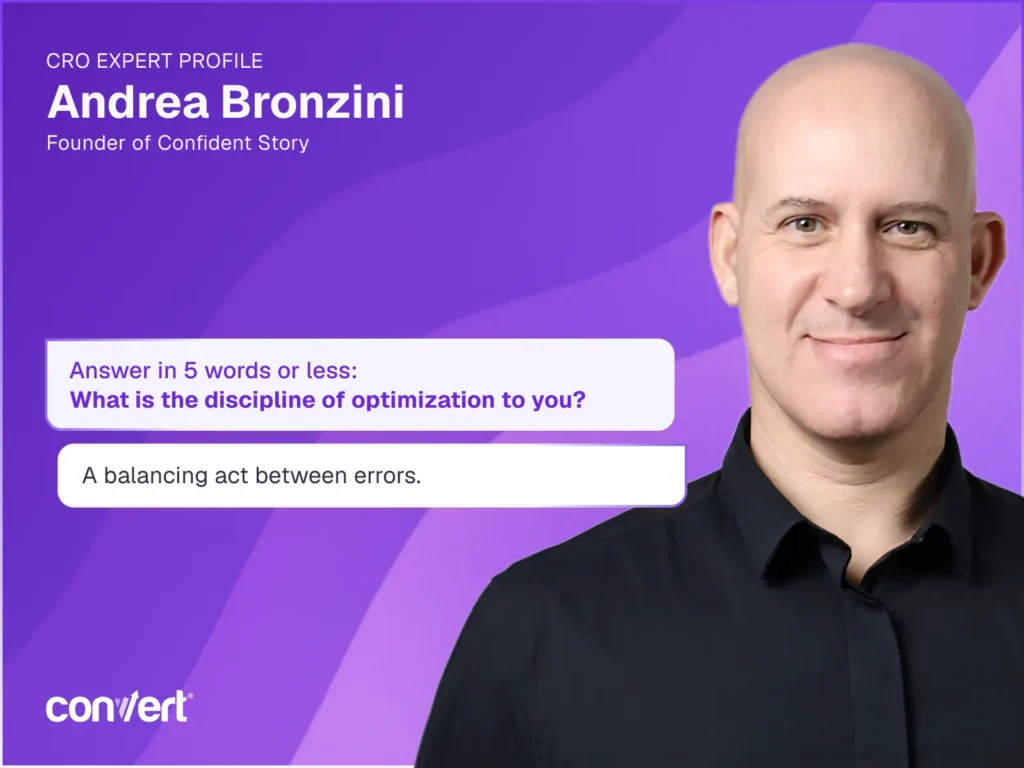
In the context of digital marketing, the signal represents the true impact of a change, such as a new call-to-action (CTA) or a redesigned checkout flow. The noise represents the external variables—seasonal shifts, browser differences, or random user behavior—that can skew results. Bronzini posits that understanding noise is the differentiator between teams that see temporary "wins" and those that build long-term, scalable systems. He defines the discipline of optimization not as a search for truth, but as a "balancing act between errors."
The Three Failure Modes of Digital Experimentation
Central to Bronzini’s philosophy is the identification of three distinct ways an experiment can fail a business. Historically, the industry has focused almost exclusively on the first mode, often ignoring the costs associated with the latter two.
1. The False Positive: Calling the Wrong Winner
The most commonly recognized error is shipping a "loser" because random noise pushed the measurement in a positive direction. Statistical significance—typically set at a 95% confidence interval—was designed specifically to minimize this risk. While effective at preventing false claims, Bronzini argues that an over-reliance on this single metric creates a "short blanket" effect: pulling it up to cover one area leaves others exposed.

2. The Missed Opportunity: The Inconclusive Pile
The second failure mode occurs when a genuine improvement is made, but because the observed lift does not cross the arbitrary 95% threshold, the test is labeled "inconclusive." In many corporate environments, these real winners are discarded and forgotten. While "power analysis" is the standard academic solution to determine required sample sizes, Bronzini notes that for most companies, traffic is a hard constraint. Consequently, power calculations often yield sample sizes that are impossible to reach within a reasonable timeframe, leading to a massive loss of potential revenue that is rarely accounted for in CRO audits.
3. The Winner’s Curse: The Inflated Estimate
Perhaps the most insidious failure mode is the "inflated winner." This happens when an experiment correctly identifies a positive direction but vastly overestimates the magnitude of the lift. For instance, a change might produce a true underlying improvement of 3%, but because only the most extreme "hot" runs cross the 95% significance threshold, the reported lift might be 12%. When the change is implemented permanently, the results inevitably "regress" to the mean. Bronzini clarifies that this is not a failure of implementation or a change in user behavior; it is a mathematical certainty when using strict thresholds that isolate extreme outliers.
The Meta-Experiment: Evidence of Statistical Inflation
To validate these theories, Bronzini conducted an extensive "meta-experiment"—an experiment about experiments. He developed a simulator designed to replay the same A/B test 5,000 times under controlled conditions with a known "true lift." In one scenario, Bronzini set a true lift of 3.2% with a sample size of 500 total conversions over a four-week period.
The results were revealing. Using a standard 95% two-tailed confidence interval, only 12 out of every 100 runs were flagged as statistically significant. The remaining 88% were deemed inconclusive, despite the fact that a true positive improvement existed. More importantly, the 12 "winners" showed an average measured lift between 9% and 14%.
This data provides a factual basis for why many CRO "wins" fail to translate into bottom-line revenue after launch. The industry’s insistence on high confidence levels essentially filters for luck. Only the versions of the experiment where noise amplified the true 3.2% lift into a double-digit figure were "seen" by the statistical model. This meta-experiment serves as the foundation for Confident Story’s approach to building more realistic forecasting models.
The AI Revolution: Removing the Developer Bottleneck
Beyond the mathematical theory of testing, Bronzini highlighted the practical impact of artificial intelligence on the CRO workflow. Historically, the greatest friction in experimentation has been implementation. Every test variation required a developer, a place in the sprint cycle, and a rigorous QA process. This bottleneck often forced teams to default to "safe" or "easy" tests, such as minor copy changes or button color adjustments.
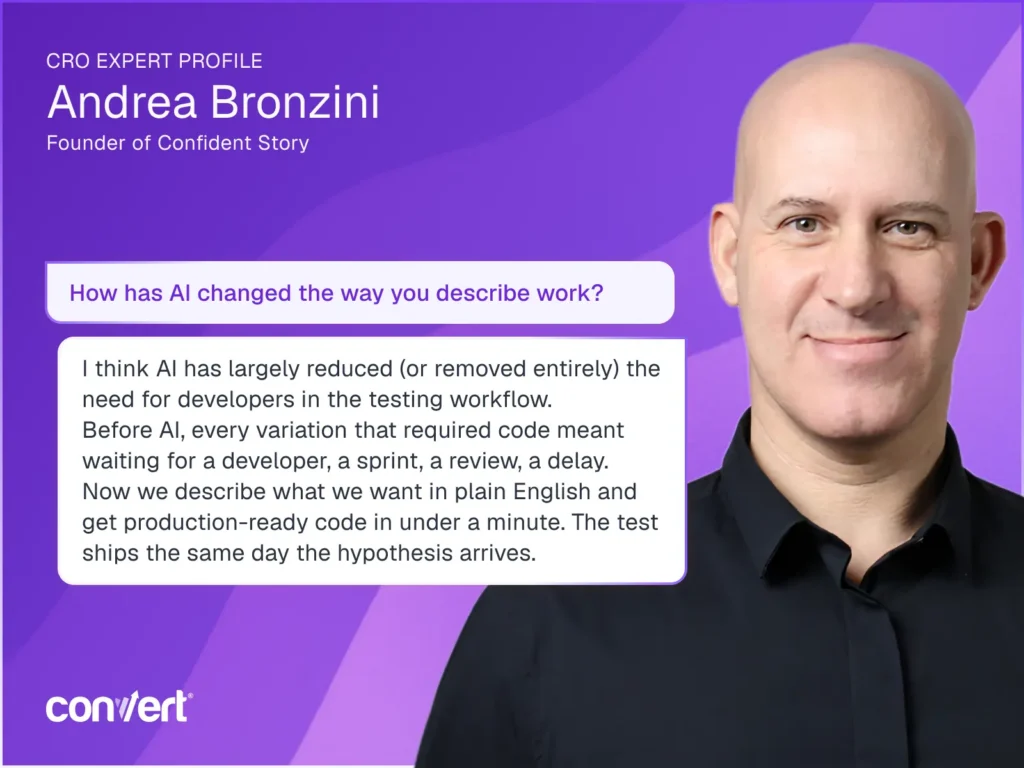
With the advent of Large Language Models (LLMs), this friction has largely evaporated. Bronzini reports that his team now uses AI to generate production-ready JavaScript for test variations in under a minute. By describing a hypothesis in plain English—such as "move the CTA above the fold and pivot the copy to focus on urgency"—AI can provide the necessary code to go live the same day.
The primary shift here is not just speed, but the scope of experimentation. When the "cost" of building a test drops to near zero, teams are empowered to test bolder, more structural hypotheses. AI is also being utilized to analyze page layouts, prioritize insights, and even predict which variations are most likely to resonate with specific user segments based on historical data.
Transitioning to Decision-Policy Thinking
The culmination of these factors—the understanding of noise and the efficiency of AI—is leading to a new era of "decision-policy thinking." Bronzini suggests that practitioners must stop treating 95% confidence as a fixed requirement and instead view it as a variable with associated costs.

A decision-policy approach asks: "Given our specific traffic constraints, our typical effect sizes, and our corporate tolerance for risk, what decision rules should we enforce?" This might mean accepting an 80% confidence level for low-risk changes to capture more "real" winners, or implementing a monitoring cadence that allows for quicker pivots.
The broader impact of this shift is the democratization of experimentation. As execution becomes a commodity handled by AI, the value of the human practitioner shifts toward higher-level strategy. The "best" optimizers will no longer be those who can navigate a testing tool, but those who can form sharp hypotheses, understand user psychology, and design robust decision frameworks that account for the inevitable presence of noise.
Industry Implications and the Path Forward
The insights shared by Bronzini suggest a maturation of the CRO field. As digital markets become more competitive and traffic costs continue to rise, companies can no longer afford to let 88% of their potential improvements sit in the "inconclusive" pile. The move toward "Confident Stories" involves a transparent acknowledgment of the limitations of data.

Industry analysts suggest that as AI-driven testing becomes the standard, the volume of experiments will increase exponentially. This will require even more sophisticated methods for managing "interference" between tests and a more nuanced understanding of how multiple changes interact across a single user journey.
In conclusion, the evolution of experimentation is moving toward a more holistic view of the business. By balancing the risks of false positives, missed winners, and inflated estimates, and by leveraging AI to remove implementation barriers, organizations can move closer to a state of continuous, meaningful optimization. Andrea Bronzini’s work underscores a vital truth in the age of Big Data: the goal of testing is not to find a perfect number, but to make a better decision.







