In the rapidly evolving landscape of digital marketing, a social media audit serves as a critical diagnostic tool, offering a structured review and analysis of an organization’s performance across all its social media platforms. Far from a mere checklist, it acts as a comprehensive report card, meticulously identifying strengths, pinpointing areas ripe for improvement, and outlining actionable next steps to enhance digital presence and achieve strategic objectives. Typically spearheaded by social media managers, marketing directors, or dedicated agency teams, these audits encompass both organic and paid social media activities, providing invaluable insights for marketing leaders to evaluate social media return on investment (ROI), refine content strategies, and make more informed budget allocations in an increasingly competitive environment.
The Imperative of Social Media Audits in a Dynamic Digital Age
The necessity of regular and thorough social media audits has never been more pronounced. With the digital realm continually expanding and user behaviors shifting, businesses must possess a clear, data-driven understanding of their social media efficacy. Such an audit empowers organizations to make superior strategic decisions, furnishing marketing leaders with the concrete evidence required to justify investments in specific platforms, content types, and campaigns. This is particularly crucial given that a significant 59% of Chief Marketing Officers (CMOs) report insufficient budgets to fully execute their strategies, according to Gartner. A well-executed audit clarifies where resources are best deployed, ensuring maximum impact for every dollar spent.

A robust audit effectively transforms disparate data points into a coherent, actionable roadmap. It addresses fundamental questions such as whether current social media efforts are truly resonating with target audiences, if brand messaging remains consistent across all channels, and where competitive advantages or disadvantages lie. Without this systematic review, businesses risk operating in the dark, potentially misallocating resources, missing emerging trends, and failing to capitalize on opportunities to connect with their vast and diverse online communities.
Distinguishing Audit from Strategy: A Foundation for Future Growth
It is essential to differentiate between a social media audit and a social media strategy, though the two are inextricably linked. A social media audit functions as a diagnostic snapshot, capturing the current state of affairs at a specific moment in time. It objectively assesses existing accounts, performance metrics, brand consistency, and audience engagement, answering the critical question: "What is currently working, and what is not?"
Conversely, a social media strategy is a forward-looking blueprint, outlining the intended trajectory for future social media endeavors. It establishes overarching goals, defines content pillars, and dictates the brand’s online presence over subsequent months. The audit provides the foundational data and insights upon which a robust and responsive strategy can be built or refined. In essence, the audit reveals "where you are," while the strategy dictates "where you are going." The logical sequence dictates that an audit should always precede the development or adjustment of a social media strategy, ensuring that all future plans are grounded in current realities and past performance.

A Seven-Step Framework for a Thorough Social Media Audit
To conduct a comprehensive and effective social media audit, a systematic, multi-step process is recommended. This methodical approach ensures no critical aspect of a brand’s online presence is overlooked, providing a holistic view for strategic planning.
1. Inventory All Social Media Accounts and Brand Presence
The initial step involves creating an exhaustive list of all social media accounts associated with the brand. This includes platforms actively managed, those that may have become dormant, and even newer entrants like Threads and Bluesky, which many brands have adopted over the past year. Given that Statista projects 5.75 billion social media users globally by 2026, the digital landscape is constantly expanding, making it crucial to consider potential new platforms for future engagement.
For larger organizations, this phase also entails identifying any "rogue" or unauthorized accounts that might have been created by different departments, regions, or even individuals within the company. Tracking down and either consolidating or deactivating these accounts is vital for maintaining brand consistency and safeguarding brand reputation. Furthermore, a thorough search for brand mentions or product names across major networks can uncover imposter or misleading accounts, which can then be reported or shut down to protect the brand’s integrity. Proactive social media monitoring programs can be instrumental in catching such unauthorized presences moving forward.

2. Ensure Brand and Profile Consistency
Once all accounts are cataloged, the next step is to review each profile for adherence to established brand style guidelines. This includes a meticulous examination of:
- Profile Pictures/Avatars: Are they current, high-resolution, and consistent with branding?
- Cover Photos/Banners: Do they reflect current campaigns, branding, and are they optimized for each platform’s dimensions?
- Bios/About Sections: Are they concise, up-to-date, keyword-rich, and do they clearly articulate the brand’s value proposition?
- Links in Bio: Are all links functional, directing users to the correct landing pages or websites?
- Tone of Voice: Does the language used align with the brand’s official communication guidelines?
- Keywords and Hashtags: Are relevant keywords and branded hashtags consistently used to enhance discoverability?
This consistency ensures a cohesive brand identity across all digital touchpoints, fostering trust and recognition among the audience.
3. Analyze Top-Performing Content
A crucial component of the audit involves identifying the top five performing posts on each social media platform. The definition of "top-performing" can vary, but a common starting point is to rank posts by engagement rate to understand what content truly resonates with the audience. However, depending on specific platform goals, other metrics such as link clicks, video views, or conversions might be prioritized.
During this analysis, it’s vital to look for discernible patterns within the successful content. Questions to consider include:

- What content formats (e.g., video, images, carousels, text-only) achieve the highest engagement?
- Which topics or themes consistently perform well?
- Are there specific calls to action that drive better results?
- What time of day or week do top posts typically go live?
- Does user-generated content (UGC) or employee advocacy perform better?
- What kind of captions or storytelling techniques are most effective?
Recording these observations in a dedicated audit document will be instrumental in informing future content strategy. Native analytics tools on each platform provide this data, though comprehensive social media reporting tools like Perch by Hootsuite can consolidate this information for a more efficient review.
4. Evaluate Channel Performance Against Strategic Goals
This step moves beyond individual post performance to assess how each social media channel contributes to the overarching marketing objectives. It requires clearly defined mission statements and key goals for each social account. While some accounts may share goals like driving website traffic or increasing conversions, others might be dedicated purely to customer service or brand awareness.
For each channel, specific progress towards its goals must be tracked. For quantifiable goals, actual numbers are recorded (e.g., website visits from Instagram, sales from Facebook Page visitors). For qualitative goals, supporting evidence is documented, such as increases in follower count or improvements in organic/paid reach for brand awareness, or enhanced Customer Satisfaction (CSAT) scores for customer service channels. This clarity on purpose and effectiveness is paramount.
Tracking conversions from social media can be complex. For Meta platforms (Facebook and Instagram), setting up the Meta Pixel, often augmented by Meta’s Conversions API for greater accuracy, is essential. Other social networks have their own tracking codes. Google Analytics is crucial for tracking website traffic and conversions originating from social media. Utilizing a social media management tool like Perch by Hootsuite can significantly streamline this process by centralizing data and reporting, as highlighted by industry professionals who note that "running a social media audit in Perch takes less than an hour."
5. Benchmark Against Industry Competitors
Understanding internal performance is only half the battle; the next crucial step is to compare it against top competitors and industry benchmarks. This competitive benchmarking reveals whether the brand’s performance is strong, average, or lagging within its niche.
Tools like Perch by Hootsuite offer robust competitive analysis capabilities, allowing users to track up to 20 competitors per network. This provides a clear view of strengths and weaknesses, alongside actionable insights into top-performing posts, hashtags, and content formats employed by rivals. Furthermore, industry benchmarking tools within such platforms enable comparison against average performance across various metrics, including engagement rate, reach, impressions, follower growth, click-through rate, and more. This contextualizes performance and helps identify areas where a brand can gain a competitive edge.
6. Deep Dive into Audience Demographics and Behavior
Understanding the audience on each platform is fundamental to effective social media marketing. This involves delving into audience insights, starting with demographics. While general trends exist (e.g., Facebook and YouTube’s largest audience segment often being men aged 25-34), it’s vital to identify the unique demographics of a brand’s specific audience on each platform.
Beyond age and gender, insights should extend to interests, behaviors, preferred content types, and even geographic locations. This information is invaluable for creating detailed buyer personas, which in turn guide content creation and targeting strategies. Native platform analytics provide some demographic data, but advanced social listening tools, such as Lumen by Talkwalker (part of the Hootsuite Social OS), can offer deeper insights. These tools allow for searching topics and keywords, filtering by demographics and location, identifying thought leaders, and monitoring brand perception in real-time, even across newer platforms like Bluesky.
7. Uphold Compliance and Governance Standards
Often overlooked, reviewing accounts for compliance and governance is a critical final step, particularly for enterprise-level teams. This safeguard protects the brand from potential legal, regulatory, and security risks. Key areas to address include:
- Data Privacy Adherence: Ensuring compliance with regulations like GDPR, CCPA, and others.
- Content Approval Processes: Verifying that all content undergoes appropriate internal review before publication.
- Brand Guidelines Enforcement: Confirming consistent application of brand guidelines across all platforms and regions.
- Security Protocols: Reviewing access permissions, password policies, and multi-factor authentication for social accounts.
- Crisis Communication Plans: Ensuring clear protocols are in place for responding to potential social media crises.
- Employee Social Media Policies: Confirming employees understand and adhere to guidelines for professional social media use.
For organizations managing social media at scale, governance layers like Hootsuite’s Vigil can help apply consistent rules and approvals, making compliance an integrated part of the audit process and ensuring a safe and defensible social presence.
Translating Audit Insights into Actionable Strategy
Upon completing the comprehensive audit, the real work of transformation begins. The findings must be translated into a revised, actionable social media strategy. This involves:

- Reviewing and Prioritizing Findings: Identifying the most significant insights and areas requiring immediate attention.
- Updating Goals: Adjusting social media goals based on performance data and new competitive insights.
- Refining Content Strategy: Developing new content ideas and formats, drawing inspiration from top-performing posts and audience preferences. For example, if video content proved highly engaging, a specific strategy to incorporate more Instagram Reels or repurpose long-form video into short clips should be outlined.
- Optimizing Budget Allocation: Shifting budget towards platforms and content types that demonstrate the highest ROI.
- Implementing Changes: Executing the refined strategy across all relevant platforms.
- Monitoring and Measuring: Continuously tracking performance against new goals to assess the impact of changes.
This post-audit phase considers the audit a reset button, allowing for clearer priorities and a more strategic approach to future efforts. Marketing strategy is a dynamic, living document that should be continually refined through testing and experimentation.
Best Practices for Sustained Social Media Excellence
Beyond the individual steps, certain habits elevate an audit from a one-off task to a powerful, repeatable process that consistently improves results:
- Regularity: Conduct audits on a consistent schedule—quarterly for most, monthly for those with high campaign velocity.
- Clear Objectives: Define what success looks like for each channel and align audit metrics accordingly.
- Accountability: Assign ownership for each step of the audit and for implementing subsequent action items.
- Integration: Ensure audit findings are shared and integrated into broader marketing and business strategies.
- Leverage Tools: Utilize social media management and analytics tools to streamline data collection and analysis.
Tailoring Audits: Different Approaches for Diverse Needs

Audits are not one-size-fits-all; their scope and depth can vary depending on organizational needs and resources.
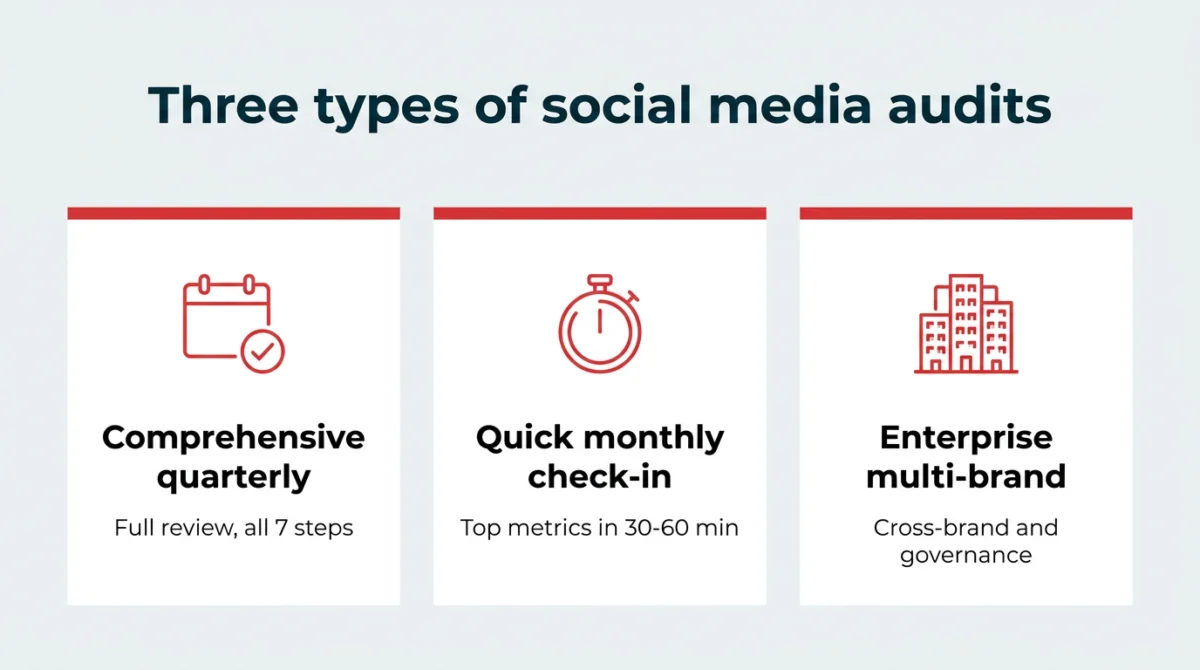
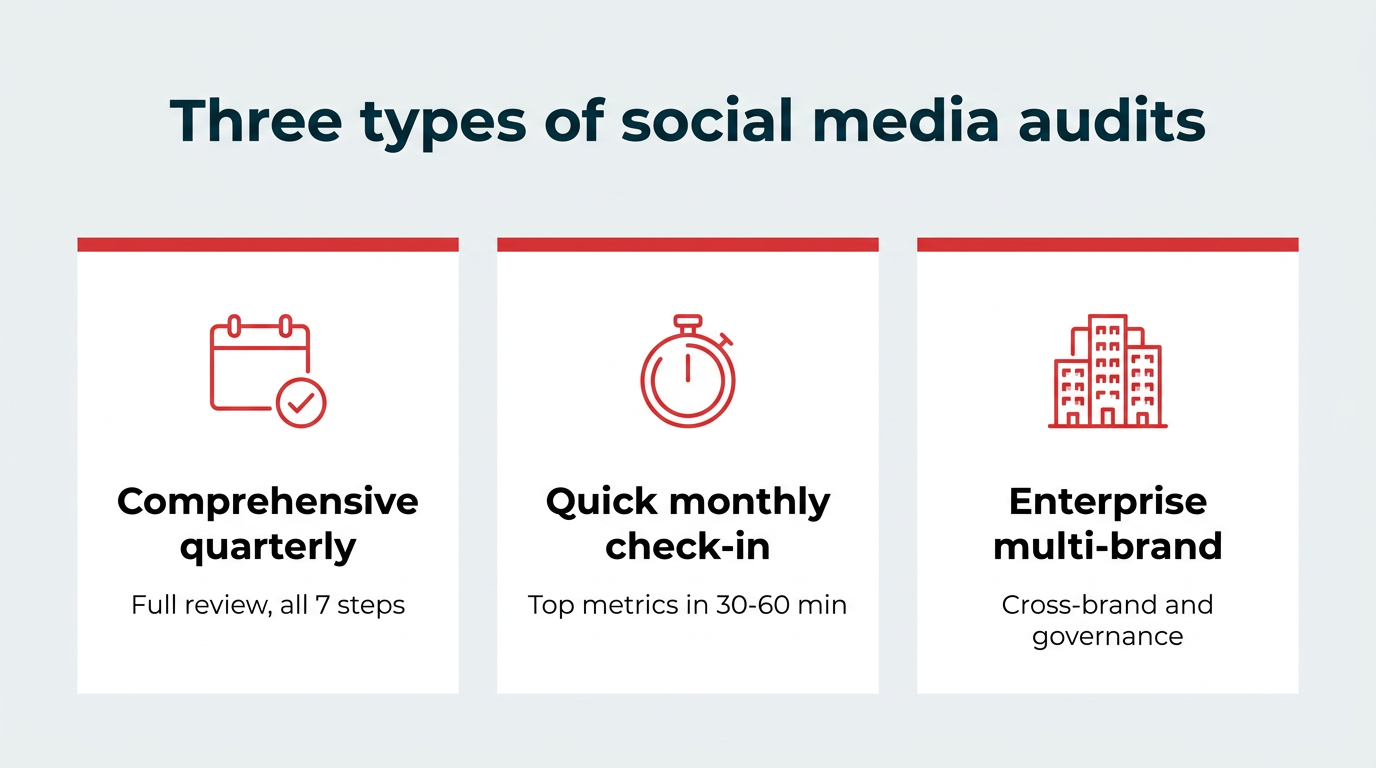
- Comprehensive Quarterly Audit: This is the full, seven-step review, examining every account, branding element, content performance, channel goal, competitive benchmark, audience segment, and compliance aspect. It’s typically conducted by a social media manager or a small team over several hours, culminating in a detailed report for leadership, guiding budget and priority decisions for the upcoming quarter.
- Quick Monthly Check-in: A more streamlined version, focusing on top-line metrics, best/worst performing posts, and any glaring branding inconsistencies. This usually takes 30-60 minutes and doesn’t require a formal report. Its purpose is to detect early trends and address minor issues before they escalate, maintaining responsiveness between comprehensive audits.
- Enterprise Multi-brand Audit: Designed for large organizations managing numerous brands, regions, or business units. This audit emphasizes cross-brand consistency, regional adaptations, and robust governance, alongside standard performance and competitive benchmarking. It often involves coordination across multiple teams and highlights alignment, divergence, and compliance gaps across the enterprise.
Leveraging Technology: Essential Tools for Streamlined Audits
While manual audits using native platform analytics and spreadsheets are possible, dedicated tools significantly reduce time and enhance the depth of analysis.
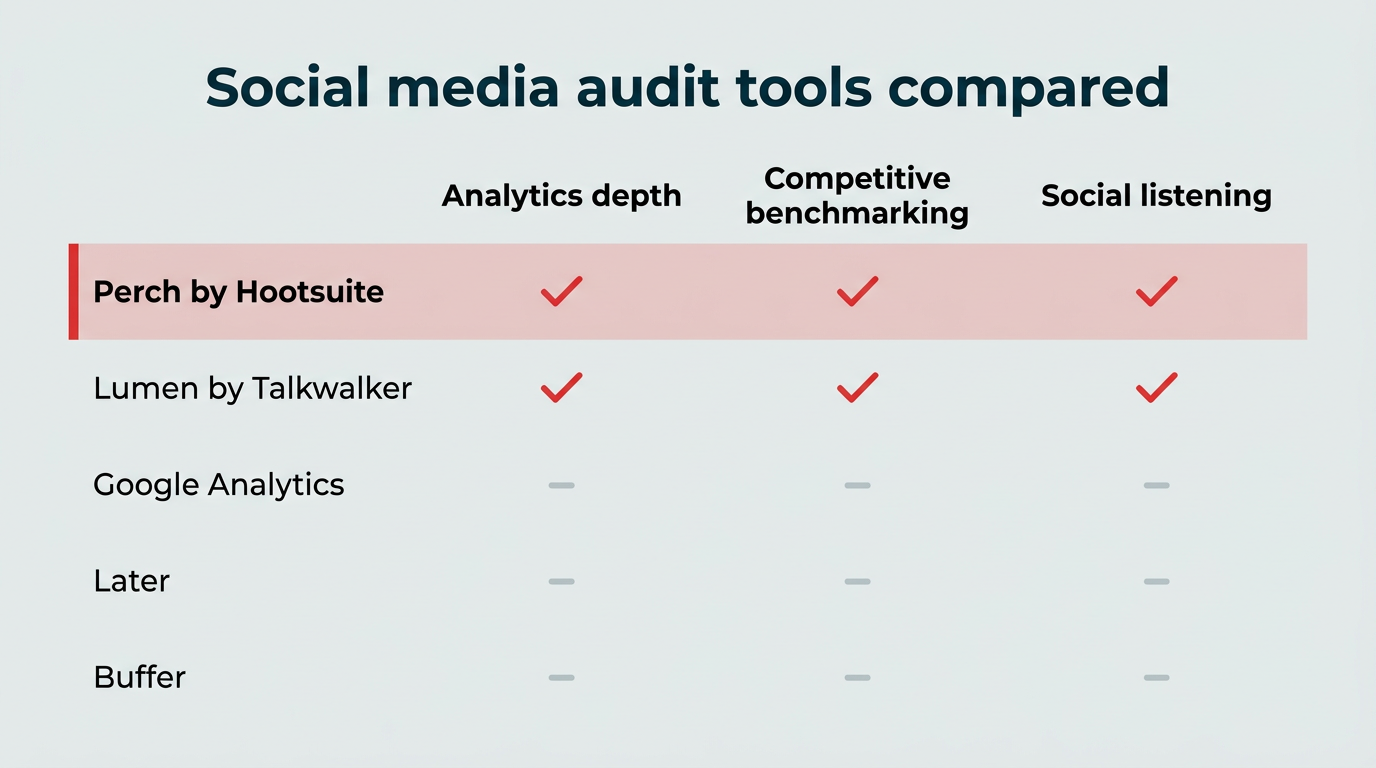
- Perch by Hootsuite: An advanced platform that powers end-to-end social audits with customizable analytics, competitive analysis (up to 20 competitors), industry benchmarking, and social listening. It centralizes growth, engagement, audience behavior, and top-performing post data.
- Google Analytics: Primarily a web analytics service, it is crucial for tracking how social media campaigns drive traffic to a website and contribute to conversions, especially if website engagement is a key marketing goal.
- Lumen by Talkwalker: An advanced social listening and intelligence platform that excels at monitoring brand mentions across social networks and the broader web, including newer platforms. It provides real-time insights into sentiment analysis, trending topics, and conversation spikes, crucial for understanding brand perception.
- Later: A social media planning tool primarily focused on scheduling and previewing posts. While it offers basic insights into post performance and helps optimize posting times, it generally lacks advanced features like competitive analysis or industry benchmarking.
- Buffer: Known for its user-friendly dashboard, Buffer’s analytics provide insights into audience engagement, performance tracking, and demographics. However, similar to Later, it typically does not include social listening or comprehensive competitive benchmarking features.
The strategic deployment of these tools can transform a tedious audit process into an efficient and insightful exercise, ensuring data-driven decisions.

Addressing Common Queries: Key Considerations for Social Media Audits
Several common questions often arise when discussing social media audits, highlighting key considerations for businesses. The metrics included in an audit should always align with specific business goals, moving beyond vanity metrics like follower count to focus on engagement rate, reach, conversions, and customer satisfaction scores where applicable. An effective social media audit checklist for businesses should encompass reviews of all accounts, branding consistency, content performance, audience insights, goal alignment, and compliance protocols. For enterprises, quarterly audits are recommended to maintain team alignment and prevent strategy drift, with monthly check-ins for high-volume campaigns. The cost of an audit can range from free (manual, in-house) to several thousand dollars (outsourced agency), but tools like Perch by Hootsuite can provide agency-level depth at a lower cost. While AI tools like ChatGPT can assist with data analysis and pattern identification, they cannot replace the strategic judgment required to act on findings or directly pull live analytics from connected accounts. The fundamental distinction between an audit (diagnostic) and a strategy (forward-looking plan) remains paramount. Common mistakes include over-reliance on vanity metrics, neglecting competitive benchmarking, and failing to translate findings into a concrete action plan, all of which can be mitigated by a structured approach and accountability. Ultimately, while manual audits are possible, dedicated social media audit tools are invaluable for teams managing multiple accounts, significantly reducing time and enhancing the depth and breadth of insights.
Conclusion
A social media audit is not merely a periodic review but a foundational component of a robust digital marketing strategy. By systematically assessing current performance, benchmarking against competitors, understanding audience dynamics, and ensuring compliance, businesses can refine their approach, optimize resource allocation, and foster genuine engagement. This cyclical process—where each audit informs the next strategy, and each strategy sets the stage for future audits—ensures continuous improvement and helps brands thrive in the dynamic social media ecosystem. Regular, insightful audits connect day-to-day marketing efforts with overarching company goals, ultimately leading to stronger audience connections and sustained success.