The digital media landscape has undergone a seismic shift over the last decade as traditional publishing houses transition from advertising-dependent revenue models to performance-based commerce strategies. As of early 2025, the proliferation of "best of" lists and product recommendation roundups has become a cornerstone of digital journalism, raising significant questions regarding the intersection of editorial integrity and commercial interests. This evolution reached a critical point of public discourse in January 2025, when industry experts and major news organizations, including The Washington Post, began a deeper investigation into the mechanics of how these recommendations are curated and the extent to which financial incentives influence the final rankings presented to consumers.
The Shift Toward Commerce-Driven Journalism
For years, major media conglomerates have leveraged their search engine authority and established brand trust to monetize consumer intent. This phenomenon, often referred to as "commerce content," involves the creation of service-oriented articles designed to guide purchasing decisions while generating revenue through affiliate marketing. In these arrangements, publishers receive a commission for every sale generated through links embedded within their content.
The motivation for this shift is primarily economic. As traditional display advertising rates plummeted due to the rise of programmatic buying and the dominance of social media platforms, publishers sought more stable revenue streams. Affiliate marketing provided a solution that appeared to align the interests of the reader, the publisher, and the merchant. However, the increasing reliance on this model has led to a complex ecosystem where the line between objective review and paid endorsement can often become blurred.
Chronology of the Content Monetization Trend
The trajectory of media-driven product recommendations can be traced through several key industry milestones that reshaped the digital publishing environment:
- The Acquisition Era (2016–2018): A pivotal moment occurred in 2016 when The New York Times Company acquired The Wirecutter, a product review site, for approximately $30 million. This move signaled to the industry that high-quality, affiliate-linked content was a viable and prestigious business model.
- The Expansion of "Underscored" and "Select" (2019–2021): Following the success of The Wirecutter, other legacy brands launched dedicated commerce verticals. CNN introduced "CNN Underscored," and NBC News launched "NBC Select," specifically designed to capture search traffic for high-intent keywords like "best laptop" or "top-rated skincare."
- The Search Authority Peak (2022–2024): Large media publishers began dominating Google Search Results Pages (SERPs). Due to their high domain authority, articles from major news outlets often outrank smaller, specialized hobbyist sites, even if the specialized sites provide more in-depth technical analysis.
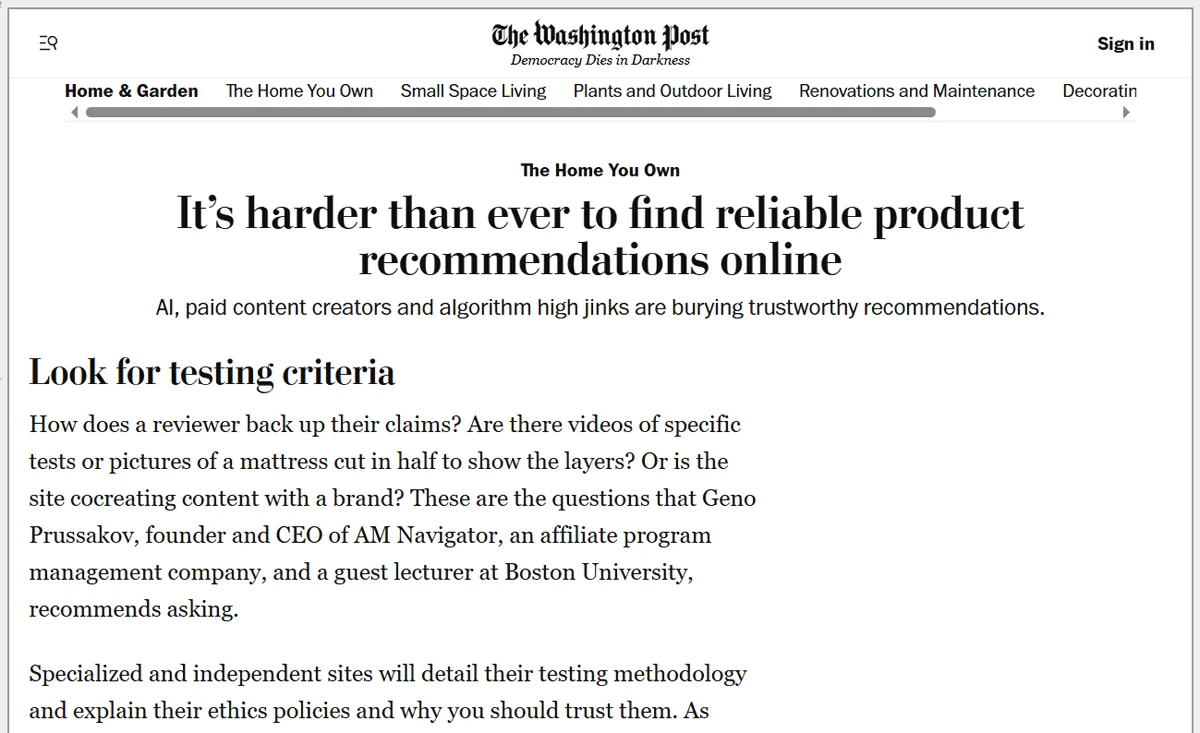
- The Transparency Inquiry (January 2025): National outlets, including The Washington Post, published comprehensive analyses on the reliability of online shopping roundups. This period marked a renewed focus on consumer protection and the disclosure of financial relationships between publishers and brands.
The Mechanics of Modern Product Roundups
To maintain their reputation, many top-tier media outlets employ rigorous methodologies for product testing. Industry analysts, including Geno Prussakov of AM Navigator, note that reputable publishers typically follow a four-pillar approach to ensure the quality of their recommendations.
First, many organizations invest in dedicated testing facilities. These labs allow journalists to test products under controlled conditions, measuring performance metrics that go beyond subjective experience. Second, outlets often hire subject matter experts or professional reviewers who possess deep technical knowledge of specific categories, such as consumer electronics or home appliances.
Third, editorial teams frequently implement a "separation of church and state" policy, where the writers and editors selecting the products are theoretically isolated from the business teams negotiating affiliate contracts. Finally, most major publishers adhere to internal sets of editorial standards designed to prioritize the reader’s benefit over short-term commission gains.
Despite these safeguards, the financial reality of digital publishing introduces potential conflicts. Product rankings can be influenced by "placement fees," where a brand pays for a prominent spot on a list, or by "Earnings Per Click" (EPC) guarantees. If one product offers a 15% commission while a superior competitor offers only 2%, the financial pressure to favor the former can be substantial.
Supporting Data: The Affiliate Marketing Surge
The scale of the affiliate marketing industry underscores why big media has pivoted so aggressively toward this model. According to market research data from 2024, the global affiliate marketing industry was valued at over $17 billion, with a projected compound annual growth rate (CAGR) of 10% through 2030.

In the United States alone, affiliate marketing spending reached approximately $9.1 billion in 2023. For major publishers, commerce content can now account for 25% to 40% of total digital revenue. This financial dependency means that the "best" product on a list is often the "best available within the affiliate network," rather than the best product available on the global market.
Furthermore, consumer behavior data indicates a high reliance on these lists. A 2024 survey revealed that 68% of online shoppers consult at least one "best of" list before making a purchase exceeding $100. This level of influence grants media publishers significant power over market trends and brand success.
Regulatory Oversight and Official Responses
The Federal Trade Commission (FTC) in the United States has tightened its guidelines regarding endorsements and testimonials to combat potential deception. Current regulations require "clear and conspicuous" disclosure when a financial relationship exists between a reviewer and a brand.
In response to increased scrutiny, many media organizations have updated their disclosure statements. However, critics argue that these disclosures are often buried in fine print or phrased in ambiguous language that the average consumer may not fully grasp. The challenge for regulators lies in the nuance of "editorial selection." If a publisher chooses a product because it is truly the best, but also happens to earn a commission from it, the FTC generally views this as permissible, provided the potential for profit is disclosed.
Industry leaders and affiliate managers have reacted to these challenges by calling for greater transparency. The consensus among ethical practitioners is that long-term brand equity is more valuable than short-term commission spikes. If a reader purchases a recommended product and finds it to be of poor quality, the publisher loses the trust—and the future clicks—of that consumer.
Consumer Strategies for Navigating Recommendations
As the distinction between editorial content and advertising continues to evolve, market analysts suggest that consumers adopt a more critical approach to online shopping. To make informed decisions, buyers are encouraged to utilize several strategies:
- Cross-Referencing Sources: Consumers should compare recommendations across multiple independent outlets. If a product appears on lists from five different major publishers, it is more likely to be a genuine top performer, though it may also indicate a very aggressive affiliate marketing department at the manufacturing company.
- Analyzing Disclosure Language: Readers should look for specific language regarding how products were tested. Statements that detail the hours of testing or the specific metrics used provide more credibility than vague assertions of quality.
- Checking Third-Party Forums: Supplementing media reviews with user-generated content from platforms like Reddit or specialized enthusiast forums can provide a "real-world" perspective that is often missing from professional lab tests.
- Identifying "Pay-to-Play" Red Flags: If a list features a relatively unknown brand alongside industry giants without a clear explanation of why that brand is superior, it may indicate a paid placement or a high-commission arrangement.
Broader Impact and Future Implications
The trend of monetizing media authority has profound implications for the future of journalism and the health of the digital economy. On one hand, affiliate revenue provides a lifeline for newsrooms that might otherwise face closure, ensuring the continued existence of investigative journalism and local reporting. On the other hand, the homogenization of product recommendations—where every major site recommends the same ten items—can stifle innovation and make it difficult for new, high-quality brands to break into the market without significant marketing budgets.
Looking forward, the integration of Artificial Intelligence (AI) in search and content creation is expected to further complicate this landscape. AI-generated "best of" lists may lack the human testing element entirely, relying instead on aggregated data that may already be biased by existing affiliate-heavy content.
In conclusion, while big media’s entry into the product recommendation space has brought a level of professional testing and high-production value to consumer reviews, it has also introduced commercial pressures that require a higher degree of consumer vigilance. The "trust authority" of a media brand remains a powerful tool, but in the modern digital marketplace, that trust is increasingly being weighed against the financial realities of a performance-based economy. The ongoing dialogue between publishers, regulators, and experts serves as a necessary check on a system where the "best" product is frequently the one that is most profitable to recommend.