
 rifanmuazin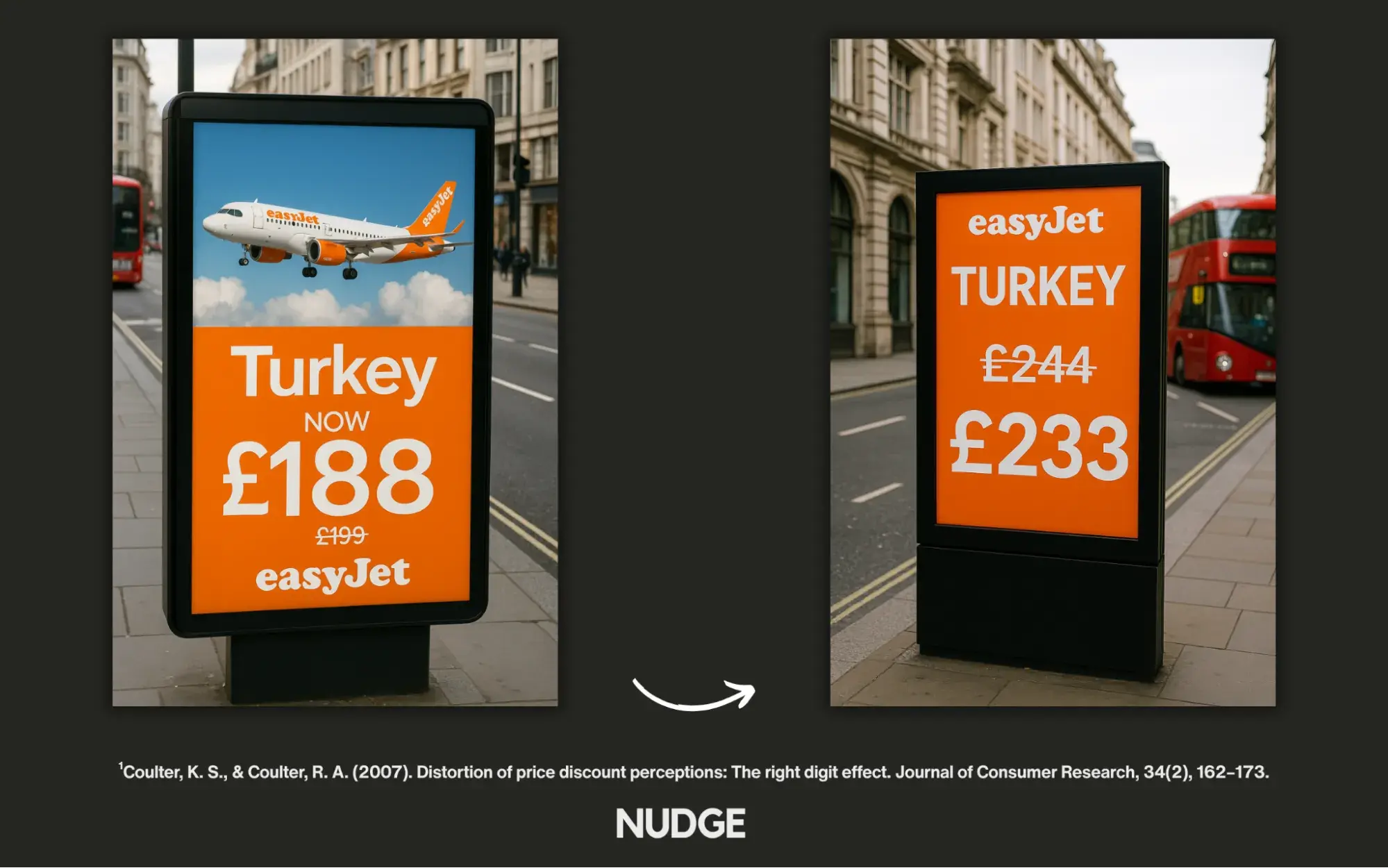
The realm of consumer purchasing decisions is often perceived as a purely rational process, driven by objective value and price points. However, a growing body of research in behavioral economics and marketing psychology reveals that human perception of value is highly subjective and can be significantly influenced by how prices are presented. These psychological “nudges” can subtly steer consumers towards certain choices, optimizing sales and perceived value without altering the fundamental product or service. This article delves into five scientifically validated pricing strategies that leverage these cognitive biases, offering actionable insights for businesses looking to refine their market approach.
The Perceptual Power of Price Endings: The Left-Digit Effect in Discounts
One of the most counterintuitive findings in pricing psychology dates back to a 2007 study by Coulter and Coulter, which illuminated the profound impact of the final digits in a discounted price. In their seminal experiment, researchers presented two distinct advertisements to two randomly selected groups of potential customers. Both advertisements offered a £10 discount on flights to Turkey. The critical difference lay in the displayed prices: one ad listed the discounted tickets at £188, while the other presented a higher price of £233 after the discount. Logically, a £10 saving should be perceived equally regardless of the initial price, yet the results painted a different picture.
Customers exposed to the £188 tickets, despite being offered a numerically cheaper option, paradoxically perceived the deal as a worse value compared to those who saw the £233 tickets. The core psychological mechanism at play here is known as the “left-digit effect” or “cognitive fluency.” Researchers posited that people differentiate smaller numbers more easily and perceive their differences more saliently than larger numbers. For instance, the mental leap from 4 to 3 feels more significant and easily processed than the jump from 9 to 8, even if the absolute difference is identical. When the discounted price ended in higher digits (like £199 discounted to £188), consumers struggled to mentally process the full magnitude of the discount because their attention was drawn to the unchanged “1” in the hundreds place and the relatively high ending digits. Conversely, a price reduction from £244 to £233, where the last digits were lower, made the £11 saving feel more substantial and easier to compute, thus enhancing the perception of a good deal.
The implications for businesses are straightforward yet powerful. When structuring discounts, particularly those with a fixed monetary value, marketers should endeavor to make the final sale price end in a lower digit, ideally between 0 and 4. This simple adjustment can enhance the perceived value of the discount, making the offer feel more attractive and prompting higher conversion rates. This strategy subtly manipulates the consumer’s mental arithmetic, guiding them towards a more favorable interpretation of the offer without any actual change in the discount amount or product quality.
Deconstructing Value: The Advantage of Per-Unit Pricing
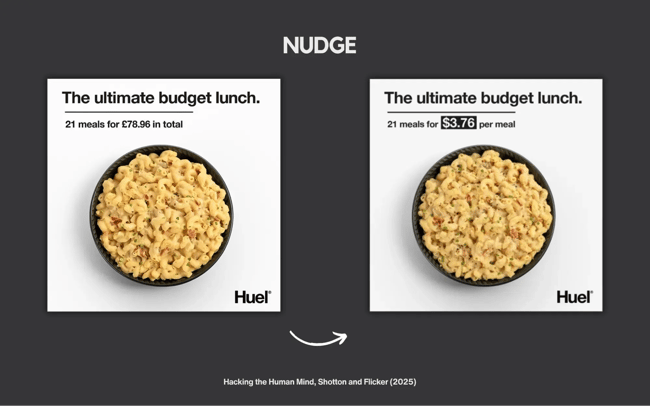
Another effective psychological pricing tactic involves breaking down the total cost of a product into smaller, more manageable units. This strategy mitigates “sticker shock” and reframes the overall expenditure as a series of smaller, more affordable purchases. Consider the contrasting advertisements for a budget lunch from Huel, a prominent meal replacement brand. One advertisement prominently displayed the total cost for 21 meals at £78.96. The alternative ad, however, broke down this total into a per-lunch price of $3.76. Studies consistently demonstrate that advertisements highlighting the price per unit outperform those showing only the aggregated cost.

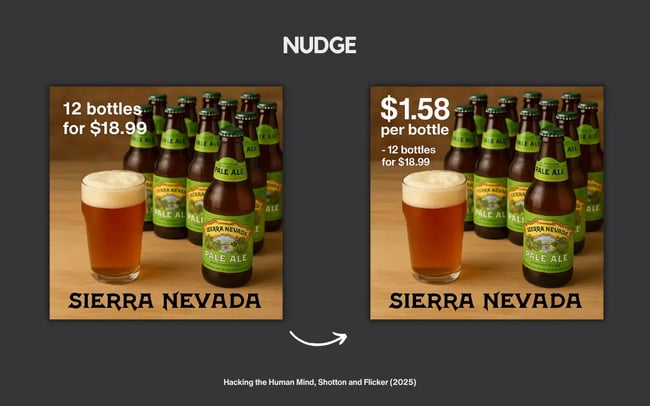
This phenomenon was rigorously tested and documented by Richard Shotton and Michael Aaron Flicker in their insightful book, Hacking the Human Mind. They conducted an experiment involving 282 shoppers, dividing them into two groups. The first group was presented with Sierra Nevada Pale Ale priced at $18.99 for a 12-pack. The second group received the same offer but with the price framed as $1.58 per bottle. The results were striking: 28.6% of those shown the per-bottle price rated it as “good” or “very good” value, a figure more than double the 13.7% who only saw the total price.
The psychological underpinnings of this strategy are rooted in cognitive ease and mental accounting. When faced with a large, aggregated price, consumers often experience a mental hurdle, perceiving the total as a significant outlay. By breaking it down into a per-unit cost, the price appears much smaller and more digestible, making the purchase feel more reasonable and affordable. It shifts the consumer’s focus from the large sum to a seemingly insignificant daily or individual cost, facilitating a quicker and more positive evaluation of the offer. This method is particularly effective for subscription services, bulk purchases, or products consumed regularly, as it allows customers to internalize the value in relation to their daily habits rather than a lump sum.
The Art of the Upsell: Highlighting Price Differences for Premium Choices
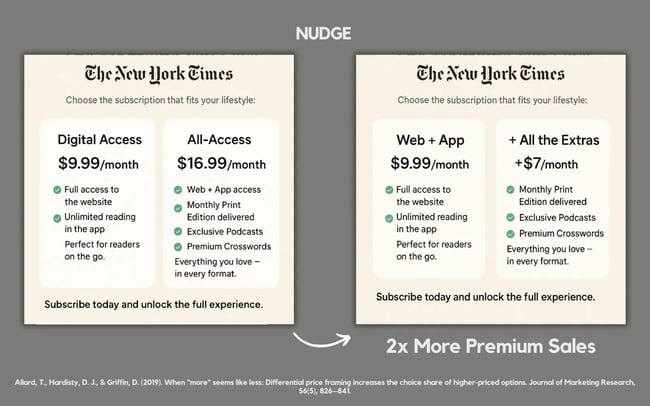
Businesses frequently aim to encourage customers to opt for premium versions of their products or services. The manner in which these upgraded options are presented plays a crucial role in influencing consumer choice. A 2019 experiment by David Hardisty at the University of British Columbia demonstrated the power of “differential price framing” in driving upsells, using New York Times subscriptions as a case study.
Hardisty divided participants into two groups, each presented with subscription options. Group A was shown two plans with their full prices: a “Web + App” subscription for $9.99/month and a “Web + App + All the Extras” premium plan for $17/month. Group B, however, saw the same products framed differently. The base “Web + App” plan was presented at $9.99/month, but the premium “All the Extras” plan was offered as an additional $7/month surcharge. Crucially, the total price for the premium plan remained $17/month in both scenarios.
Despite identical total costs, Group B chose the premium plan twice as often as Group A. This significant difference highlights how consumers perceive value when presented with incremental costs rather than absolute totals. Psychologically, $7 “extra” feels far easier to justify than an absolute price of $17. This effect is partly explained by loss aversion, where consumers are more sensitive to perceived losses than gains. Paying an additional $7 for extra features feels less like a loss than committing to a higher total price of $17 from the outset. It anchors the consumer’s perception to the lower base price and positions the upgrade as a small, incremental enhancement rather than a complete jump to a new, more expensive tier.
For companies seeking to boost sales of their premium offerings, the takeaway is clear: avoid displaying the full, higher price for upgrades. Instead, leverage differential price framing by emphasizing the surcharge—the incremental cost—of the premium features. This strategy makes the upgrade feel like a minor add-on rather than a substantial financial commitment, significantly increasing the likelihood of consumers opting for the higher-priced option.
Cultivating Trust Through Radical Cost Transparency
In an era of increasing consumer skepticism and demand for authenticity, price transparency has emerged as a powerful tool for building trust and driving sales. The concept of revealing the underlying costs of a product might seem counterintuitive, potentially exposing profit margins, yet research suggests it can dramatically improve perceived value and purchase intent. This strategy gained widespread attention following a viral LinkedIn post by Phill Agnew, showcasing an image comparing two chicken soup advertisements. One simply listed the price at $7.99, while the other meticulously detailed the cost of each ingredient, labor, and profit margin before arriving at the final price. The surprising results of the underlying research challenged conventional marketing wisdom.
Agnew’s post was based on a 2020 study from Harvard University, designed to empirically test the effects of making a product’s cost structure visible to consumers. The initial experiment was conducted in a Harvard canteen, allowing researchers to track actual purchasing behavior. When the detailed cost breakdown for the soup was displayed, sales surged by an impressive 21%.
The psychological mechanism at play here is multifaceted. Firstly, transparency fosters trust. In a market often perceived as opaque, consumers appreciate businesses that are open about their pricing. This openness reduces perceived exploitation and signals integrity. Secondly, it justifies the price. By itemizing the costs of ingredients and labor, consumers gain a deeper understanding of the effort, quality, and resources that contribute to the final price. This understanding validates the price point, making it feel more reasonable and less arbitrary. It combats the common consumer assumption that prices are inflated simply for profit. For products that are ethically sourced, handcrafted, or use premium ingredients, cost transparency can effectively communicate their inherent value and differentiate them from cheaper alternatives. The implication for businesses is that, in many contexts, openly sharing cost breakdowns can transform skepticism into trust, leading to increased customer loyalty and sales, particularly for brands that pride themselves on quality, ethical practices, or unique craftsmanship.
Overcoming Indecision: Making Subtle Differences Visible
A common challenge in consumer psychology is “decision paralysis” or “choice overload,” where too many identical or nearly identical options can lead to inaction. When faced with choices that offer no clear differentiator, consumers often find it difficult to justify picking one over the other, sometimes leading them to abandon the purchase altogether. A compelling South Korean study vividly illustrates this phenomenon.
In the experiment, participants were given the equivalent of ₩1,000 (approximately $1) and asked to choose between two identical packs of gum, each priced at ₩630. A surprising outcome was observed: only 46% of participants made a purchase, with more than half walking away without buying anything. The absence of a discernible difference between the two options led to significant hesitation and ultimately, non-purchase.
The researchers then introduced a crucial, yet subtle, modification. They adjusted the prices slightly: one pack of gum was priced at ₩620, while the other was priced at ₩640. This tiny 20-won difference had a dramatic effect on consumer behavior. With this slight differentiation, the purchase rate soared to 77%, representing a remarkable 31-point jump.
The psychological explanation lies in the human need for justification in decision-making. When two options are identical in every perceivable way, the brain struggles to find a rational basis for choosing one over the other. This cognitive friction creates discomfort and leads to avoidance. However, even a minor difference, such as a 20-won price variance, provides a tangible reason—however small—to favor one option. It gives the consumer a “hook” for their decision, alleviating the paralysis. This isn’t about one option being inherently superior, but about providing any discernible difference to enable a choice.
The practical application for businesses is vital: avoid offering perfectly identical choices, especially when a consumer is making a comparison. If you have products that are very similar, introduce a differentiating factor, even if minor. This could be a slight price adjustment, a small variation in packaging, a minuscule feature difference, or even a different promotional message. This subtle tweak can provide the necessary cognitive justification for consumers, turning potential indecision into a confirmed purchase.
Conclusion: The Enduring Power of Psychological Nudges
The collective insights from these diverse studies underscore a fundamental truth in marketing: pricing is far more than a simple numerical calculation. It is a nuanced psychological interaction between a business and its customers. The five strategies explored—leveraging the left-digit effect in discounts, breaking down prices into per-unit costs, framing upsells as incremental differences, practicing cost transparency, and creating subtle distinctions between similar options—all operate on the principle that small shifts in presentation can lead to dramatic changes in consumer perception and behavior.
None of these tactics involve altering the product itself or its fundamental value proposition. Instead, they focus entirely on the framing of the price. These “nudges” demonstrate the profound influence of cognitive biases and heuristics on purchasing decisions. By understanding and strategically applying these psychology-backed pricing methods, businesses can enhance the perceived value of their offerings, reduce decision friction, build trust, and ultimately drive higher conversion rates and sales. The ongoing imperative for marketers is to continually test and refine these approaches, recognizing that mastering the psychology of pricing is a powerful competitive advantage in today’s complex consumer landscape.









