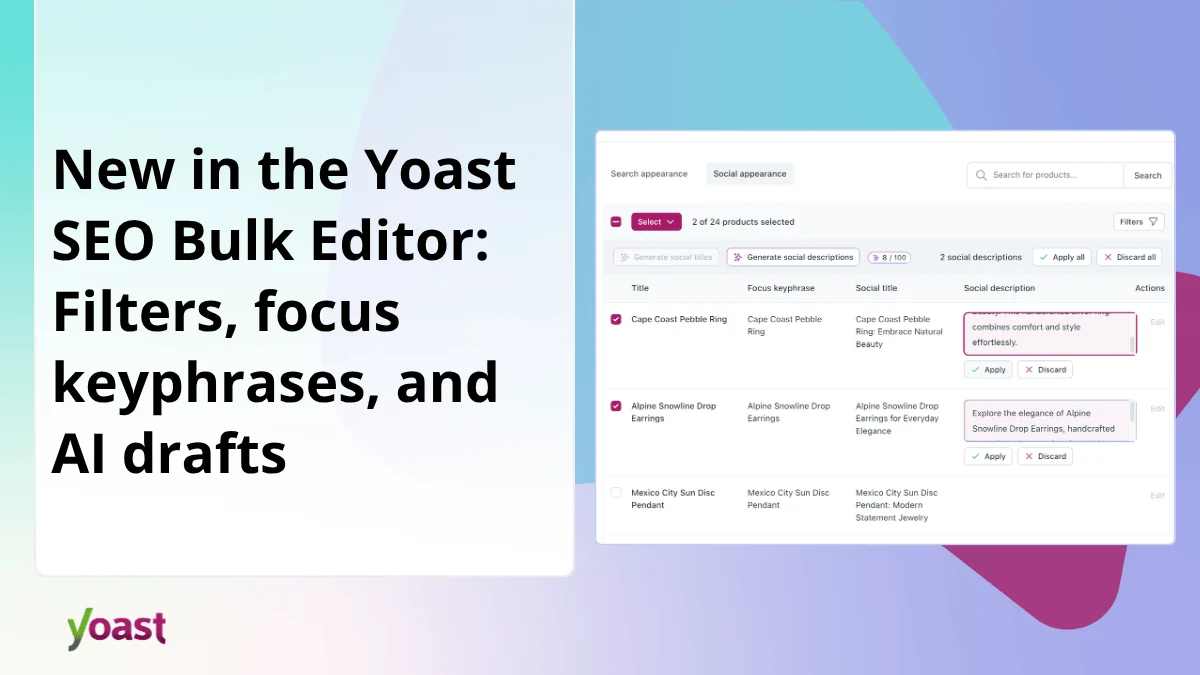
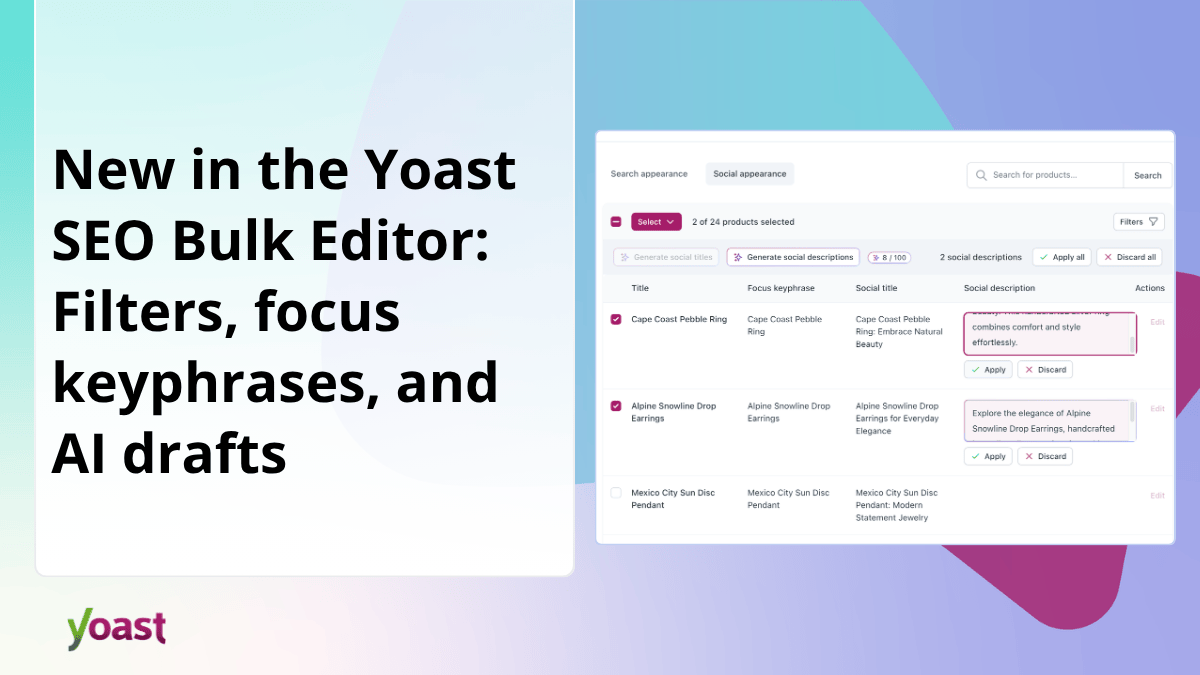
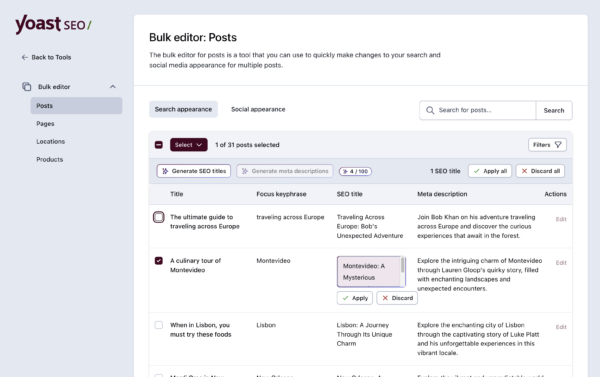
Utrecht, Netherlands – Yoast, a leading name in WordPress SEO solutions, has announced a significant overhaul of its Yoast SEO Bulk Editor, transforming it into a more comprehensive and efficient tool for website managers, content creators, and SEO professionals. The update introduces several pivotal features, including the integration of focus keyphrases, a suite of new search and status filters, dedicated editing views for various content types, and, for premium subscribers, an advanced AI-powered metadata drafting capability. This strategic enhancement aims to significantly reduce the manual effort involved in optimizing large websites, ensuring greater accuracy and consistency across diverse content portfolios, from blogs and informational pages to extensive e-commerce catalogs.
Revolutionizing SEO Workflow: A Deeper Dive into the Enhanced Bulk Editor
The core of this update lies in its commitment to addressing the persistent challenges associated with large-scale SEO management. Historically, updating SEO elements like titles and meta descriptions across hundreds or thousands of pages has been a labor-intensive and error-prone process. The previous iteration of the Yoast SEO Bulk Editor offered a centralized hub for these two crucial elements, but the latest release expands its utility dramatically by incorporating additional critical SEO parameters and intelligent automation.
A standout addition is the integration of focus keyphrases directly into the Bulk Editor interface. Focus keyphrases are the primary keywords or phrases that users aim to rank for with specific content pieces. Managing these effectively is paramount for search engine visibility. Prior to this update, users would typically need to navigate into each individual post or page editor to set or adjust their focus keyphrases. Now, webmasters can view, edit, and assign keyphrases in bulk, offering an unprecedented level of control and efficiency. This not only saves considerable time but also helps in maintaining a coherent keyword strategy across an entire website, preventing keyword cannibalization and ensuring each piece of content targets its intended audience effectively.
Furthermore, the updated editor introduces dedicated views for every content type. This means that posts, pages, products, and any custom post types (CPTs) now have their own distinct editing environments within the Bulk Editor. This segregation is particularly beneficial for websites with diverse content structures, such as news portals with articles, static pages, and author profiles, or e-commerce sites juggling product listings, category pages, and blog posts. Each content type often requires a specific SEO approach, and having dedicated views allows for more focused and less cluttered management, reducing the risk of errors and improving the overall user experience. This structural improvement reflects a deeper understanding of varied user needs, catering equally to publishers and online retailers.
Precision Filtering and Search Capabilities: Unearthing Optimization Opportunities
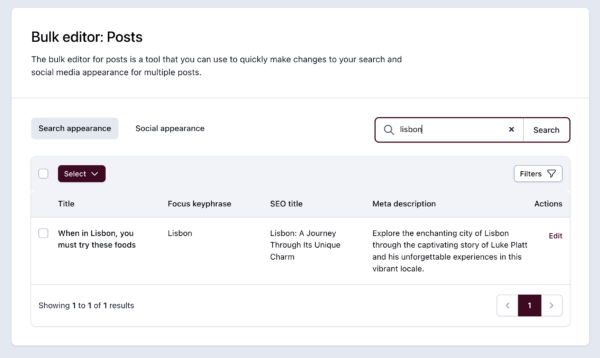
One of the most powerful aspects of the new Bulk Editor lies in its advanced search and status filters. In the realm of SEO, identifying which pages require attention is often as challenging as performing the optimizations themselves. The new filtering system allows users to quickly pinpoint content based on specific criteria. For instance, a user can now instantly filter to display:
- All pages missing a meta description.
- All posts currently in "draft" status.
- All pages targeting a specific keyphrase.
- Content with specific SEO scores (e.g., poor readability or SEO analysis).
This granular control enables webmasters to conduct targeted audits and execute rapid fixes. Instead of manually scrolling through extensive lists or opening individual pages, which can be an overwhelming task for sites with hundreds or thousands of URLs, these filters provide immediate access to actionable insights. The ability to identify "broken" or incomplete SEO elements in seconds and then rectify them in bulk represents a monumental leap in operational efficiency. This feature is particularly invaluable for website owners inheriting existing sites with potentially inconsistent or neglected SEO setups, offering the fastest route to establishing a solid SEO baseline.
The Dawn of AI-Powered Metadata: Efficiency Meets Editorial Control
Perhaps the most groundbreaking addition, available to subscribers of Yoast SEO Premium and higher plans, is the AI-drafted metadata functionality. This feature leverages artificial intelligence to generate suggested titles and meta descriptions for selected content pieces. The challenge of writing unique, compelling, and SEO-optimized metadata for every single page on a large website is immense, often leading to generic or duplicate descriptions which can negatively impact search performance.
With the AI drafting tool, users can select multiple content items that require metadata, and the AI will propose suitable titles and descriptions. Crucially, Yoast emphasizes user control in this process. Nothing is automatically saved without explicit approval. Users can review each AI-generated suggestion, apply it directly, tweak it to better fit their brand voice or specific objectives, or simply discard it. This per-row and batch apply/discard functionality, coupled with unsaved-changes warnings, instills confidence, allowing users to leverage the speed of AI without sacrificing quality or control. This hybrid approach – AI for initial heavy lifting, human for final approval – represents a significant step forward in democratizing advanced SEO tasks and making them accessible to a broader range of users, from solo bloggers to large marketing teams.
The AI drafting capabilities are not limited to standard posts and pages. For users with Yoast WooCommerce SEO and Yoast SEO AI+ plans, this intelligent automation extends to products and categories within online stores. This is a game-changer for e-commerce, where product catalogs can often run into tens of thousands of items, each requiring unique and optimized metadata to stand out in search results.
Background and Context: The Evolving Landscape of SEO and Yoast’s Role
Since its inception, Yoast SEO has been a cornerstone of the WordPress ecosystem, empowering millions of website owners to improve their search engine rankings. WordPress, which powers over 43% of all websites on the internet, relies heavily on plugins like Yoast SEO to provide robust SEO capabilities that are often missing from its core functionality. Yoast’s mission has consistently been to "SEO for everyone," making complex SEO principles understandable and actionable for non-experts.
The evolution of search engine algorithms, particularly those from Google, has continuously emphasized the importance of high-quality, relevant, and unique content, along with precise metadata. Titles and meta descriptions serve as a website’s first impression in search results, directly influencing click-through rates (CTR). A well-crafted meta description can entice users to click, even if the page isn’t the top result, while a poorly optimized one can lead to missed opportunities. Similarly, focus keyphrases are fundamental to signaling content relevance to search engines.
Over the years, as websites have grown in size and complexity, the manual management of these elements became increasingly unsustainable. SEO professionals and content managers often spent countless hours on repetitive tasks, diverting resources from more strategic initiatives. This new update from Yoast directly addresses these pain points, building upon its legacy of simplifying SEO. The integration of AI reflects a broader industry trend towards intelligent automation in marketing and content creation, acknowledging that human creativity and strategic oversight are best complemented by efficient technological support.
Implications for E-commerce: Scaling Product SEO
The e-commerce sector stands to benefit immensely from these updates. Maintaining complete and unique product metadata across a large catalog is arguably one of the most tedious and time-consuming tasks in online retail. Product pages, in particular, often suffer from generic descriptions or, worse, direct copies from manufacturers, which can severely penalize their search visibility.
The enhanced Bulk Editor, with its dedicated product view, allows e-commerce managers to quickly filter their entire catalog, identifying products missing descriptions, titles, or keyphrases. This means gaps in optimization can be spotted and addressed with unprecedented speed. When combined with the AI drafting capability (available with Yoast WooCommerce SEO and Yoast SEO AI+ plans), online stores can generate, review, and approve high-quality, unique catalog metadata at scale. This is especially critical in competitive markets and during seasonal peaks, where rapid optimization can mean the difference between capturing market share and being overlooked. By automating the initial draft, store owners can focus on refining the message, ensuring brand consistency, and ultimately driving more organic traffic and sales.
Expert Perspectives and Industry Outlook
While Yoast has not released specific statements from its leadership regarding this update at the time of reporting, the strategic direction is clear. Industry analysts suggest that this move solidifies Yoast’s position as a leader in the WordPress SEO plugin space by integrating cutting-edge AI capabilities while maintaining its core philosophy of user-friendly SEO.
Beth Parker, Product Marketing Manager at Yoast, whose role involves understanding user needs and market trends, is likely to have been instrumental in identifying the critical demand for such efficiency tools. The emphasis on streamlining workflows, reducing manual labor, and enhancing accuracy aligns perfectly with the evolving needs of digital marketing professionals.
The introduction of AI into a widely used SEO tool like Yoast SEO also signals a broader trend within the industry. As AI technologies become more sophisticated, their application in content generation, optimization, and analytics is expected to grow. This update positions Yoast at the forefront of this evolution, offering users not just tools, but intelligent assistants that augment their capabilities. The careful implementation, which prioritizes human oversight and final approval, is crucial for building trust and ensuring that AI serves as an enhancer rather than a replacement for strategic SEO expertise.
The implications extend beyond just efficiency gains. By making advanced SEO tasks more accessible and manageable, Yoast is empowering more websites, from small businesses to large enterprises, to compete effectively in search results. This could lead to a more diverse and vibrant online landscape, where optimization is less about brute-force manual labor and more about strategic application of intelligent tools.
Looking Ahead: The Future of SEO Automation
This comprehensive update to the Yoast SEO Bulk Editor represents more than just a feature release; it marks a significant evolution in how website optimization can be managed at scale. By integrating critical SEO elements like focus keyphrases, offering powerful filtering, and introducing AI-powered drafting, Yoast has delivered a tool that promises to save countless hours, reduce errors, and ultimately improve the search performance of millions of websites. As the digital landscape continues to evolve, the demand for smart, efficient, and user-centric SEO solutions will only grow, and Yoast appears well-positioned to meet these challenges with continuous innovation. The balance between automation and human control, as demonstrated in this release, is likely to be a defining characteristic of successful SEO tools in the years to come.