
Commercial email stands as a formidable pillar in modern digital marketing, boasting an impressive return on investment, with estimates ranging from $10 to $36 generated for every dollar spent. This significant ROI, however, is not a given; it is contingent upon campaigns successfully reaching their intended recipients, bypassing spam filters, rendering flawlessly across diverse devices and display modes, and adhering to a complex web of legal and technical requirements. The distinction between commercial and transactional email, far from being mere industry jargon, represents a critical differentiator for legal compliance, deliverability rates, and overall campaign efficacy. Understanding this nuanced landscape, from defining message intent to mastering technical execution, is paramount for email marketers aiming to transform potential into tangible results.
The Enduring Power of Email Marketing: A Historical Perspective and Current Landscape
Email marketing, often perceived as a veteran in the rapidly evolving digital space, has not only endured but thrived, consistently proving its worth as a cornerstone of communication strategies. Its journey began modestly in 1978 with Gary Thuerk’s unsolicited email to ARPANET users, which, despite its nascent form, generated $13 million in sales. This early success foreshadowed email’s potential, leading to its widespread adoption by businesses in the 1990s and early 2000s as the internet became more accessible. The subsequent decades saw a rapid evolution, from simple text-based messages to sophisticated, multimedia-rich campaigns, driven by advancements in email service provider (ESP) technology and data analytics.
Today, email’s enduring power stems from its direct, personalized nature and unparalleled reach. With over 4 billion global email users projected to grow to 4.6 billion by 2025, email remains an indispensable channel for direct customer engagement. Its cost-effectiveness compared to paid advertising channels, coupled with its ability to drive repeat purchases and foster customer loyalty, solidifies its position. Industry data consistently highlights email as a top driver of customer acquisition and retention, with many businesses attributing a significant portion of their online revenue directly to email campaigns. The average click-through rate for emails, while varying by industry, generally outperforms social media engagement rates, underscoring its direct impact on user action.
Defining the Boundaries: Commercial vs. Transactional Email
The legal and operational success of an email program hinges on a clear understanding of its purpose. According to the Federal Trade Commission’s (FTC) CAN-SPAM Act, a seminal piece of legislation enacted in the United States in 2003, a commercial email is defined as any message whose primary purpose is the advertisement or promotion of a commercial product or service. This definition forms the bedrock of compliance for U.S.-based entities and influences global standards.
Legal Foundation: The CAN-SPAM Act and Global Equivalents
The CAN-SPAM Act established national standards for the sending of commercial emails, granting recipients the right to stop receiving unwanted commercial messages. Key provisions include:

- Accurate Header Information: The "From," "To," and routing information must be accurate and identify the person or business initiating the message.
- No Deceptive Subject Lines: The subject line must accurately reflect the content of the message.
- Identification as an Advertisement: The email must clearly and conspicuously disclose that it is an advertisement.
- Physical Postal Address: Every commercial email must include the sender’s valid physical postal address.
- Clear Unsubscribe Mechanism: A clear and conspicuous way for recipients to opt out of future emails must be provided, typically a one-click unsubscribe link.
- Honoring Opt-Out Requests Promptly: Senders must honor opt-out requests within 10 business days.
Beyond CAN-SPAM, the global regulatory landscape has become increasingly stringent. The European Union’s General Data Protection Regulation (GDPR), implemented in 2018, sets a higher bar for consent, requiring explicit, unambiguous opt-in from users before sending any marketing communications. Similarly, Canada’s Anti-Spam Legislation (CASL), enacted in 2014, also mandates explicit consent and imposes strict requirements for electronic messages. Failure to comply with these regulations can result in substantial fines, reputational damage, and loss of sender reputation, directly impacting deliverability. Legal experts universally advise marketers to adopt the highest standard of compliance (often GDPR) as a baseline for all global operations to mitigate risks effectively.
Clear Distinction: The Primary Purpose Test
In contrast to commercial emails, transactional emails facilitate an agreed-upon transaction or relationship. Examples include order confirmations, shipping notifications, password resets, account statements, and customer service responses. These emails typically enjoy better deliverability rates because they are expected and often crucial for the user experience. The FTC employs a "primary purpose test" to differentiate: if the main goal of the email is to complete a commercial transaction that the recipient has already initiated or agreed to, it’s transactional. If the primary goal is to advertise or promote a product or service, it’s commercial.
The Hybrid Conundrum
Some emails, however, blur these lines, creating a "hybrid gray area." A common example is a purchase receipt that also includes a promotional coupon for a future purchase. In such cases, the FTC’s primary purpose test is applied rigorously. If the receipt’s main function is to confirm the transaction, the promotional element, even if present, doesn’t negate its transactional status. However, if the promotional content overshadows the transactional information, or if the email is primarily designed to drive a subsequent sale rather than confirm an existing one, it risks being classified as commercial, subjecting it to all the associated legal requirements. Misclassifying an email can lead to compliance violations, hefty fines, and damage to sender reputation. Industry analysts consistently highlight the importance of careful content review to avoid inadvertently crossing this critical threshold.
Strategic Pillars of Commercial Email Success: Types and Their Impact
Effective commercial email marketing is not a monolithic endeavor; it involves deploying different types of emails to achieve specific business outcomes. Mastering these variations allows marketers to craft a comprehensive strategy that nurtures leads, drives conversions, and builds lasting customer relationships.
Promotional Blasts: The Direct Conversion Engine
Often the most recognizable form of commercial email, promotional blasts are designed for immediate impact and direct conversion. They announce sales, new product launches, limited-time offers, or special discounts. These campaigns are the "sprint runners" of email marketing, built for speed and focused on a single, clear call to action (CTA). Data indicates that well-executed promotional emails can yield significant short-term revenue spikes, with average conversion rates for promotional emails often ranging from 1% to 5%, depending on the industry and offer. Success hinges on compelling subject lines, clear value propositions, visually appealing designs, and a sense of urgency or exclusivity.
Newsletters: Cultivating Long-Term Relationships
In contrast to the sprint of promotional blasts, newsletters are the "marathon runners." They focus on building long-term relationships and fostering loyalty by providing consistent value. Newsletters typically contain a mix of content, such as blog posts, company news, industry insights, educational resources, and soft promotions. They aim to keep subscribers engaged, informed, and connected to the brand. Research shows that segmented newsletters can achieve significantly higher open rates (up to 15% higher) and click-through rates than generic blasts, directly contributing to stronger customer loyalty and repeat business. The key to successful newsletters lies in delivering relevant, high-quality content on a consistent schedule, tailored to audience segments.
Retention and Re-engagement Campaigns: Winning Back Valued Subscribers
The retention/re-engagement email is the "comeback specialist" of commercial email. These campaigns target subscribers who have become inactive, haven’t opened emails in a while, or have abandoned their shopping carts. Their purpose is to prevent churn and reactivate dormant customers, a strategy often far more cost-effective than acquiring new ones. Studies suggest that retaining an existing customer can be five times cheaper than acquiring a new one. Re-engagement strategies include win-back series with exclusive offers, personalized recommendations, feedback requests, or surveys to understand disengagement. Effective re-engagement campaigns can recover a substantial portion of lapsed customers, with success rates varying but often proving a valuable investment.
Product Launches and Updates: Generating Excitement and Adoption
These emails serve as the "starting pistol" for new innovations or significant enhancements. Product launch emails build anticipation, educate potential customers about new features, and drive early adoption. They often follow a phased approach, starting with teaser campaigns, moving to detailed launch announcements, and concluding with follow-up emails that address FAQs or provide usage tips. For software companies, update emails are crucial for communicating new features, bug fixes, and improvements, encouraging users to leverage the latest functionality. Visual aids like videos, GIFs, and clear demonstrations of value are essential. Successful launch campaigns can significantly impact pre-order numbers and initial sales velocity.
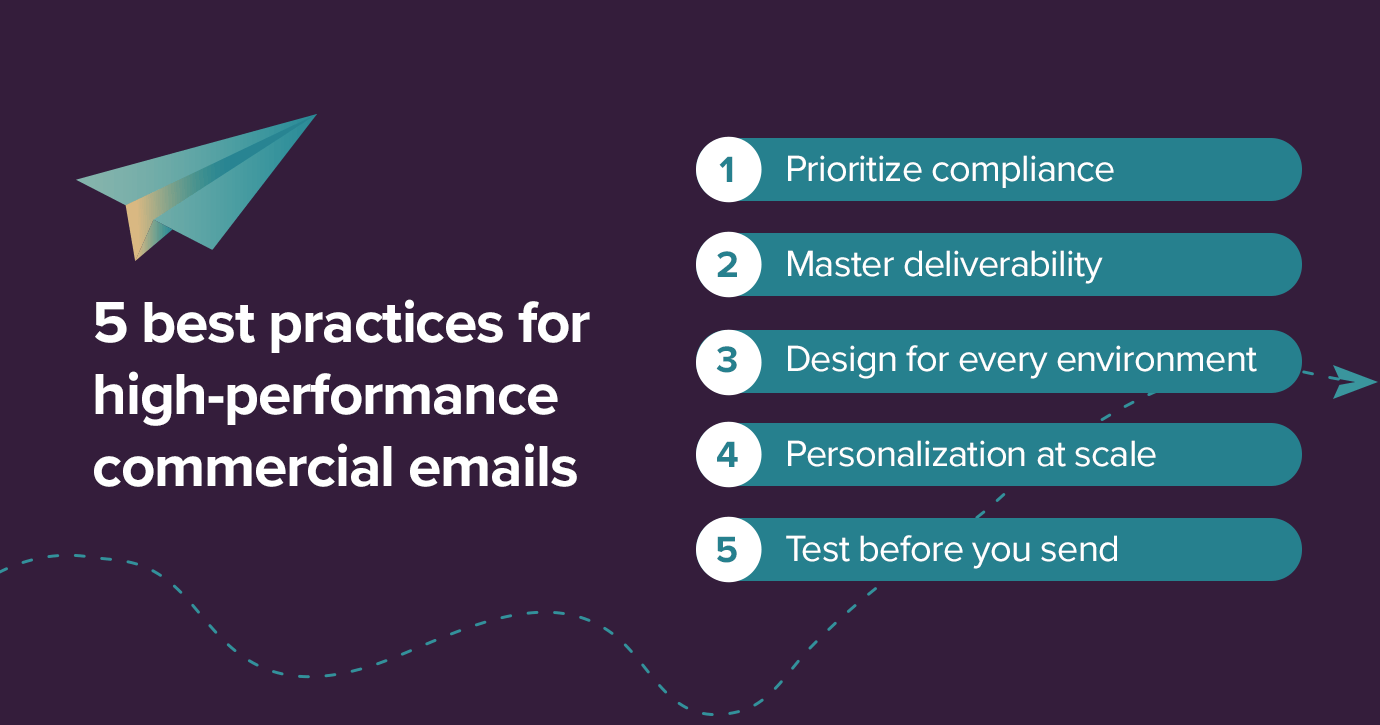
The Technical Imperatives: 5 Best Practices for High-Performance Commercial Emails
While strategic content and segmentation lay the groundwork, the ultimate success of commercial email hinges on meticulous technical execution. Neglecting these five best practices can derail even the most carefully crafted campaign, sending it straight to the spam folder or rendering it unreadable.
1. Unwavering Compliance: Navigating the Regulatory Landscape
Beyond simply avoiding penalties, prioritizing compliance builds trust. Every commercial email must rigorously adhere to the legal frameworks governing email communication in the recipient’s jurisdiction. This includes, but is not limited to, the CAN-SPAM Act, GDPR, and CASL. Critical elements mandated by these regulations include:
- Clear Sender Identification: The "From" field and subject line must accurately represent the sender and content.
- Physical Address: A valid physical business address must be included.
- Easy Unsubscribe Mechanism: A prominent, one-click unsubscribe link is mandatory, and opt-out requests must be honored within the legally specified timeframe (e.g., 10 business days for CAN-SPAM).
- Consent Management: Especially under GDPR and CASL, demonstrable, explicit consent for receiving marketing communications is crucial. This means avoiding pre-checked boxes and ensuring clear records of when and how consent was obtained.
Transparent and honest email practices signal legitimacy to recipients and Internet Service Providers (ISPs), directly enhancing sender reputation and improving deliverability. The implications of non-compliance are severe, ranging from substantial financial penalties (e.g., up to $50,120 per email under CAN-SPAM, or up to €20 million or 4% of global annual turnover under GDPR) to irreparable brand damage and blacklisting by major email providers. Legal experts universally advise that proactive compliance is not just a legal necessity but a strategic business imperative.
2. Mastering Deliverability: The Gateway to the Inbox
Email deliverability is not merely about sending a message; it’s about ensuring that message lands in the subscriber’s primary inbox, visible and ready for engagement. ISPs and Mailbox Providers (MBPs) continuously assess every sender’s reputation based on a multitude of signals, including engagement rates, complaint rates, and list hygiene. This dynamic reputation score dictates whether an email is delivered, filtered to spam, or blocked entirely.
To earn and maintain inbox placement, several technical and strategic elements are crucial:
- Email Authentication: SPF (Sender Policy Framework), DKIM (DomainKeys Identified Mail), and DMARC (Domain-based Message Authentication, Reporting & Conformance) are foundational. These protocols verify the sender’s identity, preventing spoofing and phishing, and are increasingly mandatory for major providers like Google and Yahoo. Implementing these correctly proves legitimacy and is a prerequisite for good deliverability.
- Engagement Metrics: ISPs closely monitor how recipients interact with emails. Low open rates, click-through rates, or high delete-without-opening rates signal disinterest, negatively impacting sender reputation. Regularly re-engaging or suppressing inactive subscribers is vital to maintain a healthy list and positive engagement signals.
- Complaint Rates: Every "Report Spam" click is a significant negative signal. Maintaining complaint rates below 0.1% is critical. High complaint rates often point to issues with list acquisition practices (e.g., purchased lists), confusing opt-out processes, or excessive send frequency.
- List Hygiene: A clean, validated email list is non-negotiable. Hard bounces (permanent delivery failures), spam traps (email addresses used by ISPs to identify spammers), and role-based addresses (like info@ or admin@) all severely damage sender reputation. Regular list cleaning and validation are essential.
- Send Consistency and IP Warming: Sudden, drastic increases in email volume from a new or previously low-volume sender appear suspicious to ISPs. Gradual "IP warming" — incrementally increasing send volume over time — allows MBPs to recalibrate and trust the new sending pattern.
- Separate Subdomains/Dedicated IPs: For businesses sending both commercial and transactional emails, using separate subdomains or dedicated IP addresses for each type is a best practice. This compartmentalizes sender reputation, ensuring that a struggling commercial campaign does not negatively impact the deliverability of critical transactional messages (e.g., order confirmations).
Industry reports indicate that average global deliverability rates hover around 85-90%, meaning a significant percentage of emails never reach the inbox. Robust authentication and adherence to these best practices are crucial for surpassing this average.
3. Designing for Ubiquity: Adapting to Diverse Environments
Modern email consumption occurs across an astonishing array of devices, screen sizes, and display modes. An email that renders perfectly in one environment can be completely broken in another, leading to a poor user experience and potential loss of conversion.
- Dark Mode Optimization: The increasing popularity of dark mode interfaces poses a unique challenge. Email designs can "break" with invisible text (if text color matches dark background), logos disappearing (if lacking transparent backgrounds or proper contrast), or color schemes clashing. Implementing specific CSS techniques, such as
@media (prefers-color-scheme: dark)queries, and designing with contrast in mind are essential. Testing emails in both light and dark modes across various email clients (e.g., Outlook, Gmail, Apple Mail) is non-negotiable. - Mobile Responsiveness: With over 50% of emails opened on mobile devices, mobile-first design is paramount. This includes:
- Single-column layouts: Simplifies content flow on small screens.
- Large, touch-friendly CTAs: Buttons should be at least 44×44 pixels to be easily tappable.
- Thumb-friendly button placement: Position buttons where they are easily reached.
- Responsive images: Images should scale appropriately without breaking the layout.
- Legible font sizes: Ensure text is readable without requiring zooming.
Thorough testing across a spectrum of devices (smartphones, tablets) and email clients is critical. An email that looks pristine on a desktop in light mode might be completely unusable on a mobile device in dark mode, underscoring the need for comprehensive pre-send checks.
4. Personalization at Scale: Beyond the Name Tag
While a simple "Hi [Name]" was once considered personalization, modern consumers expect far more sophisticated and relevant experiences. Personalization at scale leverages data to tailor email content, offers, and even send times to individual preferences and behaviors.
- Data-Driven Segmentation: Moving beyond basic demographics, advanced personalization utilizes rich customer data:
- Purchase history: Recommending complementary products or reminding of past purchases.
- Browsing behavior: Sending emails based on viewed but unpurchased items (e.g., cart abandonment reminders).
- Engagement patterns: Tailoring content frequency or type based on past opens and clicks.
- Geographic location: Promoting local events or store-specific offers.
- Dynamic Content Blocks: Utilizing email templates that dynamically populate content based on recipient data allows for highly customized experiences without manually creating thousands of unique emails.
- Advanced Techniques: AI-driven product recommendations, real-time content updates (e.g., showing current stock levels), and predictive analytics (forecasting future needs) represent the cutting edge of personalization.
The benefits are substantial: personalized emails generate, on average, 6 times higher transaction rates and achieve significantly higher open and click-through rates compared to generic messages. Starting with behavioral triggers (like cart abandonment) and gradually scaling to more sophisticated segmentation often yields the best results, proving that even basic behavioral personalization can outperform demographic segmentation alone.
5. Rigorous Pre-Send Testing: The Quality Assurance Checkpoint
The complexity of email clients, devices, and display modes means that what looks perfect in an email builder can be disastrous in a subscriber’s inbox. Broken links, rendering glitches, and formatting inconsistencies across 100+ email clients are real risks that can severely damage brand credibility and campaign effectiveness.
- The Imperative: A single rendering issue can turn a carefully crafted commercial email into an unreadable mess, leading to unsubscribes, spam complaints, and lost revenue. Pre-send testing is the critical quality assurance checkpoint.
- Comprehensive Testing Scope: Effective testing encompasses:
- Email Client Previews: Verifying rendering across all major email clients (Gmail, Outlook, Apple Mail, Yahoo, etc.) and devices (desktop, mobile, tablet) in both light and dark modes.
- Link Validation: Ensuring all links are functional and direct to the correct landing pages.
- Subject Line & Preheader Text Optimization: Testing different variations for maximum open rates and checking for spam filter triggers.
- Accessibility Checks: Ensuring emails are readable for users with disabilities (e.g., sufficient color contrast, proper alt text for images).
- Spam Filter Analysis: Identifying potential red flags that could cause an email to be routed to the junk folder.
- CTA Clickability: Confirming that calls to action are prominent and easily clickable across all environments.
Tools like Litmus provide comprehensive email testing platforms, allowing marketers to preview campaigns across a vast array of environments before hitting "send." This proactive approach safeguards brand reputation, ensures message clarity, and maximizes the potential ROI of every commercial email.
The Broader Implications: Trust, Reputation, and Sustainable Growth
The journey to commercial email mastery is a continuous one, requiring a blend of strategic foresight and meticulous technical execution. The impressive ROI figures associated with email marketing are not merely theoretical; they are the tangible rewards for campaigns that prioritize compliance, excel in deliverability, adapt to diverse design environments, personalize content effectively, and undergo rigorous pre-send testing.
Ultimately, these best practices converge to build an invaluable asset: trust. When emails consistently arrive in the inbox, are visually appealing, relevant, and respect user privacy, they cultivate trust with subscribers. This trust, in turn, translates into higher engagement, increased conversions, and ultimately, sustainable business growth. Neglecting any of these elements risks eroding sender reputation, falling foul of regulatory bodies, and diminishing the effectiveness of what should be one of the most powerful tools in a marketer’s arsenal. By embracing these technical imperatives, businesses can transform their commercial email programs from a mere communication channel into a high-performance revenue engine.