Commercial email generates an impressive return on investment, with reports indicating figures ranging from $10 to $36 for every dollar spent. This substantial ROI underscores email marketing’s continued vitality as a revenue driver, yet its efficacy hinges critically on whether meticulously crafted campaigns successfully navigate the complex digital landscape to reach the intended inbox, rather than being diverted to the dreaded spam folder or rendered dysfunctional by varying display environments like dark mode. This article delves into the intricacies of commercial email, clarifying its legal distinctions, exploring impactful types, and outlining the technical best practices that differentiate industry champions from those whose efforts are lost in the digital ether.
The Enduring Power of Commercial Email: A Historical Perspective
Email, one of the earliest forms of digital communication, rapidly evolved from a purely interpersonal tool to a powerful marketing channel. Its commercial application gained significant traction in the mid-1990s, offering businesses a direct, scalable, and cost-effective way to reach customers. However, this growth was not without its challenges. The proliferation of unsolicited bulk email, or "spam," quickly became a major concern, eroding user trust and threatening the viability of email as a legitimate communication medium.
In response to widespread public outcry and the detrimental impact of spam on internet users and service providers, governments began to enact legislation. The United States Congress passed the Controlling the Assault of Non-Solicited Pornography And Marketing (CAN-SPAM) Act in 2003, a landmark piece of legislation designed to establish a national standard for the sending of commercial email. This act, enforced by the Federal Trade Commission (FTC), defined what constitutes commercial email and set strict rules for senders, including requirements for identification, opt-out mechanisms, and honest representation. Globally, other regulations like the General Data Protection Regulation (GDPR) in Europe, enacted in 2018, further tightened requirements around consent and data privacy, adding layers of complexity and necessity to compliant email marketing practices. These legislative responses marked a pivotal shift, moving email marketing from an unregulated free-for-all to a domain requiring careful adherence to legal and ethical standards, thereby laying the groundwork for its continued legitimacy and impressive ROI. Despite the rise of social media and other digital channels, email’s directness, personalization potential, and proven conversion rates ensure its enduring relevance, with the global email marketing market projected to reach over $17.9 billion by 2027, according to recent industry analyses.
Defining the Digital Divide: Commercial vs. Transactional Email
Understanding the precise definition of "commercial email" is not merely academic; it is foundational for legal compliance and successful deliverability. The Federal Trade Commission’s CAN-SPAM Act explicitly defines commercial email as "any electronic mail message the primary purpose of which is the commercial advertisement or promotion of a commercial product or service." This legal bedrock dictates the rules governing your campaigns and is paramount for maintaining a positive sender reputation.
The distinction between commercial and transactional emails, while sometimes nuanced, is critical. Transactional emails are those whose primary purpose is to facilitate an agreed-upon commercial transaction or to update a customer about an ongoing relationship. Examples include order confirmations, shipping notifications, password reset links, account statements, and customer support responses. These emails are generally expected by the recipient and are often exempt from certain CAN-SPAM requirements, such as the prominent unsubscribe link, although best practices still advocate for clear communication. Because they are anticipated and typically contain essential information, transactional emails generally enjoy significantly higher open rates and deliverability compared to their commercial counterparts.
The "hybrid gray area" emerges when an email contains elements of both. Consider a purchase receipt that also includes a promotional coupon code for a future purchase. In such cases, the FTC applies the "primary purpose test." If the main intent of the email is to confirm the purchase (an agreed-upon transaction), it is considered transactional, even if it contains a secondary promotional element. However, if the promotional aspect becomes the dominant message, designed primarily to drive another sale rather than merely confirming the initial one, the email would then be classified as commercial and subject to all CAN-SPAM regulations. Misclassifying an email can have severe consequences, including significant fines and damage to sender reputation, making a clear understanding of this distinction indispensable for email marketers.
Architecting Success: Key Commercial Email Types and Their Strategic Roles
Mastering commercial email marketing involves more than just sending messages; it requires a strategic understanding of different email types and their specific objectives. Each type serves a distinct purpose in the customer journey, from initial engagement to long-term loyalty.

Promotional Blasts: These are the high-impact, short-term drivers designed to elicit immediate action. Think flash sales, limited-time offers, new product announcements, or seasonal promotions. They are characterized by urgency, clear calls-to-action (CTAs), and often a direct focus on conversion. While powerful for driving quick sales, over-reliance or poor targeting of promotional blasts can lead to list fatigue and increased unsubscribe rates. Their effectiveness is maximized when sent to segmented audiences who have shown prior interest in similar products or services, ensuring relevance and minimizing annoyance. Industry data suggests that well-timed and relevant promotional emails can see conversion rates upwards of 1-3%, significantly contributing to short-term revenue goals.
Newsletters: In stark contrast to the sprint of a promotional blast, newsletters embody the marathon strategy of relationship building. Their purpose extends beyond immediate sales, focusing on delivering value, nurturing subscriber relationships, and establishing brand authority. Newsletters typically contain a mix of curated content such as blog posts, industry insights, company news, expert tips, and sometimes soft product mentions. They aim to keep the brand top-of-mind, educate the audience, and foster a sense of community. Consistency in sending (e.g., weekly or monthly) and a strong emphasis on providing genuine value are critical for newsletter success, leading to higher long-term engagement and customer loyalty. Research indicates that companies with effective newsletter strategies often report higher brand recall and customer lifetime value.
Retention and Re-engagement Emails: These campaigns are the comeback specialists, designed to prevent churn and reactivate dormant subscribers. In an era where customer acquisition costs are rising, retaining existing customers is often more cost-effective. Retention emails might include loyalty program updates, personalized recommendations based on past purchases, or exclusive content for long-standing customers. Re-engagement emails target subscribers who haven’t opened or clicked an email in a specified period (e.g., 60-90 days). These often use compelling subject lines, special offers, or requests for updated preferences to reignite interest. The goal is to re-establish connection and prevent these subscribers from becoming completely disengaged, which can negatively impact sender reputation if they remain on the active mailing list. Studies show that a 5% increase in customer retention can lead to a 25% to 95% increase in profits, underscoring the financial importance of these campaigns.
Product Launch and Update Emails: These campaigns are the ceremonial "starting pistol" for a brand’s latest innovations. They build anticipation, educate the audience about new offerings, and drive initial adoption. A typical product launch sequence might include teaser emails, announcement emails with detailed features and benefits, and follow-up emails addressing frequently asked questions or showcasing use cases. Update emails, while less dramatic, are equally crucial for keeping existing customers informed about improvements, new features, or critical changes to products and services they already use. These maintain user satisfaction and encourage continued engagement, particularly important for software-as-a-service (SaaS) companies or products with evolving functionalities. A well-orchestrated launch campaign can generate significant buzz and early sales, leveraging the existing subscriber base as early adopters and brand advocates.
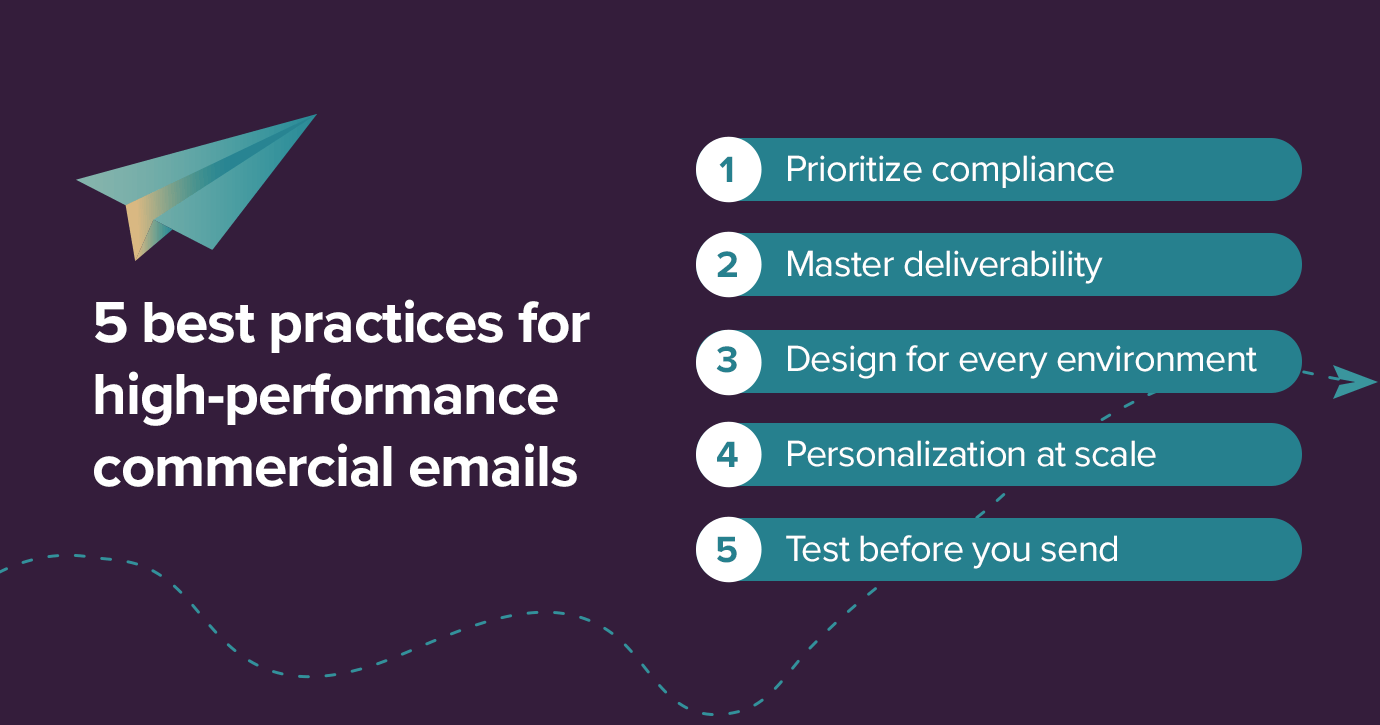
Navigating the Inbox Labyrinth: Five Pillars of High-Performance Commercial Email
Strategy sets the course, but meticulous execution wins the race in email marketing. Achieving high performance requires adherence to foundational best practices that ensure deliverability, engagement, and legal compliance.
1. Unwavering Commitment to Legal Compliance
Compliance is not merely a legal obligation; it is the bedrock of trust between a brand and its subscribers. The CAN-SPAM Act, along with international regulations like GDPR and Canada’s Anti-Spam Legislation (CASL), mandates several critical requirements for commercial emails. Every message must clearly include your physical business address, providing transparency and accountability. A conspicuous, one-click unsubscribe mechanism is also non-negotiable, allowing recipients to easily opt out. This requirement is increasingly emphasized by major mailbox providers (MBPs) like Google and Yahoo, who now penalize senders who make unsubscribing difficult. Furthermore, the "from" name and subject line must accurately reflect the content and sender, avoiding deceptive practices. Senders are legally required to honor unsubscribe requests within 10 business days. Beyond these specific mandates, GDPR and CASL impose stricter consent requirements, often necessitating explicit opt-in from subscribers before any commercial communication can be sent. Non-compliance carries severe penalties, including fines up to $50,120 per individual email for CAN-SPAM violations, alongside irreparable damage to sender reputation and deliverability. By prioritizing compliance, businesses demonstrate respect for their subscribers’ privacy and preferences, fostering trust that directly translates into improved engagement rates and a healthier email ecosystem.
2. Mastering the Art of Deliverability
Email deliverability is the ultimate gatekeeper, determining whether your meticulously crafted message lands in the inbox, the spam folder, or is blocked entirely. Mailbox providers continuously assess every sender’s reputation based on a multitude of signals, including recipient engagement, complaint rates, and list hygiene. A strong sender reputation is invaluable, granting access to the primary inbox, while a poor one relegates emails to obscurity.
Authentication protocols are the first line of defense. SPF (Sender Policy Framework), DKIM (DomainKeys Identified Mail), and DMARC (Domain-based Message Authentication, Reporting & Conformance) are no longer optional but table stakes. These protocols verify that an email originates from the domain it claims to be from, significantly reducing phishing and spoofing. MBPs heavily weigh authentication in their filtering decisions, and recent updates from giants like Google and Yahoo have made DMARC enforcement a near-universal requirement for bulk senders.
However, authentication alone cannot salvage a poor reputation. Genuine engagement is paramount. Low open and click rates signal to MBPs that recipients do not value your mail, prompting them to filter it more aggressively. Marketers must actively re-engage or suppress subscribers who have not interacted with emails for an extended period, rather than continuously mailing them into disinterest. Complaint rates are another critical metric; every spam complaint erodes sender standing. A complaint rate exceeding 0.1% is a red flag, often indicating issues with list acquisition quality (e.g., purchased lists, misleading sign-up forms) or excessive sending frequency, rather than content problems. Regular list hygiene is non-negotiable. Hard bounces (permanent delivery failures), spam traps (email addresses used to identify spammers), and role-based addresses (like info@ or admin@) all severely damage reputation. Regular list validation and the prompt removal of unengaged or invalid addresses are crucial. Finally, send consistency is vital. Sudden spikes in email volume can trigger MBP spam filters, as they mimic suspicious activity. Senders planning large campaigns should gradually "warm up" their sending infrastructure, incrementally increasing volume to allow MBPs to adjust and build trust. For optimal performance and risk management, using separate subdomains or dedicated IP addresses for commercial and transactional emails ensures that any deliverability issues with promotional campaigns do not impact critical transactional communications.
3. Designing for a Universal Digital Canvas
The modern email environment is diverse, encompassing a myriad of devices, operating systems, and display preferences. Designing commercial emails that perform flawlessly across this spectrum is a significant challenge.
Dark Mode Optimization: The rise of dark mode, a user preference for a darker color scheme, has introduced a new layer of complexity. Emails not optimized for dark mode can suffer from invisible text (e.g., black text on a dark background), disappearing logos, or jarring color inversions that undermine brand aesthetics and readability. The solution involves specific CSS techniques, such as @media (prefers-color-scheme: dark) queries, to define distinct styles for dark mode. This includes specifying light colors for text and backgrounds, ensuring image assets (like logos) have transparent backgrounds or dual-logo approaches, and thoroughly testing how brand colors render.
Mobile Responsiveness: With a substantial majority of emails now opened on mobile devices (often exceeding 60-70% according to market research), mobile responsiveness is non-negotiable. Designs must adapt seamlessly to smaller screens. This typically involves single-column layouts, larger font sizes for readability, generous spacing, and "thumb-friendly" button placement. Touch targets for calls-to-action should be at least 44×44 pixels to prevent accidental clicks. Mobile-first design principles, where the email is initially designed for mobile and then adapted for desktop, often yield the best results. Comprehensive testing across various mobile devices and email clients (e.g., iOS Mail, Android Gmail, Outlook Mobile) is essential to catch rendering issues. An email that looks perfect on a desktop in light mode could be completely unusable on a mobile device in dark mode, underscoring the need for exhaustive testing of every critical combination.
Accessibility: Beyond dark mode and mobile, designing for accessibility ensures emails are usable by everyone, including individuals with disabilities. This involves using semantic HTML, providing descriptive alt text for images, ensuring sufficient color contrast, and designing for keyboard navigation. An accessible email not only broadens reach but also reinforces a brand’s commitment to inclusivity.
4. The Power of Personalization and Segmentation
Moving beyond the rudimentary "Hi [Name]" greeting, advanced personalization and segmentation transform generic messages into highly relevant and engaging communications. This shift is critical as consumers increasingly expect tailored experiences.
Advanced Personalization: Modern email platforms allow for dynamic content blocks that adapt based on individual subscriber data. This can include product recommendations driven by past purchase history or browsing behavior, personalized offers based on loyalty program status, or even localized content based on geographic data. For instance, a frequent buyer of athletic shoes could receive emails showcasing new running gear, while a customer who abandoned a specific product in their cart could receive a reminder email with a small discount. The integration of AI and machine learning further refines personalization, enabling predictive analytics to anticipate customer needs and optimize send times based on individual engagement patterns. Data consistently shows that personalized emails generate higher open rates (up to 26% higher) and significantly boost transaction rates (up to 6x higher) compared to non-personalized emails.
Sophisticated Segmentation: Effective personalization relies on robust segmentation. Instead of sending the same message to an entire list, marketers segment their audience into smaller, more homogeneous groups based on shared characteristics or behaviors. Common segmentation criteria include demographics (age, location), psychographics (interests, values), purchase history (first-time buyers, high-value customers, product categories), engagement levels (active, inactive, infrequent openers), and behavioral triggers (cart abandonment, browse abandonment, content downloads). The key is to start simple, perhaps with behavioral triggers like welcome series for new subscribers or cart abandonment emails, and then progressively scale to more complex, multi-layered segmentation strategies. Even basic behavioral segmentation typically outperforms broad demographic targeting, leading to more relevant messaging and ultimately, higher conversions and customer satisfaction.
5. Rigorous Pre-Send Testing: The Quality Assurance Gateway
The complexity of the email ecosystem, with over 100 different email clients and devices, makes pre-send testing an indispensable step in any high-performance commercial email strategy. The risk of broken links, rendering inconsistencies, formatting errors, or accidental spam trigger words is substantial, and any single issue can undermine an entire campaign.
The Perils of Untested Emails: A carefully crafted email that appears perfect in an email builder might break in a subscriber’s inbox. Images might not load, text might overlap, calls-to-action might be unclickable, or the email might simply fail to render correctly in a specific client or on a particular mobile device. Such failures not only lead to lost conversion opportunities but also significantly damage brand credibility and subscriber trust. A user receiving a broken email is less likely to engage with future communications and more likely to mark them as spam, further harming sender reputation.
Comprehensive Testing Protocols: Modern email testing platforms allow marketers to preview their emails across a vast array of clients and devices before hitting send. This includes checking how emails render in various versions of Outlook, Gmail, Apple Mail, and others, both on desktop and mobile, and critically, in both light and dark modes. Beyond visual rendering, testing should encompass:
- Link Validation: Ensuring all hyperlinks are correct, functional, and lead to the intended destination.
- Call-to-Action (CTA) Functionality: Verifying that buttons and clickable areas are responsive and appropriately sized across all environments.
- Subject Line and Preheader Text Optimization: Testing how these elements appear in different inboxes and using tools to identify potential spam filter triggers within the copy.
- Accessibility Checks: Confirming alt text is present for images, color contrast is adequate, and the email structure is navigable.
- Spam Filter Analysis: Running emails through spam filter tests to identify and rectify content or coding issues that might flag the message as spam.
By integrating rigorous pre-send testing into the workflow, marketers can proactively identify and rectify issues, ensuring every commercial email delivered is a flawless, high-performing communication that maximizes engagement and ROI.
The Broader Implications for Business and Consumer Trust
The strategic application of these commercial email best practices extends far beyond individual campaign performance; it has profound implications for overall business health and consumer trust. Companies that excel in email marketing build stronger, more resilient brands. Effective email communication fosters loyalty, significantly increasing customer lifetime value (CLTV), which is a key metric for sustainable growth. When customers consistently receive relevant, well-designed, and compliant emails, their trust in the brand deepens, leading to repeat purchases and positive word-of-mouth referrals.
Conversely, neglecting these best practices can lead to tangible financial losses through missed sales, higher customer churn, and potential regulatory fines. Beyond the immediate impact, a consistently poor email experience erodes brand perception, making it harder to acquire new customers and retain existing ones. In a competitive digital landscape, a sophisticated and ethical email marketing strategy provides a significant competitive advantage, enabling businesses to forge deeper connections with their audience that other channels struggle to replicate.
The future of commercial email will likely see even greater integration of artificial intelligence for hyper-personalization, advanced segmentation, and automated optimization of send times and content. Interactive email elements, allowing users to engage directly within the inbox, are also on the horizon. However, as technology advances, the foundational principles of compliance, deliverability, thoughtful design, personalization, and rigorous testing will remain immutable.
Conclusion
Commercial email stands as a powerful, high-ROI revenue driver when executed with strategic foresight and technical precision. The distinction between commercial and transactional messages, adherence to compliance frameworks like CAN-SPAM, and the strategic deployment of various email types are critical first steps. However, it is the unwavering commitment to the five pillars of high-performance email—prioritizing compliance, mastering deliverability, designing for every environment, leveraging personalization at scale, and conducting rigorous pre-send testing—that truly separates industry leaders from those whose campaigns falter. These best practices are not merely suggestions but essential mandates for achieving the coveted ROI and securing a lasting presence in the subscriber’s inbox. By embracing these principles, businesses can transform their email marketing efforts into a highly effective engine for growth, customer engagement, and sustained competitive advantage.