
The digital marketing landscape has undergone a profound transformation, elevating social media from a peripheral engagement channel to a critical component of business strategy. In this evolving environment, understanding and effectively measuring Social Media Return on Investment (ROI) has become an indispensable practice for organizations seeking to justify expenditures, optimize campaigns, and drive tangible business outcomes. Social media ROI encapsulates the value a business derives from its social media marketing and advertising efforts, comparing the resources invested—including costs, time, and effort—against the resulting gains, which can be both monetary and non-monetary.
The Evolving Landscape of Social Media Accountability
Historically, social media marketing was often perceived through the lens of "vanity metrics" such as likes, shares, and follower counts. While these indicators offered a glimpse into audience engagement, they frequently fell short of demonstrating direct business value. However, as digital advertising budgets swelled and social platforms matured into sophisticated commerce and communication hubs, the demand for concrete accountability intensified. Marketing departments, now integral to revenue generation, face increasing pressure from executive stakeholders to provide clear, data-backed evidence of social media’s contribution to the bottom line. This shift marks a significant evolution, demanding a more rigorous, analytical approach to social media strategy and performance evaluation.

According to recent industry insights, a significant majority of marketers, approximately 68%, express concern over their ability to definitively prove ROI from their social efforts. This sentiment underscores the inherent challenges in attributing value in a complex, multi-touch digital ecosystem. Yet, the potential rewards are immense. Projections from Statista indicate that the global social commerce market is set to generate a staggering $908.5 billion in 2026, marking a 10.7% year-over-year increase. By 2028, purchases facilitated through social media channels are anticipated to surpass the $1 trillion mark. With nearly 5.75 billion social media users projected worldwide by 2026, these platforms represent an undeniable economic force, making effective ROI measurement not just a best practice, but a strategic imperative. For enterprise teams, robust ROI proof is the bedrock upon which sustained social investment and budget defense are built, demonstrating how social initiatives directly support revenue growth, customer acquisition, and overall business resilience. Data further supports this, with 46% of marketers acknowledging that strategic social media usage directly correlates with improved sales, alongside critical benefits like increased website traffic, brand exposure, and lead generation.
Navigating the Complexities: Key Challenges in Measuring Social ROI
Despite the undeniable importance, accurately measuring social media ROI is fraught with complexities. Social media rarely operates in isolation, meaning its contributions are often intertwined with other marketing channels, making clean, last-click attribution difficult. Understanding these common roadblocks is crucial for developing a robust measurement strategy.
One primary challenge lies in multi-touch attribution across channels. The customer journey in today’s digital age is rarely linear. A potential customer might first encounter a brand through an Instagram post, later receive an email promotion, engage with a paid search ad, and finally convert. In single-touch attribution models, such as last-click, social media’s early influence is often overlooked. This can lead to an underestimation of its true impact on conversions. Advanced multi-touch attribution models, which distribute credit across various touchpoints, and assisted conversion reports, which highlight channels contributing to conversions without being the final click, are essential for giving social media its fair due across the entire customer journey.

Another significant hurdle is delayed conversions and long sales cycles. The influence of social media can manifest weeks or even months after initial engagement. This is particularly prevalent in Business-to-Business (B2B) and enterprise sales environments, where decision-making processes are extended. A thought-leadership piece shared on LinkedIn might plant a seed for a deal that only materializes a quarter later. Focusing solely on immediate, same-day results will invariably undercount social media’s long-term contribution to pipeline development and revenue generation. Marketers must expand their attribution windows to capture this delayed impact.
Quantifying non-monetary value presents a unique challenge. Brand awareness, positive sentiment, share of voice, and customer loyalty are undeniably valuable assets, yet assigning a precise dollar figure to them can be elusive. These intangible benefits contribute significantly to brand equity and future sales but do not directly register as revenue. To integrate these into an ROI calculation, organizations often resort to proxies, such as using customer lifetime value (CLV) to estimate the worth of a new follower or assigning an estimated monetary value to engagements, leads, or clicks based on historical conversion rates and average order values. While not perfectly precise, these estimations provide a tangible number for executive reporting.
Finally, data silos across platforms create substantial fragmentation. Each social media platform, alongside web analytics tools and CRM systems, typically features its own proprietary analytics dashboard. This disparate data landscape makes it arduous and error-prone to consolidate a holistic view of social media performance. Without a unified analytical platform, marketing teams spend an excessive amount of time manually gathering and reconciling data, rather than extracting actionable insights. Industry reports, such as Nielsen’s 2025 Marketing Report, consistently identify data fragmentation as a top barrier to accurate ROI calculation, underscoring the critical need for integrated solutions.
A Strategic Framework for Calculating Social Media ROI

To accurately measure social media ROI, organizations must adopt a structured approach that systematically compares the value generated against the total investment. The fundamental formula remains:
Social Media ROI = ((Value Generated from Social Media – Costs of Social Media Investment) / Costs) x 100
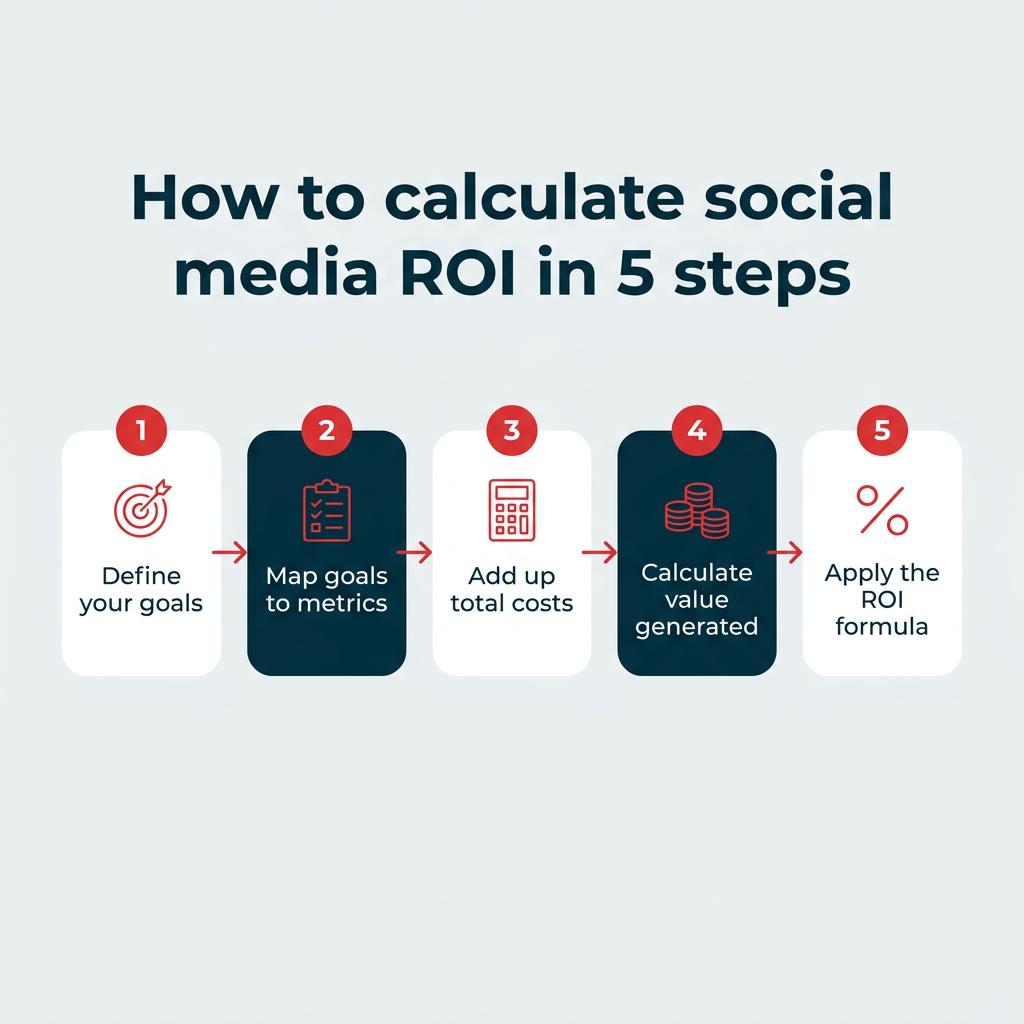
This formula requires a clear understanding of both the value derived and the total costs incurred. Below is a five-step framework to confidently calculate social ROI:
-
Define Your Social Media Goals: The cornerstone of any effective ROI measurement is a clear articulation of objectives. ROI will vary dramatically depending on whether the primary focus is sales, lead generation, brand awareness, or customer service. While overarching business goals are important, they must be translated into specific, measurable, achievable, relevant, and time-bound (SMART) campaign-level goals. For instance, campaign-specific goals might include increasing website traffic by 15% from Instagram within a quarter, generating 50 qualified leads from LinkedIn in a month, or improving customer sentiment scores by 10 points through Twitter engagement. As Eileen Kwok, former Social & Influencer Marketing Strategist at Hootsuite, notes, goals are not static; they should be revisited quarterly to align with organizational shifts and the dynamic social landscape.
-
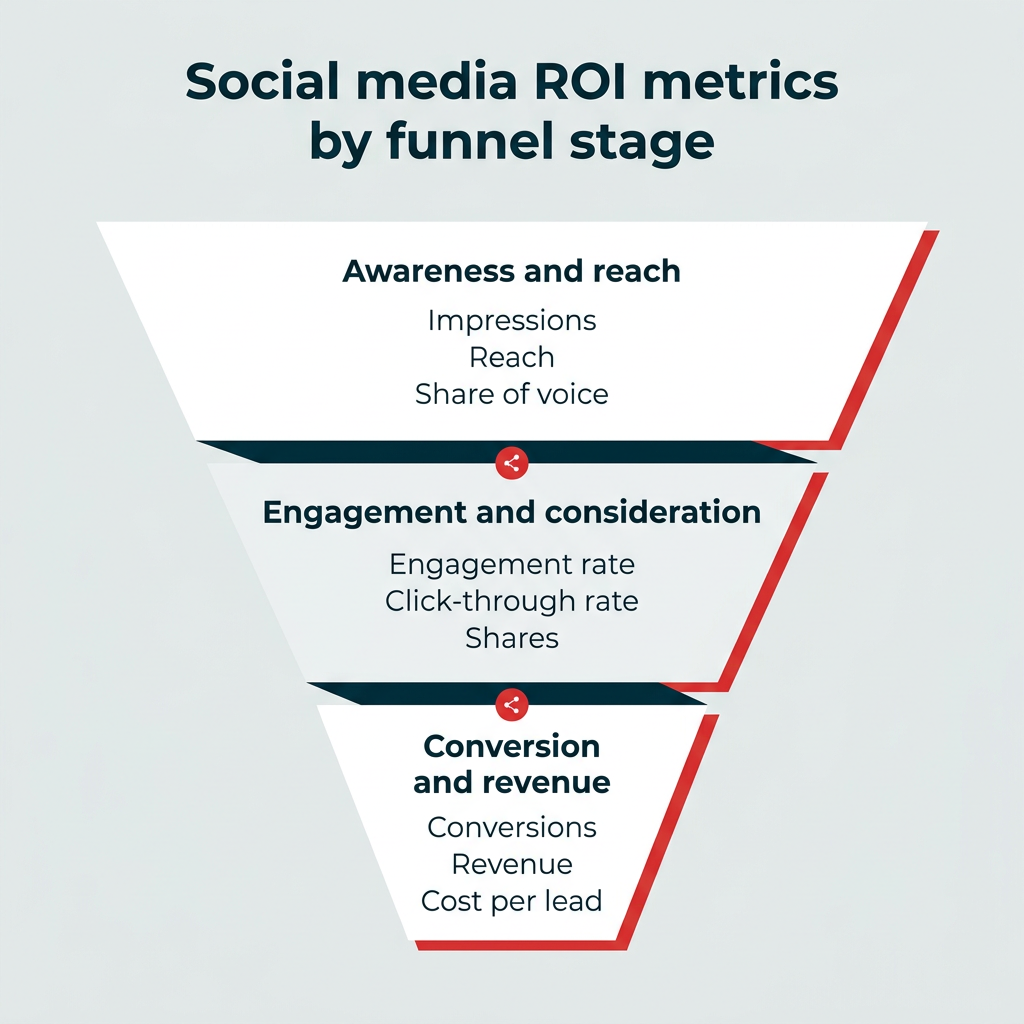
Map Goals to the Right Metrics: Once goals are established, identify the specific social media metrics that will demonstrate progress towards those objectives. Not all metrics are relevant for every goal. For brand awareness, key metrics include impressions, reach, brand mentions, share of voice, and follower growth rate. For engagement and consideration, focus on engagement rate, click-through rate (CTR), saves, shares, comments, and video views. For conversion and revenue, track direct conversions, revenue attributed to social, cost per lead (CPL), cost per acquisition (CPA), and return on ad spend (ROAS). Selecting the right metrics ensures that data collection and analysis are focused on meaningful movements that align with business objectives.
-
Add Up Your Total Social Media Costs: This step requires a comprehensive accounting of all resources—time, money, and personnel—invested in social media activities over a defined period. Common cost categories include:
- Personnel: Salaries, benefits, and training for social media managers, content creators, strategists, and analysts.
- Tools & Software: Subscriptions to social media management platforms, analytics tools, design software, and content creation applications.
- Paid Advertising: Ad spend across all social platforms (Facebook, Instagram, LinkedIn, TikTok, X, etc.).
- Content Creation: Costs associated with graphic design, video production, copywriting, photography, and licensing fees for assets.
- Agency Fees: If external agencies or consultants are utilized for strategy, content, or ad management.
- Hardware: Equipment used for content creation (cameras, microphones, computers).
- Promotions & Contests: Costs of prizes, giveaways, and platform fees for running contests.
- Influencer Marketing: Payments or product exchanges with influencers.
- Training & Education: Professional development for the social media team.
A granular approach here ensures that the "costs" component of the ROI formula is as accurate as possible.
-
Calculate the Value Generated: This is where both monetary and non-monetary returns are quantified.
- Monetary Value: Includes direct sales, leads generated (and their conversion value), website traffic that leads to conversions, and reductions in customer service costs through social support.
- Non-Monetary Value: Encompasses enhanced brand awareness, improved brand sentiment, increased customer loyalty, expanded share of voice, and positive public relations.
To integrate non-monetary outcomes into the ROI formula, assign them an estimated dollar value. This can be done by using benchmarks like customer lifetime value (CLV) for new followers or by assigning a value per lead, click, or engagement based on historical conversion rates and the average revenue per customer. For example, if a lead typically converts at 5% and generates $1,000 in revenue, each lead could be valued at $50. While estimations, these figures provide tangible data for reporting to stakeholders.
-
Apply the ROI Formula: With total value generated and total costs calculated, plug these figures into the ROI formula. The result, typically expressed as a percentage, indicates the return on investment. A positive ROI signifies that social media efforts are generating more value than their cost, justifying the investment. A negative ROI, conversely, signals that expenses outweigh returns, necessitating a strategic review and adjustment.
Translating Theory to Practice: Real-World ROI Scenarios
Understanding how the ROI formula applies in different business contexts is crucial.
-
E-commerce Business: An online retailer launches a social media campaign to boost sales of a new product line.
- Costs: Ad spend ($2,000), content creation ($500), social media manager’s time ($1,000) = Total Costs: $3,500.
- Value Generated: Direct sales ($8,000) attributed via UTM links, estimated value of 50 new email subscribers ($500, at $10/subscriber CLV), 100 website visits that converted to purchases later ($250, at $2.50/visit). Total Value: $8,750.
- ROI Calculation: (($8,750 – $3,500) / $3,500) x 100 = 150% ROI. This indicates a substantial return, generating 150% more value than the investment.
-
B2B Company (Lead Generation): A software company focuses on generating qualified leads through LinkedIn.
- Costs: Ad spend ($3,000), LinkedIn content specialist time ($1,500), CRM integration ($500) = Total Costs: $5,000.
- Value Generated: 20 qualified leads (estimated value of $1,000 per lead based on historical conversion rates and average contract value). Total Value: $20,000.
- ROI Calculation: (($20,000 – $5,000) / $5,000) x 100 = 300% ROI. A strong return, showing significant efficiency in lead acquisition through social channels.
-
Brand Awareness Campaign: A new consumer brand aims to increase visibility and positive sentiment over a quarter, without immediate sales targets.
- Costs: Influencer collaborations ($4,000), organic content creation ($1,500), social media tool subscription ($500) = Total Costs: $6,000.
- Value Generated: 10,000 new followers (estimated CLV of $5 per follower = $50,000), 500 brand mentions (estimated PR value equivalency of $20 per mention = $10,000), 2,000,000 impressions (estimated value of $0.005 per impression = $10,000). Total Value: $70,000.
- ROI Calculation: (($70,000 – $6,000) / $6,000) x 100 = 1066.67% ROI. This demonstrates how even non-sales-focused campaigns can yield significant measurable value when proxies are intelligently applied.
Defining Success: What Constitutes "Good" Social Media ROI?
There is no universal "good" social media ROI percentage. What constitutes a successful return is highly dependent on several factors: industry, specific business goals, and whether the efforts are paid or organic. A positive ROI, where value generated exceeds costs, is always a good starting point. However, a more nuanced framework for evaluation includes:
- Positive vs. Negative: Fundamentally, any positive ROI indicates a net gain, meaning the investment is paying off.
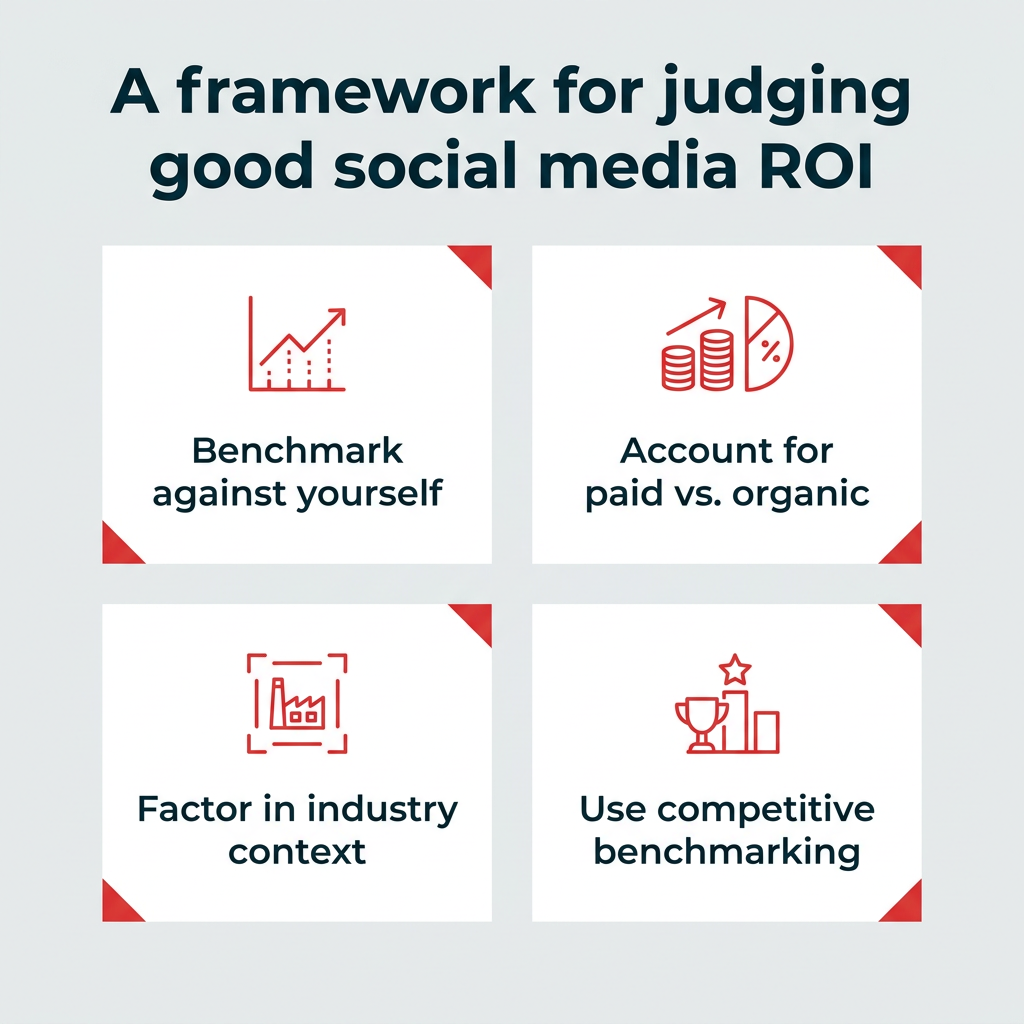
- Industry Benchmarks: Compare your ROI against industry averages. B2C sectors, particularly e-commerce, might see higher direct sales ROI, while B2B companies might prioritize lead quality and pipeline value.
- Internal Benchmarking: Track your own historical performance. An improving ROI over time demonstrates strategic effectiveness and optimization.
- Competitive Performance: Analyze how your social media ROI stacks up against key competitors. Outperforming peers indicates a competitive advantage.
- Marginal Return: Consider the incremental value generated for each additional dollar spent. As investments scale, the marginal ROI might decrease, requiring strategic adjustments.
Ultimately, a positive, consistently improving ROI that either meets or exceeds industry standards and competitive performance signifies a robust and effective social media strategy.

Amplifying Returns: Proven Strategies to Enhance Social ROI
Improving social media ROI is an ongoing process of experimentation, analysis, and refinement. Strategic implementation of specific tactics can significantly boost returns.
-
A/B Experimentation: The social media landscape is dynamic, necessitating continuous testing. Running A/B tests on content formats (e.g., carousels vs. Reels), topics, calls-to-action (CTAs), posting times, ad creatives, and landing pages helps identify what resonates most with the target audience. For example, Hootsuite’s own experiments revealed that Instagram carousels sometimes outperformed Reels in engagement and reach, challenging assumptions about content efficacy. These insights allow marketers to scale successful elements and optimize underperforming ones, directly impacting ad spend efficiency and engagement rates.
-
Analyzing Competitor Strategies: Competitor analysis is a time-honored practice in marketing. Social media’s public nature allows for observation of competitor activity. Tools like Hootsuite Analytics provide deeper insights, tracking competitor performance across channels, identifying their top-performing posts, trending hashtags, and preferred content styles. This competitive intelligence allows brands to adapt their strategies, capitalize on proven tactics, and identify untapped opportunities.
-
Leveraging UTM Parameters for Precision Tracking: Urchin Tracking Module (UTM) parameters are an invaluable tool for granular ROI measurement. These tags appended to URLs enable marketers to track the exact source of traffic, campaign, and content driving users to a website or landing page. For instance, a UTM-tagged link on a LinkedIn post directing users to an online store allows for precise measurement of how many clicks originated from that specific post, how many visitors converted, and the revenue generated. This direct attribution provides undeniable proof of social media’s impact on conversions.
-
Harnessing Social Commerce: Social commerce is rapidly becoming a primary revenue driver. With dedicated shopping features on platforms like Instagram, Facebook, and TikTok, brands can enable in-app purchases and shoppable posts, transforming engagement into direct sales without users ever leaving the platform. Measuring social commerce ROI involves tracking in-app purchases, product tag clicks, and checkout completions directly through platform commerce tools. The closed-loop nature of shoppable ads offers exceptionally clean attribution, making it a highly effective channel for measurable ROI.
-
Optimizing Content Formats: Not all content formats deliver equal returns. By analyzing performance data, marketers can identify which formats (e.g., short-form video, long-form articles, static images, interactive polls) perform best on each specific platform for their audience. Doubling down on high-performing content types and scaling back on less effective ones ensures that resources are allocated efficiently, maximizing engagement and conversion potential.
-
Refining Audience Targeting: For paid social media campaigns, precise audience targeting is paramount for maximizing ROI. Leveraging retargeting campaigns to re-engage users who have previously interacted with the brand, creating lookalike audiences based on high-value existing customers, and using social data to narrow demographic and psychographic targeting ensures that ad spend reaches the most receptive audience segments. This precision minimizes wasted budget and significantly improves return on ad spend (ROAS).

Leveraging Technology: Unified Platforms for Comprehensive ROI Measurement
Effective social media ROI tracking in today’s multi-platform environment necessitates a sophisticated mix of tools. While native platform analytics offer channel-specific data, web analytics (like Google Analytics or Adobe Analytics) track website conversions, and CRM systems link social interactions to customer lifecycles. The challenge, however, lies in integrating these disparate data sources to form a cohesive picture. This is where unified social media analytics platforms, such as Hootsuite Analytics, prove invaluable.
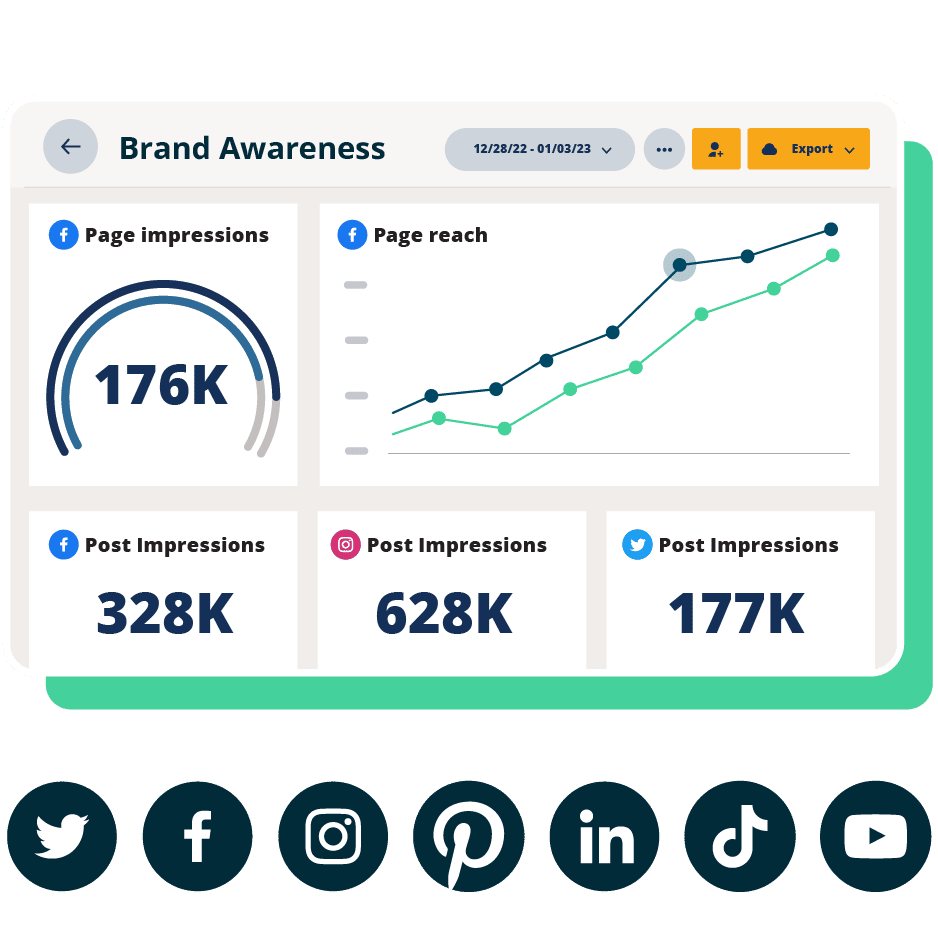
Hootsuite centralizes social data, enabling marketers to connect social activity directly to business outcomes without the laborious task of juggling multiple dashboards. Its robust analytics tools allow teams to fine-tune campaigns by examining content performance month after month and across diverse platforms. This holistic view facilitates the identification of top-performing content topics and formats, enabling rapid adaptation of content marketing strategies to expand reach and boost overall social media performance.
With Hootsuite’s Advanced Analytics, users can easily pinpoint what is working and what is not, allowing them to focus on the most effective activities. The platform tracks sales, sign-ups, and conversions directly attributed to specific posts, providing concrete data to refine content creation and optimize campaign effectiveness. Furthermore, Hootsuite offers comprehensive competitive analysis, allowing brands to monitor up to 20 competitors per social network on Advanced and Enterprise plans. This feature highlights competitor successes—their top posts, trending hashtags, and content styles—providing actionable intelligence for strategic adjustments.

Beyond competitive insights, Hootsuite’s social media benchmarking capabilities allow organizations to measure their performance against broader industry averages. By comparing key metrics such as profile impressions, reach, follower growth, and engagement rates, businesses can identify areas for improvement and opportunities for growth within their niche.
Crucially, Hootsuite’s reporting tool empowers marketers to create visually compelling and in-depth reports that clearly demonstrate the performance of both paid and organic social channels. With customizable templates and the ability to start from scratch, these reports are designed to effectively communicate the impact of social campaigns to stakeholders.
The platform’s ability to integrate with external tools like Google Analytics and Adobe Analytics is a game-changer. These integrations ensure that social media efforts are not viewed in isolation but are connected to broader business goals, tracking essential actions like website sign-ups and purchases. By linking unique post IDs with web conversion data, real-time analytics enable marketers to spot emerging trends and optimize spend proactively, rather than reacting to month-end reports.
Communicating Impact: Reporting Social ROI to Executive Stakeholders
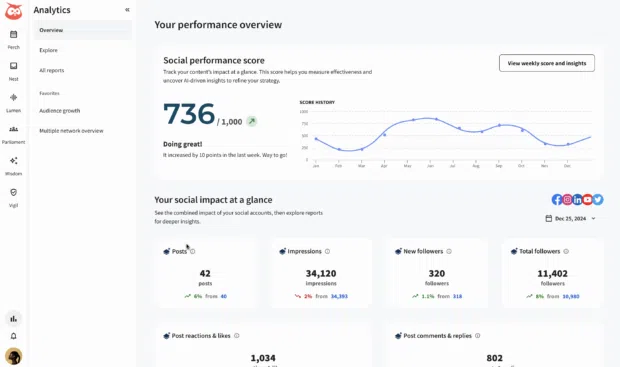
Effectively reporting social media ROI to executive stakeholders requires a strategic approach focused on business outcomes. Reports must be tailored to the audience, using language that resonates with leadership and connecting every metric back to organizational goals such as revenue growth, cost savings, or market share expansion.
Best practices for sharp reporting include:
- Focus on Business Impact: Translate social metrics into quantifiable business value.
- Keep it Concise and Clear: Executives have limited time; present key findings succinctly.
- Highlight Trends Over Time: Show progress and demonstrate the long-term value of social investments.
- Visualize Data: Use charts, graphs, and infographics to make complex data easily digestible.
- Provide Actionable Insights: Don’t just present data; explain what it means and what actions will be taken.
- Connect to Broader Business Objectives: Show how social media contributes to overall company strategy.
- Offer Strategic Recommendations: Suggest future initiatives based on current performance.
As Eileen Kwok rightly emphasizes, "You don’t know what your ROI is until you’ve laid out the goals you are tracking towards." Clear goal setting is the prerequisite for meaningful reporting.
The Future of Social Media ROI: Continuous Adaptation and Innovation

The measurement of social media ROI is a continuous, iterative process, not a one-time calculation. As social platforms evolve, new features emerge, and audience behaviors shift, so too must measurement strategies adapt. The integration of artificial intelligence and machine learning into social analytics promises even more sophisticated attribution models and predictive insights, further enhancing the ability to connect social efforts to tangible business results. Organizations that commit to defining clear goals, tracking comprehensive metrics, leveraging advanced analytical tools, and communicating impact effectively will be best positioned to unlock the full strategic value of their social media investments, ensuring sustained growth and competitive advantage in the digital age.