Content marketers in 2026 face a critical question: Do semantic keywords still hold relevance in SEO, particularly as artificial intelligence engines increasingly influence traffic and consumer buying decisions? With Google processing over 5 trillion searches annually, the fundamental shift lies not just in the volume of queries, but in how search algorithms interpret them. Modern search engines, much like conversational AI platforms such as ChatGPT, Perplexity, and Gemini, no longer rely on scanning for exact-match keyword strings. Instead, their sophistication now enables them to evaluate and understand meaning, context, and user intent at a much deeper level.
This evolution mandates that brands prioritize content demonstrating profound topical understanding to secure visibility in traditional search results and earn citations within AI-generated answers. The era of generic keyword lists is over; marketers must now optimize content around relationships, entities, and the precise questions buyers are asking throughout their journey. This comprehensive guide delves into the essence of semantic keywords, differentiates them from outdated LSI tactics, and outlines a repeatable, step-by-step process for identifying and integrating them effectively in 2026, whether optimizing for Google, its AI Overviews, or standalone answer engines.
The Dawn of Semantic Search: A Historical Perspective
The trajectory of search engine optimization has been a continuous evolution, moving from rudimentary keyword matching to sophisticated semantic understanding. In the early days of the internet, SEO was largely a game of keyword density and exact matches. Content creators would often "stuff" pages with target keywords, a tactic that, while effective then, quickly led to a poor user experience and irrelevant results.
Google’s Algorithmic Evolution: The shift began with foundational updates that introduced more nuanced language processing.
- Hummingbird (2013): This major update moved Google beyond individual keywords to understanding the meaning behind entire queries, recognizing conversational search patterns and context. It laid the groundwork for semantic search.
- RankBrain (2015): Google’s first significant foray into artificial intelligence for its core algorithm, RankBrain helped interpret ambiguous queries and improve results by understanding the user’s likely intent, even for novel phrases.
- BERT (Bidirectional Encoder Representations from Transformers, 2019): A neural network-based technique for natural language processing pre-training, BERT allowed Google to better understand the nuances and context of words in search queries, particularly prepositions and conjunctions, dramatically improving long-tail and conversational search accuracy.
- MUM (Multitask Unified Model, 2021): Building on BERT, MUM is a much more powerful AI model capable of understanding information across modalities (text, images, video) and languages. It excels at complex queries that require synthesizing information from multiple sources, allowing Google to answer questions that previously required several searches.
The Rise of Generative AI: The introduction of large language models (LLMs) like OpenAI’s ChatGPT in late 2022 marked a pivotal moment, accelerating the public’s expectation for direct, synthesized answers. Google quickly followed suit with its own Search Generative Experience (SGE), now branded as AI Overviews, integrating generative AI directly into its search results. These answer engines operate by understanding the full context of a query, synthesizing information from various sources to provide a coherent, often conversational, response. This new paradigm demands content that is not merely keyword-rich but conceptually comprehensive and structured for AI extraction.
Defining Semantic Keywords in the Modern Era
Semantic keywords are terms and phrases that are conceptually related to a page’s primary topic and its underlying user intent. They serve as contextual signals, helping search engines and AI understand the depth and breadth of the content beyond mere exact-match phrases. These keywords encompass synonyms, modifiers, related concepts, and the natural language questions a comprehensive piece on a topic would inherently address. For instance, if the primary keyword is "email marketing software," semantic keywords might include "automated drip campaigns," "subscriber segmentation," "CRM integration," "email deliverability," and "A/B testing for emails."
Semantic Keywords vs. LSI Keywords (An Outdated Distinction):
It is crucial to clarify that the term "LSI keywords" (Latent Semantic Indexing) is largely outdated and misleading in the context of modern SEO. LSI refers to a mathematical technique from a 1988 research paper, which analyzed word co-occurrence patterns. While the concept of finding related terms is valid, Google’s John Mueller confirmed in 2019 that Google does not use LSI. Modern search engines employ vastly more sophisticated Natural Language Processing (NLP) models like BERT and MUM, which understand language contextually and semantically in ways LSI never could. Therefore, while tools might still market "LSI keyword generators," marketers should evaluate if they are genuinely surfacing semantic relationships based on meaning, or simply statistical co-occurrence.
Semantic Keywords vs. Entities:
Entities are uniquely identifiable "things" – people, brands, products, places, concepts, or organizations – that search engines recognize as distinct objects with specific attributes and relationships in the real world. Google’s Knowledge Graph, for example, disambiguates "Apple Inc." from "apple (fruit)." Semantic keywords are the broader set of related terms that enrich a topic, while entities are the specific, named elements within that semantic field. A robust content piece leverages semantic keywords to build context and references entities to anchor specificity. For an article on "project management software," semantic keywords might be "task tracking," "team collaboration," and "workflow automation," while entities would include "Asana," "Monday.com," "Jira," and "Gantt chart."
Semantic Keywords vs. Topics:
A topic represents the overarching subject your content addresses, often organized into pillar pages and content clusters. Semantic keywords, conversely, are the specific terms and phrases that imbue that topic with detail and substance. The topic provides the container; semantic keywords are its essential ingredients. A well-executed content strategy begins with topic selection and then uses semantic keyword research to populate each page with the necessary depth and detail, signaling expertise to both human readers and AI systems.
The Imperative of Semantic Optimization for SEO and AEO
The evolving landscape of search makes semantic keyword optimization not just a best practice, but a necessity for digital visibility. Kelvin Ćobanaj, CEO of ZeroRank, highlights two primary reasons for their critical importance.
For Traditional SEO: Ćobanaj notes, "With traditional SEO, semantic keywords are mostly variations of the same search so that a page can rank for more queries." When Google encounters content that intelligently uses a cluster of related terms, it gains confidence that the page thoroughly covers the subject, rather than just superficially mentioning a keyword. This confidence translates directly into improved rankings for a wider array of relevant queries. Furthermore, it enhances Google’s ability to understand the content’s intent, leading to better matches with user queries.
For AI Search Optimization (AEO): Ćobanaj emphasizes a different focus for AI search: "With AI search, I focus more on covering the full topic and common questions, not just keyword variants. That gives AI enough context to include the brand in its answer." AI answer engines are designed to synthesize information and provide direct answers. Content rich in semantic keywords, entities, and comprehensive answers to related questions offers these AI systems the explicit context needed to extract, understand, and cite a brand’s information reliably. This is crucial for securing a "share of voice" in AI Overviews and conversational AI responses.
The Synergy of SEO and AEO: Bernard Huang, founder of Clearscope, succinctly captures the overlap: "I see a lot of teams treating AEO and SEO like two totally separate things, and honestly, it’s the biggest resource waste out there right now. Both come down to the same goal: creating content that genuinely covers a topic well. When you do good semantic keyword research and map out the concepts and relationships around a topic, you’re building content that works for traditional search and AI engines at the same time." This underscores that semantic keyword research is not a separate initiative for AEO but an integrated approach that strengthens both traditional rankings and AI visibility. The distinction primarily lies in execution: AEO often demands clearer definitions, more explicit entity references, and content structured for passage-level extraction.

Strategic Framework: Finding and Implementing Semantic Keywords in 2026
Effective semantic keyword research begins not with tools, but with a clear understanding of your audience and content goals. This step-by-step workflow ensures a comprehensive approach:
Step 1: Map Your Personas to Their "Money Prompts"
Before engaging with any keyword tool, identify the specific, high-intent questions your target buyers ask into AI engines or Google when actively evaluating solutions. Lindsay Boyajian-Hagan, VP of Marketing at Conductor, highlighted on the "Found in AI" podcast that the most valuable content starts by mapping personas to prompts, especially when revenue is at stake. These aren’t general curiosity questions but precise queries used during comparison, evaluation, or business case development.
For each persona, document:
- Their core problem: What challenge are they trying to solve?
- Their decision criteria: What factors influence their choice?
- Their "money prompts": The exact phrases they’d use in search or AI.
For example, a VP of Engineering at a mid-market SaaS company, evaluating project management software, might use prompts like: "best project management software for agile teams with Salesforce integration" or "compare Asana vs. Jira for enterprise scalability." These prompts form the bedrock of semantic research, focusing on buyer intent rather than mere search volume.
Pro Tip: Authenticate these prompts using voice-of-customer data from sales call recordings, demo request forms, G2 reviews, and relevant online forums like Reddit, where buyers openly discuss their needs.
Step 2: Map Primary Keywords to Prompts and Queries
Connect your traditional primary keywords (e.g., "email marketing software") to the specific persona prompts identified in Step 1. A CMO at an early-stage startup will have different semantic needs than an email marketing manager at an enterprise. The CMO might ask, "Most cost-effective email marketing platform for a team of two?", while the enterprise manager might query, "Best email marketing software with advanced segmentation and Salesforce integration." Same primary keyword, but distinct semantic profiles. Documenting this mapping helps identify which semantic terms belong on each page and prevents trying to make one page serve too many disparate audiences.
Step 3: Analyze the SERP for Your Primary Keyword
Perform a Google search for your primary keyword and meticulously examine the first page of results. The "People Also Ask" (PAA) box is an invaluable, accessible source of semantically related questions. Click on several PAA results to dynamically expand the list, uncovering dozens of queries. Pay close attention to:
- Related Questions: What common questions do users ask?
- Subtopics: What recurring themes or sections appear in top-ranking pages?
- Entities: Which specific brands, tools, or concepts are frequently mentioned?
Cross-reference these findings with your persona-to-prompt mapping. Daniel Horowitz, Enterprise SEO at Salesforce, stresses the importance of this comprehensive analysis: "I always want to see how the topic is actually being framed across rankings, AI answers, People Also Ask, forums, documentation, and competitor pages. That’s where you start to see which entities recur, which subquestions matter, where you can add value with an FAQ section, and which phrasing keeps showing up."
Step 4: Use a Dedicated Semantic Keyword Tool
While SERP analysis provides rich context, specialized tools can uncover deeper semantic relationships. Platforms like Semrush’s Keyword Magic Tool or Ahrefs’ Keywords Explorer can surface related terms not easily found manually. Look for:
- Keyword Clusters: Tools often group semantically related keywords.
- Question-Based Keywords: Identify questions users are asking related to your topic.
- Intent Classifications: Understand the underlying intent (informational, commercial, transactional).
- Related Concepts: Terms that broaden the topic’s scope.
Step 5: Prompt AI Engines Directly
Engage with AI answer engines (ChatGPT, Perplexity, Google’s AI Mode) using your persona’s "money prompts." These engines often collapse queries into broader intent clusters, revealing concepts your content needs to address. Note:
- Key Concepts and Entities: What specific ideas and named entities does the AI highlight?
- Follow-Up Questions: What questions does the AI suggest?
- Synthesized Answers: How does the AI structure its response, and what sources does it cite?
However, Horowitz advises caution: "Personalization and output variability mean you have to be careful. What you see in ChatGPT or Perplexity is useful as a signal, but not reliable enough to treat as a source of truth. I still trust the SERP, first-party data, and actual performance much more."
Step 6: Pull Insights from Voice-of-Customer Data
Rich semantic insights often lie hidden in direct customer feedback. Review:
- Sales call recordings and transcripts: Listen for the specific language buyers use to articulate problems, evaluate solutions, and express concerns.
- Customer support tickets: Identify recurring issues or questions that indicate knowledge gaps.
- Product reviews (G2, Capterra, Amazon): Analyze how users describe product benefits, drawbacks, and use cases.
- Online communities (Reddit, Quora, industry forums): Observe natural language discussions around your topic and related challenges. These phrases often translate into valuable long-tail keywords and natural-language prompts for AI engines.
Step 7: Map Your Semantic Keywords to an Entity Map
Once you’ve gathered a comprehensive list, organize it. Group semantic keywords into logical clusters, such as:
- Core concepts: Central ideas of the topic.
- Sub-topics: Related themes that branch off the core.
- Features/Benefits: Specific attributes and advantages.
- Problem/Solution pairs: The challenges addressed and how.
- Named Entities: Specific brands, tools, or people.
This clustering forms an "entity map" – a structured representation of how all terms relate to your primary keyword. This map guides content strategists and writers on which sections to include, which entities to reference, and where to delve deeper, ensuring comprehensive coverage.
Step 8: Run a Quick Audit with AEO Grader
Before embarking on content creation, use a tool like HubSpot’s AEO Grader to perform an AI visibility check. This provides a baseline understanding of your current brand representation in AI answer engines. It also reveals how competitors are being cited and highlights topical gaps your content needs to address to claim a greater share of voice in AI-generated answers.
Implementing Semantic Keywords for Maximum Impact
Finding semantic keywords is only half the battle; strategic placement is key to effectiveness. The goal is natural integration, not forced stuffing.
Where to Place Semantic Keywords
- Title Tag & Meta Description: Include the primary keyword and 1-2 key semantic terms to signal relevance.
- H1 Heading: Reiterate the primary topic clearly.
- H2 and H3 Headings: Use semantic keywords to introduce major sections and subtopics.
- Introduction (First 100-150 words): Naturally weave in core semantic concepts to establish topical authority early.
- Body Content: Distribute related terms throughout the article where they contextually fit.
- Image Alt Text: Describe images using relevant semantic terms.
- Internal Link Anchor Text: Use semantic variations for links to other relevant pages on your site.
- FAQ Section: Directly answer common questions using question-based semantic keywords.
Before and After Example
Before (primary keyword only, no semantic depth):
"Email marketing software helps you send emails. The best email marketing software has features for sending emails and managing your email list. If you need email marketing software, look for one that fits your email marketing needs."
After (with semantic keywords integrated):
"Email marketing software gives B2B teams the tools to build automated drip campaigns, segment subscriber lists by behavior or lifecycle stage, and track engagement metrics like open rate and click-through rate. The strongest platforms in 2026 also integrate with your CRM for lead scoring and support A/B testing across subject lines, send times, and content blocks. If you’re evaluating options, prioritize workflow automation, deliverability tracking, and native analytics."
The "after" version demonstrates a natural, comprehensive understanding of the topic, incorporating terms like "automated drip campaigns," "segment subscriber lists," "open rate," "CRM integration," "A/B testing," "workflow automation," and "deliverability." These are semantic keywords effectively doing their job.
Pro Tip: Resist the urge to include every single semantic keyword on a single page. A focused page with 10-15 strategically placed, highly relevant semantic terms will generally outperform a page attempting to cram in 50 loosely related ones. The emphasis should always be on natural language and readability.
Essential Semantic Keyword Research Tools for 2026
Not all keyword tools are created equal for semantic research; some still lean heavily on exact-match logic. The following tools are particularly effective for uncovering genuine semantic relationships:
1. HubSpot SEO Marketing Software
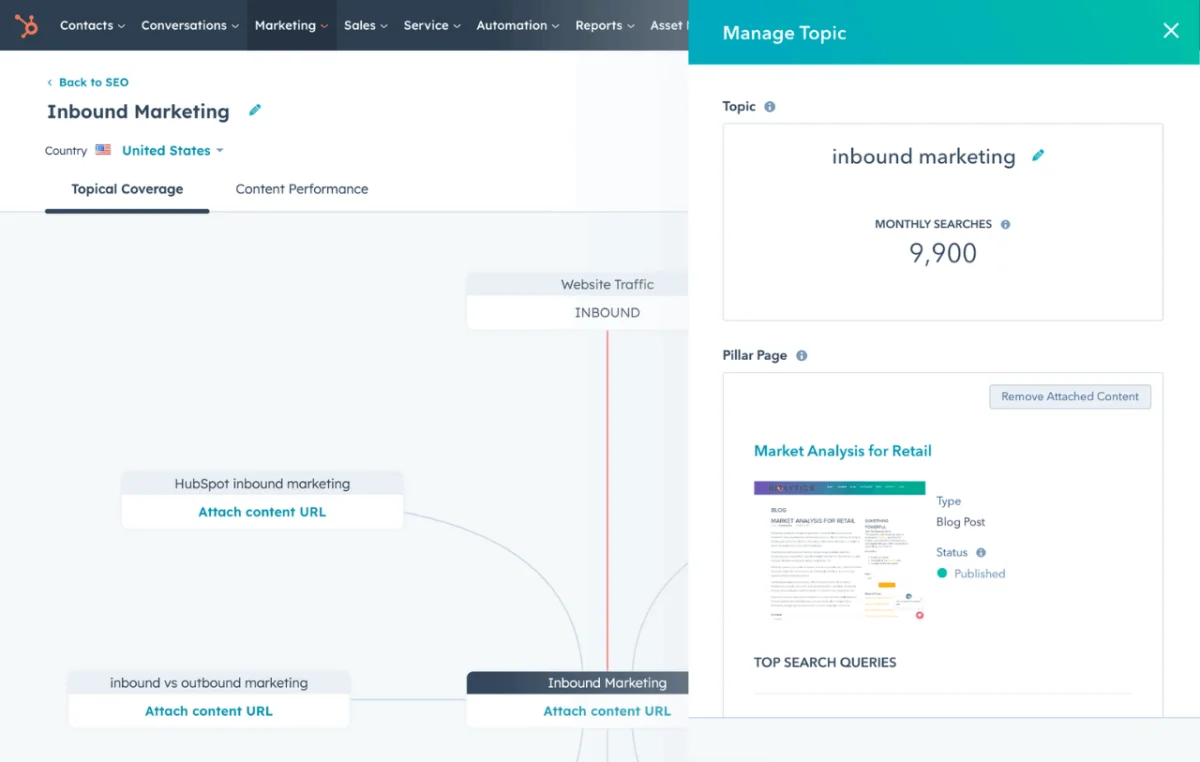
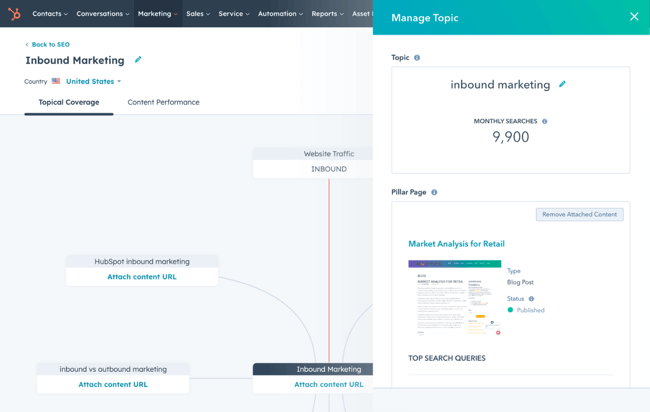
HubSpot’s integrated SEO Marketing Software within its Marketing Hub is highly relevant for a semantic keyword strategy. It enables users to map pillar pages to subtopic content, visually representing how semantic clusters connect. This effectively builds the entity map discussed earlier, directly within the content creation platform. For teams managing extensive content libraries, this visibility prevents content fragmentation. Its Google Search Console integration pulls keyword performance data directly into HubSpot, allowing marketers to identify which semantic terms drive traffic and where content might be underperforming. Furthermore, HubSpot’s AEO Grader and HubSpot AEO complement its SEO tools, allowing brands to benchmark AI visibility and understand how answer engines represent them.
Key Features:
- Topic Cluster Visualization: Maps pillar pages and subtopics, showing semantic relationships.
- On-Page SEO Recommendations: Provides real-time suggestions for semantic optimization during content creation.
- Google Search Console Integration: Displays keyword impressions and CTR data for semantic terms.
- AEO Grader & Tools: Benchmarks AI visibility and identifies competitive gaps in AI answers.
Best for: Marketing teams already using or considering HubSpot, who desire semantic keyword optimization integrated into their content creation and analytics workflow.
Pricing: Marketing Hub starts at $20/month per seat (billed monthly), with pricing and features varying by plan.
What we like: Its strength lies in connecting SEO recommendations directly to content creation, facilitating real-time semantic optimization.
Where it falls short: It’s an execution and monitoring layer, not a primary deep semantic research tool. It works best when paired with a dedicated research platform that then feeds insights into HubSpot.
2. Semrush
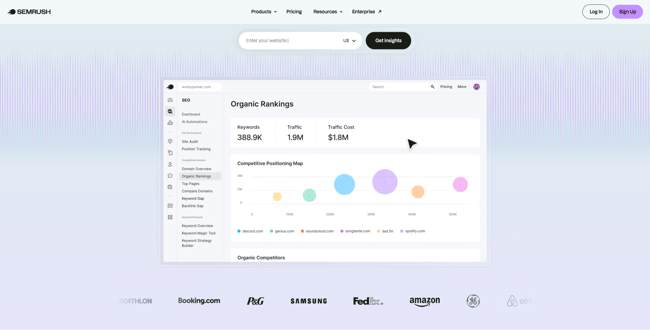
Semrush is a comprehensive SEO and competitive research platform invaluable for semantic keyword research. Its large keyword database, topic research capabilities, and intent-based groupings reveal related terms, subtopics, and questions around a primary keyword.
Key Features:
- Keyword Magic Tool: Generates vast lists of keywords, categorized by intent and relatedness.
- Topic Research Tool: Identifies popular questions, subtopics, and content gaps based on top-ranking pages.
- Content Marketing Platform: Offers tools for content briefs and optimization, integrating semantic insights.
- SERP Analysis: Provides deep insights into ranking factors and content elements of top pages.
Best for: Teams requiring extensive data to construct a complete semantic map from a single, robust platform.
Pricing: Starts at $139/month for the Pro plan ($117.33/month annually).
What we like: The Keyword Magic Tool is exceptionally comprehensive, automatically clustering related terms, saving significant manual effort. The Topic Research tool is excellent for uncovering content gaps and understanding what questions top-ranking pages address.
Where it falls short: Its pricing can be prohibitive for smaller teams, and the sheer volume of data can be overwhelming without a clear research framework.
3. Ahrefs Keywords Explorer
Ahrefs Keywords Explorer assists marketers in researching keywords, assessing difficulty, estimating traffic, and understanding how related terms connect to larger parent topics. Its parent topic and traffic potential features are particularly useful for semantic research, guiding decisions on whether related keywords should target the same page or warrant separate content.
Key Features:
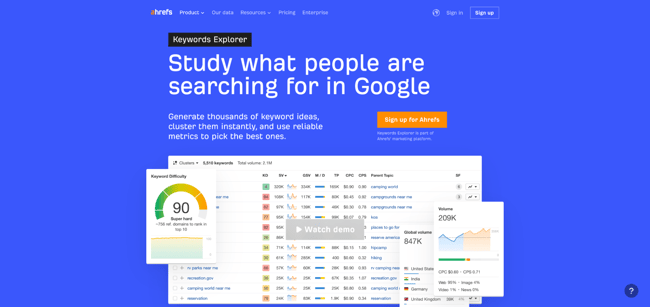
- Keywords Explorer: Provides extensive keyword data, including "Parent Topic" identification.
- Related Terms and Questions: Surfaces a broad array of semantically related queries.
- Traffic Potential: Estimates actual traffic received from ranking, accounting for SERP features.
- Content Gap Analysis: Identifies keywords competitors rank for that you don’t.
Best for: Teams already engaged in SEO who need to integrate semantic research with competitive analysis and content architecture planning.
Pricing: Paid plans start at $29/month for Starter; Lite starts at $129/month.
What we like: The "Parent Topic" feature is underrated for semantic research, preventing content cannibalization by identifying when multiple keywords should target a single page. Traffic potential is more practical than raw search volume, and the Content Gap tool is excellent for competitive semantic analysis.
Where it falls short: Less intuitive than Semrush for pure semantic discovery, often requiring more manual grouping of terms into semantic clusters.
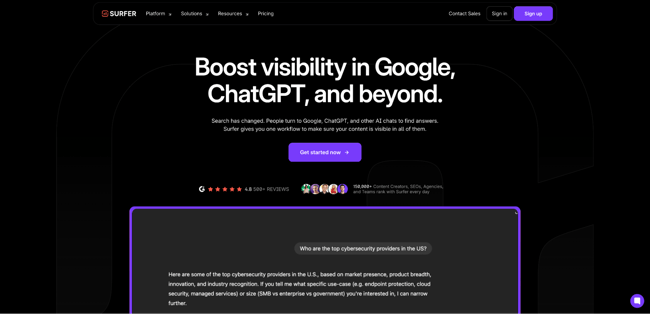
4. Surfer SEO
Surfer SEO is a content optimization platform that analyzes top-ranking pages and translates those patterns into actionable writing recommendations. For semantic keywords, it excels during the drafting and editing phases by showing writers which related terms, entities, headings, and content elements are present across competing pages.
Key Features:
- Content Editor: Provides real-time feedback on content optimization, including semantic keyword usage.
- NLP-Driven Suggestions: Recommends relevant terms, questions, and entities based on top-ranking SERPs.
- Outline Builder: Helps structure content with suggested headings and questions.
- Internal Linking Suggestions: Identifies opportunities for semantic internal linking.
Best for: Writers who prefer to focus on drafting and want real-time semantic optimization guidance integrated into their workflow.
Pricing: Paid plans start at $49/month for Discovery (billed yearly); Standard starts at $99/month (billed yearly).
What we like: Surfer is exceptional for semantic keyword implementation. Its content editor acts as a semantic checklist, analyzing top-ranking pages and providing a real-time score as content is written, ensuring comprehensive coverage.
Where it falls short: It’s not a standalone semantic research tool; it works best as a companion for the writing and optimization phase after initial research is done in other platforms.
5. KeywordsPeopleUse
KeywordsPeopleUse is a focused keyword research tool that unearths questions, entities, semantic maps, and related queries from sources like Google Autocomplete, People Also Ask, Reddit, and Quora. It helps marketers understand how people phrase questions around a topic and which concepts Google associates with it.
Key Features:
- Question Extraction: Identifies user questions from various sources.
- Entity Mapping: Visualizes semantic relationships and entities.
- Related Queries: Shows terms and phrases closely associated with the primary keyword.
Best for: Solo marketers and small teams operating on a budget who need a focused tool for semantic discovery.
Pricing: Paid plans start at $15/month for Lite (150 credits/month).
What we like: This tool is highly focused on semantic relationships, highlighting what Google truly associates with a topic. Its entity extraction feature is particularly useful for AEO, identifying specific entities AI systems expect in authoritative content.
Where it falls short: It lacks search volume, keyword difficulty, or competitive analysis metrics, requiring pairing with a traditional keyword tool for a complete picture.
Frequently Asked Questions About Semantic Keywords
Are LSI keywords real?
The underlying technique of Latent Semantic Indexing is a real concept from 1989 for analyzing word co-occurrence. However, Google does not use LSI in its search algorithm. Modern search engines rely on advanced NLP, including transformer-based models like BERT and MUM, which understand contextual meaning far beyond what LSI could achieve. When "LSI keywords" are mentioned in an SEO context, they typically refer to what are now properly called "semantically related keywords," which remain highly valuable. Focus on current semantic keyword research methodologies and tools, and disregard claims of using Google’s "LSI algorithm."
How many semantic keywords should I add to a page?
There isn’t a magic number, but most well-optimized pages benefit from 10 to 20 strategically placed, highly relevant semantic keywords. The emphasis should be on natural integration and relevance, not sheer volume. A page with 12 contextually perfect semantic terms will generally outperform one that forces 40 loosely related terms into the copy. Use your entity map to prioritize core concepts and high-intent terms, then layer in supporting entities and question-based keywords. If a term doesn’t fit naturally, it’s best to omit it to maintain readability and content quality.
What is the difference between semantic keywords and entities?
Semantic keywords are the broader set of related terms, phrases, and concepts that help search engines understand a page’s topic and intent. Entities are a specific subset of uniquely identifiable things (people, brands, tools, places, concepts) that search engines recognize as distinct objects in the world. For an article about "project management software," semantic keywords might include "task tracking," "team collaboration," and "workflow automation." The entities on that page would be specific named items like "Asana," "Monday.com," "Jira," and "Gantt chart." Semantic keywords build topical depth, while entities provide specificity and clarity.
How do I find semantic keywords for free?
You can find semantic keywords for free through several methods:
- Google SERP Analysis: Utilize "People Also Ask" boxes, "Related Searches," and the bolded terms in Google’s featured snippets.
- AI Engines (Free Tiers): Prompt free versions of ChatGPT or Perplexity with your core topic or persona "money prompts" to generate related concepts, entities, and follow-up questions.
- Google Natural Language API: For small volumes, this tool can perform entity analysis and sentiment analysis.
- Forums and Q&A Sites: Explore Reddit, Quora, and industry-specific forums to see how real people discuss your topic and the language they use.
Where should semantic keywords go on the page?
Semantic keywords should be naturally distributed throughout your content. High-impact placements include the title tag and meta description, H1 heading, H2 and H3 subheadings, the introduction (first 100-150 words), the opening sentence of each major section, within body paragraphs where contextually relevant, in FAQ answers, in image alt text, and as anchor text for internal links. The goal is to demonstrate comprehensive topical coverage across the entire piece, ensuring related terms appear wherever they belong naturally, without forced inclusion that could negatively impact readability.
Build for Meaning, Not Just Keywords
The landscape of content optimization has fundamentally shifted with the rise of AI. In 2026, search engines and AI systems alike reward content that exhibits a genuine, deep understanding of a topic, moving far beyond surface-level keyword placement. Teams that approach semantic keyword research as a strategic input to their content strategy, rather than a mere checklist item, consistently produce stronger content that not only ranks effectively but also earns valuable citations in AI-generated answers.
By investing in robust semantic keyword research now, brands are building a resilient foundation for visibility across both traditional search engine results pages (SERPs) and the increasingly prevalent AI-generated search experiences. Employing the tools and steps outlined in this guide will help establish a repeatable process, and regular benchmarking with tools like AEO Grader will provide crucial insights into your brand’s presence in the AI engines where your target buyers begin their research journeys. The future of search is semantic