The landscape of digital discovery has undergone a profound transformation, ushering in an era where Answer Engine Optimization (AEO) has moved from a theoretical concept to a strategic imperative with demonstrably measurable returns for marketing leaders. As an increasing number of consumers and B2B buyers initiate their brand discovery through sophisticated AI tools such as ChatGPT, Google AI Overviews, Perplexity, and Claude, the marketing teams that proactively invest in AEO are now witnessing tangible benefits in conversion rates and the cultivation of long-term brand authority. This shift represents a fundamental re-evaluation of how brands connect with their audiences, demanding a new approach to content strategy that prioritizes direct, authoritative answers within AI-generated responses.
The Paradigm Shift: From Blue Links to AI Answers
For decades, Search Engine Optimization (SEO) focused primarily on securing top rankings in traditional search results, driving traffic through clickable "blue links." The advent of generative artificial intelligence and large language models (LLMs) has fundamentally altered this paradigm. Beginning with the widespread public adoption of tools like ChatGPT in late 2022, followed by major search engines integrating AI-powered summaries and "AI Overviews" into their results, the user journey has significantly evolved. Users are now frequently receiving direct, synthesized answers to their queries before ever clicking through to a website. This means that for a brand to maintain visibility and influence, its content must be structured and optimized not just for search engine algorithms, but for AI systems designed to extract, understand, and cite authoritative information.
AEO, distinct from traditional SEO, centers on structuring content so that AI-powered search engines can efficiently extract, comprehend, and confidently cite a brand’s information as the definitive answer to a user’s query. While traditional SEO aims to rank pages in a list, AEO’s focus is on ensuring a brand’s content becomes the answer. This requires a nuanced understanding of entity recognition, clear answer formatting, and robust structured data implementation.
Quantifying the Advantage: Tangible Benefits of AEO
The advantages of embracing AEO are no longer speculative; they are yielding concrete, measurable results that directly align with the key performance indicators (KPIs) marketing leaders are accountable for. These benefits compound over time, establishing a defensible competitive advantage for early adopters.
-
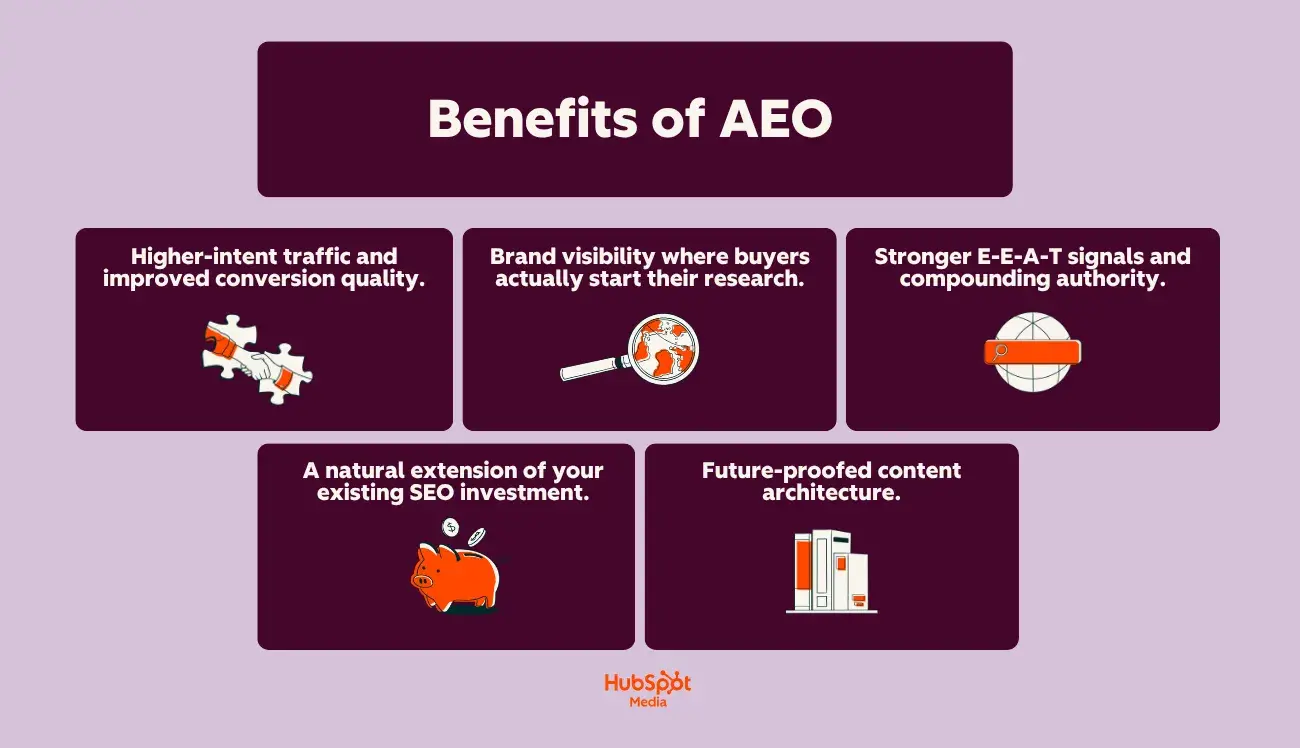
Higher-Intent Traffic and Improved Lead Quality: AEO fundamentally enhances lead quality and accelerates the time-to-value for new prospects. When a user arrives at a brand’s website via an AI-generated answer, the AI has already served as a preliminary filter. It has explained the topic, confirmed the user’s intent, and positioned the brand’s content as a highly relevant and authoritative source. This pre-qualification means visitors are often much further along in their buyer’s journey, resulting in shorter sales cycles, higher conversion rates, and a reduced cost per acquisition. Industry data corroborates this: HubSpot’s 2026 State of Marketing Report indicates that while nearly half of marketers (49%) observe a decrease in web traffic from traditional search due to AI answers, a significant 58% report that AI referral traffic exhibits much higher intent. This underscores the qualitative improvement in traffic driven by AEO.
-
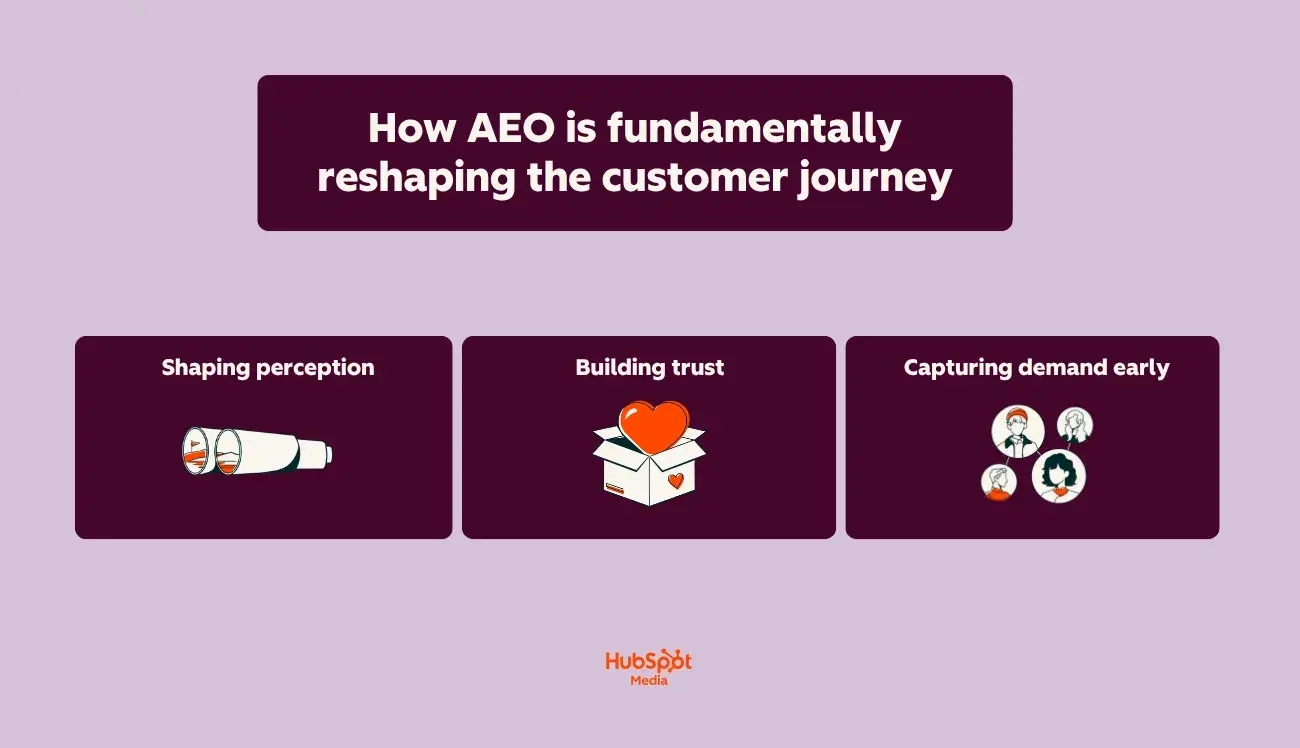
Enhanced Brand Visibility at the Point of Intent: As buyer behavior shifts, AEO ensures brand visibility precisely where research now begins. Brands appearing within AI-generated responses capture demand at the critical moment of intent formation, rather than after the initial information gathering. This visibility is not merely about presence; it’s about being recognized as a credible source by sophisticated AI systems, a signal that reinforces brand trust and authority.
-
Strengthening E-E-A-T and Long-Term Authority: The very nature of AEO work—meticulously defining entities, embedding structured data, and publishing clear, well-sourced answers—directly reinforces the E-E-A-T (Experience, Expertise, Authoritativeness, Trustworthiness) signals that both traditional and answer engines reward. Each piece of answer-optimized content contributes to a brand’s entity profile across LLMs, exponentially increasing the likelihood of future citations and solidifying its position as a go-to expert in its field. This creates a compounding effect, where initial AEO efforts build a foundation for sustained authority.
-
Measurable Performance through Specialized Tools: One of the most significant initial challenges for AEO adoption was the inability to accurately measure its ROI using traditional SEO tools, which were not designed to track AI citations. This hurdle is rapidly being overcome with the emergence of purpose-built AEO measurement tools. Platforms like HubSpot’s AEO Grader allow marketers to benchmark their current visibility and performance across various answer engines, identifying content gaps and providing prioritized recommendations. This concrete data enables marketing teams to directly link optimization efforts to measurable outcomes, moving beyond intuition to data-driven strategy.
-
Seamless Integration with Existing SEO Strategies: Far from being a competing initiative, AEO functions as a powerful complementary layer to existing SEO investments. Content that already ranks highly in traditional search often possesses topical authority, making it prime for AEO optimization. The structured data implemented for AI citation eligibility simultaneously enhances rich results in traditional search. Furthermore, established topic clusters for SEO provide the interconnected entity relationships that LLMs require for comprehensive understanding. This symbiotic relationship means teams can incrementally adopt AEO without overhauling their entire content strategy, directly addressing concerns about integration friction and resource allocation.

-
Future-Proofing Content Architecture: Investing in AEO today is an investment in the future of digital interaction. Emerging technologies like voice search, multimodal AI, agent-driven commerce, and zero-click interfaces all rely on the same foundational principles: clearly defined entities, well-structured content, and explicit relationships between information. By optimizing for AEO, brands are not just preparing for today’s answer engines but are building a robust content infrastructure that will scale and perform across every new and evolving digital channel.
Navigating the Hurdles: Common AEO Challenges and Strategic Solutions
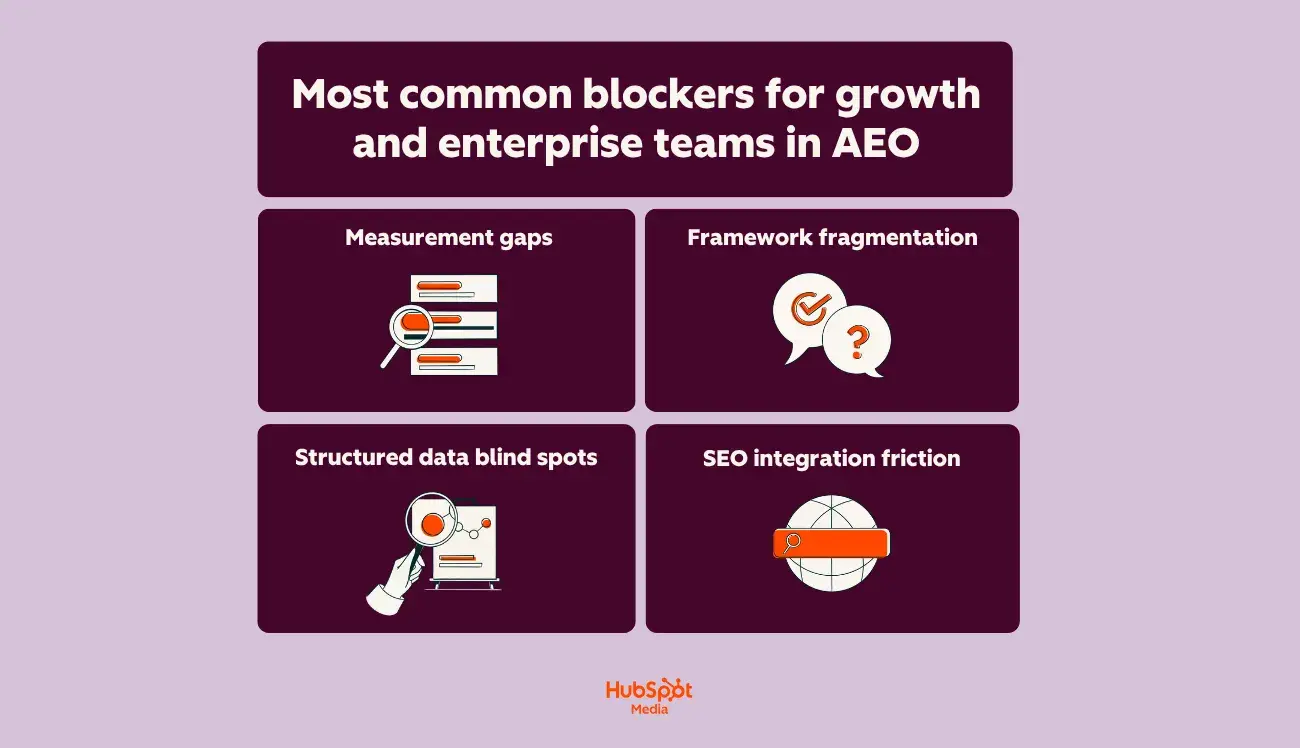
Despite the clear advantages, the path to successful AEO implementation is not without its obstacles. Many marketing teams encounter common challenges when transitioning from experimental AEO initiatives to a scalable, integrated program.
-
Measuring ROI in a New Landscape: The inability of legacy SEO tools to track AI citations has historically made it difficult to justify AEO budgets and demonstrate impact.
- Solution: Adopt purpose-built AEO measurement tools, such as HubSpot’s AEO Grader, to establish a baseline score, conduct gap analyses, and track AI citation presence with the same rigor applied to organic traffic. Continuous monitoring tools like HubSpot AEO allow for real-time tracking of visibility gains or drops, directly linking them to content changes.
-
Establishing Repeatable Optimization Frameworks: Many teams approach AEO in an ad hoc manner, leading to inconsistent results and scalability issues.
- Solution: Develop a systematic AEO content workflow. This involves auditing existing content for answer readiness, mapping AI-driven customer journeys, identifying key "answer surfaces" (e.g., FAQ sections, summary paragraphs), and establishing clear guidelines for content creation and updates. This transforms AEO from a sporadic effort into a consistent operational capability.
-
Integrating AEO with Traditional SEO: Concerns about duplicate effort, conflicting priorities, or cannibalizing existing rankings are common.
- Solution: Position AEO as an enhancement layer to SEO. Prioritize optimizing high-ranking pages, as they already possess topical authority. Emphasize that structured data for AI citations also improves rich results in traditional search. Framing AEO as a reinforcement of existing investments helps secure buy-in and ensures synergy.
-
Overcoming Technical Barriers: Structured Data Implementation: The perceived technical complexity of structured data and schema markup often deters marketing teams lacking extensive developer resources.
- Solution: Begin with high-impact, low-effort schema types like FAQPage, HowTo, and Organization schema. Many CMS platforms offer plugins or native support for these, significantly reducing the engineering lift. Platforms like HubSpot’s Content Hub simplify the creation and management of answer-friendly formats with built-in structured data capabilities.
-
Securing Leadership Buy-In: Translating AEO’s benefits into terms that resonate with C-suite and VP-level stakeholders can be challenging.
- Solution: Frame AEO in the context of business outcomes leaders already track, such as pipeline influence, customer acquisition cost, and competitive advantage. Emphasize that AI overviews are projected to handle an increasing share of queries previously driving organic traffic, making AEO a critical risk mitigation strategy against potential visibility loss. Leverage tools like the AEO Grader to provide a clear benchmark and demonstrate progress against pipeline metrics.
-
Understanding Diverse Answer Engine Behaviors: The varying retrieval behaviors of different LLMs (ChatGPT, Google AI Overviews, Perplexity, Claude) can lead to ambiguity regarding where to focus optimization efforts.
- Solution: Prioritize optimizing for shared fundamentals. Focus on creating content that is exceptionally clear, well-structured, authoritative, and directly answers user queries. This consistent approach ensures broad eligibility across diverse answer engines, as they all value high-quality, unambiguous information.
A Strategic Roadmap: Implementing AEO in Practice
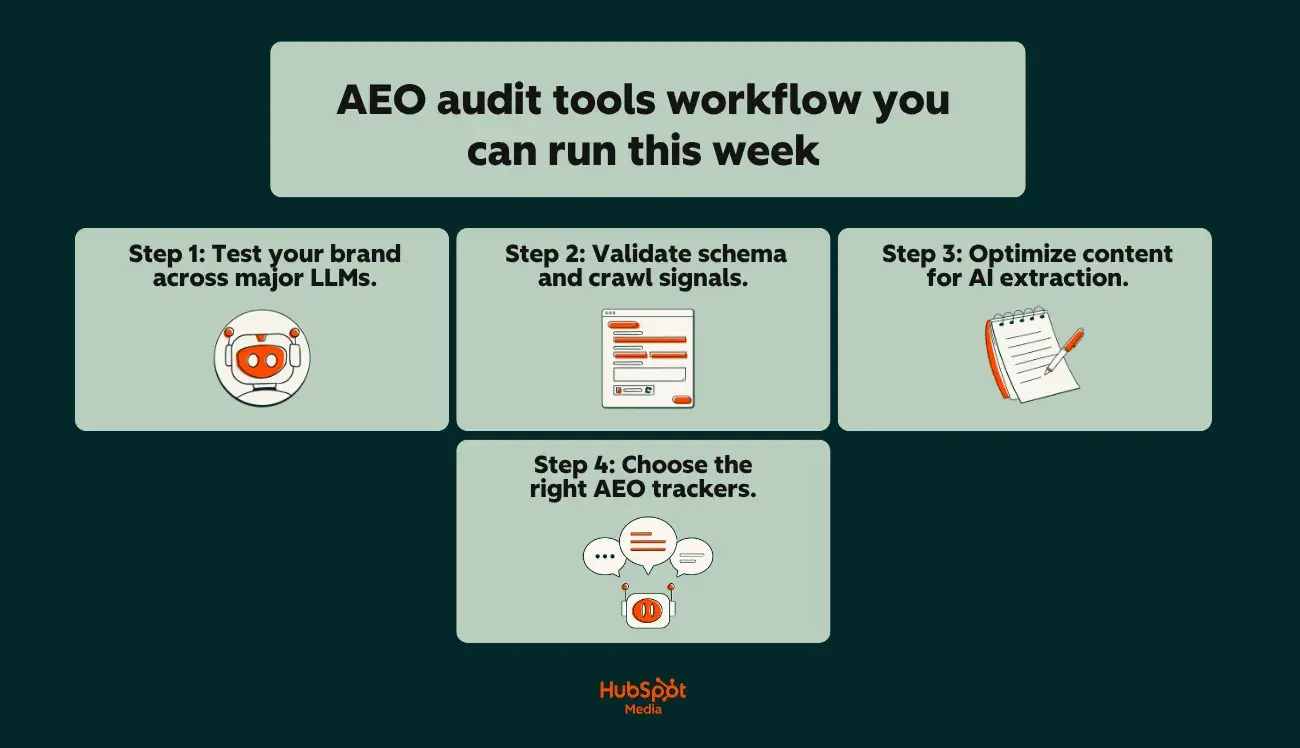
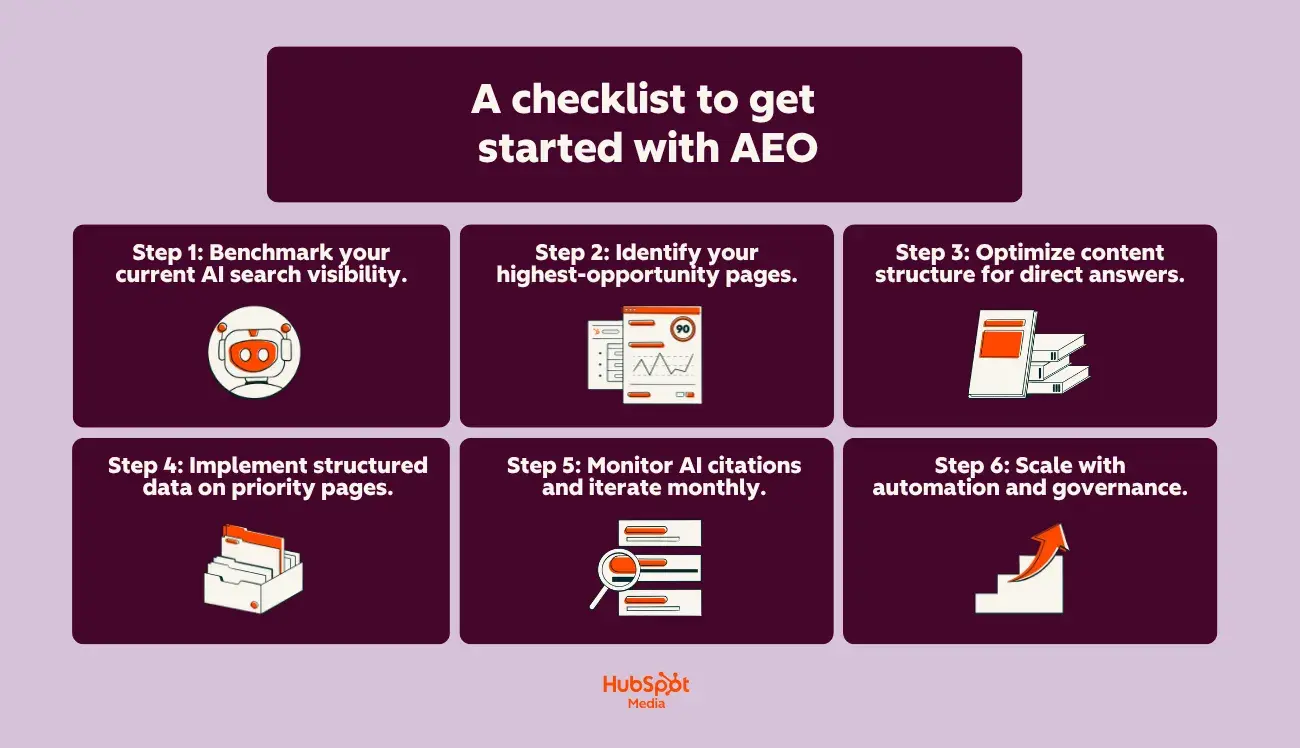
Overcoming these challenges requires a clear, repeatable workflow. The teams currently excelling in AEO are those who have adopted a systematic, tool-supported approach.
Step 1: Baseline Your AI Search Presence. Before any optimization, establish a concrete benchmark of your brand’s current visibility within AI-generated answers. Tools like HubSpot’s AEO Grader provide an initial visibility score, identify content gaps, and offer actionable recommendations, creating a measurable starting point for all subsequent efforts.
Step 2: Prioritize High-Impact Content. Not all content needs immediate AEO optimization. Focus on pages with existing topical authority and strong organic traffic. These pages already send robust signals to LLMs. Leverage AI-powered content audit tools like AirOps to programmatically evaluate large content libraries for answer-readiness, entity clarity, and structured data gaps, efficiently identifying the highest-opportunity pages.
Step 3: Structure Content for Direct Answers. AI answer engines perform best when content is clearly structured. For priority pages, ensure introductory paragraphs directly answer key questions, use clear headings (H2, H3) for distinct sub-topics, implement bulleted or numbered lists for summaries, and define key terms and entities explicitly. HubSpot’s Content Hub facilitates the creation of such answer-friendly formats.
Step 4: Implement Strategic Structured Data. Focus on foundational, high-impact schema types that don’t require extensive developer input. This includes FAQPage schema for question-and-answer sections, HowTo schema for step-by-step guides, and Organization schema to clearly define your brand’s identity and key attributes. Many CMS platforms and tools like Content Hub offer native or plugin-based support for these.
Step 5: Continuous Monitoring and Iteration. Set up ongoing monitoring to track AI citations, content summarization accuracy, and competitor presence. Regularly review results, re-run AEO assessments (e.g., quarterly with the AEO Grader), and use insights to prioritize the next batch of content for optimization. Tools like Perplexity can serve as testing surfaces to see how your content is cited in real-time.
Step 6: Scaling with Automation and Governance. Once initial optimizations yield results, scale efforts using automation. This involves establishing clear content governance guidelines, creating templates for answer-optimized content, and using AI-assisted tools (like AirOps for programmatic audits and bulk schema generation) to maintain quality and consistency across a large content library.
Industry Perspectives and Future Outlook
Industry analysts widely agree that the trajectory of AI in search is only upward. "The competitive advantage will increasingly accrue to brands that embrace AEO as a core operational capability now," states a prominent digital marketing strategist. "Those who wait risk becoming invisible in an environment where direct answers supersede traditional clicks." This perspective highlights AEO not merely as a trend, but as a foundational shift in how digital authority is built and maintained. The integration of AI into every facet of the customer journey, from initial discovery to post-purchase support, means that a well-architected AEO strategy future-proofs a brand against rapid technological evolution. The successes of AEO are no longer theoretical; they are measurable, compounding, and directly tied to the visibility and pipeline goals that define marketing accountability.
Conclusion
A year ago, Answer Engine Optimization was an emerging trend. Today, it is a critical differentiator. The rapid evolution of AI systems and their increasing role in information retrieval mean that winning strategies for AEO are now well-defined, measurable, and essential for maintaining brand visibility and driving high-intent traffic. The benefits, including improved lead quality, enhanced brand authority, and a future-proofed content infrastructure, are compelling. While challenges exist, they are solvable through strategic planning, the adoption of purpose-built tools, and a commitment to continuous iteration. The brands that treat AEO as a core operational capability today are the ones building defensible authority and securing their position in the fast-evolving AI search landscape. The potential for AEO will only grow as AI systems assume a larger share of the discovery journey, making prompt and decisive action an imperative for any forward-thinking marketing team.