The digital landscape is undergoing a profound transformation, driven by the emergence of AI search interfaces that are fundamentally altering how information is discovered, consumed, and attributed. This seismic shift, characterized by the rise of "answer engines" and AI-generated summaries, is compelling content creators and marketers to re-evaluate traditional search engine optimization (SEO) strategies in favor of Answer Engine Optimization (AEO), where structured Frequently Asked Questions (FAQs) are proving to be a critical asset.
The Shifting Search Landscape: From Clicks to Answers
For decades, search engine optimization focused primarily on ranking high in search results, driving users to click on links to find information. However, the advent of sophisticated AI models and large language models (LLMs) has ushered in an era where users increasingly receive direct answers within the search interface itself. This phenomenon, often referred to as "zero-click" search, is rapidly becoming the norm.
Data from 2025 underscores this dramatic shift. Research by Pew Research indicated that approximately one in five Google searches now produce an AI-generated summary. Significantly, 88% of these summaries cited three or more sources, highlighting the AI’s reliance on diverse, verifiable information. Complementing this, Bain’s 2025 research revealed that roughly 80% of consumers depend on zero-click results for at least 40% of their searches. These figures paint a clear picture: users are increasingly satisfied with the synthesized information provided directly by AI, diminishing the imperative to click through to external websites.
This evolution is driven by major players like Google, which has been integrating AI Overviews (formerly Search Generative Experience or SGE) directly into its search results, offering comprehensive summaries powered by generative AI. Conversational AI tools and chatbots are also becoming primary entry points for information retrieval, particularly among younger demographics. HubSpot’s 2025 AI Trends for Marketers report found that 31% of Gen Z respondents initiate their queries directly in AI or chat-based tools, bypassing traditional search engines altogether. This shift necessitates a re-evaluation of content strategy, moving beyond mere keyword ranking to focus on "quotability" and "extractability" by AI systems.
The Rise of Answer Engine Optimization (AEO)
Answer Engine Optimization is the strategic discipline focused on making content readily digestible, summarizable, and attributable within AI-generated responses. Unlike traditional SEO, which prioritizes ranking positions and organic clicks, AEO aims for content to be cleanly extracted and cited as part of an AI’s synthesized answer. If a piece of content cannot be cleanly isolated or interpreted by an LLM, its chances of being featured in an AI summary dramatically decrease.
Modern AI SEO, therefore, emphasizes how machines interpret and reuse information rather than solely how pages perform for isolated keywords. In this context, content structure emerges as a paramount visibility lever. For content to be AEO-ready, it must be easy for AI to retrieve, summarize, attribute, and trust. This is precisely where well-structured FAQ sections become invaluable. By isolating specific questions and delivering direct, self-contained answers, FAQs create structured passages that are inherently useful for answer engines. They mirror the conversational query patterns prevalent in AI environments, making them highly compatible with how LLMs process information.
FAQs as a Cornerstone of AEO Strategy
FAQs designed for AEO are not merely collections of common questions; they are strategically engineered content units. They are answer-first, meticulously structured for extraction, entity-consistent, supported by schema markup, and aligned with natural-language query behavior. This deliberate construction is vital because LLMs retrieve passages associated with defined entities and synthesize responses based on contextual alignment. When a section cleanly isolates a question and resolves it, it significantly reduces the interpretive effort required during the AI’s synthesis process.
FAQ sections improve AEO performance through three primary mechanisms:
- Increased Extractability and Reduced Ambiguity: By presenting discrete question-and-answer pairs, FAQs allow AI systems to easily identify, extract, and reuse specific passages without needing to recontextualize surrounding content. This clarity minimizes the potential for misinterpretation.
- Strengthened Entity Clarity and Consistency: Consistent terminology and clear definitions within FAQs reinforce semantic relationships for LLMs. For example, explicitly defining "AEO" as "the process of optimizing content so AI systems can extract, summarize, and cite it in answer-driven search environments" establishes a clear entity relationship. Repeating such explicit relationships across multiple passages within a single URL reduces ambiguity and increases citation reliability.
- Alignment with Natural-Language Query Patterns: FAQs inherently mirror the conversational structure of AI prompts. By matching how users phrase questions, these sections improve retrieval matching and reduce semantic drift, making the content more discoverable by AI.
These structural signals align with patterns observed in AI-generated search features, where long-tail, instructional, and clearly organized content surfaces more frequently. Tools like HubSpot’s AEO Grader offer practical ways for teams to evaluate whether their FAQ sections effectively contribute to citation frequency in AI-generated responses, moving beyond mere on-page content volume metrics.

Architecting for AI: Structuring FAQs for Optimal Extraction
To effectively leverage FAQs for AEO, content creators must adopt a disciplined structural approach. Answer engines prioritize structure over prose, scanning for defined question patterns, extractable answers, and consistent hierarchies to determine what content can be reused. The following five steps are crucial for establishing repeatable standards that protect citation eligibility:
-
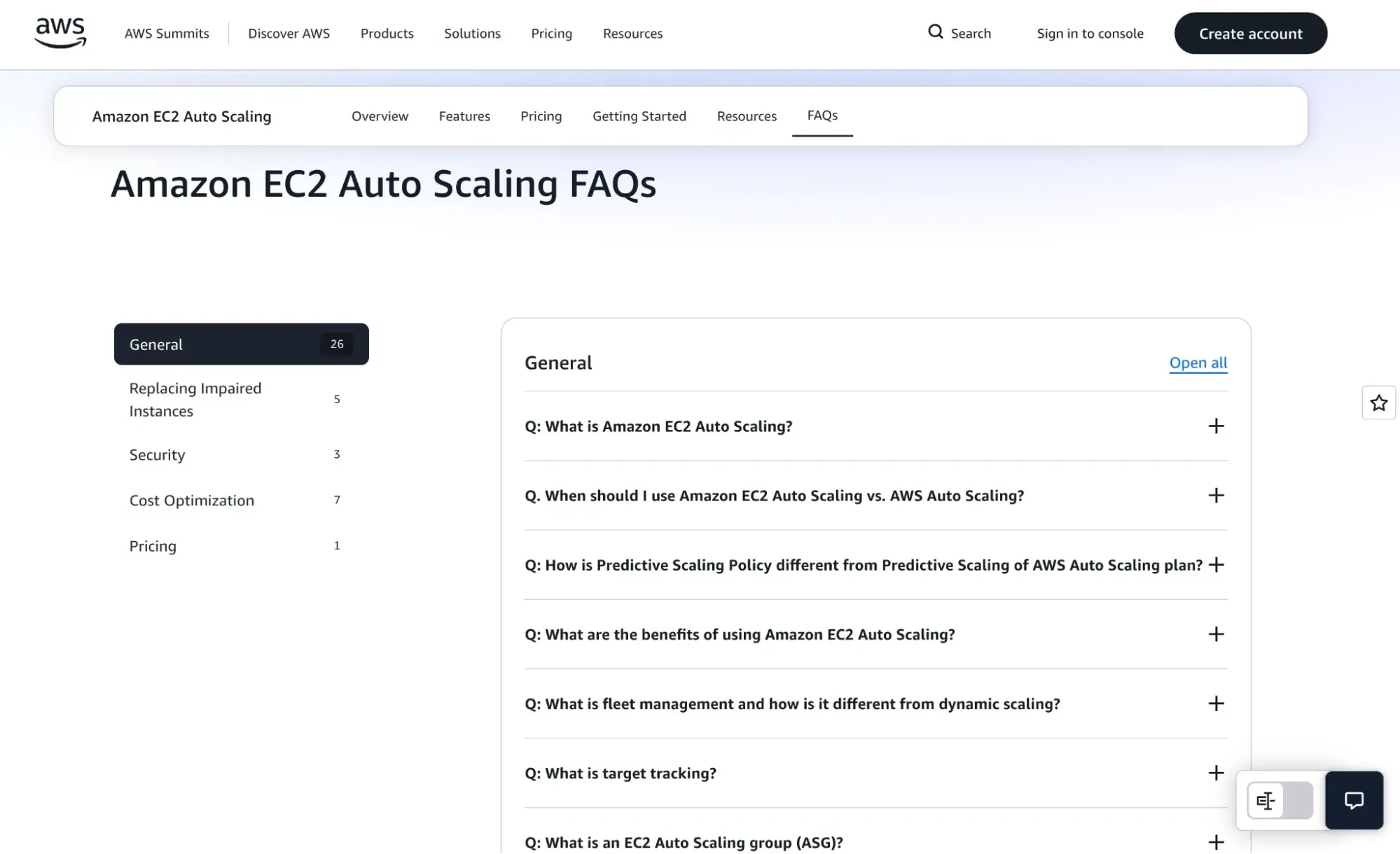
Choose One Topic Per FAQ Page and Define it Clearly: A focused FAQ page performs best. Attempting to cover unrelated topics (e.g., product features, pricing, onboarding, and compliance) on a single page weakens its thematic boundary and lowers the AI’s selection confidence. A focused page should have a clear thematic owner, offer comprehensive coverage of that single topic, and establish a distinct purpose. For example, a page dedicated solely to "EC2 Auto Scaling FAQs" (as seen with Amazon Web Services) offers high retrieval precision and strengthens authority signals for that specific topic.
-
Use a Consistent Question-and-Answer Pattern for Every Entry: Predictable hierarchy is favored by answer engines. Each FAQ entry must follow a repeatable structural pattern where question and answer boundaries are unambiguous. This includes using distinct headings (e.g., H2 or H3) for questions, placing the answer immediately below the question, and ensuring a clear visual separation between entries. If FAQs are presented within accordions, it is paramount that the answer text is rendered directly in the HTML on page load, preventing front-end design choices from impeding retrieval eligibility.
-
Write Answer-First Responses That Can Stand Alone When Quoted: Answer engines frequently extract isolated snippets. Therefore, each FAQ response must be self-sufficient. Direct, answer-first responses significantly increase the likelihood of AI citation because they minimize the interpretation required during extraction. Begin each answer with a direct resolution of the question, ideally within 40-60 words, without requiring prior explanation. Follow with concise supporting sentences or a short, scannable list (3-5 items) for steps or criteria. Avoid conversational openings, internal references that require context, or vague language.
-
Match Question Phrasing to Real-World Query Language: FAQ headers should directly reflect how users phrase questions in AI tools and search interfaces. Natural-language alignment improves retrieval matching. This involves using full sentences for questions, focusing on user-centric phrasing rather than internal jargon, and incorporating common question prefixes (e.g., "What is," "How do I," "Why is"). Clear query phrasing strengthens the alignment between user intent and page structure.
-
Add FAQ Schema Only After the Content is Structurally Stable: Schema markup reinforces existing structure; it cannot compensate for poor formatting. Once content is clearly organized and answer-first, FAQPage schema formally clarifies which text represents the question and which the answer for answer engines. This structured data identifies a list of question-and-answer pairs, helping systems distinguish prompts from responses. Implementation requires accurate JSON-LD or Microdata, ensuring that the schema precisely matches the visible on-page content. Schema acts as a structural verification layer, reducing ambiguity during machine interpretation.
Refining for Performance: Advanced AEO FAQ Optimization
Beyond foundational structure, ongoing optimization refines intent alignment, extractability, entity precision, authority, and measurement. While structure establishes eligibility, optimization determines competitive visibility.
-
Align FAQ Questions with Commercial Intent: Many FAQ sections focus solely on definitional queries, which support awareness but rarely influence evaluation or purchase-stage visibility. AEO optimization requires expanding coverage to include decision-oriented micro-intents. High-value questions address comparative aspects, implementation challenges, pricing models, common objections, or integration processes. For instance, questions like "What is the cost of implementing [Product X]?" or "How does [Solution A] compare to [Solution B]?" directly address evaluation-stage behavior, increasing the likelihood of content surfacing during commercially relevant prompts.
-
Optimize for Extractability Across Platforms: Answer engines prioritize passage completeness and synthesis efficiency. Content that can be reused with minimal rewriting is more likely to be cited. This means answers should be brief, self-contained, devoid of jargon, and avoid ambiguity. They should also be platform-agnostic, designed to be extracted cleanly by various AI interfaces without structural reconstruction. This principle underpins generative engine optimization frameworks, which emphasize clarity and structural coherence as primary citation drivers.
-
Reinforce Entity Clarity Within Each Answer: Consistent terminology strengthens an LLM’s confidence and understanding of entities. When terminology shifts unnecessarily, it weakens semantic reinforcement. If an FAQ references a product, use its official name consistently. If it defines a category, restate the core term rather than replacing it with stylistic synonyms. Clear entity framing supports association stability and reinforces E-E-A-T (Experience, Expertise, Authoritativeness, Trustworthiness) signals, aiding models in connecting brands, categories, and concepts over time.
-
Include Freshness and Source Signals: Answer engines evaluate credibility alongside clarity. Content that appears outdated or unsourced introduces risk during synthesis. Strengthening authority signals involves including the year directly in sentences containing statistics or time-sensitive claims, prominently featuring author names and publication dates, and providing internal and external links to reputable sources. Temporal specificity reduces ambiguity, and attribution reduces rewrite risk, both improving appearances within AI responses.

-
Connect FAQ Optimization to Visibility Measurement: Optimization without measurement limits strategic value. AEO FAQs should support broader AI visibility objectives, including brand mentions, citation frequency, sentiment framing, and share of voice across prompts. Operational measurement can include tracking changes in citation volume, monitoring sentiment around brand mentions in AI summaries, and analyzing traffic patterns from AI-generated results (if available). Benchmarking citation performance across AI platforms often requires dedicated visibility tracking tools, such as HubSpot’s AEO Grader, to identify which FAQ topics drive measurable citation gains. Crucially, recent BrightEdge research found that over 80% of AI-generated citations originate from pages outside conventional top-ranking results, underscoring that structural clarity and extractability often outweigh traditional positional dominance.
Strategic Considerations for FAQ Deployment
As organizations adapt to the AI-driven search environment, several common questions arise regarding the practical implementation and management of AEO-focused FAQs:
-
Optimal Question Volume: An AEO FAQ page should comprehensively cover a single, clearly defined topic. While there’s no fixed number, most well-scoped pages contain between 8 and 20 entries. The goal is to address the full decision arc related to a topic (definition, implementation, comparison, objections) without introducing repetitive or loosely related questions that dilute thematic focus.
-
Standalone vs. Embedded FAQs: Both approaches support AEO, serving different structural roles. Standalone FAQ pages consolidate topical authority for broad category-level queries (e.g., "FAQs for AEO"). Embedded FAQs on product or pillar pages reinforce evaluation-stage prompts and implementation questions directly relevant to that specific commercial content. The most robust strategy often combines both models, ensuring coherence and avoiding unnecessary duplication.
-
Schema Coexistence: A page can utilize FAQPage schema alongside other structured data types (e.g., Organization, Product, Article schema), provided each markup accurately reflects the visible content. The critical requirement is consistency: structured data must precisely match on-page wording, and FAQPage schema should only mark up actual question-and-answer pairs. Misaligned schema introduces ambiguity and weakens machine trust signals.
-
Content Refresh Cycle: AEO FAQs should be reviewed at least quarterly and updated whenever material changes occur in positioning, data, or buyer behavior. Regular reviews ensure answers remain citation-eligible and contextually accurate. Including the year directly in time-sensitive claims further reduces ambiguity, reinforcing entity stability as AI systems incorporate new sources.
-
Duplication Risks: Duplicating identical FAQ content across multiple URLs can dilute topical authority and create ambiguity regarding page citation preferences. Answer engines favor pages with clear subject ownership. If a question must appear in more than one location, the answer should be tailored to the specific context of that page, preserving semantic clarity and reinforcing expertise within distinct content clusters.
The Future of Content: Sustainable AI Visibility
FAQs for AEO are more than just a content format; they are structural assets critical for navigating the evolving digital landscape. They improve citation eligibility by isolating user intent, resolving it with clarity, and reinforcing consistent terminology across related questions. When FAQ sections align with buyer-stage prompts and adhere to answer-first formatting, they significantly expand retrieval surface area without fragmenting authority.
Sustainable AEO performance hinges on intentionality, not simply volume. Expanding FAQ libraries or generating vast quantities of AI-assisted pages alone will not guarantee selection by answer engines. AI systems prioritize clarity, specificity, and coherence. Therefore, content creators must focus on producing genuinely useful and structurally precise content. In this new era of AI-driven search, citation becomes a direct byproduct of quality, marking a fundamental shift in how digital visibility is achieved and maintained.