Global digital ad spend is projected to exceed $740 billion in 2026, a staggering figure that underscores the escalating investment in online advertising. However, this boom comes with a significant challenge: the proliferation of marketing channels is outpacing the ability of many organizations to effectively coordinate them. This complexity is precisely where the discipline of cross-channel marketing emerges as a critical solution, bridging the gap between fragmented efforts and a cohesive customer experience.
Cross-channel marketing represents a strategic and coordinated approach to engaging customers across paid, owned, and earned media. Its core principle lies in leveraging data from each channel to inform the messaging and timing of communications on others, ensuring a single campaign feels like a continuous narrative rather than a series of disconnected advertisements. For professionals navigating this intricate digital ecosystem, understanding and implementing cross-channel strategies is no longer a luxury, but a necessity for sustained growth and customer engagement.
Understanding the Core of Cross-Channel Marketing
At its heart, cross-channel marketing is about seamless integration. Operationally, successful cross-channel campaigns share three fundamental layers:
- A Unified Audience Definition: A single, well-defined audience is pushed across all relevant platforms, ensuring consistency in targeting.
- A Channel-Native Creative System: While the core message remains consistent, creative assets are adapted to perform optimally within the specific nuances of each channel.
- A Centralized Measurement Framework: Data from all channels is aggregated and analyzed to answer a singular return on investment (ROI) question, providing a holistic view of campaign performance.
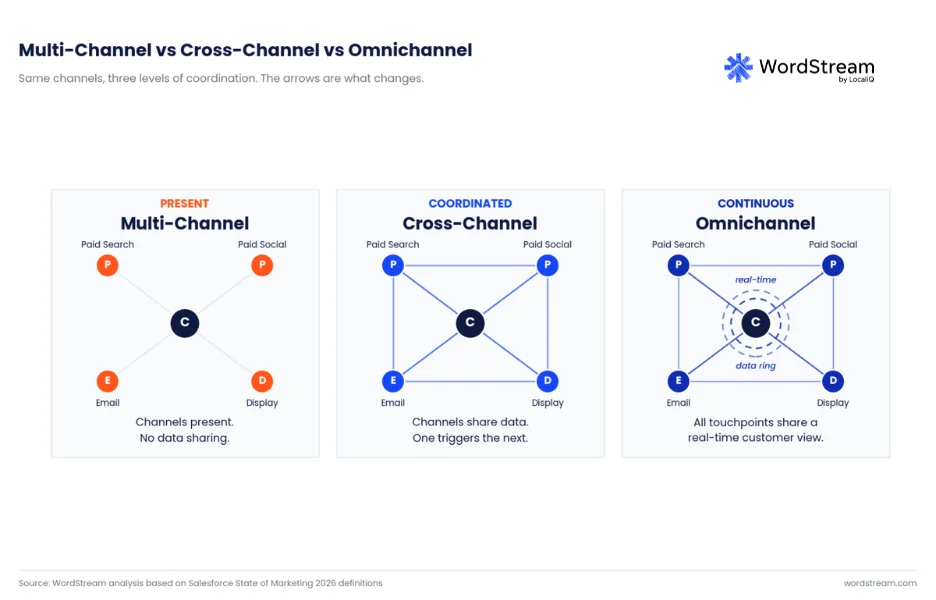
Without these elements, efforts can easily devolve into what is known as the "multichannel trap." This occurs when organizations utilize multiple channels—such as Google Ads, Meta, and email marketing—but these channels operate in silos, never sharing audience data or signals. Multichannel marketing focuses on broad coverage, whereas cross-channel marketing prioritizes intelligent coordination. The distinction is crucial: multichannel is about presence, while cross-channel is about synchronized action.

Navigating the Nuances: Cross-Channel vs. Multichannel vs. Omnichannel
The terminology surrounding customer engagement strategies can be confusing, with "multichannel," "cross-channel," and "omnichannel" often used interchangeably. However, subtle yet significant differences distinguish these approaches:
- Multichannel Marketing: This is the most basic level, characterized by the presence of a brand across multiple channels. However, these channels operate independently, with no data sharing or coordination. The customer experience can feel disjointed as each channel serves its own purpose.
- Cross-Channel Marketing: This represents a significant leap in coordination. Channels within a cross-channel strategy share data and influence each other. For instance, a customer’s interaction on one channel can trigger a specific action on another, creating a more fluid and relevant journey. This is often considered the ideal for many small to medium-sized businesses (SMBs) and mid-market companies.
- Omnichannel Marketing: This is the most advanced and integrated approach. Omnichannel aims for a truly seamless and unified customer experience across all touchpoints, both online and offline. It involves real-time data sharing across marketing, customer service, sales, and commerce platforms, offering a consistent and context-aware interaction regardless of how the customer chooses to engage. While aspirational for many, achieving true omnichannel requires significant technological infrastructure and data maturity.
The practical implication for most businesses is that aiming for cross-channel marketing provides a substantial improvement over multichannel without the overwhelming complexity and investment typically associated with full omnichannel implementation.
The Evolving Channels in a Cross-Channel Mix
The specific channels that constitute a cross-channel marketing mix are highly dependent on the business’s industry, target audience, and marketing objectives. Marketers today are engaging customers across an average of 10 distinct channels. However, high-performing marketers are adept at personalizing experiences across approximately six of these channels, according to Salesforce’s State of Marketing Report. The gap between the number of channels utilized and the number effectively coordinated highlights the pervasive "cross-channel problem."
The key to a successful cross-channel mix is not the sheer number of channels employed, but rather the strategic integration of those channels. This means ensuring that the chosen channels share audiences, triggers, and measurement data. For small businesses with limited resources, a cross-channel mix might consist of just two or three carefully coordinated channels that work in tandem to achieve specific campaign goals.
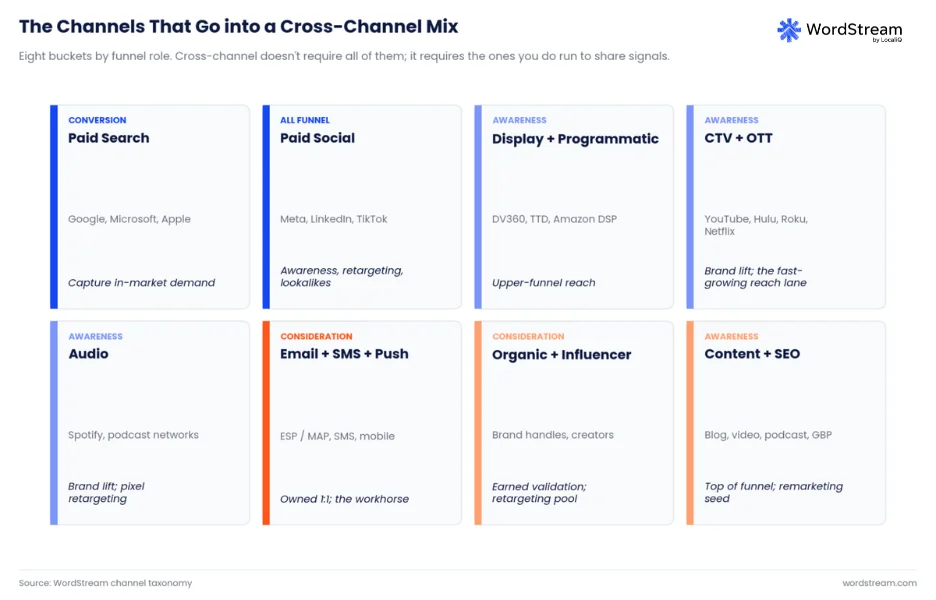
The common channels that can be incorporated into a cross-channel strategy, categorized by their funnel role, include:
- Conversion-Focused Channels:
- Paid Search/Shopping: Platforms like Google Ads, Microsoft Ads, and Apple Search Ads are crucial for capturing immediate, in-market demand and can serve as valuable sources for feeding audiences into other channels.
- All-Funnel Channels:
- Paid Social: Networks such as Meta (Facebook, Instagram), LinkedIn, TikTok, Pinterest, and Reddit are versatile, supporting awareness campaigns, retargeting efforts, and seeding lookalike audiences.
- Awareness-Focused Channels:
- Display/Programmatic/CTV/OTT: These channels, including platforms like DV360, The Trade Desk, and Amazon DSP, excel at broad upper-funnel reach. Connected TV (CTV) and Over-The-Top (OTT) streaming services are identified as significant growth areas for 2026.
- Audio: Spotify, podcast networks, and programmatic audio advertising offer opportunities for brand lift and can facilitate retargeting through pixel-enabled hosts.
- Owned Channels:
- Email, SMS, and Push Notifications: These direct communication channels (often managed through Email Service Providers (ESPs) or Marketing Automation Platforms (MAPs)) are the workhorses for direct, 1:1 customer engagement and nurturing.
- Earned Channels:
- Organic Social Media and Influencer Marketing: Brand-managed social media accounts, collaborations with creators, and affiliate programs provide earned validation and can expand retargeting pools.
- Top-of-Funnel Channels:
- Content and SEO: Blogs, videos, and podcasts serve as magnets for attracting new audiences at the top of the funnel, often providing valuable remarketing seeds.
- Offline Channels:
- Direct Mail, Out-of-Home (OOH)/Digital Out-of-Home (DOOH), Events, and In-Store: These traditional channels can significantly boost reach and can be measured through unique URLs, QR codes, or promotional codes, bridging the online-offline divide.
The strategic decision lies in selecting channels that align with the overall marketing funnel and ensuring that the selected channels are not operating in isolation but are actively sharing data and signals.
The Tangible Benefits of Cross-Channel Marketing
Implementing a cross-channel marketing strategy requires upfront effort and investment, but the rewards can be substantial. While it may not directly lead to a surge in raw, incremental leads or sales, its primary value lies in optimizing existing spend and improving the efficiency of marketing efforts. The key benefits include:
- Enhanced Customer Experience: By providing a consistent and relevant journey, cross-channel marketing fosters stronger customer relationships and improves brand perception.
- Improved Conversion Rates: Tailored messaging and timely interventions across channels can significantly increase the likelihood of conversion.
- Increased Customer Lifetime Value (CLTV): A superior customer experience and personalized engagement contribute to greater customer loyalty and repeat business.
- Optimized Marketing Spend: By coordinating efforts and avoiding message fatigue, businesses can allocate their budgets more effectively, reducing wasted ad impressions and improving ROI.
- Deeper Customer Insights: The integrated data flow provides a more comprehensive understanding of customer behavior across different touchpoints.
Ultimately, cross-channel marketing is about maximizing the yield from current marketing investments through intelligent coordination, rather than solely focusing on expanding reach.
Building a Robust Cross-Channel Marketing Strategy
A successful cross-channel marketing strategy is built upon a foundation of clear objectives and a deep understanding of the target audience. The process involves several key steps:
-
Define a Singular Audience: Begin by establishing a unified audience definition outside of individual ad platforms. This "source of truth" can be derived from a Customer Relationship Management (CRM) system, a Customer Data Platform (CDP), or even a well-maintained spreadsheet. This single definition is then pushed to all relevant platforms, such as Google Ads Customer Match, Meta Custom Audiences, and email service providers.
-
Map the Customer Journey to Channels: Instead of allocating budget and then fitting the customer journey, reverse the process. First, map out the customer journey, identifying the optimal channel, message, and next best action for each stage. This customer-centric approach ensures that marketing efforts are aligned with how customers actually interact with a brand.
-
Establish a Unified Creative System: Aim for consistency in creative assets, offers, and the overall brand experience across all channels. A single campaign-level promise, featuring a core offer and proof point, should be translated into channel-native executions that resonate with each platform’s audience.
-
Wire Up Identity and Signal Sharing: Crucially, ensure that all ad platforms are aware of key customer actions, such as purchases, form submissions, or calls. This seamless flow of information is essential for accurate reporting. For many businesses, enabling features like Enhanced Conversions in Google Ads and the Conversions API in Meta are critical, often achievable within an afternoon. For more complex needs, server-side tagging solutions can provide a robust data pipeline.
-
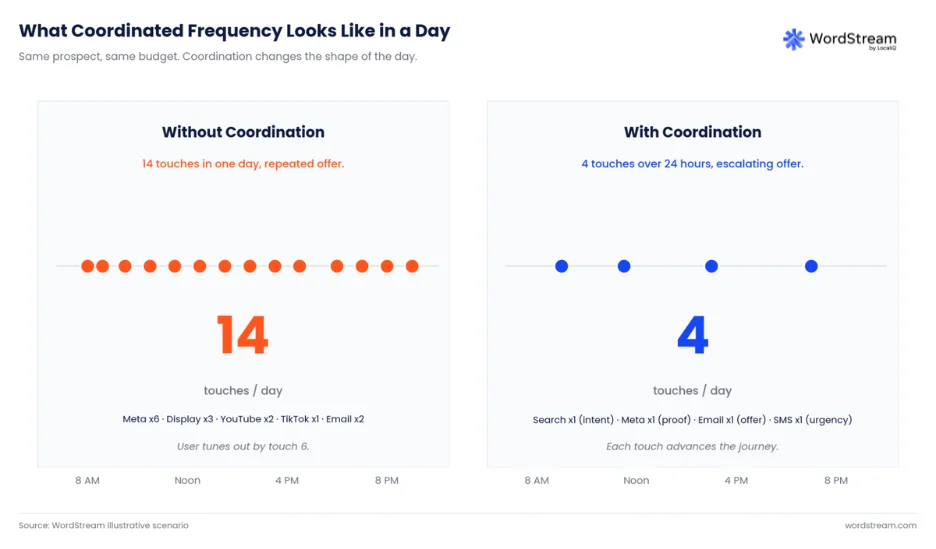
Implement Cross-Channel Frequency Caps: A significant benefit of cross-channel marketing is the ability to prevent message fatigue. Instead of capping ad impressions independently within each platform (multichannel capping), establish frequency caps across all channels combined. This requires a unified user ID and identity resolution to accurately track exposures to the same individual across different platforms.
-
Decide on the Measurement Frame Before Launch: Define what "success" looks like before initiating any campaign. Identify one or two key marketing KPIs, such as cost per lead or return on ad spend, and document them prior to launch. This prevents the temptation to cherry-pick favorable metrics from individual dashboards and ensures accountability.
Illustrative Cross-Channel Marketing Examples
To further clarify the practical application of cross-channel marketing, consider these examples:
-
Example 1: B2C E-commerce (Apparel Brand)
An apparel brand integrates its browse-abandon and cart-abandon audiences from a single customer data source into Meta, Google Ads, and Klaviyo. A website browse triggers a retargeting ad, capped at a total of three impressions across all three platforms combined. An email follow-up is sent 24 hours later, and for opted-in users, an SMS is dispatched at 48 hours. The critical cross-channel element here is the unified identity match, ensuring the frequency cap is enforced across the entire mix, preventing repetitive ad exposure and optimizing budget. -
Example 2: B2B SaaS/Account-Based Marketing (ABM)
In B2B sales, where buying decisions often involve a group of stakeholders, cross-channel coordination is paramount. An Account-Based Marketing (ABM) platform can monitor the digital activity of individuals within target accounts across platforms like LinkedIn, display networks, and the company website. When engagement signals from a target account intensify, the platform can automatically trigger direct mail campaigns to that account. Conversely, if engagement wanes, outreach can be paused. This ensures that all marketing efforts are synchronized with account-specific intent signals, moving beyond independent channel actions. -
Example 3: Local and Multi-Location SMB (Auto Service Shop)
A local auto-service shop leverages Local Services Ads, Google Ads, Meta, organic Google Business Profile listings, and email marketing. The cross-channel integration occurs when phone call conversions from Google Ads are fed back into Meta as custom conversion events. This allows the shop to retarget individuals who called for a brake quote with a more relevant offer, such as an oil change promotion, rather than a generic "schedule service" ad they may have already disregarded. Server-side tagging and a marketing services partner can facilitate this data flow for multi-location SMBs without requiring a full CDP.
Measuring Success in a Post-Cookie World
The landscape of digital advertising measurement has become increasingly complex, particularly with the ongoing deprecation of third-party cookies. Multi-touch attribution coverage has declined significantly, and the rise of AI-powered research platforms further complicates the tracking of customer journeys. This means that traditional measurement models often miss a substantial portion of conversions.
To combat this leakage and gain accurate insights, a robust measurement stack is essential. This typically involves:
- Server-Side Tracking: Ensures clean and reliable data inputs from various platforms.
- Platform-Specific Attribution Models: Utilizing models like Google Analytics 4’s data-driven attribution for day-to-day optimization, provided sufficient conversion volumes are met.
- Media Mix Modeling (MMM): For strategic budget allocation, MMM offers a higher-level view of channel effectiveness over longer periods.
- Incrementality Testing: Regularly conducting incrementality tests provides causal validation of marketing efforts.
Key performance indicators (KPIs) that truly matter for cross-channel marketing include:
- Incremental Lift: Measuring the actual, attributable increase in conversions or revenue due to specific cross-channel initiatives.
- Customer Lifetime Value (CLTV): Assessing the long-term value of customers acquired or retained through coordinated efforts.
- Cross-Channel ROAS: A holistic view of return on investment across all integrated channels, rather than isolated platform ROAS figures.
- Brand Lift: Measuring the impact of coordinated campaigns on brand awareness and perception.
- Customer Journey Completion Rate: Tracking how effectively customers move through defined cross-channel paths.
It is crucial to avoid common measurement pitfalls, such as relying solely on last-click attribution, which unfairly credits only the final touchpoint, or summing up individual platform ROAS figures, which often leads to inflated and unrealistic performance numbers.
Common Cross-Channel Marketing Mistakes to Avoid

Even with the best intentions, several common mistakes can derail cross-channel marketing efforts:
- Treating Channels as Silos: The fundamental error is failing to integrate data and communication flows between channels.
- Lack of a Unified Audience: Using disparate audience definitions across platforms undermines targeting accuracy and message consistency.
- Inconsistent Messaging: Presenting conflicting offers or brand messages across different channels confuses customers and dilutes campaign impact.
- Ignoring Frequency Capping: Over-exposing prospects to ads across multiple channels leads to ad fatigue and wasted spend.
- Poor Data Integration: Technical limitations or a lack of focus on data flow prevent the realization of cross-channel benefits.
- Measuring in Isolation: Relying on channel-specific metrics without a unified measurement framework leads to an incomplete and often misleading understanding of performance.
The Future of Customer Engagement: Cross-Channel as a Growth Engine
Cross-channel marketing is no longer a nascent concept but a proven methodology for driving leads, conversions, and sustainable business growth. By blending sophisticated creative strategies, the intelligent application of technology, and a deep understanding of buyer psychology, organizations can create impactful customer journeys that resonate across multiple touchpoints.
The adaptability of cross-channel marketing allows it to be scaled to fit a diverse range of business needs, from large enterprises to local businesses. Whether it’s an e-commerce retailer looking to recapture abandoned carts, a B2B company aiming to engage complex buying committees, or a local service provider seeking to optimize its digital presence, cross-channel strategies offer a powerful framework for success. As the digital advertising landscape continues to evolve, mastering the art and science of cross-channel coordination will be a key differentiator for businesses striving to connect with their audiences in a meaningful and effective way.