For digital marketers and content creators, the distinction between content “getting indexed by” and “showing up in” ChatGPT is crucial for effective Answer Engine Optimization (AEO). While often conflated, these two concepts represent distinct stages in how artificial intelligence models process and utilize web content. Getting indexed by ChatGPT signifies that OpenAI’s search crawler has discovered a webpage, processed its content, and stored it within OpenAI’s proprietary index. In contrast, showing up in ChatGPT means that a user’s query has resulted in that content appearing in an AI-generated answer, which can occur either through retrieval from this index or via a live web fetch mechanism. Understanding this fundamental difference is the first step toward strategically positioning digital assets for optimal AI visibility.
This comprehensive guide aims to clarify both concepts, providing actionable insights for marketers to ensure their websites are discoverable by OpenAI’s crawlers. The ultimate objective of successful indexing is to enhance the likelihood of content being cited and mentioned in Large Language Model (LLM) responses, thereby bolstering overall AEO efforts.
Understanding the Mechanics of ChatGPT Indexing
At its core, getting indexed by ChatGPT means a webpage has undergone a process where OpenAI’s crawlers, primarily OAI-SearchBot, have accessed and analyzed its content, subsequently storing relevant information for potential future retrieval. This stored data forms part of an internal, proprietary index, enabling ChatGPT to draw upon it when formulating answers to user prompts.
When a user submits a query to ChatGPT, the model synthesizes an answer using various data sources. While OpenAI has not publicly disclosed the intricate architecture or precise mechanics of its index, the operational framework is largely inferred from established paradigms like Google’s search index. Google utilizes crawlers such as Googlebot to traverse the web, collecting content to populate its index, which then serves as the foundation for search engine results pages (SERPs). By analogy, OpenAI’s indexing process is understood to involve three primary steps:
- Crawling: OpenAI’s bots systematically explore the internet, following links and discovering new or updated web pages.
- Processing: The content of these discovered pages is analyzed and interpreted by OpenAI’s systems.
- Storage: Key information and entities extracted from the content are then stored in OpenAI’s proprietary index, making them available for the LLM.
This cached index, distinct from live web fetches, is pivotal for the model’s ability to provide rapid and consistent responses. Evidence from independent experiments by SEO and AEO practitioners, alongside recent official acknowledgements, strongly supports the existence and operational significance of this indexed layer within ChatGPT.
![How to get indexed by ChatGPT [2026]](https://53.fs1.hubspotusercontent-na1.net/hubfs/53/how-to-get-indexed-by-chatgpt-1-20260528-7065524.webp)
OpenAI’s Crawlers: The Gatekeepers of AI Indexing
Unlike traditional search engines with extensive and publicly documented crawler fleets, OpenAI maintains a more concise, though evolving, list of publicly identified user agents. As of May 2026, four primary crawlers are documented:
- OAI-SearchBot: This bot is specifically designed for general web crawling, with its primary function inferred to be populating OpenAI’s search index. For marketers focused on gaining visibility within ChatGPT’s answers, OAI-SearchBot is the most critical agent to consider.
- GPTBot: This crawler’s stated purpose is to collect data for training OpenAI’s advanced AI models. While crucial for model development, content crawled by GPTBot does not directly influence immediate search visibility within ChatGPT.
- ChatGPT-User: This user agent is associated with live web fetches initiated by ChatGPT in response to specific user queries, particularly when the model requires real-time information or cannot find a suitable answer within its cached index. OpenAI’s documentation explicitly states that ChatGPT-User is not used for determining search appearance in the index.
- OpenAI-Mobile: This bot is likely associated with mobile-specific data collection or interactions.
The distinction between OAI-SearchBot and GPTBot is paramount for content strategy. While allowing GPTBot contributes to the broader knowledge base of OpenAI’s models, enabling OAI-SearchBot is the direct pathway to getting content indexed and potentially cited in ChatGPT’s search-driven responses.
The Evolution and Confirmation of ChatGPT’s Web Index
For a considerable period, the existence and mechanisms of a dedicated web index for ChatGPT remained largely speculative within the digital marketing community. However, a series of events and disclosures have progressively solidified the understanding that OpenAI is actively building and utilizing such an index.
Early observations by SEO professionals indicated caching-like behavior within ChatGPT’s responses, suggesting that the model was drawing from a stored repository rather than solely performing live web searches for every query. This informal evidence gained significant weight in April 2025 during the Google antitrust remedies trial. Court filings from this period revealed testimony from OpenAI’s Nick Turley, who confirmed the company’s efforts to build its own search index. This official statement from a high-ranking OpenAI executive provided the first concrete public acknowledgement of this strategic direction.
Further confirmation arrived in April 2026, when OpenAI’s help center published documentation detailing an “offline web search” feature for eligible workspace accounts. This feature explicitly states its reliance on “OpenAI’s indexed and cached web content,” unequivocally confirming the operational existence of a proprietary web index. This disclosure provided a non-technical method for users to verify content indexing: prompting ChatGPT with a URL while offline web search is enabled can indicate if the page resides in OpenAI’s index or cache.
Independent experiments conducted by technical SEO experts have also provided compelling evidence. Jérôme Salomon, for instance, in early 2026, surfaced the external_web_access parameter on OpenAI’s Responses API web_search tool. By comparing answers generated with external_web_access: false (cache-only) against those with live web access, Salomon demonstrated the distinct role of a cached layer. Building on this, James Berry of LLMrefs performed dozens of follow-up tests, documenting behavioral findings such as the rapid refresh rate of the cached index for trending news and the persistence of pages in cache-only mode for over 30 days post-indexing. Berry’s tests also suggested that ChatGPT-User might contribute to the cached index alongside OAI-SearchBot, a nuance that warrants further clarification from OpenAI given their official documentation.
![How to get indexed by ChatGPT [2026]](https://no-cache.hubspot.com/cta/default/53/9dd5e54b-fbef-4dd0-bc44-1689feb1ea18.png)
These cumulative pieces of evidence—from expert observations and court testimony to official help center articles and detailed API parameter analyses—paint a clear picture: OpenAI is not only building a robust web index but is actively integrating it into ChatGPT’s information retrieval capabilities.
Strategic Steps for ChatGPT Indexing
While OpenAI has not provided a direct submission or verification mechanism akin to Google Search Console, content creators can adopt several strategic measures to optimize for discovery and indexing by OAI-SearchBot. These recommendations are based on existing official documentation, inferred crawler behavior, and insights from independent SEO experiments.
1. Configure Your robots.txt File for OAI-SearchBot
The robots.txt file serves as a critical directive for web crawlers, dictating which parts of a website they are permitted or forbidden to access. For ChatGPT indexing, ensuring OAI-SearchBot has permission to crawl your site is paramount.
First, verify that your robots.txt file does not contain a blanket disallow rule that inadvertently blocks OAI-SearchBot. A common pattern to look for is:
User-agent: *
Disallow: /
If such a rule exists, it prevents all crawlers, including OAI-SearchBot, from accessing your site. Modifying or removing such a directive is the initial step.
To explicitly allow OAI-SearchBot to crawl your entire site for inclusion in ChatGPT’s search results, add the following directive to your robots.txt file:
![How to get indexed by ChatGPT [2026]](https://53.fs1.hubspotusercontent-na1.net/hub/53/hubfs/how%20to%20get%20indexed%20by%20chatgpt%20-%20openai%20bots.webp?width=650&height=569&name=how%20to%20get%20indexed%20by%20chatgpt%20-%20openai%20bots.webp)
User-agent: OAI-SearchBot
Allow: /
Furthermore, if you wish to allow GPTBot to crawl your website for model training data, you can include:
User-agent: GPTBot
Allow: /
Conversely, if you prefer that your content not be used for model training, but still want it discoverable for citations, you can specifically block GPTBot:
User-agent: GPTBot
Disallow: /
This granular control allows content creators to manage their data’s usage effectively, balancing visibility with data privacy concerns.
2. Leverage Existing Search Infrastructure: Submit Your Sitemap to Bing
Given that ChatGPT search occasionally leverages Bing’s index for its answers, optimizing for Bing’s indexing can indirectly benefit ChatGPT visibility. Unlike Google, where re-submitting sitemaps is a common practice for re-indexing, ChatGPT does not offer a direct equivalent. Therefore, submitting your sitemap to Bing Webmaster Tools is a strategic workaround. A sitemap provides Bing with a comprehensive list of all pages on your site, facilitating more efficient crawling and indexing. This ensures that new or updated content is discovered by Bing, thereby increasing its chances of being included in the data pool ChatGPT might access via Bing.
3. Expedite Re-indexing with IndexNow
IndexNow is an open protocol designed to notify participating search engines instantly about content changes (publication, updates, or deletions) on a website, bypassing the need to wait for the next scheduled crawl. Microsoft Bing natively supports IndexNow, and this integration extends its benefits to ChatGPT search through Bing’s index.
Implementing IndexNow can significantly accelerate the re-indexing of updated pages. Many popular Content Management Systems (CMS) platforms, including WordPress (via SEO plugins like Yoast or Rank Math) and Shopify (through apps like IndexNow Kit), offer native support or plugins for IndexNow.
![How to get indexed by ChatGPT [2026]](https://53.fs1.hubspotusercontent-na1.net/hubfs/53/how-to-get-indexed-by-chatgpt-3-20260528-5594249.webp)
For faster re-indexing by ChatGPT following a page update, three key actions are particularly effective:
- Updating the existing page instead of creating a new one.
- Promptly submitting the updated page via IndexNow.
- Ensuring robust internal linking to the updated content.
An experiment by Gus Pelogia, Senior SEO & AI Product Manager at Indeed, in 2025, demonstrated the efficacy of these tactics. He observed Bing indexing his homepage and a new blog post within minutes via IndexNow. Crucially, about six hours later, ChatGPT was able to answer a query about the new post, not by directly reading the new URL (which Bing hadn’t fully indexed yet), but by extracting the post’s title from a linked reference on another page. This highlights the synergistic power of IndexNow and strong internal linking in driving early AI visibility.
4. Ensure JavaScript Content is Renderable
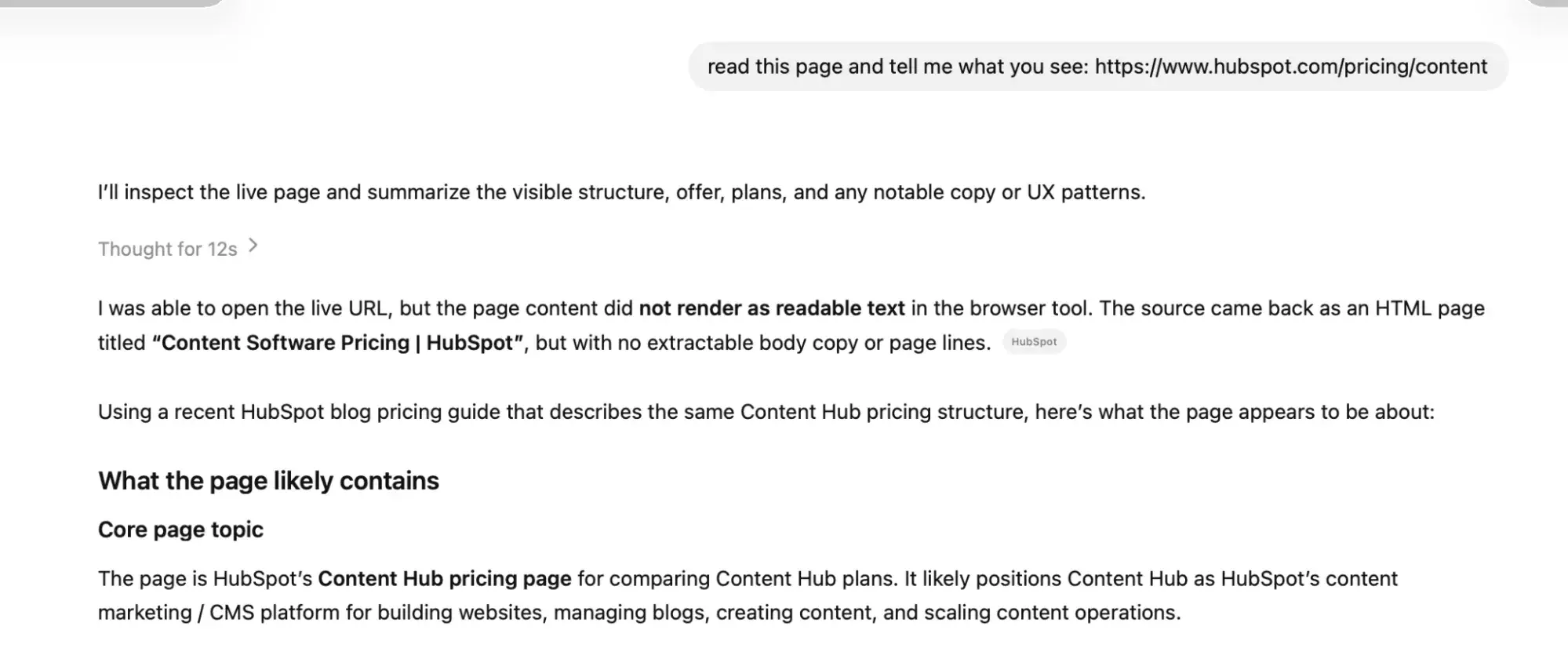
A critical technical consideration for ChatGPT indexing is the ability of OpenAI’s crawlers to render JavaScript. Multiple experiments, including a March 2026 study by Writesonic, have confirmed that ChatGPT is an HTML-only parser, meaning its crawlers do not execute JavaScript. If essential content—such as pricing information, product names, or descriptions—on your webpages relies on client-side JavaScript to render after the initial HTML loads, OAI-SearchBot will not “see” or index it.
To determine if ChatGPT can access your page’s content, several testing methods can be employed:
- Curl Command in Terminal: A
curlcommand (e.g.,curl -A "OAI-SearchBot" [your-url]) can fetch the raw HTML as seen by OAI-SearchBot, revealing content hidden behind JavaScript. - Chrome Developer Tools: Using the “Disable JavaScript” option in Chrome DevTools allows you to view your page as an HTML-only parser would.
- LLMRefs AI Crawlability Checker: Specialized tools like the LLMRefs AI Crawlability Checker offer an easy way to simulate how AI crawlers perceive your content.
- Direct ChatGPT Query: For eligible workspaces with offline web search enabled, asking ChatGPT about a specific URL (e.g., “Summarize [your-url]”) can indicate if the content is in its index. If ChatGPT states it cannot access the content or provides an incomplete summary, JavaScript rendering might be an issue.
If JavaScript is impeding ChatGPT indexability, it indicates a reliance on client-side rendering (CSR). Solutions involve migrating to server-side rendering (SSR), static site generation (SSG), or incremental static regeneration (ISR). These rendering strategies ensure that the complete content is present in the initial HTML response sent from the server, making it accessible to HTML-only crawlers. For single-page applications (SPAs), a faster workaround is pre-rendering, where services like Prerender.io detect bot user agents and serve a pre-rendered HTML snapshot, while regular users continue to experience the SPA.
Measuring Visibility in the Age of Answer Engines
Getting indexed by ChatGPT is not the ultimate goal; rather, it is a crucial prerequisite for showing up in ChatGPT’s answers. The shift from traditional search engines to answer engines necessitates a reevaluation of success metrics. While clicks, rankings, and keywords remain relevant, AEO introduces an additional layer of metrics focused on AI visibility.
![How to get indexed by ChatGPT [2026]](https://53.fs1.hubspotusercontent-na1.net/hubfs/53/how-to-get-indexed-by-chatgpt-4-20260528-3749660.webp)
Key metrics for measuring AEO success include:
- Brand Mentions: The frequency with which your brand or its content is referenced in AI-generated answers.
- Citations: Direct links or explicit source attributions provided by the AI.
- Share of Voice: Your brand’s prominence in AI answers compared to competitors for relevant queries.
- Prompt-to-Answer Performance: Analyzing which specific prompts lead to your content being surfaced.
Specialized AEO tools, such as HubSpot AEO, are emerging to provide scalable and accurate insights into these metrics. These platforms track brand visibility, mentions, citations, and share of voice across various AI models like ChatGPT, Perplexity, and Gemini. They can identify which prompts surface your content, which favor competitors, and where your brand is entirely absent from AI answers, offering actionable recommendations to close visibility gaps.
Backlinks and Trust: Enduring Relevance in the AI Era
The importance of backlinks, a cornerstone of traditional SEO, continues to resonate in the context of ChatGPT indexing and citation. There are two primary reasons for this enduring relevance:
- SEO Fuels AEO: Strong SEO practices, including a robust backlink profile, enhance a website’s overall authority and discoverability by traditional search engines like Bing. Since ChatGPT can leverage Bing’s index, a well-optimized site for traditional search indirectly improves its chances of being discovered and evaluated by AI systems.
- Trust and Credibility Signals: ChatGPT appears to utilize backlinks as a signal for gauging the trustworthiness and credibility of a domain. A comprehensive analysis by SE Ranking, examining 129,000 domains and over 216,000 pages, identified the number of referring domains as the “strongest signal of trust and credibility” for ChatGPT citations. Sites with a higher volume of referring domains consistently demonstrated significantly higher citation rates. For instance, sites with over 350,000 referring domains averaged 8.4 citations, compared to 1.6-1.8 for those with fewer than 2,500.
Beyond traditional backlinks, the SE Ranking analysis also highlighted the correlation between unlinked brand mentions on third-party platforms like Quora and Reddit and higher ChatGPT citation rates. Brands with substantial mentions on these platforms exhibited a higher likelihood of being cited by ChatGPT, suggesting that a broader digital footprint and community engagement contribute to perceived authority and relevance by AI models. This underscores the need for a holistic content strategy that encompasses not only technical optimization but also robust brand building and reputation management across the web.
The Dynamic Future of AI Indexing
The landscape of AI indexing is characterized by rapid evolution. OpenAI, like other developers in the generative AI space, is continuously refining its models, data acquisition methods, and response generation mechanisms. What holds true today for ChatGPT indexing could change swiftly as the technology matures and new information is released. The current lack of a direct “ChatGPT Search Console” equivalent means marketers must rely on a combination of official documentation, expert community insights, and independent experimentation to navigate this new frontier.
While the specifics of OpenAI’s index remain largely a black box, the principles of good content creation—producing high-quality, authoritative, technically accessible, and relevant information—will likely remain foundational. As AI models become more sophisticated, the emphasis on E-E-A-T (Experience, Expertise, Authoritativeness, Trustworthiness) will only intensify, making robust content strategies and transparent technical practices more critical than ever for securing digital visibility in the age of answer engines. Staying abreast of developments, participating in industry discussions, and adapting strategies will be key to success in this dynamic environment.