The landscape of digital marketing and conversion rate optimization (CRO) has undergone a fundamental transformation as artificial intelligence transitions from a speculative tool to a foundational element of daily operations. For experimentation teams, the integration of AI has become a double-edged sword; while it promises unprecedented speed in generating copy and analyzing data, the reliance on general-purpose AI tools has introduced significant operational friction. The industry is currently witnessing a pivotal shift away from external, “copy-paste” AI workflows toward integrated intelligence layers, a movement punctuated by the recent strategic consolidation of industry leaders AB Tasty and VWO into a single entity: Wingify. This merger, and the subsequent launch of its AI layer “Wandz,” signals a new era where experimentation intelligence is no longer an external consultant but a core component of the testing infrastructure.
The Strategic Shift in Digital Experimentation
For years, experimentation teams—responsible for A/B testing, personalization, and user experience (UX) improvements—have operated under a high-pressure mandate to move quickly while maintaining statistical rigor. As the volume of data generated by modern web platforms increased, teams began turning to Large Language Models (LLMs) like OpenAI’s ChatGPT or Google’s Gemini to synthesize results. The standard operating procedure involved exporting CSV files of test results, taking screenshots of heatmaps, and manually inputting performance notes into external prompts to seek insights or new test ideas.
However, industry analysts have noted that this fragmented approach creates a “context gap.” General-purpose AI tools, while linguistically sophisticated, operate in a vacuum. They lack visibility into a company’s specific test configurations, historical experiment data, audience segment nuances, and the overarching business objectives that dictate whether a 2% lift in a secondary metric is actually a success or a distraction. The emergence of Wingify’s Wandz represents a direct response to this fragmentation, embedding AI directly into the environment where the data is born and the experiments are executed.
The Wingify Merger: A Timeline of Consolidation
The path to integrated experimentation AI is best understood through the timeline of industry consolidation. AB Tasty and VWO have long been recognized as dominant forces in the experience optimization market. AB Tasty, headquartered in France, established a strong foothold in the European and North American markets with a focus on experience optimization and feature management. VWO, founded by Paras Chopra, became a global powerhouse by democratizing A/B testing for mid-market and enterprise brands alike.
The decision to join forces as Wingify marks one of the most significant mergers in the CRO space. This consolidation was driven by a shared recognition that the next frontier of growth for brands would not be found in better testing tools alone, but in the intelligence that powers those tools. By combining their respective AI initiatives—AB Tasty’s “Evi” and VWO’s “Copilot”—Wingify has created Wandz, a unified AI layer designed to oversee the entire experimentation lifecycle.
This move follows a broader trend in the software-as-a-service (SaaS) industry where “point solutions” are being replaced by integrated platforms that leverage proprietary data to provide contextual AI responses. In the context of Wingify, this means the AI does not just see the results of a test; it understands the hypothesis that led to the test, the technical constraints of the website, and the specific behavior of the audience segments involved.
The Technical Fallacy of External AI Workflows
The reliance on external AI tools for experimentation analysis introduces three primary risks: data integrity, manual friction, and the loss of context. When a marketing team exports data to an external tool, they are essentially stripping away the metadata that gives that information value.
- The Context Gap: An external AI does not know that a “Variation B” was designed specifically for mobile users on a slow connection. Without that context, the AI might suggest a “Variation C” that is heavy on high-resolution imagery, inadvertently sabotaging the user experience.
- Operational Friction: The “copy-paste” workflow creates a bottleneck. A team might gain a brilliant insight from an external AI, but they must then manually return to their testing platform to configure the metrics, define the audience, and set up the traffic allocation. This back-and-forth limits the number of experiments a team can run annually.
- The Hallucination Risk: General AI tools are programmed to be helpful, often leading them to provide confident answers even when they lack sufficient data. In experimentation, where statistical significance is the difference between a winning strategy and a costly mistake, these “hallucinations” can lead to the implementation of false positives.
By contrast, an internal AI layer like Wandz has access to the “source of truth.” It can verify the traffic split, check if the primary metric was reached, and cross-reference the current results with previous tests conducted on the same page. This allows for a level of accuracy that general-purpose tools cannot replicate.
Wandz: A Deep Dive into Integrated Intelligence
Wingify’s Wandz is positioned not as a chatbot, but as an orchestration layer. It is designed to assist at four critical stages of the experimentation journey:
1. Hypothesis Generation and Ideation
Instead of asking an AI for “ideas to improve a landing page,” Wandz allows users to ask questions grounded in their specific data. Because the AI is connected to the platform’s analytics, it can identify patterns—such as a specific drop-off point in the checkout funnel—and suggest hypotheses rooted in observed user behavior. It can also ingest external assets, such as competitor design mockups or internal project briefs, to ensure that new test ideas align with the brand’s visual identity and business goals.
2. Quality Assurance and Configuration Review
One of the most common causes of failed experiments is improper setup. Wandz acts as a built-in auditor, reviewing campaign configurations before they go live. It can flag inconsistencies in audience targeting or warn a user if the traffic allocation is unlikely to yield statistically significant results within the desired timeframe. This preventative measure reduces the “wasted” time associated with broken or inconclusive tests.
3. Real-Time Result Synthesis
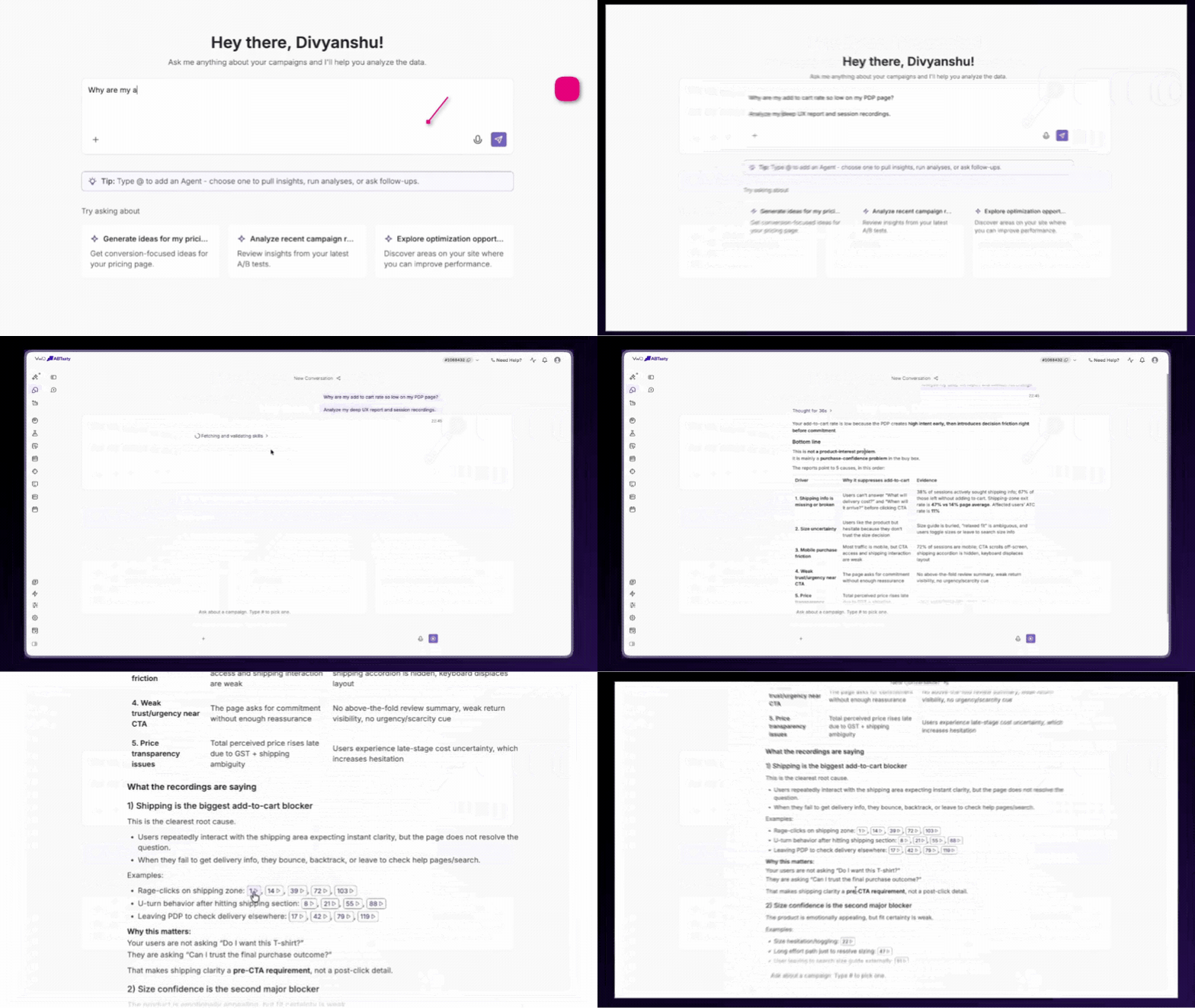
Wandz enables users to query their data using natural language. A growth manager can ask, “How did the new header perform among returning visitors in the UK compared to the US?” The AI generates the answer instantly by pulling from the platform’s segmented data, eliminating the need for manual report building.
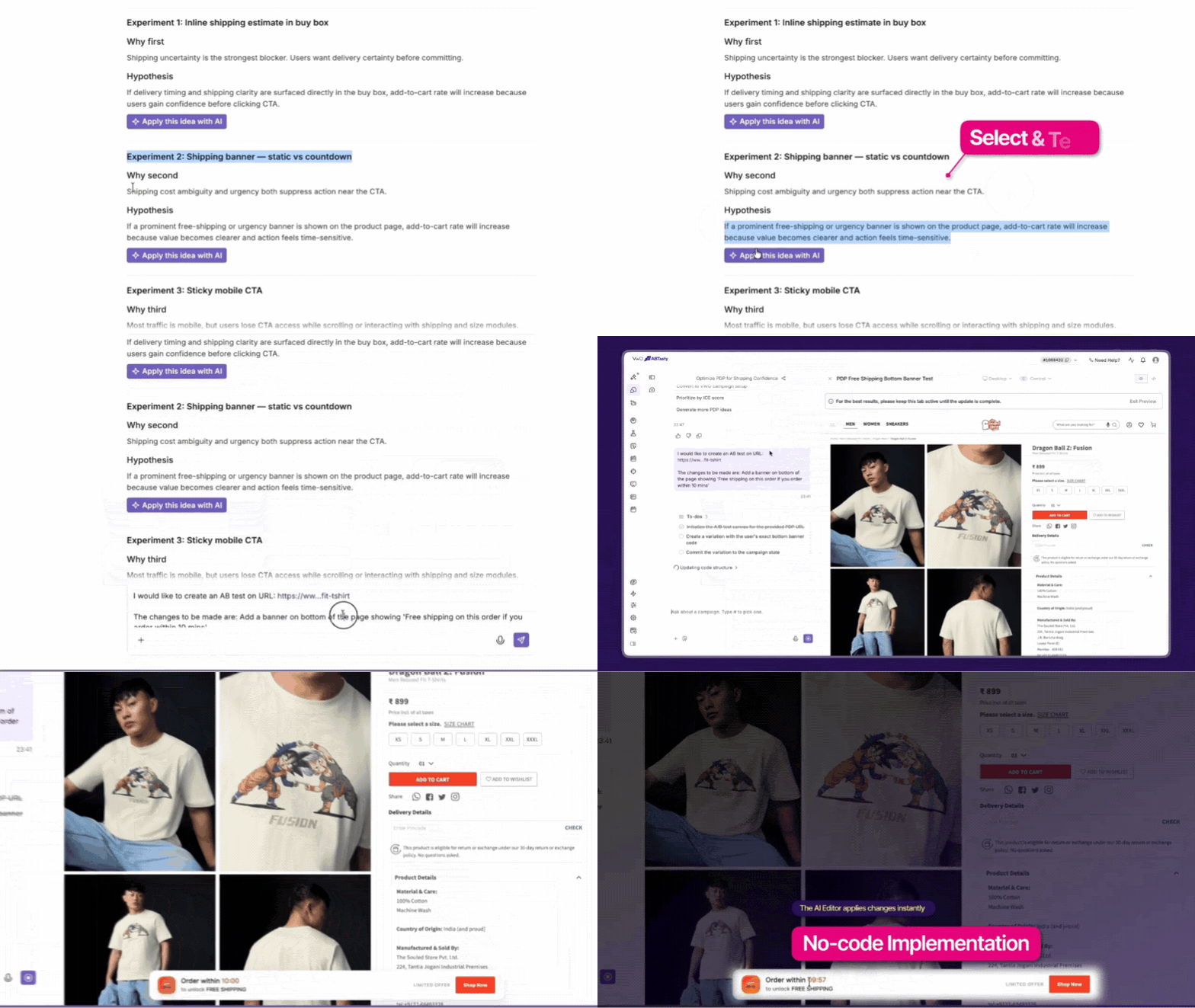
4. The AI Editor: Bridging Insight and Action
The most significant advancement in Wandz is the AI Editor. This tool allows users to make adjustments to their campaigns using natural-language instructions. If the AI suggests a change to a call-to-action (CTA) button, the user can instruct the platform to make that change directly within the editor. However, maintaining the “human-in-the-loop” philosophy, the platform requires human review for every AI-generated change, ensuring that brand standards and strategic judgment remain intact.
Market Implications and the Future of Experience Optimization
The shift toward integrated AI is expected to redefine the competitive landscape of the Experience Optimization market. Competitors such as Optimizely and Adobe Target are also racing to integrate generative AI, but the Wingify merger suggests that the market is moving toward a “data-first” rather than a “feature-first” model.
Industry data suggests that companies using AI in their marketing workflows can see a 15% to 20% increase in productivity. In the niche of A/B testing, this productivity is measured by “test velocity”—the number of experiments a team can run per month. By removing the friction of data export and manual configuration, integrated platforms like Wingify aim to double or triple the test velocity of their users.
Furthermore, the integration of AI addresses a growing talent gap in the digital industry. As experimentation becomes more complex, the demand for data scientists and CRO specialists has outpaced supply. Integrated AI acts as a “force multiplier,” allowing generalist marketers to perform complex data analysis and campaign setups that would have previously required specialized technical knowledge.
Conclusion: The Path Forward for Growth Teams
The evolution of AI in experimentation marks a move from superficial assistance to deep integration. The lesson for growth and marketing teams is clear: speed is useless without context. While tools like ChatGPT will continue to have a place in the creative process, the heavy lifting of data analysis and campaign execution belongs inside the testing platform.
As Wingify rolls out Wandz across its global user base, the industry will be watching closely to see if this integrated approach results in higher win rates for experiments. If successful, the “copy-paste” era of AI will likely be remembered as a brief transition period before the industry realized that for AI to be truly intelligent, it must live where the work happens. The future of experimentation is not just about having more data or faster AI; it is about creating a seamless loop where every insight leads directly to the next action, powered by an intelligence that understands the full picture.