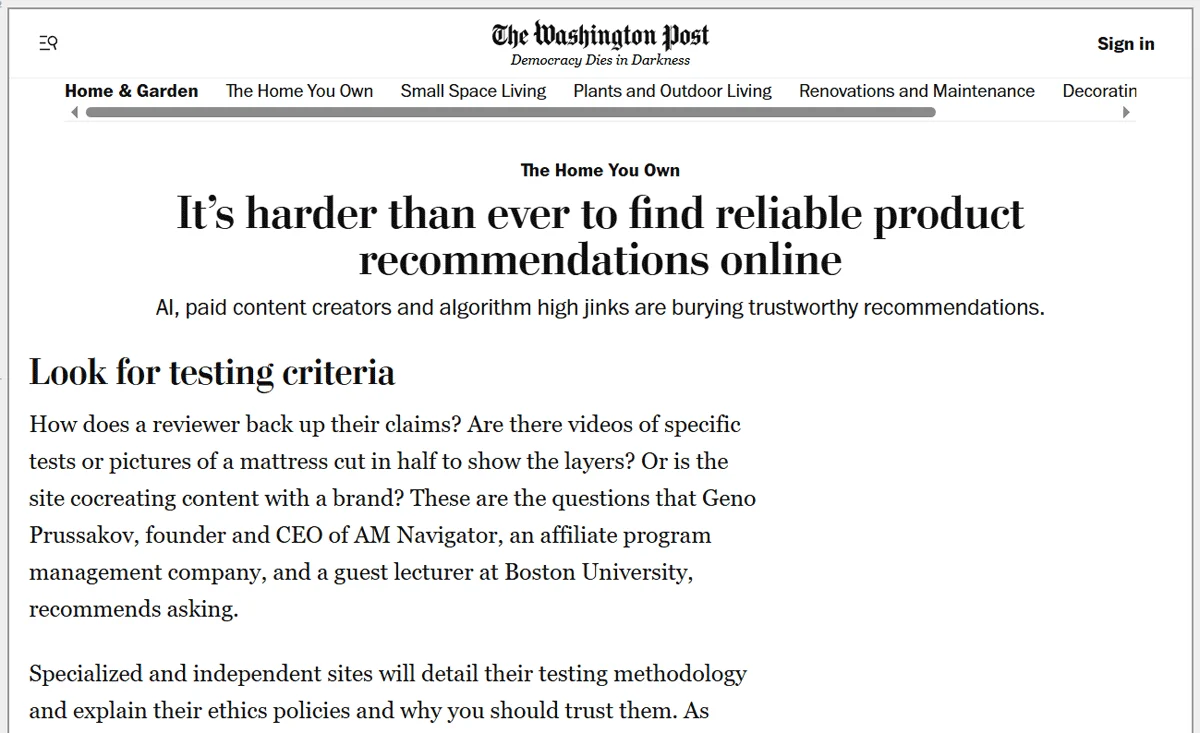
The landscape of digital consumerism is undergoing a significant transformation as traditional media conglomerates increasingly leverage their established brand authority to enter the lucrative world of e-commerce and affiliate marketing. This shift was recently highlighted in a comprehensive inquiry by The Washington Post, which sought expert analysis on the reliability of product recommendation lists—often referred to as “roundups”—published by major media outlets. As consumers increasingly rely on digital “best-of” lists to inform their purchasing decisions, the line between objective journalism and revenue-driven content has become a focal point for industry scrutiny.
The phenomenon, often termed “commerce content,” involves reputable news and lifestyle organizations reviewing products and providing direct links to purchase them, typically earning a commission on any resulting sales. While this model has provided a vital revenue stream for the journalism industry in an era of declining print circulation and ad-blocker usage, it raises critical questions regarding editorial independence and the potential for financial incentives to color consumer advice.
The Evolution of Media Monetization: A Historical Context
To understand the current state of online product recommendations, one must examine the economic pressures that have reshaped the media industry over the last two decades. Historically, news organizations relied on a “church and state” separation between editorial content and advertising. However, the collapse of traditional display advertising and the rise of search engine dominance by platforms like Google forced publishers to find more integrated ways to monetize their audiences.
The chronology of this shift reveals a steady progression toward affiliate-heavy business models. In the early 2010s, smaller, niche review sites proved that high-quality, service-oriented content could generate significant revenue through affiliate links. The pivotal moment for the mainstream media occurred in 2016 when The New York Times Company acquired The Wirecutter, a product review site, for approximately $30 million. This acquisition signaled to the broader market that “trust-based commerce” was a viable and prestigious pillar for legacy media.
Following this lead, other major players like CNN launched “CNN Underscored,” and publishers such as Condé Nast, Hearst, and Dotdash Meredith integrated dedicated commerce teams within their newsrooms. By 2024, affiliate marketing had become a multi-billion-dollar industry, with estimates from the Performance Marketing Association indicating that the sector contributes significantly to the digital economy, growing at a compound annual growth rate (CAGR) of nearly 10%.
The Mechanics of Modern Product Reviews
Despite the inherent potential for conflict of interest, many large media organizations have implemented rigorous standards to protect their brand equity. Industry experts note that for these outlets, their most valuable asset is not the commission from a single sale, but the long-term trust of their readership. To maintain this, high-tier publishers generally employ a four-pronged approach to product vetting:
- Specialized Testing Facilities: Many major outlets now operate independent laboratories or testing kitchens where products are subjected to standardized stress tests, performance evaluations, and long-term durability assessments.
- Hands-on Evaluation: Unlike “content farms” that rewrite manufacturer specifications, reputable media outlets typically require reviewers to use the products in real-world scenarios for weeks or months before a recommendation is published.
- Expert Consultation: Reviews are often supplemented by interviews with subject matter experts, engineers, or medical professionals to ensure that technical claims are accurate and that the recommendations are safe for the general public.
- Editorial Independence: In the most robust models, the editorial teams responsible for testing products are kept separate from the business teams that manage affiliate relationships and negotiate commission rates. This “firewall” is designed to ensure that a product is selected for its quality rather than its profit margin.
The Financial Realities and Potential Conflicts
While the rigorous testing described above represents the industry’s “gold standard,” the reality of digital publishing is often more complex. Financial arrangements between publishers and advertisers can take several forms, some of which may subtly influence the visibility or ranking of a product.
One such arrangement is the “placement fee” or “tenancy payment,” where a brand pays a flat fee to be included in a specific roundup or to occupy the top spot on a list. Additionally, publishers may be incentivized by inflated affiliate commission rates or “EPC (Earnings Per Click) guarantees.” In an EPC guarantee, a merchant promises a publisher a minimum return for every click sent to their site, regardless of whether a sale occurs.

These financial layers create a paradox for the consumer: while a major media outlet has the resources to perform better testing than an individual blogger, they also have higher overhead costs and more aggressive revenue targets that may prioritize high-converting products over superior, but less profitable, alternatives.
Supporting Data: The Scale of the Affiliate Market
Recent market data underscores the high stakes of this industry. According to a 2023 report by Statista, spending on affiliate marketing in the United States alone reached an estimated $8.2 billion. Globally, the industry is projected to exceed $15 billion by the end of 2025.
Consumer behavior data further illustrates why big media outlets are so invested in this space. A survey by HubSpot found that 88% of consumers trust online reviews as much as personal recommendations, but only when they perceive the source to be “authentic” and “authoritative.” This explains why legacy brands like The Washington Post or Forbes are so effective at driving sales; they “lend” their decades of journalistic credibility to the products they feature.
Regulatory Oversight and Consumer Protection
The Federal Trade Commission (FTC) in the United States has taken an increasingly active role in regulating how these recommendations are presented. The FTC’s “Endorsement Guides” require that any relationship between a recommender and a brand—including affiliate commissions—must be clearly and conspicuously disclosed to the consumer.
In 2023, the FTC updated these guidelines to further clarify that “clear and conspicuous” means the disclosure must be unavoidable. Consumers will notice that most reputable media sites now feature a disclaimer at the top of their articles stating, “We may earn a commission if you purchase through our links.” However, critics argue that these disclosures are often written in fine print or framed in a way that minimizes the potential for bias, leading to calls for even more transparent labeling of “sponsored” versus “organic” editorial picks.
Practical Strategies for the Modern Consumer
Given the complexities of the digital marketplace, industry analysts suggest that consumers adopt a more analytical approach to “best-of” lists. To navigate the potential biases of media-driven product recommendations, experts recommend the following strategies:
- Cross-Referencing Sources: Consumers should compare recommendations across multiple independent outlets. If a product appears as the “top pick” across five different reputable sites with different testing methodologies, its quality is more likely to be genuine.
- Methodology Verification: Reliable reviews should include a detailed explanation of how the products were tested. Consumers should look for specific metrics, such as “battery life tested under 50% brightness” or “tensile strength measured in a lab setting,” rather than vague praise.
- Analyzing the “Why”: A trustworthy recommendation should explain not only why a product is good but also who it is not for. If a review is 100% positive without mentioning any drawbacks or trade-offs, it may be a sign of marketing-influenced content.
- Checking for Updates: The best review sites frequently update their content to reflect new product releases or changes in manufacturing quality. A “best of 2025” list that has not been updated since mid-2024 may no longer be accurate.
Broader Impact and Industry Implications
The trend of media-driven commerce has broader implications for the future of the internet and the survival of journalism. On one hand, affiliate revenue provides a sustainable path for newsrooms to continue funding investigative journalism and high-quality reporting. On the other hand, the “commoditization” of trust poses a long-term risk. If consumers begin to feel that “best-of” lists are merely paid advertisements in disguise, the very authority that makes these lists valuable will erode.
Furthermore, the rise of Artificial Intelligence (AI) is adding a new layer of complexity. AI-generated “review” sites are proliferating, often scraping data from legitimate media outlets to create fake recommendation lists. This makes the role of established media even more critical, as they must distinguish themselves through human expertise and verifiable, physical testing that AI cannot replicate.
The intersection of media authority and affiliate marketing represents a new frontier in the digital economy. While the financial incentives are significant, the survival of legacy media brands in this space depends entirely on their ability to maintain the “trust” that they are now so effectively monetizing. As the industry matures, the pressure will increase on both publishers to maintain transparency and on consumers to remain vigilant in an increasingly commercialized digital landscape.