The digital marketing landscape is undergoing a profound transformation, compelling brands to fundamentally rethink their content strategies. Gone are the days when a simple Google query reliably presented a list of ten blue links, guiding users directly to source material. Today, the immediate reality for many users is an AI Overview, a concise summary generated by advanced algorithms, often accompanied by a few citations. Similar experiences unfold on platforms like ChatGPT or Perplexity, where complex queries yield neatly summarized answers, frequently obviating the need for a direct click to the original content source. This shift presents a formidable challenge for marketers: if a brand is fortunate enough to be mentioned, it is often reduced to a single, unembellished line, stripped of its unique style and the carefully constructed narrative that once defined it. The headline, painstakingly crafted by a managing editor, is rewritten; nuance is flattened; and a once-differentiated point of view is homogenized, resembling committee-produced text.
This emerging reality mandates a new approach for content creators. While humans remain the ultimate consumers of content, it is increasingly machines that determine what information they encounter first. The contemporary marketer’s role now involves a delicate balance: speaking simultaneously to human customers, with their distinct motivations and mercurial emotions, and to robotic algorithms, which extract, rewrite, and rank ideas. The critical task is to achieve this without devolving content into bland, uninspired prose. The brands poised for success in this new era will be those whose core ideas not only survive but thrive through algorithmic translation, seamlessly blending standout storytelling with an extraction-ready structure.
The Genesis of the Two Audiences Problem
The advent of sophisticated generative AI models and their integration into search interfaces marks a significant inflection point in content distribution. AI Overviews, generative search experiences (like Google’s Search Generative Experience, SGE), ChatGPT Search, Perplexity, and various voice assistants now routinely process, compress, and represent brand content, frequently before a human user even has the opportunity to visit the original page. These systems snip, condense, and reword information, leading to several practical implications: fewer direct clicks to websites, an elevated risk of content paraphrase without adequate context, and a redefinition of how credit and attribution are conveyed.
This seismic shift in content distribution creates a dual mandate for brands: to captivate human audiences with memorable narratives and, concurrently, to furnish machines with cleanly extractable facts. The trajectory of search and content consumption has evolved dramatically over the past two decades. Early search engines relied heavily on keyword matching and rudimentary link analysis. The mid-2010s saw the rise of semantic search, where algorithms began to understand the meaning and context behind queries, moving beyond mere keyword density. The early 2020s, however, introduced generative AI, a paradigm shift where AI not only understands but also creates content, summarizing information and synthesizing answers. This technological leap, spearheaded by entities like Google, OpenAI, Microsoft, and Amazon (through its voice assistants), has fundamentally reshaped user expectations, favoring instant, concise answers over a journey through multiple web pages.
Crafting Content for the Human Element
Despite the machine-driven revolution, the human element remains paramount. People are ultimately the decision-makers who share content, engage with brands, and make purchasing decisions. A 2023 Ipsos study unequivocally demonstrated that even within marketing content, audiences exhibit a strong preference for human-created material. This preference underscores a crucial point: while AI tools are becoming indispensable in content marketing workflows – and indeed, by 2025, their strategic use will be almost mandatory – the final message must never sound overtly mechanical or devoid of human touch.
What truly moves people are narratives that evoke emotion, foster connection, and resonate on a personal level. Humans are drawn to stories that feel both familiar and refreshingly new, content that offers utility while remaining relatable. The best human-centric content earns attention by demonstrating an understanding of the reader’s needs, challenges, and aspirations. It’s content that feels like it was penned by someone who genuinely comprehends their audience. This necessitates an emphasis on authentic voice, empathetic storytelling, and a clear articulation of value that goes beyond mere information dissemination. Marketers must focus on building trust, establishing credibility, and fostering a sense of community around their brand – attributes that AI can augment but not replicate entirely. Even as generative AI reshapes discovery and distribution, these foundational principles of human connection remain immutable.
Optimizing Content for Machine Comprehension
Concurrently, content must be meticulously engineered for machine consumption. AI engines and Large Language Models (LLMs) operate by tokenizing, extracting, and ranking information. These algorithms are indifferent to the lyrical quality of prose or the hours spent perfecting a tagline. Their primary objective is to confidently answer a user’s question by identifying claims, substantiating them with evidence, and mapping them to recognizable entities within a given context.
Machines prioritize clarity, structure, and verifiable facts. This means content must be presented in a highly organized and unambiguous manner. Clear headings and subheadings (e.g., H1, H2, H3), bullet points, numbered lists, and structured data markup (Schema.org) are not merely aesthetic choices but critical signals for AI. Explicitly labeling answers, standardizing terminology across all content, and providing clear “receipts” in the form of direct citations and verifiable data are essential. When crafting content for AI, clarity – not cleverness – is the currency that earns citations and ensures accurate representation. Furthermore, recent analyses, such as those by Ahrefs, suggest that content freshness is an increasingly vital factor, with AI assistants tending to favor and cite more current information. This implies a need for ongoing content audits and regular updates to maintain relevance and visibility in AI-driven search.
Strategic Integration: Speaking to Both Audiences
To navigate today’s search-and-summary landscape effectively, brands require a dual-pronged content strategy. The art lies in creating content that reads beautifully and compellingly to humans while simultaneously providing machines with the clean, structured signals they need to understand and amplify the brand’s story. This integration is not about compromise but about strategic design.
-
Lead with a Scene; Label with Structure: Begin every piece of content with a captivating hook designed to draw human readers into a moment. This could be an evocative question, a relatable conflict, or a vivid visual description. Such narrative openings foster engagement and curiosity. Immediately following, or interwoven throughout, ensure that subheadings, schema markup, and concise summaries clearly outline the main takeaways. Humans are inherently wired to remember stories and experiences; machines, conversely, rely on structured scaffolding to interpret and categorize information. For instance, a blog post might open with a compelling anecdote about a customer’s pain point before an H2 heading clearly states “The Challenge of [Specific Problem].”
-
Make Every Claim Quotable and Parsable: When presenting an insight or a key piece of information, ensure it is both impactful for human readers and easily digestible for AI. Back every claim with concrete data, explicitly name your sources, and phrase the statement cleanly and concisely enough for an AI to lift directly. Think of this as writing for direct citation: crafting a line that resonates deeply with readers while simultaneously being a self-contained, verifiable sentence suitable for an AI Overview snippet. An example could be: “According to a 2023 industry report by [Research Firm], 78% of consumers prioritize sustainable brands, a significant increase from 62% just two years prior.” This provides both a compelling statistic and clear attribution.
-
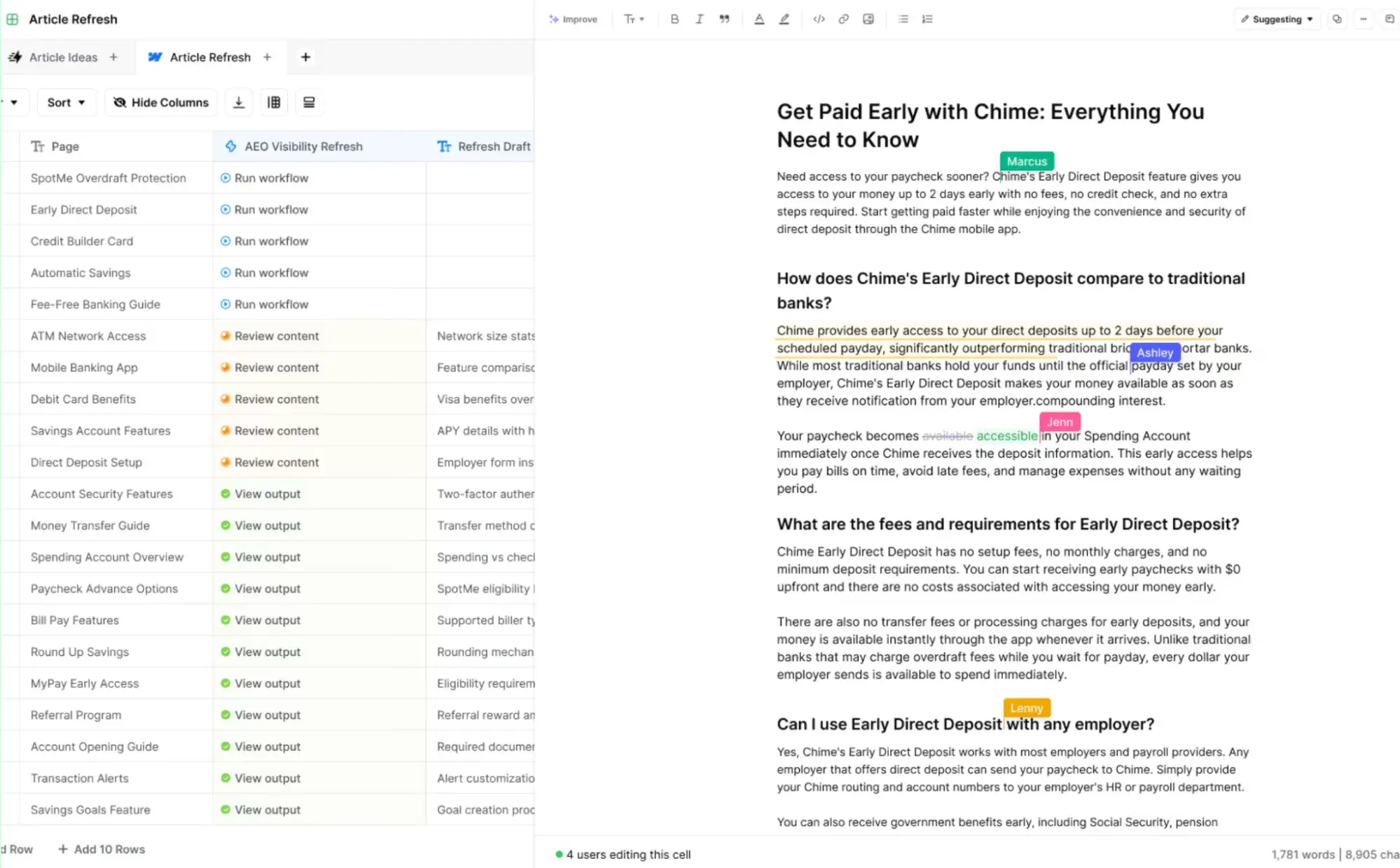
Design Visuals that Speak in Two Languages: Visual content, whether images, infographics, or videos, must serve a dual purpose. For human audiences, visuals should tell a compelling story, complete with emotional resonance and contextual depth. They should enhance understanding and engagement. For machines, every visual requires comprehensive text alternatives (alt text), descriptive filenames, and clear, informative captions. This rich metadata allows algorithms to understand the content and context of the visual, making it searchable and interpretable. Whether it’s a data-rich chart or a product demonstration video, robust metadata acts as a crucial bridge between visual storytelling and machine comprehension.
-
Use Video to Teach Twice: Video content, particularly short-form, offers a powerful opportunity for dual communication. For viewers, the first three seconds are critical – they function as the video’s headline, needing to hook attention immediately. For algorithms, strategic optimization is key. Incorporate relevant keywords naturally into voiceovers, provide accurate and consistent captions, and include a structured, keyword-rich description when uploading. This dual approach helps algorithms surface the video in relevant searches and recommendations, while simultaneously giving human viewers a compelling reason to engage with the content until the end. Video transcripts, often automatically generated or manually refined, also provide a wealth of machine-readable text.
-
Keep Your Message Stable Across Every Touchpoint: Consistency is paramount for both audiences. Machines learn through repetition and alignment, reinforcing their understanding of entities and relationships. Humans, too, learn through consistency in branding, tone, and messaging, which builds recognition and trust. Employ the same product names, brand taglines, and key phrasing consistently across all touchpoints – from blog posts and website copy to social media updates and YouTube video titles. This uniformity ensures that both algorithmic parsers and human consumers recognize, recall, and correctly associate information with your brand, strengthening brand identity and authority in the fragmented digital ecosystem.
Measuring Success in a Zero-Click Era
As AI-generated summaries increasingly serve as the initial point of contact for information, traditional traffic metrics alone no longer paint a complete picture of content performance. A significant spike in content visibility or a prominent mention within an AI Overview may not translate into a direct website click, yet it can profoundly influence brand perception, recall, and ultimately, purchasing behavior. The success metrics for this new era reside at the intersection of influence and alignment.
New Key Performance Indicators (KPIs) must reflect this shift:
- AI Overview Visibility and Citation Rate: Tracking how frequently a brand’s content is referenced or summarized in AI Overviews, and the prominence of its citations. Tools that monitor SERP features and AI-generated content snippets will become indispensable.
- Brand Authority Score: Measuring the frequency and context of brand mentions as an authoritative source across AI models and other digital platforms, indicating thought leadership.
- Semantic Relevance and Entity Alignment: Assessing how well a brand’s content maps to key entities and topics relevant to its industry, ensuring algorithms correctly understand its domain expertise.
- Direct Conversions and Brand Recall: While clicks may decline, measuring direct conversions (e.g., newsletter sign-ups, product purchases) that occur after AI exposure, and conducting brand recall surveys, becomes crucial to ascertain true business impact.
- Content Freshness Index: A metric tracking the recency and relevance of content updates, reflecting its appeal to AI models that prioritize up-to-date information.
- Audience Engagement Metrics (Post-Summary): Analyzing deeper engagement metrics such as time on site, social shares, and comments for users who do click through, indicating the quality and resonance of the human-centric content.
For years, marketing efforts have been meticulously optimized for people and various digital platforms. The current imperative expands this to optimizing for people and algorithmic parsers. This evolution does not necessitate stripping the soul from compelling narratives; rather, it demands a sophisticated understanding of how to teach machines to accurately carry those stories forward. The marketers who master this dual capability will undoubtedly dominate the next era of digital visibility and influence.
Frequently Asked Questions (FAQs):
What does it mean to create “machine-readable” content?
Machine-readable content is meticulously structured and formatted to facilitate easy interpretation and summarization by AI systems, search engines, and voice assistants. This involves utilizing clear, hierarchical headings (H1, H2, H3), maintaining consistent terminology throughout the content, implementing schema markup (structured data) to define entities and relationships, and presenting unambiguous claims supported by evidence. The goal is to ensure that your ideas can be extracted by algorithms without any loss of their original meaning or context.
Should marketers still care about SEO if AI Overviews and chatbots dominate search?
Absolutely, but the definition and focus of SEO are evolving. SEO now primarily means “structuring for understanding,” rather than merely optimizing for keyword rankings. Elements such as schema markup, precise entity alignment (connecting your content to recognized concepts), and establishing first-party credibility (E-E-A-T: Experience, Expertise, Authoritativeness, Trustworthiness) are more critical than ever. While traditional keyword density tactics may diminish in importance, semantic clarity, topical authority, and technical SEO that aids machine comprehension remain fundamental for content visibility.
Does this shift change how we approach video and visual content?
Undoubtedly. Every piece of visual content must now be approached as both a narrative element and an algorithmic signal. For human viewers, visuals should be emotionally engaging and contextual, drawing them into the story. For machines, comprehensive metadata is essential. This includes using descriptive titles, writing detailed and accurate captions, implementing robust alt text for images, and providing structured descriptions for videos. Moreover, incorporating spoken keywords within video voiceovers and providing complete transcripts or captions significantly enhances machine understanding, allowing algorithms to accurately interpret the content and surface it in relevant searches.