

In the rapidly evolving landscape of digital marketing, the efficacy of email campaigns hinges not merely on captivating design or intelligent AI-generated copy, but fundamentally on the accuracy of the recipient list. Email verification, often relegated to a post-campaign maintenance task, is increasingly recognized as a critical prerequisite for all marketing activities, serving as the bedrock upon which successful campaigns are built. By proactively verifying leads, organizations can drastically minimize invalid data, thereby enabling precise evaluation of campaign success, optimal resource allocation, and sustained brand reputation.
The Evolving Landscape of Email Marketing
Email marketing has undergone a profound transformation, shifting from rudimentary mass mailings to highly sophisticated, data-driven strategies. Initially, marketers focused primarily on reach, often prioritizing quantity over quality. However, as inboxes became saturated and consumer expectations for relevance grew, the industry pivoted towards personalization and engagement. This evolution has, paradoxically, amplified the need for impeccable data hygiene. The promise of hyper-personalization, powered by advanced analytics and artificial intelligence, remains unfulfilled if the underlying data is flawed or, worse, directed at nonexistent addresses.
From Mass Blasts to Hyper-Personalization
The trajectory of email marketing has moved firmly towards individualization. Modern consumers expect communications that are tailored to their specific interests, purchase history, and demographic profiles. This drive for hyper-personalization, while offering unprecedented opportunities for engagement and conversion, places immense pressure on data accuracy. A meticulously crafted email, designed to resonate deeply with a specific segment, loses all impact if it never reaches the intended recipient or, worse, lands in a spam folder. The sophistication of current marketing automation platforms and AI tools, which can dynamically adjust content, subject lines, and send times, is utterly dependent on the foundational integrity of the email addresses themselves. Without verification, even the most innovative technologies are rendered ineffective, akin to building a magnificent skyscraper on quicksand.
The Regulatory Imperative: Data Privacy Laws
Beyond mere effectiveness, the regulatory environment has significantly elevated the importance of email verification. Landmark legislations such as the General Data Protection Regulation (GDPR) in Europe, the California Consumer Privacy Act (CCPA) in the United States, and Canada’s Anti-Spam Legislation (CASL) have imposed stringent requirements on how organizations collect, store, and process personal data. Sending emails to unverified or invalid addresses can, in some cases, be interpreted as poor data management, potentially leading to compliance issues and hefty fines. These regulations underscore the necessity of obtaining explicit consent and maintaining accurate records, making proactive verification a cornerstone of legal and ethical marketing practices. According to a 2023 report by IBM, the average cost of a data breach globally reached $4.45 million, a figure that highlights the financial risks associated with lax data hygiene, even if not directly from email bounces, but certainly from broader data mismanagement.
The Criticality of Clean Data: Beyond Basic Checks
Email verification is far more nuanced than a simple syntax check. It is a multi-layered technical process designed to identify the validity and deliverability of an email address, protecting sender reputation and optimizing campaign performance.
Unpacking the ‘Why’: Deliverability, Reputation, and ROI

The direct consequences of neglecting email verification are stark. A high bounce rate—the percentage of emails that fail to be delivered—is a red flag to mailbox providers (like Gmail, Outlook, Yahoo!). Hard bounces, which signify permanent delivery failures due to nonexistent addresses, are particularly damaging. A consistently high hard bounce rate signals to these providers that a sender’s data management practices are poor, leading to a degraded sender reputation. This, in turn, can result in future emails being routed directly to spam folders, or even being blocked entirely, regardless of the quality of their content. Industry benchmarks suggest that a bounce rate exceeding 2% can start to negatively impact sender reputation, while rates above 5% are often considered problematic. Proactive verification mitigates this risk, allowing marketers to scale campaigns confidently without fear of suspension or reduced deliverability. Ultimately, protecting deliverability ensures that creative efforts and marketing spend are not wasted, and that valuable leads actually receive the intended communications, thereby directly impacting the campaign’s return on investment (ROI).
The Technical Nuances: What Verification Entails
Email verification extends far beyond merely checking for the presence of an “@” symbol and a domain name. While basic syntax checks are a first line of defense against obvious typographical errors, true verification delves deeper. It involves a series of complex technical checks:
- Domain Validation: Ensuring the domain exists and has valid Mail Exchange (MX) records, indicating it can receive emails.
- SMTP Connection: Attempting to connect to the mail server associated with the domain to confirm it’s active and responsive.
- Mailbox Existence Check: Querying the mail server to determine if a specific mailbox (the username part of the email address) actually exists on that server. This is often done without actually sending an email to avoid spamming.
- Temporary vs. Permanent Failures: Distinguishing between temporary issues (e.g., a full inbox, server timeout) and permanent failures (e.g., nonexistent user, invalid domain). This distinction is crucial for deciding whether to retry sending or to remove the address from the list.
- Spam Trap Detection: Identifying addresses known to be “spam traps,” which are email addresses used by mailbox providers and anti-spam organizations to identify senders with poor data hygiene. Sending to these addresses can severely damage sender reputation.
Identifying the Culprits: A Taxonomy of Invalid Data
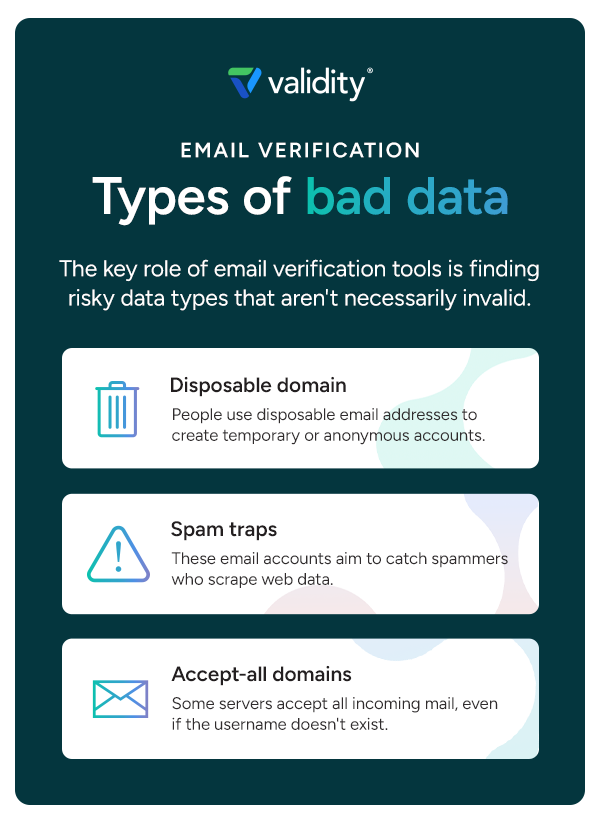
Email verification tools are designed to categorize various types of problematic data, beyond just outright invalid addresses:
- Invalid Addresses: Nonexistent users, domains that don’t exist, or malformed email addresses. These lead to hard bounces.
- Spam Traps: Addresses specifically designed to catch spammers. These are the most dangerous for sender reputation.
- Disposable Email Addresses (DEAs): Temporary email addresses often used to sign up for services without revealing a real address, indicating low engagement intent.
- Catch-All Domains: Domains configured to accept all emails sent to them, even if the specific user doesn’t exist, making it hard to verify individual addresses.
- Role-Based Emails: Addresses like
info@,support@,sales@, which often represent departments rather than individuals and may have lower engagement rates. - Known Complainers: Addresses associated with users who frequently mark emails as spam.
- High-Risk Domains: Domains often associated with fraudulent activities, purchased lists, or poor data hygiene.
By identifying and segmenting these risky data types, marketers can make informed decisions about which addresses to remove, quarantine, or treat with caution, thereby safeguarding their email program and ensuring compliance with data protection regulations.
The Downstream Fallacy: Reorienting Marketing Priorities
A prevalent issue in marketing, particularly email marketing, is what can be termed the “downstream fallacy.” This occurs when marketing teams disproportionately allocate resources to the later stages of the workflow—such as creative development, A/B testing, and advanced personalization—while neglecting the fundamental quality of the data at the very beginning.
The Peril of Misplaced Resources
The pressure on marketers to demonstrate tangible results often leads to a focus on visible outputs: beautiful emails, engaging copy, and sophisticated segmentation. However, the true impact of these efforts is significantly diluted if the underlying recipient data is compromised. It’s challenging to accurately measure the success of an A/B test on a subject line, for instance, if a substantial portion of the emails are bouncing before they even reach an inbox. This misplaced emphasis creates an “invisible ceiling” on ROI, as resources are poured into optimizing elements that only matter if the email is successfully delivered. The Gartner 2025 CMO Spend Survey revealed that marketing budgets have flatlined at 7.7 percent of overall company revenue. In an era of tighter budgets, maximizing every dollar spent becomes paramount. Sending emails to “ghosts” or invalid domains represents a direct financial waste, making the correction of this downstream fallacy an economic imperative. Furthermore, this internal misalignment often extends to sales teams. When marketing passes on unverified leads, sales teams waste valuable time pursuing nonexistent prospects, leading to internal friction and a breakdown of trust between departments.
Building from the Ground Up: The Hierarchy of Email Success
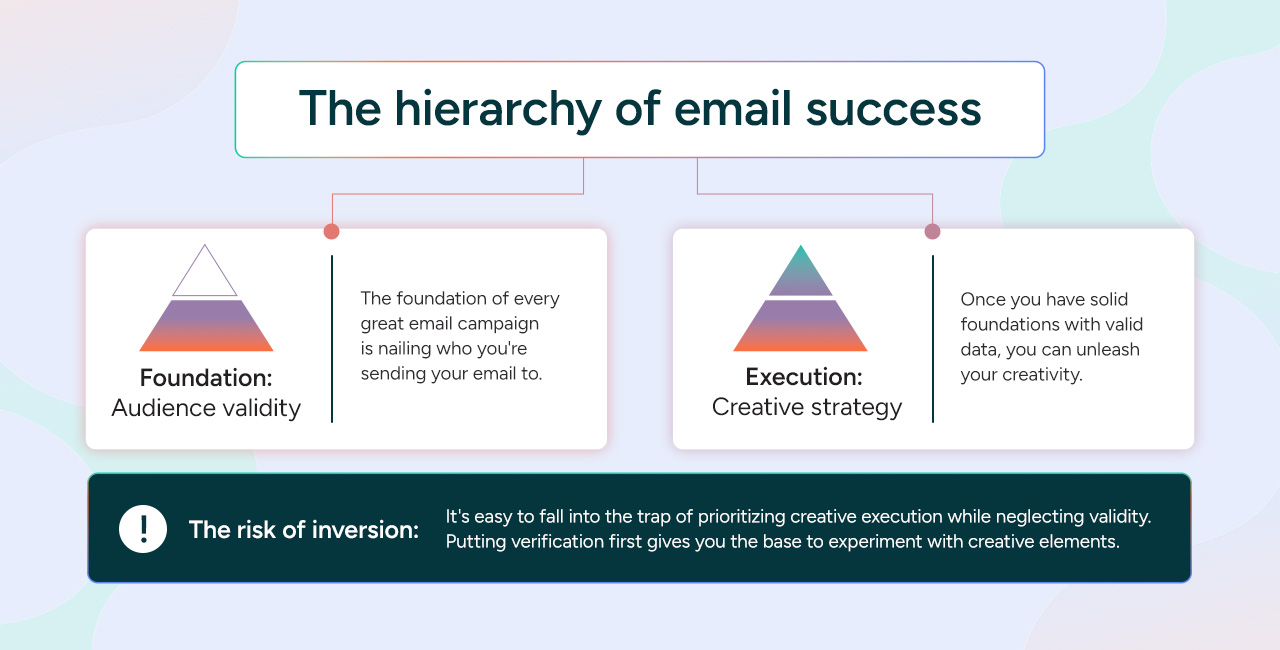
To correct the downstream fallacy, a fundamental shift in perspective is required, viewing email success through a strategic hierarchy:
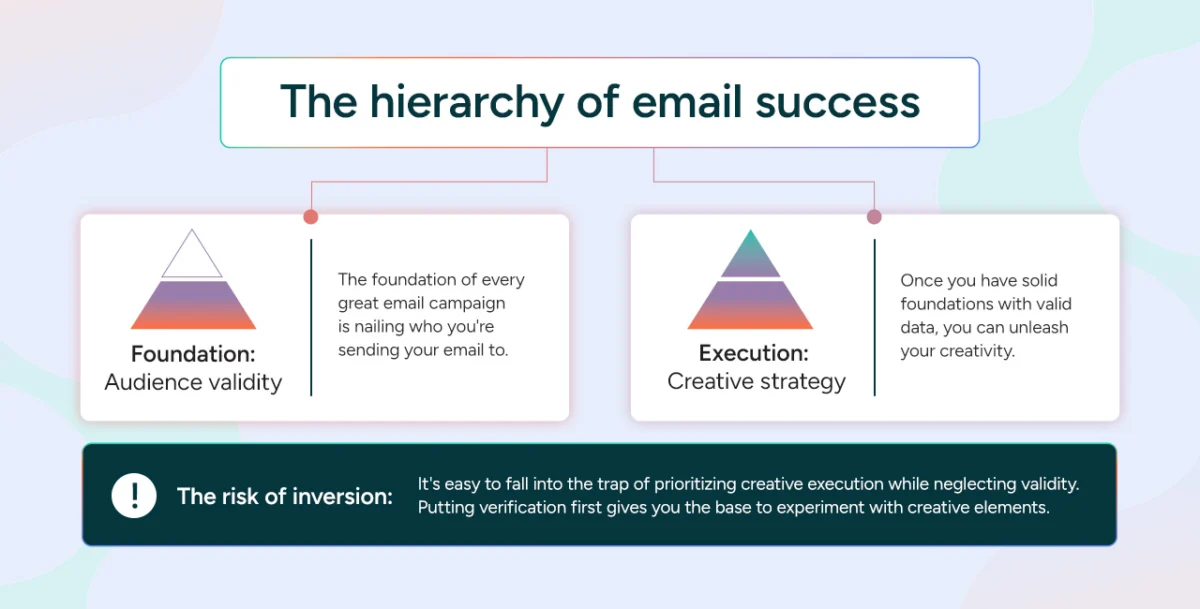
- Foundation: Audience Validity: This is the absolute first step. Before any creative thought or strategic planning, the primary focus must be on ensuring that the target audience consists of valid, reachable email addresses. This informs all subsequent creative assets and prevents efforts from being “shouted into the void.” A healthy, verified list is scalable, allowing campaigns to grow without the detrimental effects of rising bounce rates. It’s the difference between building on solid rock and shifting sand.
- Execution: Creative Strategy: Once a robust foundation of valid data is established, marketers can unleash their creativity. This layer encompasses compelling copy, engaging design, strategic personalization, and sophisticated segmentation. These elements are crucial for capturing attention and driving engagement, but their effectiveness is entirely reliant on the deliverability assured by the foundational verification.
- The Risk of Inversion: The danger lies in inverting this hierarchy, prioritizing creative execution over audience validity. This can create a false sense of security, as teams might celebrate click-through rates on a small fraction of delivered emails while ignoring the vast number of bounces. Correcting this inversion requires a cultural shift within marketing teams, championing clean data metrics—such as low bounce rates and high deliverability—with the same fervor typically reserved for click-through rates and conversion metrics.
The Tangible and Intangible Costs of Neglect
The real cost of bad data in email marketing extends far beyond just wasted creative effort; it directly impacts an organization’s bottom line and long-term viability.
Direct Financial Drains
Email Service Providers (ESPs) typically charge based on subscriber count or email volume. Maintaining a database bloated with invalid or nonexistent contacts means paying for services that deliver no value. By regularly purging these addresses through verification, organizations can streamline their email lists, potentially reducing their ESP tier and directly lowering operational costs. This immediate cost saving ensures that every dollar spent on an ESP goes towards reaching verifiable, engaged leads. For example, if an ESP charges $500 for up to 50,000 contacts, and 20% of that list is invalid, the company is effectively wasting $100 per month, or $1,200 annually, on “ghosts.”
The Erosion of Sender Reputation and Brand Trust
One of the most insidious indirect costs is the damage to sender reputation. Each hard bounce signals to mailbox providers that the sender’s data is poor. Over time, this cumulative effect can lead to emails being consistently routed to spam folders, or even blocked. Recovering a damaged sender reputation is a lengthy and arduous process, often requiring significant investment in IP warm-up strategies, careful list segmentation, and slow, deliberate sending practices. A 2022 study by Twilio SendGrid found that over 85% of legitimate marketing emails end up in the spam folder due to poor sender reputation. This directly impacts future campaign deliverability, meaning that even perfectly valid emails to genuine leads may never be seen. Furthermore, consistent delivery issues can subtly erode brand trust. When subscribers expect emails from a brand but repeatedly don’t receive them, or find them in spam, it can foster a perception of unreliability and unprofessionalism.
Operational Inefficiencies and Lost Opportunities
Bad data creates significant operational drag across an organization. When marketing teams pass invalid leads to sales, sales representatives waste precious time and resources pursuing dead ends. This not only saps productivity but also fosters distrust between marketing and sales, hindering overall revenue generation efforts. A study by ZoomInfo indicated that poor data quality costs U.S. businesses more than $600 billion each year. Moreover, bloated databases with erroneous entries can slow down synchronization times between various platforms, such as CRMs, marketing automation systems, and analytics tools. This increased load can lead to higher storage costs for backups and slower system performance, affecting the efficiency of multiple business functions.
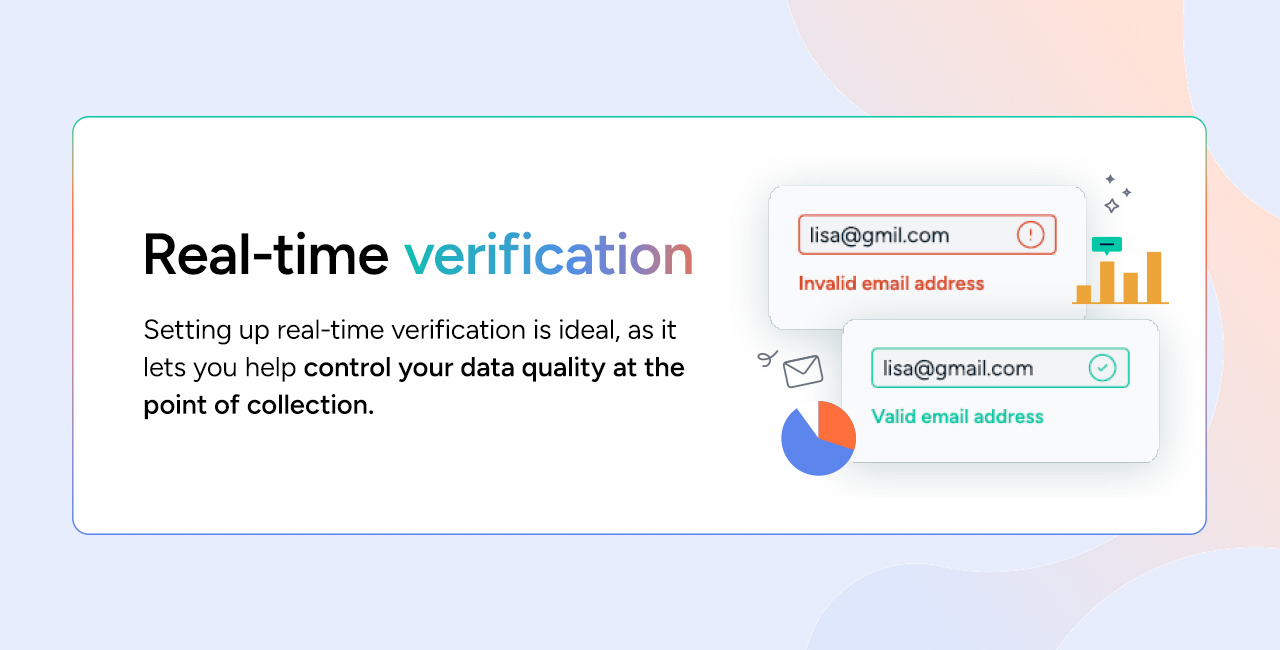
Finally, there’s the critical aspect of opportunity cost. This refers to the potential leads that could have been saved. Often, an email address might contain a simple human-error typo (e.g., gmal.com instead of gmail.com). Without real-time verification at the point of capture, these potentially valuable leads are lost. Real-time correction creates a frictionless user experience, instantly validating the input and reinforcing the brand’s professionalism, ensuring the prospect receives the information they requested without delay.
Implementing a Robust Verification Strategy
An effective email verification strategy integrates various methods to ensure data quality at every stage, from initial collection to ongoing maintenance.
Real-time Safeguards at Point of Entry
Real-time verification is the most proactive approach, acting as a gatekeeper for data quality. By integrating an Application Programming Interface (API) into web forms, registration pages, and checkout processes, organizations can instantly validate email addresses as users type them. If a typo is detected, the user can be prompted to correct it immediately. This not only prevents invalid data from entering the CRM or marketing database but also improves the user experience by offering immediate feedback. This “prevention is better than cure” approach minimizes the volume of bad data passed to sales teams, significantly reducing “hand-off anxieties” and improving inter-departmental trust.
Proactive List Hygiene: Bulk Verification and Regular Audits
While real-time verification prevents new bad data, existing lists also require attention. Data naturally decays over time due to job changes, company closures, domain expirations, and user inactivity. Industry estimates suggest email lists decay at a rate of 20-30% annually, particularly in fast-moving sectors like SaaS and e-commerce. Bulk verification tools allow organizations to upload entire existing lists for a comprehensive cleanup, identifying and removing invalid addresses, spam traps, and other risky data types. Establishing a regular cadence for bulk verification—whether monthly, quarterly, or semi-annually—is crucial. This “regular maintenance” ensures that the active audience always aligns with the actual reachable audience, maximizing the effectiveness of ongoing campaigns.
Verifying Before Critical Campaigns
It is especially prudent to verify email lists before major seasonal campaigns, product launches, or any high-stakes send. Events like Black Friday, Cyber Monday, or a new product announcement rely heavily on email marketing to drive immediate engagement and sales. Ensuring the list is as clean and up-to-date as possible just prior to these critical sends significantly boosts deliverability, protects sender reputation during peak sending periods, and ultimately drives campaign success when it matters most.
Navigating the ‘Unknowns’: A Strategic Approach
Even with advanced verification tools, a small percentage of email addresses may return an “unknown” status. This can occur due to temporary server issues, strict security settings on recipient mail servers, or other transient network conditions. A common mistake is to treat these unknowns as valid and include them in subsequent major campaigns, which can inadvertently inflate bounce rates. A more strategic approach involves segmenting these “unknowns” onto a separate quarantine list. These contacts can then be tested with low-volume, text-only re-engagement emails. Crucially, this testing should ideally be done from a secondary sending IP address to protect the primary sender’s reputation. If these test emails bounce, the addresses can be permanently removed; if they are delivered and elicit engagement, they can be reintegrated into the main list, thus recovering potentially genuine leads without risking the main sending infrastructure.
Industry Perspectives and Expert Commentary
“The era of ‘spray and pray’ email marketing is unequivocally over,” states Dr. Anya Sharma, a leading digital marketing strategist. “Today’s successful marketers understand that the quality of their data directly correlates with the quality of their customer relationships and, ultimately, their revenue. Verification isn’t just about avoiding bounces; it’s about building trust and demonstrating respect for the recipient’s inbox.”
A spokesperson for a major email service provider, who wished to remain anonymous due to competitive reasons, echoed this sentiment: “We observe a clear pattern: clients who prioritize email verification consistently achieve higher deliverability rates and stronger engagement metrics. Their sender reputation remains robust, allowing them to scale their operations without encountering the common pitfalls of spam filtering and account suspension. It’s an investment that pays dividends in every subsequent campaign.” Data privacy experts also emphasize the link between verification and compliance. “Maintaining accurate and verifiable data is not just good practice, it’s a legal obligation under frameworks like GDPR,” notes Eleanor Vance, a data privacy consultant. “Proactive verification is a key component of demonstrating accountability and minimizing regulatory risk.”
The Future of Data-Driven Marketing and Verification
As marketing continues its inexorable march towards hyper-personalization and AI-driven insights, the role of email verification will only intensify. Clean, validated data will become the essential fuel for these advanced technologies, ensuring that the sophisticated algorithms and predictive models are working with reliable information. This foundational integrity will empower marketers to truly leverage the potential of AI for content generation, audience segmentation, and behavioral targeting, moving beyond mere guesswork to data-informed certainty.
Beyond immediate campaign success, a consistent commitment to email verification contributes to a healthier overall data ecosystem within an organization. It fosters a culture of data quality that benefits not just marketing, but also sales, customer service, and business intelligence departments. This holistic approach to data management leads to a more accurate understanding of the customer journey, improved forecasting, and more strategic decision-making across the enterprise, offering a significant competitive advantage in an increasingly data-centric world. The long-term implications are clear: businesses that embrace rigorous email verification will build stronger customer relationships, achieve greater operational efficiency, and sustain superior growth.
Choosing a Trusted Partner: The Role of Advanced Solutions
When selecting a partner for email verification, speed, accuracy, and scalability are paramount. Solutions like Validity’s BriteVerify have emerged as industry standards, relied upon by tens of thousands of organizations globally for their ability to significantly improve customer data quality. BriteVerify’s architecture is designed to handle massive data volumes without introducing latency, ensuring that real-time verification APIs never impede the user experience on web forms. This scalability means whether processing thousands of leads per hour or millions of records in a bulk batch, the tool performs consistently.
The accuracy of such solutions stems from deep technical expertise and extensive industry relationships. BriteVerify, for instance, maintains close relationships with leading inbox providers and leverages a vast global data network. This allows for more precise status checks compared to tools that rely on less sophisticated data scraping methods, significantly reducing the number of “unknown” results in email lists. By accurately identifying valid leads and systematically removing bad data, BriteVerify helps organizations protect their sender reputation and enhance deliverability, ensuring that more interested prospects are engaged. Furthermore, seamless integration into existing CRM, marketing automation, and other business systems minimizes implementation headaches, allowing teams to quickly operationalize their data hygiene strategies.
Maximize Every Send with BriteVerify
Prioritizing email verification is no longer an option but a strategic imperative. It empowers creative teams to maximize their resources, fostering innovation and optimization by providing a trusted data foundation. Solutions like Validity BriteVerify enable comprehensive verification—at the point of capture, through regular bulk validations, and even immediately before critical campaigns. This multi-faceted approach safeguards sender reputation, optimizes deliverability, and ensures that marketing efforts consistently reach and engage the most interested leads.
To transform your email marketing strategy and unlock the full potential of your campaigns, consider leveraging industry-leading verification tools. Get started by requesting a demo today and experience the difference that first-step accuracy can make.








