

The landscape of digital advertising is undergoing a seismic transformation with Meta’s introduction of Andromeda, its new AI-powered ad retrieval and ranking system. This sophisticated engine, which replaced the platform’s previous ad infrastructure, represents the most significant overhaul in how Meta serves advertisements in over a decade. The implications for Paid Social media managers and advertisers are profound, demanding a fundamental re-evaluation of campaign structuring, creative strategy, and audience targeting.
The Dawn of Andromeda: A New Era of AI-Driven Advertising
At its core, Andromeda is a retrieval-based AI system designed for hyper-personalized ad delivery. Its name, a poetic nod to the vastness of the Andromeda galaxy, reflects its immense scale. Just as the galaxy comprises over a trillion stars, Meta’s algorithm is engineered to sift through tens of millions of potential ad-to-user matches in real-time, ensuring the most relevant advertisement is presented to each individual user. This marks a significant departure from the more segmented and manually controlled approaches that have dominated paid social advertising for years.
The impetus behind Andromeda stems from Meta’s ongoing commitment to enhancing user experience and advertiser efficacy. By leveraging advanced AI, the platform aims to move beyond simple interest-based targeting and manual funnel segmentation. The system’s architecture is built to consolidate various signals—including audience demographics, placements, and user behaviors—to identify conversion efficiencies at an unprecedented scale. This necessitates a richer dataset and a more diverse creative output from advertisers to effectively communicate with the AI.
From Granular Segmentation to Galactic Signal Design: Adapting to Andromeda’s Scale
Historically, Paid Social managers have meticulously structured their campaigns around granular segmentation. This often involved creating separate ad sets for distinct audience types such as interests, lookalikes, and retargeting segments, typically housing only a handful of ads within each. This approach, while effective in its time, is becoming increasingly obsolete under Andromeda’s paradigm.
Andromeda operates on a principle of consolidation. It thrives on a “good chunk” of data and a “good chunk” of creatives, allowing it to identify patterns and optimize delivery across a broader spectrum. The system’s ability to search through millions of potential ad-to-user combinations in real-time means that the role of the advertiser is shifting from direct “control” of performance to the “design of systems” that generate strong, clean signals for the AI to learn from. This signals a move away from micro-managing individual ad sets towards a more holistic, data-driven approach.
Consolidation: The Key to Unlocking Andromeda’s Potential
The concept of consolidation is paramount for advertisers aiming to succeed in the Andromeda era. By concentrating data and budget, advertisers enable Andromeda to detect patterns more clearly, leading to faster learning cycles and smoother scaling. Instead of spreading resources thinly across numerous, highly segmented campaigns and ad sets, Meta’s algorithm increasingly favors concentrated efforts. This means that fewer, more robust campaigns with broader targeting and a diverse creative library are likely to yield better results.
This shift is underpinned by the sheer volume of data Meta possesses. The platform has unparalleled access to behavioral and predictive data on its users, far exceeding what any individual advertiser can realistically process. Consequently, the reliance on rigid, manually defined audience segments is diminishing.
Campaign Structure Aligned with Business Objectives, Not Just Audiences

A critical aspect of effective consolidation is restructuring campaigns to align directly with overarching business goals, rather than solely focusing on audience segments. This approach offers greater scalability as it unifies signals toward the ultimate objective. For instance, instead of employing a traditional Top-of-Funnel (TOF), Middle-of-Funnel (MOF), and Bottom-of-Funnel (BOF) structure, advertisers are encouraged to think in terms of broader business outcomes.
This might translate to campaign structures focused on:
- Brand Awareness and Reach: Aiming to expose a broad audience to the brand message.
- Consideration and Engagement: Driving deeper interaction with the brand’s offerings.
- Conversion and Sales: Directly prompting desired actions like purchases or lead generation.
- Customer Loyalty and Retention: Re-engaging existing customers and fostering advocacy.
By organizing campaigns around these core business objectives, advertisers provide Andromeda with clearer direction, allowing the AI to more effectively allocate resources and identify the most receptive users for each stage of the customer journey.
Leveraging Broad Targeting: An Expanding Universe of Opportunity
The need for consolidated data naturally leads to the strategic adoption of broader targeting. As Meta’s AI becomes increasingly adept at understanding user behavior and predicting intent, manually defined, granular audience segments lose their efficacy. Andromeda’s ability to process vast amounts of user data renders strict, narrow audience targeting increasingly obsolete.
Instead, a robust and diverse creative system is emerging as the new “targeting layer.” This means that the quality, relevance, and variety of the advertisements themselves will play a more significant role in determining which users see them. The AI will utilize creative signals to qualify audiences, effectively turning compelling content into a powerful targeting mechanism.
Creatives as the New Frontier: Beyond Audience Qualification
The paradigm shift is evident in how Andromeda utilizes creative assets. Previously, audience definitions were the primary determinant of ad delivery. Now, the creative elements—the hook, the message, the visual appeal—are instrumental in qualifying users. Andromeda aims to curate a “shortlist” of strong ads, not a single universal winner. This shortlist comprises highly relevant variations that resonate differently with distinct user segments.
The success of an ad is no longer solely dependent on its alignment with a pre-defined audience. Instead, the ad’s ability to capture attention and convey value, irrespective of explicit audience segmentation, becomes paramount. A “winning” ad for one user might be irrelevant to another, even if they share common interests. Andromeda’s objective is to personalize delivery by matching the right creative variation to the right user. This necessitates a move beyond quantity and towards meaningful, impactful variety in creative execution.
The Power of Diversity: Maximizing Engagement and Discovery
Andromeda learns from a wide range of user interactions, not just clicks or conversions. Engagement patterns and interaction behaviors provide crucial signals for the AI. Consequently, minor creative tweaks, such as changing copy, swapping backgrounds, or slightly altering existing visuals, are increasingly being interpreted by Meta as variations of the same ad. The era of “find 7 differences” is over.
“Different” now signifies substantial creative divergence. This means exploring entirely new concepts, themes, and visual styles. Meta’s own research, such as the “Creative Advantage” initiative, highlights the power of diversification. The platform suggests that truly different creative approaches can unlock new audiences with a high degree of success. This aligns with the practical observation that creative variation is a key driver of expansion and scaling.

Structured Creative Diversity: The Engine of Scalability
Scaling paid social campaigns effectively in the Andromeda era hinges on structured creative diversity. Different individuals are motivated by distinct factors, even when they share a common interest. By presenting a variety of motivators and hooks within creative assets, advertisers increase the chances of Andromeda finding a resonant match.
Meta has indicated that “different motivators unlock new audiences 89% of the time.” While this statistic should be approached with caution and context, it underscores the critical role of creative variety in expanding reach and finding new customer segments. A robust scaling system should therefore incorporate:
- Diverse Hooks: Presenting a range of unique selling propositions or problem-solution narratives.
- Varied Proof Points: Showcasing different benefits and evidence of value.
- Persona-Driven Messaging: Tailoring content to resonate with specific customer archetypes.
- Key Visuals and Formats: Utilizing a spectrum of visual styles and media types to capture attention.
Crucially, before rolling out entirely new creative hooks into established campaigns, rigorous testing remains essential. A dedicated testing environment should be integrated into the account structure to validate the performance of new creative directions before broader deployment.
The Evolution of Campaign Structure: From Micro-Planets to Galaxies
The transition to Andromeda necessitates a fundamental rethinking of campaign structure. The traditional model, characterized by highly segmented ad sets and a rigid funnel logic, is being replaced by a more consolidated and objective-driven approach.
Old Structure (Pre-Andromeda):
- Multiple campaigns for different funnel stages (TOF, MOF, BOF).
- Numerous ad sets within each campaign, segmented by granular audiences (interests, behaviors, lookalikes).
- Limited number of ads (5-6) per ad set.
- Focus on audience targeting as the primary driver of delivery.
New Structure (Andromeda Era):
- Consolidated campaigns aligned with core business objectives (e.g., Awareness, Consideration, Conversion).
- Broader targeting within ad sets, allowing Andromeda to identify relevant users.
- A significantly larger volume of diverse creative assets (10-15+ ads) per ad set.
- Emphasis on creative signals and diversified messaging to drive delivery and personalization.
- Dedicated testing environments for new creative concepts and hooks.
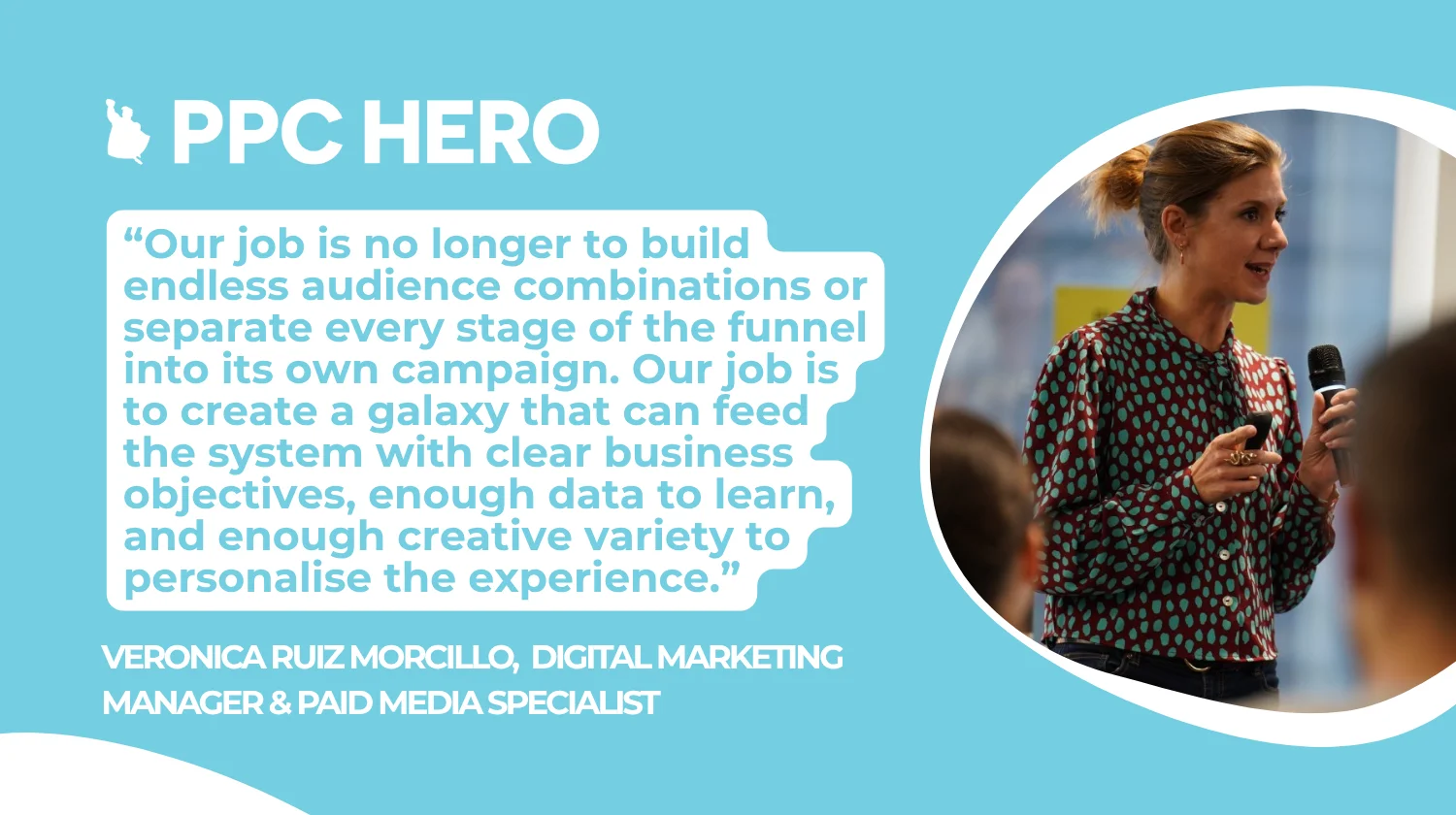
This evolution reflects a philosophical shift. For years, advertisers meticulously built complex account structures—akin to “micro-planets”—to assist Meta in identifying the right users. Today, Meta’s AI is demonstrably more proficient at this task than individual advertisers can be. The advertiser’s role has evolved from audience segmentation to creating a comprehensive “galaxy” of clear business objectives, sufficient data for learning, and ample creative variety to facilitate personalized user experiences.
The Poetic Shift: Simpler Structures, Sophisticated Creatives
The irony of Andromeda’s impact is that campaign structures are becoming simpler, while creative strategy is becoming exponentially more sophisticated. The time once spent organizing audiences is now being redirected towards a deeper understanding of human behavior and motivations. This shift fosters a more engaging and ultimately more rewarding role for advertising professionals. The focus moves from the mechanics of audience delivery to the art of compelling storytelling and resonant communication, making the job not just more effective, but also more intellectually stimulating and “poetic.”
The implications of Andromeda are far-reaching, signaling a new epoch in digital advertising where AI-driven personalization, consolidated strategies, and creative innovation are the cornerstones of success. Advertisers who embrace this paradigm shift will be best positioned to navigate the evolving landscape and unlock the full potential of Meta’s powerful advertising platform.









