In the relentless churn of the digital age, content creators frequently confront the daunting challenge of writer’s block, a phenomenon that can stall publishing schedules and diminish audience engagement. The pressure to consistently deliver fresh, high-quality blog posts is immense, yet the wellspring of inspiration can, at times, seem dry. While modern AI tools like Large Language Models (LLMs) and specialized platforms such as the Yoast AI Content Planner offer significant assistance, a multi-faceted approach combining analytical tools, external research, and personal reflection remains the most robust strategy for maintaining a vibrant content pipeline.
The Modern Content Imperative and the Persistent Challenge of Writer’s Block
The digital landscape has transformed content from a mere add-on to the cornerstone of online presence. For businesses, personal brands, and media outlets alike, “content is king” is not merely a slogan but a strategic imperative. Consistent, valuable content drives organic traffic, establishes authority, fosters community, and ultimately converts readers into loyal followers or customers. According to a 2023 HubSpot report, approximately 60% of marketers identify content creation as their biggest challenge, with ideation frequently cited as a primary bottleneck. This underscores the universal nature of writer’s block, which manifests as a blank screen, a lack of direction, or an inability to articulate new perspectives on familiar topics. The demand for regular updates, fueled by SEO algorithms that favor fresh content and audience expectations for continuous value, makes effective content ideation more critical than ever.
Harnessing Internal Data: Unlocking Ideas from Your Existing Ecosystem
One of the most potent sources of new content ideas lies within a blog’s existing ecosystem – its audience and its performance data. These internal reservoirs offer direct insights into what readers truly seek and what content gaps currently exist.
Inspiration from Your Audience: The Voice of the Reader
Direct feedback from the audience is an invaluable, often underutilized, resource. Blogs equipped with comment sections or contact forms frequently receive queries, suggestions, and expressions of interest that extend beyond simple positive or negative sentiments. While some questions can be addressed with a quick reply, others might warrant extensive elaboration or delve into topics not yet covered. For instance, a reader asking “How do I make my sourdough starter more active in winter?” might reveal a need for a detailed post on seasonal sourdough maintenance.
Beyond passive feedback, proactive engagement through questionnaires or polls can systematically gather input. Distributing a brief survey to subscribers or social media followers, asking about their biggest challenges related to the blog’s niche or topics they wish to see covered, can yield a treasure trove of ideas. This direct interaction not only provides concrete post concepts but also strengthens community bonds, showing readers their opinions are valued. Maintaining a running list of these audience-generated questions and suggestions creates a ready-made content calendar for periods of low inspiration.
Google Search Console (GSC): The Data Goldmine for SEO-Driven Ideas
Google Search Console stands as a foundational tool for any content creator focused on organic visibility. It offers a direct window into how users find a website, providing raw, unfiltered data on search queries, impressions, clicks, and average rankings. The Performance Report within GSC is particularly insightful for ideation. By analyzing the search queries that lead users to a site, creators can identify topics where their content might be ranking but not fully addressing the user’s intent.
For example, if GSC reveals that a parenting blog receives impressions for “how to keep toddlers busy without screens,” but the site lacks a dedicated, comprehensive article on this specific topic, it signals a clear content gap. Similarly, queries where a site ranks on page two or three indicate an opportunity to create more authoritative content that could capture higher positions. This approach is rooted in understanding actual user behavior, ensuring that new content directly addresses demonstrated needs.
The integration of GSC data directly into content management systems, such as through Yoast SEO with Google Site Kit for WordPress users, streamlines this process. This allows bloggers to access critical performance metrics and top search queries without navigating multiple platforms, fostering a more efficient workflow. While advanced tools like Ahrefs or Semrush offer competitive analysis, GSC’s direct, free, and reliable data from Google itself remains unparalleled for understanding audience search behavior. Its utility in identifying topics that matter most to a site’s existing and potential audience cannot be overstated.
Leveraging the Yoast AI Content Planner for Strategic Content Development
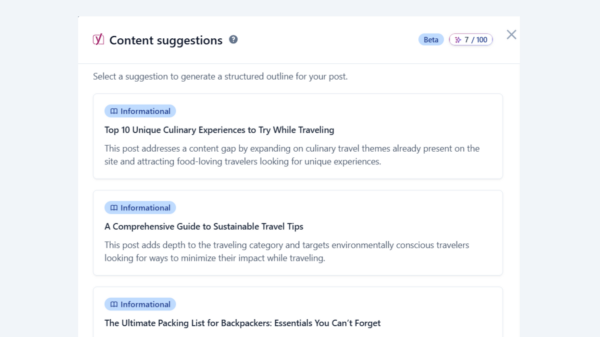
The advent of artificial intelligence has introduced sophisticated tools designed to alleviate content creation bottlenecks. The Yoast AI Content Planner, a feature included in Yoast SEO Premium products, exemplifies this evolution by moving beyond generic suggestions to provide highly tailored content ideas. This tool operates by scanning a user’s existing blog content, analyzing its themes, keywords, and coverage, and then identifying logical gaps or related topics that would complement the existing library.
When a user initiates a new post, the planner generates five relevant blog ideas. These are not random prompts but strategic suggestions based on the blog’s established niche and what its audience is already engaging with. For instance, a food blog with extensive content on meal prep but lacking specific articles on “quick vegetarian lunches” might receive suggestions in that vein. This ensures that new content is not only fresh but also strategically aligned with the blog’s overall content strategy and audience interests.
Beyond ideation, the Yoast AI Content Planner provides a structured draft for selected ideas, including a suggested title, hierarchical headings, and even a meta description. This immediate outline dramatically reduces the initial effort required to start writing, transforming a daunting blank page into a manageable framework. The ability to generate new batches of ideas with a single click offers flexibility, ensuring that users can find the perfect angle. This tool represents a significant step forward in automating the strategic aspects of content planning, enabling consistent publishing without sacrificing relevance or quality. Its integration within a widely used SEO plugin signifies a broader industry trend towards intelligent, data-driven content creation.
Deepening Keyword Research for Niche Authority
Traditional keyword research documents are foundational assets for SEO, but their utility extends far beyond simply identifying popular search terms. To truly unearth compelling blog ideas, creators must delve deeper into the intent behind keywords. A keyword is merely a starting point; understanding why someone searches for it reveals the actual information need. Tools like Yoast SEO’s integration with Semrush, Google’s autocomplete suggestions, and analyzing Google’s AI Overviews or AI Mode answers are crucial for this.

Consider the keyword “best running shoes for flat feet.” A superficial approach might lead to a simple listicle. However, by asking deeper questions, a wealth of related content opportunities emerges:
- What specific problems do people with flat feet face when running? (e.g., arch pain, pronation)
- What types of running are they engaging in? (e.g., trail, road, marathon)
- Are they looking for buying guides, reviews, or educational content about foot mechanics?
- What brands or technologies are relevant to this problem?
Each of these questions can be expanded into its own comprehensive blog post:
- “Understanding Pronation: How it Affects Runners with Flat Feet” (Educational)
- “Top 5 Trail Running Shoes for Flat Feet in 2024” (Review/Buying Guide)
- “Beyond the Shoes: Exercises to Support Flat Feet Runners” (How-to/Problem-solution)
- “The Role of Orthotics vs. Stability Shoes for Flat Feet” (Comparative Analysis)
This methodical approach ensures that content doesn’t just target a keyword but comprehensively answers the nuanced questions an audience is asking. Furthermore, integrating tools like Wincher within Yoast SEO allows creators to track the performance of these keyword-targeted posts over time, providing data to refine future content strategies. This deep dive transforms a list of keywords into a strategic content roadmap, building niche authority and catering to diverse user needs.
External Exploration: Broadening Your Ideation Horizon
While internal data provides invaluable insights, looking beyond one’s immediate ecosystem can spark creativity and identify emerging trends. The vastness of the internet offers numerous platforms for external inspiration.
Pinterest: A Visual Trend Forecaster
Pinterest, often perceived solely as a visual discovery engine, is a powerful tool for content ideation, particularly for visually-driven niches such as food, DIY, fashion, travel, and home decor. Its strength lies in its ability to reveal visual trends and popular content themes. Searching for broad terms like “[blog post ideas],” “[blog ideas],” or “[what to blog about]” can yield generic starting points. However, including a niche-specific modifier, such as “[blog post ideas for parents]” or “[blog post ideas for lifestyle bloggers],” refines the results significantly.
Analyzing top-pinned posts and popular boards within a niche can highlight topics generating high engagement. These often represent content formats or angles that resonate strongly with a specific audience. For example, if a search for “vegan meal prep” reveals numerous pins about “one-pot vegan dinners,” it suggests a popular sub-topic worth exploring. A critical note, however, is the prevalence of clickbait on Pinterest. Content creators must exercise caution, prioritizing quality and genuine value over sensational headlines to avoid falling into the trap of superficial content. The goal is to identify genuine interest areas, not just viral headlines, and then develop them into substantive articles.
Content Idea Generators: Sparking Lateral Thinking
Online content idea generators, such as Portent’s Title Maker, are not designed to deliver ready-to-publish article ideas. Instead, their primary value lies in their ability to jolt creativity and offer unexpected angles. By inputting a core keyword, these tools often generate quirky or unconventional titles that, while not immediately usable, can serve as springboards for more viable concepts.
For instance, entering “[house plant]” might yield “The 15 Biggest House Plant Blunders.” While the title itself might be slightly sensationalized, it prompts thinking about common mistakes in houseplant care, leading to blog ideas like “Common Houseplant Watering Mistakes and How to Fix Them” or “Troubleshooting Pests: Identifying and Treating Houseplant Infestations.” Similarly, “[wine]” could generate “17 Unexpected Uses for Wine,” which could inspire “Creative Culinary Uses for Leftover Wine” or “Beyond the Glass: DIY Wine-Based Skincare Recipes.” These generators encourage lateral thinking, pushing creators beyond their usual thought patterns and often leading to unique, engaging content ideas that might not have emerged from traditional brainstorming.
AI and Chatbots: The New Frontier of Content Inspiration
The rapid evolution of AI tools and chatbots like ChatGPT, Claude, and Gemini has fundamentally reshaped the landscape of content ideation. These LLMs can process vast amounts of information and generate ideas with remarkable speed. However, their effectiveness hinges on the quality of the prompts provided. Generic requests will yield generic results, emphasizing the need for specificity and context.
To maximize their potential, creators should:
- Ask for specific angles: Instead of “Give me blog ideas about parenting,” try “Generate five unique blog post angles for parents of toddlers struggling with sleep, focusing on gentle methods and backed by expert advice.”
- Refine vague ideas: If an initial prompt generates a broad topic, ask the AI to narrow it down. For example, if “sustainable living” is too broad, refine it to “Provide five blog post ideas on sustainable living for urban dwellers with limited space, focusing on actionable tips for apartment living.”
- Reverse-engineer competitors: Input a competitor’s blog URL and ask the AI to “Analyze this blog’s content and suggest five topics they haven’t covered but would be relevant to their audience, or five ways to improve upon their existing popular posts.”
Crucially, content creators must guard against producing “commodity content” – ideas that feel generic or overdone. AI often defaults to popular, easily accessible concepts. The human element remains vital for injecting unique perspectives, personal experiences, original data, or specific case studies that elevate content beyond the commonplace. For example, if AI suggests “10 tips for better sleep,” a human creator might refine it to “My 30-Day Sleep Experiment: What I Learned from Tracking My Habits with Wearable Tech” or “Expert Interview: A Neuroscientist’s Top 5 Uncommon Sleep Hacks.” While AI offers unprecedented speed, content strategists emphasize that human insight remains paramount for authenticity, depth, and establishing a distinctive brand voice.
“Days Of The Year”: Timely and Engaging Content Hooks
Websites like “Days Of The Year” curate a vast calendar of global holidays, celebrations, and quirky observances, offering a rich source of timely and engaging content ideas for virtually any niche. This resource allows bloggers to tap into cultural relevance and seasonal trends, providing unique hooks for their content.
For instance, “Unicorn Day” on April 9th could inspire a children’s book blogger to review fantasy literature, a craft blogger to share DIY unicorn projects, or even a business blog to discuss “mythical” business strategies. “Towel Day” on May 25th, a nod to Douglas Adams, can be leveraged by travel bloggers for “The Ultimate Travel Towel Guide,” by lifestyle bloggers for “How to Keep Your Towels Luxuriously Soft,” or by sustainability blogs for “Eco-Friendly Towel Alternatives.” By connecting these observances to their specific niche, creators can generate content that is both topical and evergreen, capitalizing on existing public interest. This strategy helps maintain a dynamic content calendar and provides opportunities for creative storytelling around diverse themes.
Other Blogs and Fellow Bloggers: The Power of Community and Collaboration
The internet’s interconnected nature means that inspiration is often just a click away. Following other bloggers within or adjacent to one’s niche can be a potent source of ideas. Scrolling through their post feeds, observing their content formats, and identifying popular themes can spark new directions. Similarly, engaging with online communities, such as Facebook groups for bloggers or niche-specific forums, provides opportunities for discussion and idea exchange. These interactions can reveal common pain points, emerging topics, or innovative content approaches.
However, it is paramount to adhere to ethical guidelines: inspiration should never cross the line into plagiarism. The goal is to draw ideas and refine them through one’s own unique lens, adding personal insights, experiences, and research. Attribution, where appropriate, maintains professional integrity. This collaborative approach fosters a sense of community while simultaneously fueling individual creative endeavors.
Personal Wellsprings: Drawing Inspiration from Lived Experience
Beyond tools and external sources, some of the most authentic and compelling blog post ideas originate from a creator’s own life, experiences, and observations.
Current Events: Timeliness and Relevance
Connecting current events to a blog’s niche provides an excellent opportunity to create timely and highly relevant content. The art lies in translating breaking news into a context that resonates with the audience, adding value rather than simply re-reporting. For a parenting blog, a new study on the long-term effects of screen time could inspire “Beyond the Headlines: What New Screen Time Research Means for Your Family.” A personal finance blog might analyze recent interest rate hikes in “Navigating Inflation: Three Strategies to Protect Your Savings.”
Setting up Google Alerts for keywords related to a blog’s topic ensures creators stay informed of relevant developments. When a significant event occurs, the key is to consider its direct implications for the target audience. For instance, a sustainable living blog could explore “Understanding Your City’s New Recycling Guidelines: A Practical Guide.” While current events offer a potent source of ideas, sensitive topics require careful, thoughtful handling, focusing on providing helpful information and avoiding sensationalism or exploitation. The objective is to leverage timeliness to deliver high-quality, purpose-driven content.
Your Daily Life and Professional Insights
Everyday experiences, professional challenges, and personal observations offer a rich, unique vein of content. Sharing insights from one’s work, detailing how specific problems were solved for clients or colleagues, or recounting personal lessons learned can be incredibly relatable and valuable. For example, a marketing consultant might write “The Client Who Taught Me the Power of Storytelling: A Case Study,” offering practical takeaways from a real-world scenario. A therapist with a blog on mental health might discuss general coping mechanisms inspired by common themes in their practice.
Crucially, when drawing from real-life situations, ethical considerations regarding privacy and confidentiality are paramount. If client or colleague experiences are used, all identifying details must be rigorously altered, and explicit permission should be sought where appropriate. Anonymization is essential to protect individuals and maintain professional trust. When handled ethically, personal and professional anecdotes infuse content with authenticity, relatability, and a unique perspective that differentiates it from generic advice.
Clear Your Head to Find Fresh Ideas: The Power of Breaks
Prolonged periods of intense focus can lead to mental fatigue and creative stagnation. Staring at a blank screen often exacerbates writer’s block. Stepping away from the desk and engaging in activities that shift focus can be remarkably effective. A short walk, engaging in a hobby, or even mundane tasks like washing dishes can provide the mental space needed for ideas to surface organically. The brain often makes connections and generates insights when it’s not actively trying to force them.
For a more structured approach to breaking mental blocks, a ten-minute brainstorming sprint can be highly productive. Set a timer and challenge yourself to generate twenty blog ideas about a specific topic: five weird, five practical, and ten in between. The key is to suspend judgment and simply write down whatever comes to mind, no matter how outlandish. When the timer sounds, review the list, select the most intriguing idea, and then freewrite about it for another five minutes. This exercise bypasses typical thought patterns, encouraging unconventional connections and often leading to surprising, fresh angles. Returning to the primary task afterward, creators often find renewed focus and inspiration.
Keep a List of Ideas: The Idea Repository
The simplest yet most effective strategy for combating writer’s block is to maintain a dedicated idea repository. Inspiration is often fleeting; brilliant ideas can emerge at unexpected moments – during a commute, while exercising, or in the middle of a conversation. By consistently noting these ideas down, whether in a digital app (e.g., Notion, Evernote, Google Keep) or a physical notebook, creators build a powerful resource for future use.
This list serves as a safety net for those days when inspiration is scarce. Instead of facing a blank page with a blank mind, a creator can consult their curated list of potential topics, angles, or even just keywords. This proactive habit transforms sporadic bursts of creativity into a sustained pipeline of content possibilities, ensuring that a publishing schedule can be maintained even during creative lulls.
Sustaining the Creative Flow in a Dynamic Content Landscape
Overcoming writer’s block and consistently generating fresh blog ideas is an ongoing process that demands adaptability and a multi-pronged strategy. The digital content landscape is constantly evolving, with new tools and trends emerging regularly. Relying on a single method for ideation is increasingly insufficient. Instead, the most successful content creators combine systematic approaches with creative spontaneity.
Whether leveraging the analytical power of Google Search Console, the strategic suggestions of the Yoast AI Content Planner, the visual trends on Pinterest, the generative capabilities of AI chatbots, or the profound insights drawn from personal experiences, a diverse toolkit is essential. The integration of technology, particularly AI, is transforming the initial stages of content creation, offering unprecedented speed and scale in idea generation. However, the human element – critical thinking, unique perspective, emotional intelligence, and ethical judgment – remains irreplaceable for crafting content that truly resonates, builds trust, and establishes authority.
The next time the blank screen looms large, content creators are encouraged to experiment with the diverse strategies outlined. Dive deep into audience feedback, analyze performance data, explore external trends, or simply step away to clear the mind. Each method offers a unique pathway to reigniting creativity and ensuring a steady flow of engaging, valuable content. In a world saturated with information, the ability to consistently produce original and insightful content is not just a skill but a strategic advantage, demanding a continuous embrace of both innovative tools and timeless creative practices.