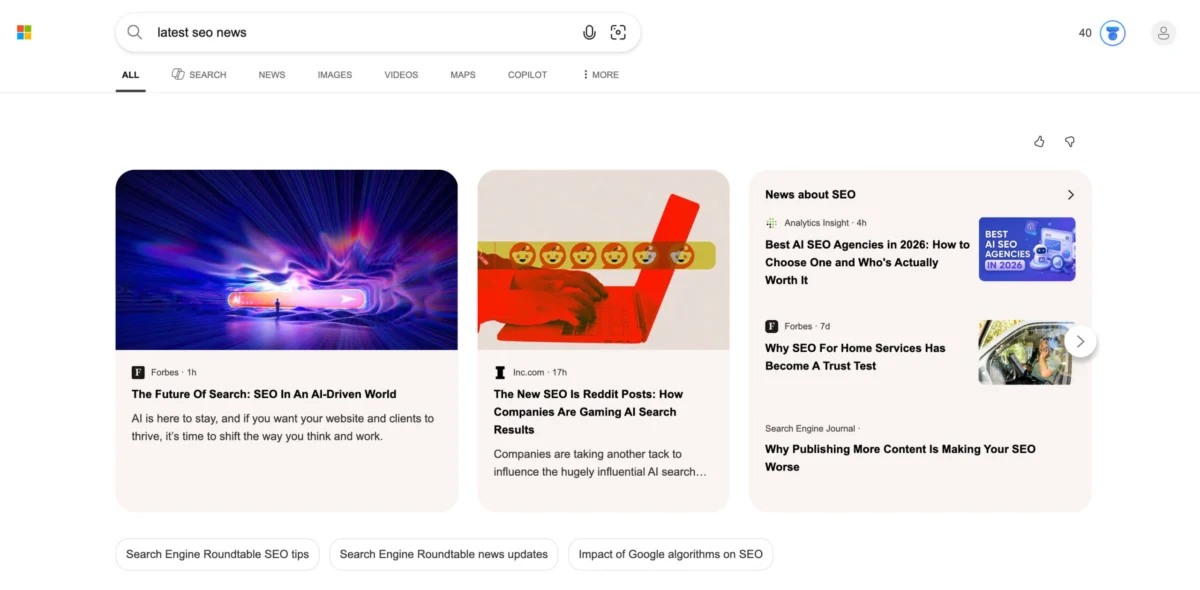
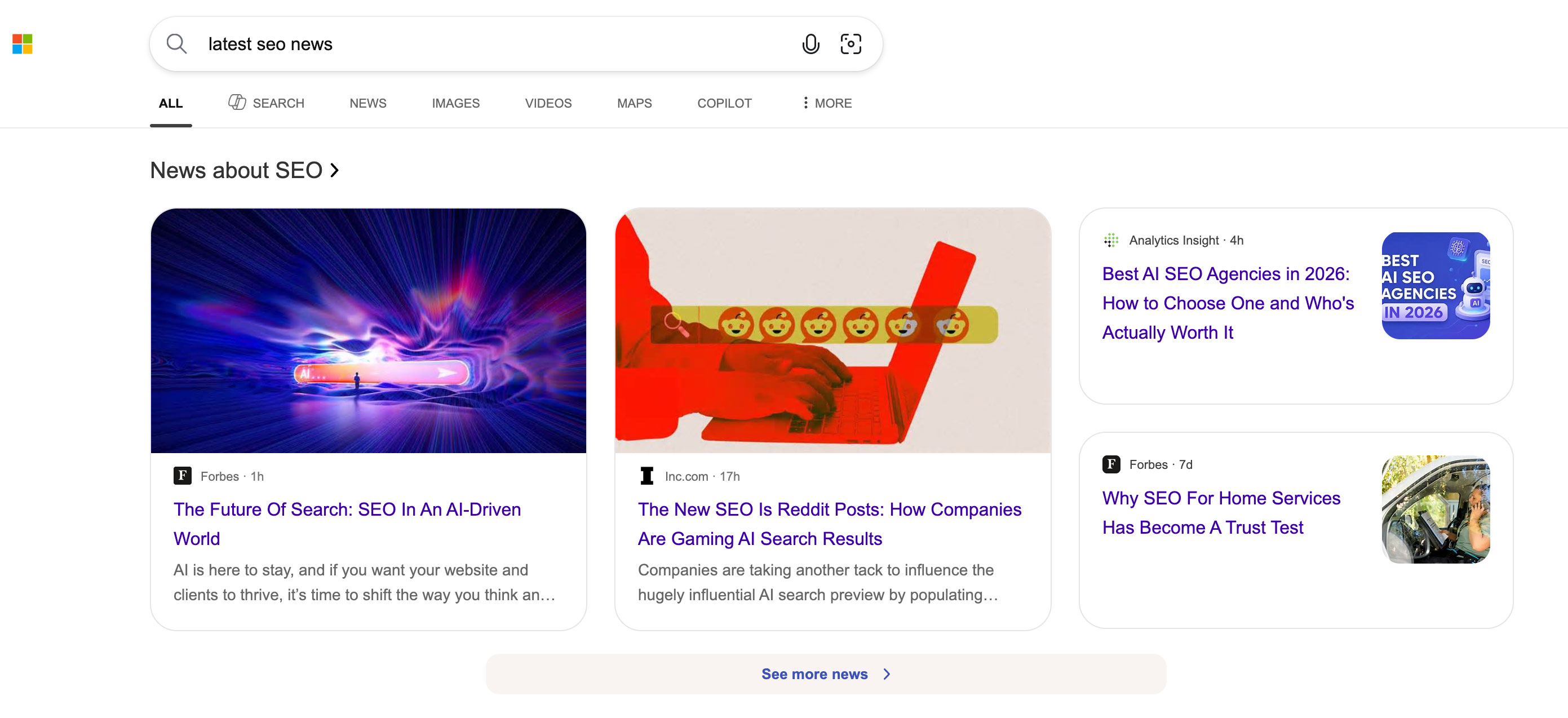
Microsoft Bing is actively testing a significantly updated design for its news section within its search results interface, a move that signals the company’s continued commitment to refining user experience and information clarity. The new visual presentation, which has been observed in live testing environments, aims to make news content more accessible and distinctly identifiable, addressing a key aspect of how users consume current events directly from search engine results pages (SERPs).
The redesigned news box presents a cleaner, more intuitive layout that industry observers suggest will greatly improve comprehension and navigation for users. This enhancement is particularly critical in an era where the rapid dissemination of information and the clear distinction of credible news sources are paramount. The initial feedback from those who have encountered the new design points towards a positive reception, primarily due to its enhanced legibility and the unambiguous identification of news articles within the broader search results.
The Design Overhaul: A Closer Look at Clarity and Distinction
The core of this update lies in its visual transformation. Comparing the test version to the current live iteration reveals several strategic design choices aimed at improving the user’s interaction with news content. The current design, while functional, integrates news snippets in a manner that can sometimes blend with other organic search results, potentially requiring a moment longer for users to process. The new design, however, appears to introduce clearer visual cues, likely employing more defined borders, distinct typography, or perhaps subtle color variations to delineate news blocks from other search elements.
For instance, the new layout, as captured in various user screenshots, seems to emphasize the source of the news more prominently. This could involve larger logos, clearer source domain names, or dedicated badging that instantly communicates the origin of the information. Furthermore, the headlines and summaries themselves might be presented in a format that maximizes readability, perhaps utilizing improved font weights, line spacing, or a more efficient use of white space. These seemingly minor adjustments collectively contribute to a more organized and less visually cluttered presentation, which is a hallmark of modern user interface design principles. The goal is to reduce cognitive load, allowing users to quickly scan and identify relevant news items without distraction.
Chronology of Discovery and Replication
The initial public spotting of this new Bing news design was attributed to technology enthusiast Sachin Patel, who shared his discovery on X (formerly Twitter). Patel’s observation, posted on June 18, 2026, quickly garnered attention within the search engine optimization (SEO) and webmaster communities, indicating the keen interest in Bing’s ongoing interface developments. Following Patel’s initial report, other users and industry experts, including prominent figures in the SEO space, were able to replicate the new design in their own Bing search experiences, confirming that this was not an isolated test but rather a broader rollout to a segment of Bing users.
Such A/B testing methodologies are standard practice in the tech industry, allowing companies like Microsoft to gauge user reactions, collect data on engagement metrics, and iterate on designs before a full-scale public launch. The fact that the design is replicable by multiple users suggests it has moved beyond an internal concept and is being actively evaluated with real-world user interaction data. This iterative approach ensures that any major UI changes are data-driven and align with user preferences and behaviors.

Bing’s Ongoing Evolution and Market Positioning
This design update for the news section is not an isolated event but rather fits into Microsoft’s broader strategy for Bing, which has seen continuous evolution over the years. While Google remains the dominant force in the global search engine market, Bing has consistently sought to carve out its niche by focusing on distinct user experiences, innovative features, and deep integration with Microsoft’s ecosystem, including Windows, Edge browser, and more recently, its Copilot AI.
According to StatCounter GlobalStats, as of late 2023 and early 2024, Bing typically holds a global desktop search market share ranging from 3% to 6%, with variations across different regions. While this is a modest share compared to Google’s overwhelming majority, Microsoft’s sustained investment in Bing underscores its strategic importance. Bing is not just a search engine; it serves as a critical data source for Microsoft’s AI initiatives, a default search experience for millions of Windows users, and a platform for advertising revenue. Enhancements like a clearer news section contribute to making Bing a more compelling and sticky product, encouraging users to choose it for their daily information needs.
Microsoft has been particularly aggressive in integrating advanced artificial intelligence into Bing, most notably with the introduction of the AI-powered Copilot experience. This integration has redefined what a search engine can do, moving beyond simple link retrieval to providing conversational answers, content generation, and complex query resolution. In this AI-enhanced environment, the presentation of traditional news content becomes even more crucial. A well-designed news section can complement AI-generated summaries by offering direct access to original reporting, allowing users to delve deeper into topics with trusted sources.
The Strategic Importance of News in Search
News aggregation and presentation play a vital role in the utility of any major search engine. For users, the ability to quickly access current events, understand unfolding stories, and verify information from multiple sources is a fundamental expectation. Search engines serve as primary gateways to this information, and the quality of their news sections directly impacts user satisfaction and trust.
From a strategic perspective, offering a superior news experience can differentiate a search engine. In an age of misinformation and information overload, providing clear, well-sourced news directly within search results builds credibility and establishes the platform as a reliable information hub. Furthermore, timely news coverage drives repeat visits, as users frequently check search engines for updates on breaking stories, political developments, financial markets, and cultural events.
For news publishers, being prominently featured in search engine news sections is critical for traffic generation and brand visibility. Search engines act as powerful referral sources, driving millions of readers to news websites daily. A clearer, more engaging news design on Bing could potentially increase click-through rates (CTRs) to news articles, benefiting publishers by directing more traffic to their content. This symbiotic relationship between search engines and news publishers underscores why UI/UX improvements in news presentation are so important.
Implications for Users, Publishers, and the Competitive Landscape
The implications of Bing’s updated news design are multifaceted, impacting users, news publishers, and the broader competitive landscape of search.
For Users: The primary benefit will be an enhanced user experience. The promised clarity and ease of understanding mean less time spent deciphering search results and more efficient access to the information they seek. This could lead to higher satisfaction rates, improved trust in Bing as a news source, and potentially increased engagement with news content overall. In a world saturated with information, design choices that prioritize clarity and user-friendliness are highly valued.
For News Publishers: A more prominent and visually appealing news section on Bing could translate into increased referral traffic. If the new design successfully draws more attention to news articles and encourages clicks, publishers might see a boost in their audience reach from Bing searches. This reinforces the importance for publishers to optimize their content for search engines, ensuring their news articles are well-structured, timely, and adhere to journalistic best practices to be discoverable and prioritized by algorithms. It also highlights the ongoing need for publishers to monitor search engine design changes and adapt their strategies accordingly.
For the Competitive Landscape: While Bing’s market share is smaller than Google’s, every improvement contributes to its competitive standing. Google News has long been a benchmark for news aggregation within search. By refining its own news presentation, Bing signals its intent to compete more effectively in this crucial area. This iterative improvement could attract users who prioritize a clean, uncluttered, and reliable news experience, potentially drawing them away from competing platforms or at least encouraging them to diversify their search habits. This continuous innovation from Microsoft puts pressure on other search providers to also consistently evaluate and improve their own news interfaces.
Microsoft’s Vision for Search and the Future of UI/UX
This UI update aligns with Microsoft’s broader vision for Bing: to be an intelligent, comprehensive, and user-centric information hub. The company is investing heavily in making Bing more than just a search box, transforming it into a sophisticated tool that can understand complex queries, provide insightful answers, and present information in the most digestible format. The news section plays a critical role in this vision, as it provides real-time, authoritative content that enriches the overall search experience.
The trend in search engine UI/UX design is increasingly towards rich snippets, visual elements, and direct answers rather than just lists of links. Users expect to find information quickly, often without needing to click through to external websites for basic facts. However, for nuanced topics like news, the ability to easily identify and access original reporting from trusted sources remains paramount. Bing’s updated news design strikes a balance, aiming to provide immediate clarity while also facilitating deeper dives into journalistic content.
Looking ahead, we can anticipate further refinements to search interfaces across all major platforms. The integration of AI will likely continue to influence how news is discovered, summarized, and presented, potentially leading to more personalized news feeds within search results based on user preferences and browsing history. However, foundational design principles such as clarity, source attribution, and ease of navigation will remain central to effective information delivery. Bing’s current test of its news section design is a testament to this ongoing evolution, demonstrating a proactive effort to enhance the user journey in the ever-evolving digital information landscape. The successful implementation of this design could mark another significant step in Bing’s journey to establish itself as a preferred destination for comprehensive and clearly presented current events.